

Believe in Something
Grenoble
Joined May 2011
- Tweets2.2K
- Following1.7K
- Followers1.3K
- Likes9.4K
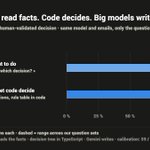


Healthcare intake is the hard case for AI triage: complex workflow, safeguards everywhere, a human able to check every decision.
We moved the decision step from an LLM to Jev (@typesafeai): 25 typed questions, 0.29 s, $0.00015, code walks the workflow.
Method, numbers, limits 🧵
Limits. It doesn't write, and replies didn't get better (blind judges preferred our old composer 70/30). It misses implicit confirmations, one question over-triggers, French is undocumented. We pseudonymize before anything leaves: safer, and it costs precision on linking.
What I want next: typed judgments as a primitive for care workflows, decision trees clinicians can read and sign. Open weights for Jev, so this runs on our HDS servers with full context and nothing leaving. Thanks @typesafeai.
Self-hosted notifications usually mean six containers, MongoDB, Redis and a dashboard. 1.1 GB of RAM before the first email goes out.
We wanted one binary on Postgres. Rust, MIT, 13 MB. Email, SMS, push, in-app, Telegram, Slack, Discord, and your agent runs it over MCP.
Repo and the measurements in the replies. Curious what your notification stack looks like today.
Repo, docs, TypeScript and Python clients: github.com/rmzlb/notifyd
Measured on the same machine, both idle. Novu 3.19 with its own community compose: 6 containers, 1.4 GB to pull, 1.1 GB of RAM. notifyd 0.4.0: 1 container, 14 MB to pull, 13 MB of RAM. Novu ships a dashboard and we don't, so read docs/BENCHMARKS.md before quoting this.

The part that took longest was the bad day. Your provider answers 429. Most stacks retry blindly or drop mail. notifyd pauses that lane for exactly the time asked, keeps password resets ahead of campaigns, then tells you. More and more, "you" is an agent, so the digest lands in Telegram or Slack.
MIT, in production for three companies. If you know Swift or Kotlin, we would love a hand.
shipped notifyd v0.2.0
notification service in one rust binary, postgres only. email, sms, push, in-app inbox.
no dashboard: a digest endpoint + an MCP server, so an agent runs it. I operate 3 instances in prod that way.
42 MB image, 13 MB RSS idle, 3.5k jobs/s drained on 8 vcpu
repo + reproducible benchmarks: github.com/rmzlb/notifyd
docker pull ghcr.io/rmzlb/notifyd
i used novu for a while. works, but 500mb+ of ram and my agents couldn't manage it without fighting the react sdk and the mongodb/redis setup.
rewrote the whole thing in rust. 30mb of ram, ~500 notifs/sec, one postgres database. one binary.

rmz 🌱🌐 - 🐺 retweeted

🚨 Screen Studio charges $89 for this. Someone open sourced the entire thing for free.
It's called OpenScreen. 8,400+ GitHub stars.
You record your screen. It automatically transforms it into a polished, professional demo video.
Auto-zoom into clicks. Smooth cursor animations. Motion blur. Custom backgrounds with wallpapers, gradients, and shadows. Webcam overlays. Annotations. Timeline editing. Export in any aspect ratio.
The exact workflow that Screen Studio sells for $89 and Loom sells as a subscription. Free. No watermarks. No accounts. No subscriptions.
Here's what you get out of the box:
→ Full screen or window capture with system audio and mic
→ Automatic zoom that follows your cursor and clicks
→ Manual zoom with customizable depth and timing
→ Smooth motion blur on pan and zoom transitions
→ Animated cursor rendering with motion effects
→ Webcam bubble overlay with drag-and-drop positioning
→ Wallpapers, solid colors, gradients, or custom backgrounds
→ Text and arrow annotations layered over recordings
→ Timeline trimming and variable speed segments
→ Crop, resize, and export in any resolution or aspect ratio
→ Save and reopen projects anytime
Here's the wildest part:
A developer forked it and built an even more advanced version called Recordly. Full cursor animation pipeline. Native macOS and Windows recording. Zoom behavior that mirrors Screen Studio frame-for-frame. Audio tracks. Webcam overlays with zoom-reactive scaling.
Both are free. Both are MIT licensed. Both work on Windows, macOS, and Linux.
Download. Record. Export. Done.
100% Open Source. MIT License.
(Link in the comments)

rmz 🌱🌐 - 🐺 retweeted

Okay so I made an open source toolkit for the EU AI Act compliance.
Here's the thing, it's coming (it's already there in fact). GPAI rules kicked in August 2025. Full high-risk requirements hit August 2026. Fines go up to €35M or 7% of global turnover. And most teams I talk to still have no idea what tier their system even falls under.
So I built three things, same data layer, no vendor lock-in:
→ TypeScript SDK: classification, checklists, templates
→ CLI with an interactive classification wizard
→ Web dashboard with timeline + compliance tracking
14 languages supported in the web app.
One command to find out where you stand:
npx @ eu-ai-act/cli classify
Ah, also it's agentic native, so you can just install the skills and ask your favorite agent to use it ;)
Repo below 👇
rmz 🌱🌐 - 🐺 retweeted
Can LLMs be PROVABLE computers?
Percepta showed that a transformer can BE a computer. Compiled weights, deterministic execution, 30k tokens/sec.
But nobody asked the obvious follow-up: how do you know it computed correctly?
So I built the verification layer. A STARK that proves it 👇
