

New Artificial Intelligence papers from https://xitter.cf/t.co/gDZs9w7xd4: expert systems, theorem proving. Thank you to arXiv for use of its open access interoperability.
- Tweets33.2K
- Following21
- Followers21.2K
- Likes4




ALT Text injection trains speech recognition models on unpaired text alongside paired audio. We feed the speech encoder synthetic input derived from text so the whole model learns from it. Previously, we synthesized this input with a frozen text-to-speech (TTS) model. Here, a simple lookup table replaces the TTS model: a mean log-mel vector (or one-hot encoding) per phoneme, repeated for a random duration drawn from alignment statistics, with silence between words. Training is 1.8 times faster than with the neural TTS, achieving comparable word error rates. With an external language model, our system reaches 1.36 / 2.90 / 1.52 / 3.24 % WER on LibriSpeech dev,test-clean,other, to our knowledge state-of-the-art using only LibriSpeech paired data, text, and lexicon. We analyze components of synthetic input (durations, acoustic features), compare different HMM aligners, evaluate scaling on the 25 000 h Loquacious dataset, and show that full-encoder injection yields strong relative improvements

ALT Indoor context deciphered by ambient sensing underpins many applications, from assisted living to smart buildings, yet remains weakly connected to the language-aligned paradigm of modern multimodal systems. Through billions of IoT devices, ambient WiFi Channel State Information (CSI) captures the indoor context of human activity and environmental dynamics passively via ubiquitous, always-on infrastructure. However, unlike vision or audio, CSI lacks naturally paired text like captions or transcripts, limiting its integration with language-driven AI systems. We present CSI-TextBench, a large-scale dataset and benchmark for aligning CSI data with natural language, unifying 3 sensing benchmarks into 285,790 samples across 7 tasks and pairing them with 2,291 hierarchically structured, label-derived descriptions via many-to-many assignment to construct 2.0 million CSI-text training tuples. Benchmarking 5 alignment methods from 4 paradigm families, we show that contrastive CSI-text alignment

ALT We release a battery of 28 propensities for AI research, with expert-written rubrics, synthetic datasets, and annotated demand intervals, built with the method of Romero-Alvarado et al. (2026). We selected a wide collection of generic propensities that may influence the behavior of AI systems and humans. They are inspired by psychometric, psychological, and behavioral research, so that experimental results can be understood in the context of familiar constructs previously used also for human behavior research. The rubrics are useful for annotating existing benchmarks whose items may be relevant or not for one or more propensities. For easier profiling, however, the synthetic datasets are defined in such a way that they should be sensitive to one propensity only, allowing for a quick prototyping of propensity profiles using the battery of datasets. We also outline directions for future propensity research.

ALT We describe HobbyLM, a family of small sparse Mixture-of-Experts (MoE) models trained from scratch with a few hundred to a few thousand dollars of rented GPU time. The core is a decoder-only transformer with fine-grained experts, sigmoid routing with auxiliary-loss-free load balancing, grouped-query attention with per-head QK-normalization, and aMuon/AdamW optimizer split. Each of these choices was selected with a single-variable ablation suite at 130M parameters. On this architecture we train a 500M-parameter model (169M active) on 40B FineWeb tokens and post-train it into a chat model, a masked-diffusion language model, a function-calling and computer-use agent, and a single "omni" checkpoint that reads text, images, video, sound and speech through frozen encoders and small projectors. We run these models on a laptop CPU with a from-scratch Rust inference engine. Two of the authors then adopted the architecture without architectural changes to build HobbyLM-1B (1.04B total, 305M acti

ALT Statement autoformalization translates mathematics from natural language into a proof assistant such as Lean 4, and models now do it at scale. As provers get stronger, the burden of correctness shifts from the proof to the statement, that is, to whether the formal statement faithfully translates its source. Given a trusted reference formalization, the natural test is logical equivalence, and it proves too much. P ↔ Q holds trivially for any two statements P and Q that the library proves, because a prover can prove each separately and pass through P ↔ True ↔ Q. The stronger the prover, the more unrelated pairs pass. Earlier methods restrict the prover and check that each proof names the other statement. We introduce SemantEq, a more principled relation that instead requires each statement to turn into the other only through a chain of allowed steps, such as logical rearrangement and rewriting with the library's own equations. Our programs judge a proof by the proof term Lean checks, not

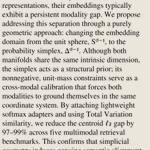
ALT While multimodal contrastive models like CLIP and CLAP successfully learn shared representations, their embeddings typically exhibit a persistent modality gap. We propose addressing this separation through a purely geometric approach: changing the embedding domain from the unit sphere, Sᵈ⁻¹, to the probability simplex, Δᵈ⁻¹. Although both manifolds share the same intrinsic dimension, the simplex acts as a structural prior; its nonnegative, unit-mass constraints serve as a cross-modal calibration that forces both modalities to ground themselves in the same coordinate system. By attaching lightweight softmax adapters and using Total Variation similarity, we reduce the centroid ℓ₂ gap by 97–99% across five multimodal retrieval benchmarks. This confirms that simplicial geometry induces genuine semantic alignment, matching or exceeding the retrieval performance of standard unconstrained models.

ALT Reinforcement learning (RL) post-training improves the reasoning capabilities of large language models, but its cost is dominated by autoregressive rollout generation, which can exceed 70% of training time. Existing speculative-decoding methods are poorly suited to this setting: model-based drafters consume scarce GPU memory and may become misaligned as the policy evolves, while existing model-free methods do not explicitly exploit repetition across training epochs. We observe that recent rollouts of the same prompt provide a high-quality, self-updating draft source. Based on this insight, we propose NgramRL, a per-prompt n-gram drafter constructed from bounded recent rollout history. NgramRL requires no auxiliary model, drafter training, or persistent GPU-resident drafter state, while target-model verification preserves the rollout distribution. To hide CPU cache lookup and scheduling, we further introduce an adaptive fan-out prefetcher that predicts likely verification outcomes (j, b

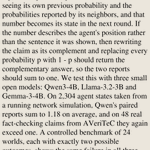
ALT In LLM-agent opinion simulations, each agent reports the probability that a claim is true after seeing its own previous probability and the probabilities reported by its neighbors, and that number becomes its state in the next round. If the number describes the agent's position rather than the sentence it was shown, then rewriting the claim as its complement and replacing every probability p with 1 - p should return the complementary answer, so the two reports should sum to one. We test this with three small open models: Qwen3-4B, Llama-3.2-3B and Gemma-3-4B. On 2,304 agent states taken from a running network simulation, Qwen's paired reports sum to 1.18 on average, and on 48 real fact-checking claims from AVeriTeC they again exceed one. A controlled benchmark of 24 worlds, each with exactly two possible outcomes, shows the same failure in all three models. The discrepancy is two to ten times larger than the change produced by a same-meaning paraphrase, and it persists under repeated s

ALT This paper proposes a five-level organization of message formation and understanding within thinking and activity in which ASI participates. Its central thesis is that a language model's context is fundamentally incapable of presenting the foundations of utterance formation for examination and verification. These foundations are established in advance by acquired schemas, systemic representations of the world of activity, and connections accepted as true within them. Neither context nor trained LLM weights, in themselves, attest to the presence of deliberately constructed systemic representations. The five levels distinguish systemic representations of the world of activity, a particular situation cut out from those representations, its narrative description, the full sense of a message, and text. A situation's schema-model is not identical to a story about it. A recipient reconstructs the full sense from an abbreviated text through jointly constructed and agreed-upon representations a

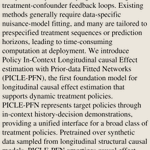
ALT Longitudinal causal effect estimation is complicated by time-varying confounding and treatment-confounder feedback loops. Existing methods generally require data-specific nuisance-model fitting, and many are tailored to prespecified treatment sequences or prediction horizons, leading to time-consuming computation at deployment. We introduce Policy In-Context Longitudinal causal Effect estimation with Prior-data Fitted Networks (PICLE-PFN), the first foundation model for longitudinal causal effect estimation that supports dynamic treatment policies. PICLE-PFN represents target policies through in-context history-decision demonstrations, providing a unified interface for a broad class of treatment policies. Pretrained over synthetic data sampled from longitudinal structural causal models, PICLE-PFN amortizes causal effect estimation across datasets, policies, and horizons. Given a new observational dataset and target policy, it directly predicts conditional average potential outcomes (CA

ALT Enterprises are deploying agentic AI across the software development lifecycle, and they need the behavioral logic of the systems they act on, not stakeholder documentation. A seven-agent reverse-engineering pipeline recovered this logic, processing 241 repositories across 18 services into thousands of artifacts describing scope, journeys, rules and acceptance criteria. Recovery does not confer usability. Entities like offer, eligibility, and activation recur across services under a shared vocabulary, related in name but operationally distinct, so one end-to-end journey implicates over a thousand near-identical rules that must not be conflated. Flat vector retrieval fails, returning an identical rule from the wrong service at high similarity with no signal of error. Content-level ontology, the traditional remedy, did not exist, and relating every occurrence of recurring entities would have cost more than the engagement and not survived a release cycle. We place the ontology at the arti

ALT Agent harnesses repeatedly invoke reasoning after tool feedback, even when an earlier call has already fixed the next action. We introduce HarnessMM (Harness Minus Minus), a method for improving harness token efficiency through guarded decision reuse and recursive self-improvement (RSI). RSI iteratively refines companion harness configurations from training feedback, with validation selecting the configuration for deployment. A controller at the model-tool boundary reuses resolved decisions to replace later reasoning callbacks while actor weights remain fixed. Executable Decision Graphs store exact actions, literal arguments, causal dependencies, and public guards. Guarded Decision Reuse activates these persistent decisions from observed receipts; Certified Callback Substitution executes them through the native interface and records removal of the registered slow callback. New semantic decisions, unsupported evidence, and selector abstention invoke the original actor again. The represe

ALT LLM agents need long-term memory that can recover precise and mutually consistent evidence from growing interaction histories, particularly when answers depend on relations among facts rather than isolated semantic matches. Current memory pipelines remain vulnerable at two stages: indexing errors can fragment repeated entities or merge distinct ones, and online retrieval often treats initial similarity scores as final even when the surrounding graph provides evidence for revising them. We introduce ActionRAG, a graph memory architecture that couples cautious indexing with query-time graph retroevaluation. Its indexing pipeline reconciles type labels and applies tiered entity resolution. Given a query, dual-channel entity and triple retrieval forms an initial evidence set and induces a bounded local graph. Query-conditioned receiver-normalized diffusion refines triple scores using local path structure. Seed protection, hub-penalized flux, and triple materialization preserve direct evide

ALT Hazard maps are essential tools for public risk communication, preparedness, and evacuation planning, yet effective cartographic design is not always ensured due to limited access to cartographic expertise across local governments and communities. We present Agentic Hazard Mapper, a multi-agent system that automates hazard-map production by emulating professional cartographic workflows and iterative design trade-offs while adapting design decisions to different data, locations, and hazard contexts. We conducted a formative study with map experts to inform the system design, followed by a user study and interviews with map experts and hazard practitioners. The generated maps improved participants' spatial understanding and evacuation-planning performance, reduced perceived workload and task completion time, and were generally preferred over corresponding municipal maps. We further discuss human oversight, adaptation across users and communication contexts, and opportunities to extend ag

ALT The pace of a robot demonstration is often determined by the teleoperator rather than by the task itself. As a result, the same motion can appear at widely different speeds across demonstrations, and policies trained on such data may inherit operator-specific timing along with task behavior. We propose to learn a speed prior directly from large-scale demonstration data. Given a task instruction, a motion path and the images along it, it predicts a distribution over execution speed along the path, from which a chosen quantile defines a consistent clock for retiming each demonstration. Existing methods derive the acceleration signal from the very data they accelerate, so each new task costs another fit, annotation, or pair of predefined rates. A single trained speed prior instead covers every task in a corpus. We fit a speed prior on both robot teleoperation data and handheld demonstrations in which a human arm, rather than a robot arm, moves the gripper, and use it to retime robot demon

ALT Large Language Models (LLMs) have been widely adopted in text classification tasks, where they not only output class predictions but also generate explanations that highlight the tokens deemed most relevant for reaching the predicted label. Yet it remains unclear whether these highlighted elements are behaviorally consistent with the model's own predictions under targeted interventions, which we refer to as functional auto-consistency. While much of the literature evaluates the textual plausibility of such explanations, few studies assess their functional consistency with the model's actual behavior. In this work, we propose an experimental framework based on the principle of auto-consistency: if a model identifies certain tokens as decisive, then isolating, removing, or semantically inverting them should produce systematic and interpretable changes in its predictions. We operationalize this evaluation through sufficiency, comprehensiveness, and counterfactuality metrics, and conduct e

ALT Continual Wi-Fi sensing must balance plasticity, learning new rooms or users, against stability, keeping earlier ones, yet nodes often cannot retain channel state information (CSI) for privacy and storage reasons. We propose WiMoT (Wi-Fi Moment Transport), which stores the per-class feature mean and covariance of every earlier domain instead of samples. When the representation changes, stored statistics become stale. WiMoT restricts the change to an affine map on a frozen feature basis and applies the same map to the statistics, so they stay valid without old samples. Supervised contrastive learning learns the new domain, a closed-form loss on the stored statistics keeps earlier classes separable, and a Gaussian discriminant classifier, refitted from the transported statistics with equal weight per domain, predicts without domain identity. On 3DO, WiMANS, and Widar3.0, WiMoT's average final accuracies are 94.02%, 89.61%, and 95.16% with at most 0.58 percentage points (pp) of forgetting

ALT Large Language Models (LLMs) increasingly serve as reasoning components in modern software systems, yet a model that answers a logical query correctly can contradict itself when the same problem is restated in an equivalent form. Static benchmarks evaluate queries in isolation and therefore fail to expose such inconsistencies. To address this limitation, we present LGMT, an open-source tool that detects reasoning inconsistencies through metamorphic relations grounded in first-order logic. Given a source test case in premise-conclusion form, LGMT generates logically equivalent follow-up cases and checks whether the model's entailment predictions agree across the pair, without ground-truth labels. The tool provides 20 built-in metamorphic relations, supports custom ones verified by the Z3 theorem prover, and runs from a CLI or a web studio, including an offline mock mode requiring no API key. Across six widely used LLMs on a bundled benchmark of 3,091 metamorphic groups, LGMT reveals inc

ALT LLM agents optimize a ligand in a protein pocket by editing it step by step and docking each edit. Recent agents first spend extra dockings probing the complex with controlled edits; guidance induced from these probes is reported to help more than the chemical knowledge the model already carries. The probes are then discarded with the instance that produced them, so the obvious next step is to keep them in an experience base, letting a new pocket inherit what earlier ones already paid for. Such a base is read through a key: the record properties under which past edits are pooled and a new one is looked up. Using the full log of one such run over the CrossDocked2020 test-set pockets, we ask whether its keys recur on a pocket the base has never seen and still separate improving from worsening edits. crchangeUsing the contacts at the site being edited, the action, and the round as crchangea key, the base separates them sharply. Within our analysis, this separation is largely explained by

ALT Continuous diffusion models have emerged as a promising non-autoregressive paradigm for text generation over continuous embedding spaces. Along the continuous trajectory, the residual token identity directly shapes the denoising objective. However, the geometric trajectory misaligns with temporal progression, triggering severe temporal compression. In this paper, we show that embedding norm decay causes Euclidean distance to yield spurious overtaking, indicating that token competition must be evaluated directionally. In this space, a candidate overtakes the source token only when the effective noise magnitude surpasses their semantic separation. We formalize these pairwise dynamics as the Competition Threshold Theory (CTT). Crucially, high-dimensional overtaking requires extreme noise levels, causing standard trajectories to concentrate identity decay into a narrow window near the noisy endpoint. To resolve this, we propose Semantic Retention Scheduling (SRS) to align time allocation w