

This is the official Twitter presence for Vito Technology, Inc. that developed the night sky app Star Walk! #GoStargazing with #StarWalk #AstronomyApp
Alexandria, VA
Joined January 2009
- Tweets20.2K
- Following444
- Followers40.9K
- Likes6.1K
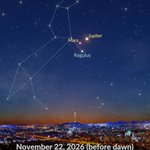
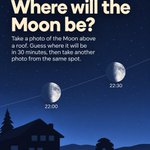


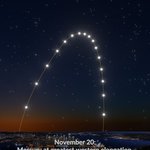


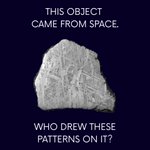


Look for a sky triangle on Nov 22! 🔺✨
Before dawn, Mars, Jupiter, and Regulus form a nearly isosceles triangle in Leo. Find brilliant Jupiter, reddish Mars, and blue-white Regulus — all visible without a telescope. 👀
starwalk.space/news/mars-the…

If your kid sees a dinosaur where the star chart shows a bear, ask them to point out the tail. 🦖✨ Then let them draw it so you can both try to find it again on the next clear night.
November 20 is World Children’s Day, a good excuse to let your child be the sky guide. If the Moon is up, try asking, “See where it is above that roof? Where do you think it’ll be in half an hour?” Take a photo, head inside for a snack, then come back and see whose guess was closer.
Swipe for three things to try without a telescope, including how to spot the International Space Station. That little moving dot has people on board. Give them a wave!
You’ll find all nine activities in our family stargazing guide at starwalk.space/news/stargazi…


Is Mercury a dead planet? 😵
For a long time, Mercury looked geologically quiet. Its surface is covered in ancient impact craters and vast plains left by eruptions billions of years ago. Scientists knew Mercury once had active volcanoes, but its surface today looked almost unchanged. Then, they used AI to take a fresh look at old spacecraft images and found 402 clues that Mercury might still be geologically active.
The team trained an AI model to recognize bright streaks called lineae in photos from NASA’s MESSENGER spacecraft, which ended its mission in 2015. By combing through roughly 100,000 images, the team could map hundreds of them and see a pattern that was hard to trace with the human eye.
🔎 Take a look at the cover of this post. Those thin white lines running down the crater wall are the streaks the researchers were looking for. Near their upper ends are bright, shallow pits called hollows, where the streaks appear to begin.
Most of the streaks turned up on steep, sun-facing slopes of young impact craters. The researchers think impacts may crack the rock, allowing buried materials to escape as gas when heated by the Sun. That process could help explain both the hollows and the streaks.
BepiColombo could photograph the same slopes again. If new streaks have appeared since MESSENGER last looked, that would be a clue that Mercury’s surface is still changing.
What other discoveries might be hiding in images we have for years? 👀
📷 Cover image credit: NASA / JHUAPL / Carnegie Institution of Washington

Happy 28th birthday, ISS! 🛰️🌅
On Nov 20, 1998, Zarya (“Sunrise”) launched as the station’s first module. It orbited Earth alone for 16 days before Unity joined it.
Spot the ISS with Star Walk 2, then test your space station knowledge:
starwalk.space/quiz/iss

Never seen Mercury? Set an early alarm! ⏰
Mercury reaches greatest western elongation (19.6°) on Nov 20. Look low in the east before sunrise. Find bright Venus first, then look below it for Mercury. 🌅
More about Mercury and how to spot it:
starwalk.space/news/facts-ab…

🌔 What are those two dots near the Moon?
Look up after dusk on November 19–22. The brighter, pale golden dot is Saturn. The fainter one is Algenib, a star that marks one corner of the Great Square of Pegasus. If you can only see Saturn at first, try again once the sky is fully dark.
November 20 and 21 are the nights to compare. On the 20th, the Moon forms a wide triangle with Saturn and Algenib. Look again around the same time on the 21st, and you’ll find the Moon roughly between them. That’s how far it travels across our sky in just one day! 🌙
#MoonTonight #Saturn #Algenib #Stargazing #StarWalk

On November 18, 2026, NASA’s Voyager 1 became the first human-made object to reach one light-day from Earth. That’s about 25.9 billion kilometers (16.1 billion miles). 📡
A light-day is how far light travels in 24 hours. Radio signals travel at the same speed, so a command from Earth takes about a day to reach Voyager 1. Even if the spacecraft replies immediately, its answer takes another day to get back.
Voyager 1 took more than 49 years to cover that distance. Since launching in 1977, it has flown past Jupiter and Saturn, entered interstellar space, and kept sending scientific data home.
🗓️ The next milestone will be on September 5, 2037, which will mark 60 years since Voyager 1 lifted off from Cape Canaveral. The spacecraft will still be traveling through interstellar space, carrying its Golden Record with sounds and images from Earth.
If you could add one sound from Earth to the Golden Record today, what would it be? 🌍
PATTERNED ROCKS ARE FALLING FROM THE SKY! ☄️
Some iron meteorites hide something extraordinary inside: stripes, triangles, and intricate geometric patterns.
Gifts from aliens? Fragments of ancient extraterrestrial machinery?
Nope. The explanation is much more boring. (Or fascinating, depending on how you look at it.)
Meet the Widmanstätten pattern (VID-man-shtay-tin), also known as the Thomson structure.
Billions of years ago, deep inside ancient asteroids, hot iron and nickel began to cool. Very, VERY slowly.
As the temperature dropped, the metal's structure changed. Two different iron-nickel phases formed, and one grew into thin crystal plates along specific directions.
Over millions of years, these plates created an intricate geometric pattern.
Eventually, pieces of those asteroids fell to Earth. Humans cut them open and... saw pretty much nothing.
Turns out, the hidden artwork needs a little help. The cut surface has to be polished and etched with acid, which reveals the pattern by reacting differently with the two metallic phases.
We were really hoping for messages from aliens, but apparently not this time.


The Planet Parade isn’t over! 👀🪐
Nov 20–22 is your chance to spot Mercury, Venus, Mars, and Jupiter before sunrise! Mercury reaches its greatest western elongation on Nov 20, making it easier to see.
Learn more:
starwalk.space/news/planetar…


🌍💧 Earth isn't the Solar System's biggest water world!
We may call Earth the Blue Planet, but some icy moons could be hiding far more liquid water beneath their frozen surfaces! 🧊🌊
🪐 Ganymede, Titan, Callisto, and Europa may all contain more liquid water than Earth — even though they're much smaller!
💦 And here's the surprising part: liquid water makes up only about 0.13% of Earth's total volume!
🔭 Scientists are still exploring these mysterious ocean worlds, and estimates of their hidden oceans remain highly uncertain.
✨ Which of these ocean worlds would you most like to explore?

The Leonids return! ☄️🦁
In November 1966, some observers witnessed around 50 meteors EVERY SECOND. The Leonids became legendary for their spectacular storms — and their incredibly fast meteors, sometimes leaving glowing trails behind. No major storm is predicted for 2026, but the meteor shower is still worth watching👇
Plan for the night of November 17–18. The peak is predicted for November 17 at 23:45 UTC, but your local darkness and viewing conditions matter more than catching that exact minute.
The Moon will be just past First Quarter, washing out fainter meteors while it’s up. So, your best observing window is after local moonset and before morning twilight, when the radiant of the meteor shower in Leo is higher in the sky.
The forecast is around 15 meteors per hour under ideal conditions. That assumes a perfectly dark sky and the radiant overhead — your actual count will usually be lower. The shower is visible from both hemispheres, with generally better views from the Northern Hemisphere.
📱 Before settling in, use Sky Tonight to find the Leonids’ radiant and check your local moonset time.
Save this for November 17–18 and tag your meteor-hunting companion!
o_O
It's Mars and Jupiter! Well, if you tilt your head sideways. 🙃
On November 15–16, the two planets will appear incredibly close together in the sky!
📅 Mark your calendars:
🔴 Conjunction: November 15, 02:42 GMT (1°14′ apart)
🟡 Closest approach: November 16, 02:04 GMT (1°11′ apart)
Start looking late at night! 🌙 The images show the dates and times when the planets will appear especially close together while still being high enough above the horizon in a dark sky.
And for the early birds (or those who just never went to bed) — bonus points! ✨ Literally, two more bright points of light: Venus and Mercury, low above the eastern horizon before sunrise.
All four planets are visible to the naked eye and form a mini planet parade that you can catch until around November 22! 🌌


The four-planet parade is here! 🪐✨
For the next several mornings, Mercury, Venus, Mars, and Jupiter will share the predawn sky.
🌅 November 14: The four planets appear in a relatively compact arrangement. Mercury, however, is still quite low above the horizon.
🌅 November 20: The planets are a bit more spread out, but Mercury is higher and brighter! This makes November 20–22 a better opportunity to spot the elusive planet.
✨ There's another treat in between: Mars and Jupiter will appear especially close together on November 15–16!
Look toward the eastern to southeastern sky before sunrise. The alignment is best viewed from the Northern Hemisphere, and a clear horizon will help you catch Mercury.
💬 Would you watch the planet parade?
#StarWalk #Astronomy #Stargazing #PlanetParade #PlanetaryAlignment


We hit an asteroid. Will it hit back with shooting stars? 🌠
In September 2022, NASA deliberately crashed its DART spacecraft into Dimorphos, a small asteroid orbiting the larger Didymos. The planetary defense test shortened Dimorphos’s orbit by about 33 minutes — and blasted rock and dust into space.
Simulations suggest some of that debris may eventually reach Earth, potentially creating the first meteor shower triggered by an asteroid-deflection mission!
🌠 When should we look for the human-made meteor shower?
There is no confirmed date. The first predicted appearance is not expected until 2029. Then, it may become an annual meteor shower, though some years will be more prolific than others. The meteors will most likely occur in May and favor the Southern Hemisphere. However, scientists still don’t know if the incoming particles will be large enough to produce bright shooting stars.
🛰️ Meanwhile, Hera is investigating the aftermath of the crash.
ESA’s spacecraft Hera is now just 25–30 km from Didymos and Dimorphos, investigating what DART left behind. Its mission: find out whether DART carved a crater or reshaped the entire asteroid, and study Dimorphos’s mass, structure, and composition. These clues will help scientists understand how to deflect a dangerous asteroid if Earth ever needs defending.
While Hera investigates what DART left behind, the debris blasted into space has a journey of its own. Some of those fragments could one day end that journey as shooting stars in our skies.
If you could name the first-ever human-made meteor shower, what would you call it? ☄️

Venus is done moving backward ➡️✨
On November 14, Venus ends its retrograde motion and starts moving eastward against the stars again — right near Spica, Virgo’s brightest star.
Venus passed close to Spica on November 9 and, after turning direct, will approach it again for another conjunction on November 19. Look before sunrise to catch brilliant Venus near Spica in the eastern sky. ✨
Learn more about retrograde motion:
starwalk.space/news/what-is-…
🌌 5 Sky Events You Can't Miss This Week!
The sky has plenty of surprises in store for November 9–15. All five events can be enjoyed without a telescope! 🔭 Swipe through to see what's coming! 👉
🌙 November 10–11: Moon Meets Antares
Look low in the west after sunset to spot a delicate crescent Moon near Antares, the bright red star in Scorpius. The view will be especially beautiful from the Southern Hemisphere!
☄️ November 11–12: Northern Taurids Peak
Don't expect a meteor storm — the Northern Taurids produce only about 5 meteors per hour. But they're famous for their bright fireballs, so keep your eyes on the sky!
🔺 November 12: A Celestial Triangle
The crescent Moon, Kaus Australis, and Shaula will form a nearly equilateral triangle in the evening sky. Look for this beautiful arrangement after sunset, especially from the Southern Hemisphere.
🪐 November 13: Four-Planet Parade
Mercury, Venus, Mars, and Jupiter will line up across the morning sky! The planetary alignment will remain visible until around November 22, so you'll have more than a week to catch it. Look east before sunrise. Venus, Mars, and Jupiter will be easier to spot, while Mercury may be a challenge near the horizon.
🔺 November 14–15: Another Cosmic Triangle!
Mars and two stars in Leo — Regulus and Algieba — will form a nearly isosceles triangle before dawn. Bonus: brilliant Jupiter will shine nearby!
💬 Which event are you most excited to see?


🌙 This week, a thin crescent meets a red supergiant!
🔴 Nov 10–11: Look for Antares near the Moon. If this star replaced our Sun, it would extend beyond Mars’s orbit!
🦂 Nov 12: Look about one fist held at arm’s length from the Moon for Shaula, a star in the Scorpion’s stinger.
🫖 Nov 12–13: The Moon passes Kaus Australis, Sagittarius’s brightest star and part of its famous Teapot pattern.
Look low after sunset. Tropical and southern latitudes get the best views; farther north, twilight may hide these stars.
📱 Find them with Star Walk 2 — and tell us which ones you spotted! 👇
#Moon #Antares #Stargazing #StarWalk


✨ Venus Meets Spica on November 9!
On November 9, Venus and Spica — the brightest star in the constellation Virgo — will appear just 1°09′ apart. That's roughly the width of your little finger held at arm's length! 👀
🌅 Look toward the eastern horizon before sunrise. Venus will be easy to spot — it shines much brighter than any star nearby! Look for Spica glowing close beside it.
You won't need a telescope or binoculars to enjoy this beautiful pairing, though binoculars may help you spot Spica in the morning twilight.
📸 Note: Spica's brightness has been exaggerated in the image for clarity. In reality, the star will appear much fainter than Venus.
💫 Would you wake up early to catch this celestial duo?
#venus #spica #astronomy #nightsky #starwalk

This is what the Milky Way’s stellar nurseries look like in 3D 🌌
Using data from ESA’s Gaia space telescope, scientists created the most accurate 3D map yet of nearby star-forming regions in our galaxy.
The map is based on observations of about 44 million ordinary stars and 87 massive O-type stars, tracing huge clouds where new stars are born. It extends roughly 4,000 light-years around the Sun, giving us a new way to see the structure of our galactic neighborhood.
Instead of looking at the Milky Way as a flat picture, this visualization lets us actually fly through its stellar nurseries and see how the clouds are arranged in space.
The Milky Way suddenly feels a lot more three-dimensional. ✨
Video Credit: European Space Agency, ESA