

Int AI, After-tax total return, and artisanal memes. Reality has a surprising amount of detail.
Austin
Joined March 2012
- Tweets28.3K
- Following606
- Followers30K
- Likes23.3K




Last year our health insurance premiums jumped, and I spent a bunch of time figuring out what to do. This year I AI-ified the process to build a spreadsheet that compared what we’d pay in a normal year, what a bad year could cost, and which hospitals we could use.
It's the kind of thing where a comparison that thorough would take me 30 or 40 hours pre-AI which is more time than I’d have put into it. With AI, it took me a few hours because building the spreadsheet was mostly just riffing into a mic.
I’m writing up how I did it. If you are in a similar situation and figuring out health insurance, any particular questions to cover?
P.S. The biggest surprise was that splitting coverage could make sense for us. It turned out that some of family is on traditional health insurance and others are on health sharing. Depending on everyone's expected health care and tax deduction/HSA contributions, this can make sense but is the sort of tedious calculation that I wouldn't have bother with but AI is great at.
8
14
2,235
Please consider this a retraction of my earlier post that I was wondering "why cybersecurity losses in light of AI aren't worse than they are."

October in a nutshell:
- PHP got hacked
- Railway got hacked
- OpenCode got hacked
- Binance got hacked
- Polymarket got hacked
- GitHub Actions got hacked
- SoftBank got hacked
- Cursor marketplace got hacked
- Coinbase vendor got hacked
- Fireworks AI got hacked
- LiteLLM got hacked
- Capcom got hacked
- npm packages got hacked
- TiDB Cloud got hacked
- Warp's vendor got hacked
happy cybersecurity awareness month
4
1,020
Reality has a surprising amount of detail

1/ Everyone take a deep breath. Texas data centers aren't going anywhere. The Texas governor has very limited authority to stop them. Calls for a pause or moratorium must be approved by TCEQ—the permitting authority of Abbott appointees. Here's how Texas permitting really works👇

6
969
Kindle/Goodreads have not gotten much love from Amazon so great to see @readwise making ebooks a first class product with better tracking and social features
readwise.io/books/invite/DZO…


I think there is a really good 'big history' style book to be written on the spreadsheet and Excel's impact on the global economy.
I feel like every year of my career, my appreciation for how impactful the spreadsheet is has grown.
I have been thinking lately about why cybersecurity losses in light of AI aren't worse than they are.
Probably there is some under reporting because companies are embarrassed about getting hacked and try to cover it up.
It makes sense that another piece of the explanation is just the cybercriminals are not very good at their jobs. There was a post on terrorism (I think from @gwern ) years ago that basically suggested the reason we hadn't had another 9/11 type event was just that terrorism had an adverse selection mechanism: people competent enough to succeed within social norms tended to just do that and so most of the people engaging in terrorism (and perhaps cybercrime) were (happily) just not very good at their jobs.
marginalrevolution.com/margi…

1
605
Have been enjoying Jonny's unpacking/developing this thinking for a while and loved seeing it in one place.
For me at least, the clenching/unclenching framing is really helpful.
I've been in a group therapy program for the last two years and the therapist described the goal to me in these terms.
1. Let yourself feel the emotion
2. Be able to articulate the emotion
3. Be able to inegrate that into the group dynamic and talk about it.
(I do wonder how important 2 and 3 are at some level. I have found psychotherapy really helpful but I wonder if it overintellectualizes in ways that are maybe not helpful. Especially the early childhood emphasis feels like perhaps more narrative fallacy than anything.)
In any case, I have likened it to a "scrimmage" where you are having real interactions with people that trigger real emotional reactions (clenching!) and then having a sort of dedicated container where the goal of the interaction is just to feel the emotional content of it and work through it.

After months of writing, 'How to Unclench' is finally live!
It's an interactive essay packed with stories, science & guided practices to help you unclench.
→ howtounclench.com


You can sort of think about AI as making a particular kind of "deep out of the money intelligence option" very cheap.
The way the models were able to get out of the local environment and on the open web was a series of incredibly improbable exploits.
It's unlikely humans would do this because for a person to try hundreds or thousands of very-unlikely-to-work options would just be too time consuming and expensive.
But when that cost functionally drops by a few orders of magnitude, suddenly those things are going to become much more common.

If you haven't watched this breakdown on the hugging face incident, pretty fascinating: youtube.com/watch?v=87DyyMV0…
For me as a non-tech/non-cyber person, was illuminating in terms of
1. what cyber security stuff will have to evolve to defend against.
2. how basically a huge token budget just lets it keep trying increasingly improbable things and eventually one is able to work (found 2 zero day exploits)
3. How swarms of agents can then capitalize on that (stigmergy!!!)
2
1,059
If you haven't watched this breakdown on the hugging face incident, pretty fascinating: youtube.com/watch?v=87DyyMV0…
For me as a non-tech/non-cyber person, was illuminating in terms of
1. what cyber security stuff will have to evolve to defend against.
2. how basically a huge token budget just lets it keep trying increasingly improbable things and eventually one is able to work (found 2 zero day exploits)
3. How swarms of agents can then capitalize on that (stigmergy!!!)
“[Wealth is] any income that is at least one hundred dollars more a year than the income of one's wife's sister's husband.”
-H.L.Mencken
In a sense, we didn't get ARTIFICIAL intelligence so much as we got something like "Scalable, probabilistic human intelligence."
There is no "reasoning from first principles"
The reasoning is very much grounded in human language and human principles.
that's a good point. I think a lot of AI discourse is still sort of rooted in pre-LLM thinking and the fact that we got a version of AI trained on human text is a very particular path dependancy that "AI" doesn't really get at.
3
7
1,282
I find that compared to a human, AI models are very bad at discerning when they should move quickly versus when it should move slow and always wants to move at the same pace.
I've tried to add instructions about tailoring it to the domain but I think the pre-training/RL base model configuration is just too strong.
If I am working on something complex and hard to reverse then I often have to add "Don't do anything yet, let's just talk”
If I am working on something simple often have to say “this is way overcooked, can we simplify?”
2
11
1,433
I went on a dashboard-building spree over the last few months.
My latest project was 13 years of health data scattered across PDFs, spreadsheets, portals, and apps: bloodwork, DEXA and VO2 tests, weight and blood pressure readings, and thousands of logged workouts. I pointed Fable at the pile and let it rip.
I got exports of everything I could and had it build a SQLite database with a Streamlit dashboard on top. I also had it make a few small Python import scripts and a YAML file with my target ranges and testing cadence.
Once the history was in place, I used it for an annual health review. The first round was a brain dump because I had to piece together medication start dates, supplement changes, illnesses around blood draws, etc.
It evolved into a skill with five workflows:
0. Assemble the cycle: import the current tests and training history.
1. Audit the prior year: compare what I intended to do with what actually happened and how the relevant markers responded.
2. Walk through every off-target item: look at the full series, separate likely signal from artifacts, and talk through plausible causes.
3. Re-decide the protocol: review every medication, supplement, and recurring test in light of the whole history.
4. Plan the next cycle: write the priorities, record each decision in my own words, and turn the open questions into a plan for the next testing round.
I had done a version of this manually before, but AI helped in two big ways.
The database and dashboard let me see everything in one place instead of paging through PDFs.
Once the data was organized, I could talk through the whole history with AI. We could check when an intervention started, compare plausible explanations, and record a decision instead of leaving a vague concern.
The initial import took some work because the old records used inconsistent names, units, and formats. But having the data, history, decisions, and follow-ups in one place felt surprisingly empowering. Health had always been episodic for me: get tests, have a few conversations, remember part of it. Now it feels like I have a lot more control over it.

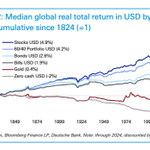
I was reading Deutsche Bank’s long-term asset return study, which pulls together more than 200 years of data. Three things stood out that I’ve seen before but continually surprise me:
1. Over five years, equities had a 25.8% chance of failing to beat inflation. Over 25 years, that fell to 7.5%. A long horizon helps a lot, but “stocks always win in the long run” is stronger than the global historical record supports and the long run is decades not years.
2. Gold has been the best-performing major asset class of the 21st century, returning 7.45% per year after inflation, higher than equities! (Across the full 200 years, it returned just 0.4% per year so major outperformance relative to its history)
3. The median 60/40 portfolio often delivered returns closer to equities than a simple weighted average of stock and bond returns would imply. Bonds have much lower standalone returns, but their imperfect correlation with stocks lowers the portfolio’s volatility. Regular rebalancing means selling some of what held up and buying what lagged, materially ratcheting up the compounded return. (Add a little bit of commodities to the mix and it starts to get really interesting!)
I’ve seen all this data before, but it still strikes me as counter to how most people think about investing.
Paper: dbresearch.com/PROD/IE-PROD/…

Taylor Pearson retweeted

Lost my phone at the office and spent 30 minutes turning the place over. Find My was disabled by MDM.
Out of ideas, I asked Claude how I could find it. It suggested tracking the Bluetooth signal strength, then wrote me a meter in about a minute.
I walked around watching the number climb. Found it.
Apparently you can just make the tool you need now.
Code: github.com/ben-z/findphone