

Product Developer Human Biology, Medicine & Health Technology Host of The Active Site podcast
Joined October 2014
- Tweets3.3K
- Following76
- Followers34.1K
- Likes413





In oats, the cholesterol-lowering ingredient is a single fiber whose effect is set by how long its molecules are, not by how many grams of it are in the bowl.
Beta-glucan lowers LDL by dissolving into a viscous gel in the small intestine, and that viscosity is governed by molecular weight. The gram figure on a label captures how much is present. It reports nothing about chain length, and chain length is what decides whether the gel forms.
In a double-blind trial of 345 adults with raised LDL, 3 grams a day of oat beta-glucan at 2,210 kDa lowered LDL by 0.21 mmol/L, about 8 mg/dL or 5.5 percent, against a wheat fiber control over four weeks. Four grams a day at 210 kDa lowered it by 0.10 mmol/L, a result the trial could not distinguish from control. The larger dose of the shorter molecule did roughly half the work of the smaller dose of the longer one, and the authors reported efficacy falling by half at the shortest chain length. A 4 gram arm at 850 kDa performed as well as the high molecular weight arm, so the failure belonged to the short molecule and not to the dose.
Processing sets the length. A 2026 review of oat processing reported that boiling holds molecular weight between 1,400 and 1,900 kDa, extrusion drops it to 251 kDa, and microwave heating drops it from 1,067 to 165 kDa. Physical form tracks the same direction in people. In a crossover trial of 30 adults, steel-cut oats produced a peak glucose rise of 1.93 mmol/L against 2.47 for instant oats, and 2.49 for an energy-matched ready-to-eat oat cereal.
The molecular weight hypothesis has failed a direct test. In a randomized double-blind crossover trial, 22 adults ate oat bran breads delivering 6 grams a day of beta-glucan at either 217 or 797 kDa for three weeks each. The two breads did not differ on any measured variable, including blood lipids, insulin, and glucose. Inside a bread matrix eaten as part of a habitual diet, molecular weight did not appear to matter. Whether viscosity survives depends on the food, not only on the number.
The effect is modest regardless. A meta-analysis of 28 randomized trials at 3 grams a day or more found LDL fell by 0.25 mmol/L and total cholesterol by 0.30 mmol/L, with no effect on HDL or triglycerides and no evidence that dose across a 3 to 12.4 gram range changed the outcome. Reductions were larger in people starting with higher LDL and in people with diabetes. That analysis searched in-house study reports from an oat beta-glucan ingredient supplier alongside the published literature.
The distortion sits in what the health claim measures. Regulators approved the claim on 3 grams a day, and manufacturers formulate to that number. Nothing in the claim and nothing on any label reports molecular weight. A puffed cereal, an extruded bar, and a pot of steel-cut oats can print the same gram figure while sitting at opposite ends of the viscosity range that produced the effect.
Oats lower LDL. The compound responsible is one soluble fiber, the effect runs through viscosity, and viscosity is set by processing no label discloses. Less processed cooked oats are the form most likely to keep the longer chains that produced the effect.
Sources: Wolever et al., American Journal of Clinical Nutrition, 2010; Mohammadi et al., Food Research International, 2026; Wolever et al., British Journal of Nutrition, 2019; Frank et al., Journal of Nutrition, 2004; Whitehead et al., American Journal of Clinical Nutrition, 2014.

Source: Mohammadi et al., Food Research International 2026;240:119660. doi.org/10.1016/j.foodres.20…
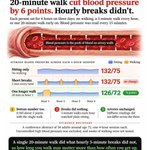
In older adults with type 2 diabetes, one 20-minute walk lowered blood pressure by about 6 points, while hourly five-minute breaks did nothing.
People with type 2 diabetes spend a large share of the day sitting, and that stillness itself has been tied to higher blood pressure. Earlier work by Dempsey and colleagues found that breaking long sitting with three-minute walks or simple resistance moves every half hour cut resting blood pressure in adults with diabetes, and a systematic review led by Mary Whipple concluded that light and moderate walking breaks can acutely lower blood pressure in people at elevated diabetes risk, while standing alone usually does not.
A new AHA 2026 abstract from Whipple's group asked a practical next question: in older adults with diabetes, is a single longer walk better than frequent short ones on a quiet afternoon of sitting. Thirty-four adults with a mean age of about 72 completed three separate four-hour sessions at least a week apart. One day they sat the whole time, one day they took a five-minute self-paced walk every hour, and one day they took a single 20-minute walk in the first hour and then sat. Across the four-hour window, average blood pressure sat around 132 over 75 with uninterrupted sitting and with the hourly breaks. With the single longer walk it fell to about 126 over 72, roughly 6 points lower on the top number and about 3 on the bottom. Measures meant to capture arterial stiffness did not differ across the three days.
This was a conference abstract of one acute four-hour session in a small sample that excluded people with uncontrolled high blood pressure, so it cannot speak to what happens over weeks or months. Even so, on this day a single 20-minute walk did what hourly five-minute breaks did not, which suggests that how long you walk may matter more than how often you stand up.
Sources: Whipple et al., Circulation, 2026; Dempsey et al., Journal of Hypertension, 2016; Whipple et al., Vascular Medicine, 2021; Wheeler et al., Hypertension, 2019.

Source: Whipple et al., Circulation 2026;154(Suppl 1):A5921. doi.org/10.1161/circ.154.sup…

1
260
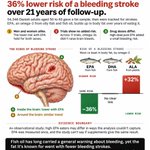
A blood signature of ultra-processed eating, low in the omega-3 fat DHA, came with about 20 percent more diabetes and heart disease over two decades.
Ultra-processed foods now supply half or more of the calories in countries like the UK and the US, and an umbrella review in The BMJ linked higher intake to greater risks of type 2 diabetes and cardiovascular disease. Those associations often survive adjustment for sugar, salt and fat, which has pushed researchers to look for biological pathways that go beyond the nutrient label. Metabolomics, the measurement of hundreds of circulating molecules at once, is one way to see what a diet leaves behind in blood.
A new Whitehall II analysis led by Mengmei Wang followed that trail in 6,010 middle-aged civil servants. Diet from two food questionnaires in the 1990s was scored with the Nova system, fasting blood was profiled for 233 molecules, and elastic-net models pulled out a 34-molecule signature of ultra-processed eating and a 50-molecule signature of minimally processed eating. The ultra-processed signature ran low in DHA and other omega-3 fats and high in atherogenic VLDL fats, while the minimally processed signature ran the other way, with fish intake tracking most closely with DHA. Over about 20 years of follow-up, people in the highest third of the ultra-processed signature had 19 percent higher cardiovascular disease risk and 20 percent higher type 2 diabetes risk than those in the lowest third. The minimally processed signature tracked with 19 percent lower cardiovascular disease risk and 40 percent lower diabetes risk. Those blood patterns explained roughly 43 to 51 percent of the link between reported diet and later disease, and the risk associations held even after the models adjusted for how much ultra-processed or minimally processed food people said they ate.
This is still observational work in a mostly white, male occupational cohort whose diets were recorded in the 1990s, so it cannot prove that changing the blood signature changes disease risk, and today's ultra-processed food supply is denser than the one measured here. What it does show is that ultra-processed eating leaves a measurable mark in blood, led by low DHA, and that mark may carry about half of the diet's long-term cardiometabolic risk.
Sources: Wang et al., BMC Medicine, 2026; Lane et al., BMJ, 2024; Monteiro et al., Public Health Nutrition, 2019; Juul et al., Advances in Nutrition, 2021; Borges et al., BMC Medicine, 2022.

Source: Wang et al., BMC Medicine 2026. doi.org/10.1186/s12916-026-0…

309
Resting until you felt ready built no more muscle than about two minutes of rest, but the workouts ran more than 20 minutes longer.
How long you wait between sets is one of the quiet choices that shapes a training session. A 2018 systematic review found that longer rests tend to support greater strength gains than short ones, and a 2024 Bayesian meta-analysis of hypertrophy studies suggested that resting more than about a minute may help a little, with little clear benefit past roughly 90 seconds. Guidelines often land around two to three minutes for hard compound work for that reason.
A new randomized trial led by Adam Mohan and Brad Schoenfeld tested whether giving trained lifters free rein to rest as long as they wanted would beat a fixed clock. Forty resistance-trained men and women completed eight weeks of supervised lower-body training twice a week, doing four sets of eight to twelve reps to failure on squats, leg extensions, standing calf raises and seated calf raises. Twenty-one people started the next set when they felt ready, and nineteen rested about two minutes. Both groups grew muscle thickness in the quads and calves, and both improved squat strength and local endurance, with no meaningful difference between them. Session effort felt about the same, roughly an 8 out of 10. The difference showed up on the clock. Fixed-rest sessions averaged 56 minutes, while rest-when-ready sessions averaged 78.5 minutes, about 22.5 minutes longer, because self-selected rests drifted toward nearly four minutes between sets.
The trial was small, lasted eight weeks, trained only the lower body, and used young recreationally trained adults under supervision, so beginners, older adults and upper-body programs were not tested. Within those limits, waiting until you feel fully recovered did not buy extra muscle or strength, and a two-minute timer saved a large chunk of gym time without giving anything up.
Sources: Mohan et al., International Journal of Sports Medicine, 2026; Singer et al., Frontiers in Sports and Active Living, 2024; Grgic et al., Sports Medicine, 2018; de Salles et al., Sports Medicine, 2009.

Source: Mohan et al., Int J Sports Med 2026. doi.org/10.1055/a-2999-0052
2
479
GLP-1 drugs like Ozempic are usually discussed as weight-loss medicines. But in October 2025, a testing company announced that semaglutide had reversed biological age by 3.1 years, and in 2026 a study in Nature reported that old female mice given the drug lived longer. The story of these drugs began with a gut hormone the body destroys in about two minutes, a lizard venom, and heart safety trials that were never meant to find a benefit. This investigation follows that evidence from the original discovery to the latest human trials to determine what GLP-1 drugs actually do, and whether their reputation as longevity drugs has been earned.
youtube.com/watch?v=vgf-kUPd…

Adults who got the most magnesium from food had about 38 percent lower odds of depressive symptoms than those who got the least.
Magnesium sits at the center of how brain cells handle excitatory signals. It helps stabilize NMDA receptors, the glutamate channels that can overfire when the mineral is scarce, and a 2020 review by Botturi and colleagues described magnesium as one of the nutrients most consistently tied to mood biology. Shortfalls are common. US survey data summarized by the NIH show that about half of Americans get less magnesium from food than they need, and a 2019 analysis of national survey data found that people in the highest magnesium intake group had roughly half the odds of depression compared with the lowest group.
A new cross-sectional analysis from the Aidai Cohort Study put that link to a large Japanese sample. Yoshihiro Miyake and colleagues assessed a year of diet with a detailed food questionnaire in 10,316 adults aged 20 to 95 and scored depressive symptoms with a standard questionnaire, treating scores of 16 or higher as elevated. About 15 percent of the sample met that threshold. After adjusting for age, sex, smoking, alcohol, activity, body weight, chronic disease, prior depression, employment, education and income, each higher quarter of magnesium intake tracked with lower odds of depressive symptoms, and people in the highest quarter had 38 percent lower odds than those in the lowest. The pattern held in people under 65 and over 65, and in both men and women.
That finding sits inside a broader literature. A 2024 dose-response meta-analysis of observational studies covering more than 50,000 adults found that the highest magnesium intake was linked to about a 34 percent lower risk of depression, with each extra 100 milligrams a day associated with a 7 percent lower risk. An open-label trial of 126 adults with mild to moderate depression also reported that about 248 milligrams a day of magnesium chloride improved mood scores within two weeks, though that trial had no placebo arm.
Because Aidai captured diet and mood at a single visit, low mood could change what people eat rather than the reverse, food questionnaires are imprecise, and the study did not test supplements. The association is consistent across large observational samples and a small trial, but it does not prove that magnesium itself lifts mood.
Sources: Miyake et al., Clinical Nutrition ESPEN, 2026; Hajhashemy et al., Nutrition Reviews, 2024; Sun et al., Journal of Affective Disorders, 2019; Tarleton et al., PLOS ONE, 2017; Botturi et al., Nutrients, 2020; NIH Office of Dietary Supplements, 2026.

Source: Miyake et al., Clin Nutr ESPEN 2026. doi.org/10.1016/j.clnesp.202…
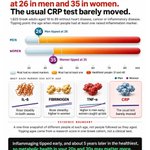
The slow, low-grade inflammation behind many diseases of aging may start switching on in your late twenties and thirties rather than in old age.
Scientists call this process inflammaging, a term the Italian immunologist Claudio Franceschi introduced in 2000 to describe the gradual rise in background inflammation that comes with age. A 2018 review by Luigi Ferrucci and Elisa Fabbri described how most older adults develop it and how it raises the risk of heart disease, diabetes, kidney disease, dementia, frailty and early death.
A new analysis of the ATTICA study asked when that shift begins. Researchers measured blood markers of inflammation in 1,825 Greek adults aged 18 to 89 who had no heart disease, cancer or chronic inflammatory disease, and combined IL-6, TNF-alpha and fibrinogen into a single immune activation score. Most men had crossed into the activated range by about age 26 and most women by about 35, and the healthiest participants crossed roughly five years later. IL-6, a signaling protein released by immune cells and fat tissue, and fibrinogen, a clotting protein, rose steadily with age in both sexes, with fibrinogen running higher in women. TNF-alpha was higher in men earlier in life while women caught up later, and CRP, the inflammation test most doctors order, barely changed with age.
Those markers matter because earlier studies tied them to real outcomes. Among 1,293 healthy older adults in Iowa, people with the highest IL-6 levels were nearly twice as likely to die over the following four to five years, and a pooled analysis of 31 studies covering more than 154,000 people linked higher fibrinogen to more heart attacks, strokes and deaths. Visceral fat, the fat packed around the abdominal organs, is one likely source of this signal, since a 2007 study of people with severe obesity found that blood draining that fat carried about 50 percent more IL-6 than blood elsewhere in the body.
Because ATTICA is a single snapshot of different people at different ages rather than the same people followed over time, it shows when inflammation tends to be higher, not how it changes inside one person. The tipping ages come from a research score in one Greek cohort rather than a test you can order, and these markers predict risk without proving that lowering them prevents disease. Even so, the fact that the healthiest people crossed the line about five years later suggests that metabolic health in your twenties and thirties may shape how you age more than most of us assume.
Sources: Giannakopoulou et al., Mechanisms of Ageing and Development, 2026; Franceschi et al., Annals of the New York Academy of Sciences, 2000; Ferrucci and Fabbri, Nature Reviews Cardiology, 2018; Harris et al., American Journal of Medicine, 1999; Fibrinogen Studies Collaboration, JAMA, 2005; Fontana et al., Diabetes, 2007.

Source: Giannakopoulou et al., Mech Ageing Dev 2026.
doi.org/10.1016/j.mad.2026.1…
408
A little-known omega-6 fat called DGLA appears to be a weak spot for the damaged cells that build up in our bodies as we age.
As we get older, some damaged cells stop dividing but never die off, a state called senescence, and they linger in tissues while releasing inflammatory signals. Some of the strongest evidence that they matter came from a 2016 study in Nature, which found that clearing them from normal mice extended median lifespan and slowed the age-related decline of the kidneys, heart and fat tissue.
DGLA is rare in food, so your body builds it from GLA, an omega-6 fat concentrated in a few seed oils. Borage seed oil is the richest source at roughly a fifth to a quarter of its fat, black currant seed oil provides about a sixth, and evening primrose oil a little under a tenth. The body quickly converts GLA into DGLA, and because the next enzyme in the chain works slowly, much of it stays as DGLA and is used to make compounds such as prostaglandin E1 that are generally linked to calmer inflammation. In a controlled trial of 64 healthy adults, four weeks of borage oil raised blood DGLA by about half in some people and more than doubled it in others, depending on which version of the FADS1 gene they carried.
The new study in Cell shows why senescent cells avoid this fat. They keep DGLA unusually low because it can trigger ferroptosis, an iron-driven form of cell death in which the fats in a cell's membrane oxidize until it breaks apart, something earlier work had already shown in worms and human cancer cells. When the researchers restored DGLA, senescent cells died this way while healthy cells were largely spared. In old mice, five days of oral DGLA lowered markers of senescence in fat and liver, and the males developed less liver scarring. In 185 Finnish adults with obesity, people carrying a FADS1 variant that keeps DGLA higher had lower levels of a senescence marker in their fat tissue.
Because most of this evidence comes from cells and mice, and the human finding is a genetic association rather than a trial, nobody has yet shown that GLA oils or DGLA clear senescent cells in people. DGLA also increased liver fat in the mice, and human observational studies have linked higher blood DGLA to fatty liver and type 2 diabetes, so more is not automatically better. The study's senior author is also an inventor on patents covering this use. What the work offers is a clear, testable explanation of how one nutrient could shape aging biology, which is a reason to watch for human trials rather than to start supplementing.
Sources: Kuehnemann et al., Cell, 2026; Baker et al., Nature, 2016; Perez et al., Developmental Cell, 2020; Mustonen and Nieminen, International Journal of Molecular Sciences, 2023; Sergeant et al., American Journal of Clinical Nutrition, 2020.


A normal fasting glucose is often read as an all-clear for metabolic health, but it can stay in a reassuring range for years while insulin sensitivity is falling.
In the Whitehall II study, researchers followed 6,538 British civil servants without diabetes for a median of almost ten years. During that time, 505 developed type 2 diabetes, and the researchers reconstructed how their blood measures had changed over as many as 13 years before diagnosis.
In the people who went on to develop diabetes, insulin sensitivity fell steeply over the five years before diagnosis. Fasting glucose rose only slowly at first and then climbed sharply over the final three years, moving from just above the normal range to above the threshold used to diagnose diabetes. The pancreas's insulin output, estimated from blood tests, rose between four and three years before diagnosis, as if compensating, and then declined.
That pattern helps explain why glucose can look fine for a long time. As the body responds less to insulin, extra insulin can keep glucose in check, and fasting glucose tends to rise once that compensation starts to fail. A normal result is reassuring, but it does not rule out insulin resistance.
The study population was 71% male and 91% white, and it was an occupational cohort, so the pattern may unfold differently in other groups. The measures of insulin sensitivity and output were estimates rather than gold-standard tests. The study was also observational. It describes how these changes typically unfolded, but it did not test whether measuring insulin earlier improves outcomes.
Tabák et al., The Lancet, 2009.

Older adults who lifted weights built muscle and strength on both a vegetarian and an omnivorous diet. The vegetarian group gained somewhat less muscle on average, but the trial could not tell whether that gap was real.
In the IMPACT randomized trial, 108 adults aged 55 and over (median age 66) did 12 weeks of resistance training, three sessions a week. Each was assigned to either a lacto-ovo vegetarian diet, with most protein from plants, or an omnivorous diet, with most protein from animal foods. Participants chose their own foods with dietary counseling and were given a daily protein target.
Both groups met that minimum target, but the vegetarian group ate about a fifth less protein overall. Arm and leg muscle, measured by DXA scan, increased by about 0.8 pounds in the vegetarian group and about 1.5 pounds in the omnivorous group. Leg press strength and chair-stand performance improved in both groups, with no clear difference between them.
The trial was designed to show whether the vegetarian diet was no worse for muscle gain, and it could not show that. The estimated difference was about 0.7 pounds in favor of the omnivorous diet, but the range of plausible results included no difference at all. The result is inconclusive, not proof that an omnivorous diet builds more muscle.
Because the vegetarian group also ate less protein, the effect of diet type and the effect of protein amount cannot be separated. The trial also lasted only 12 weeks.
What the study does show is that older vegetarians who train can build muscle and strength. Getting enough protein still matters, but this trial does not show that vegetarians cannot build muscle.
van Oppenraaij et al., American Journal of Clinical Nutrition, 2026.
