
Puzzling over how tissues build themselves
UCSF, San Francisco
Joined November 2011
- Tweets107
- Following189
- Followers692
- Likes20





Zev Gartner retweeted

Build bricks, not dashboards
TL;DR:
AI has given us the ability to realize an enormous amount of implicit knowledge—ideas, analyses, and applications that were always within reach of what we already knew, but previously took considerable effort to produce. This is tremendously useful, but it doesn't necessarily give us the foundations needed to push further. For that, we need to focus on building new, reusable pieces of knowledge that make the next round of progress possible. Let's spend our tokens building bricks, not dashboards. 😀
AI has given us a crazy new world of apparently analytic and information abundance. Now, with a few vague lines of instruction, I can create not just a dashboard, but whole worlds, on demand, in hours or even minutes. In principle, this development represents an utter and complete transformation of knowledge work. And yet… I can’t help but ask myself sometimes: where’s the meat? Do I really need another dashboard? I mean, yes, there are seemingly huge gains in so many things, but it also feels like there is this invisible wall at the boundary (many other AI-pilled people I know also feel this boundary).
One way I’ve been thinking about it is that we currently have a lot of implicit, unrealized knowledge. Imagine the world of knowledge as a sphere. Normally, people work really hard to extend human knowledge by pushing past the boundary of this sphere in a particular direction (perhaps that’s your PhD, ala Matt Might). It takes a lot of work even to make a small dent in this universe. Now, it seems like we can push the entire sphere out all at once. AI lets us bring ideas to life faster than could have ever been imagined, realizing all that implicit knowledge. But I think it will hit a wall sooner than we think, because what we build with it is often more of a cloud than a solid layer.
It’s worth asking HOW AI is able to realize implicit knowledge. Take coding. The reason that it can whip up a dashboard in minutes is because it is able to build on foundational, battle-tested frameworks. Sure, you can now build crazy things completely from scratch, but again, that’s generally following a playbook (and spending a ton of tokens). But it seems that many of these gains are relatively shallow, and consequently are often very hard to build upon. I feel like the same is true in my neck of the woods in science. We are now extremely capable with AI of filling in a lot of blanks using all the various scientific packages and knowledge out there. This capability gives you “AI euphoria”. But is that what we should be doing with our time?
I think that building the next layer of knowledge requires building bricks, not dashboards. What makes something a brick? To me, a brick is something that changes not just what is possible now, but what is possible next. A new conceptual framework, or a new, well-tested package that solves an important problem robustly. Making a brick requires synthesis, focus, and careful, deep thought. A bunch of half-baked dashboards, semi-playable video games, and minor scientific connections are not going to get us to the next step. I suggest we spend our efforts and tokens towards building these foundations instead of fluff.
Note: I am very much NOT saying that building foundations requires humans per se. I do think that as of right now, building these bricks does, to some extent, still seem to require humans. But that might all change in a month, and I would be a fool to bet against that. My point is more that as we guide our own intelligence or our purchased intelligence (or purchased intelligence guides itself, or whatever), we should be pushing it towards a common goal of building foundational pieces of knowledge that we can build upon. I worry a little that we are optimizing AI towards making flashy demos that give us a bit of dopamine and a nice Tweet, but don’t actually move the needle for knowledge. Regardless of who makes it, maybe the measure of a new piece of knowledge might not be how much it tells us here and now, but how much additional knowledge it makes accessible.
Zev Gartner retweeted

Remembering Yoshiki Sasai, another scientist who made a mistake and took his life from the onslaught of media. Even worse, his death allows the community to continue "robbing" him from being credited adequately for making the first brain organoids in a stunning series of studies dating back to 2008-2011. sciencedirect.com/science/ar…
nature.com/articles/nature09…
nature.com/articles/nature10…
Zev Gartner retweeted

organs develop in a dynamic environment where their boundaries are constantly changing shape, relaxing, compressing, etc. in synchrony with the embryo.
see how this inspired us to create a material for optimal organoid bioprinting & self-organization!
nature.com/articles/s41563-0…

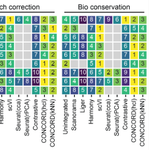
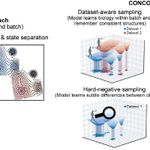
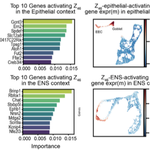
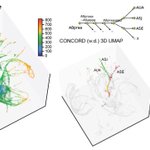
1. Excited to share CONCORD, now out in @NatureBiotech! It's an ML framework for single-cell analysis that solves integration, dimensionality reduction, and denoising in one go. Huge effort led by @qinzhu1.🔗 nature.com/articles/s41587-0… Check out this CONCORD atlas of worm development resolving detailed differentiation trajectories:
7. Best of all, it's fast (1M cells in <10 mins) and memory-friendly.
💻 Open Source: github.com/Gartner-Lab/Conco… 📖 Docs: qinzhu.github.io/Concord_doc… Try it out and let us know what you think!

8. We thank team member Zuzhi Jiang, collaborators Binyamin Zuckerman, Leor Weinberger, Matt Thomson, funding sources @cancerresearchinst (@CancerResearch) @NIH @czbiohub @czi @UCSF, the thoughtful reviewers for @NatureBiotech, and everyone else who shared data and feedback!
Zev Gartner retweeted

CONCORD: Revealing a coherent cell state landscape across single cell datasets biorxiv.org/content/10.1101/…

1. Struggling to integrate single-cell datasets? Finding it hard to resolve clear differentiation trajectories? Reveal the underlying structure in your data with CONCORD.biorxiv.org/content/10.1101/…

4. We validated CONCORD on an embryonic atlas of C. elegans and C. briggsae from @jisaacmurray. CONCORD captured known bifurcations, subtle cell states, and lineage convergence events missed by other methods (click here for interactive 3D UMAP! qinzhu.github.io/Concord_doc…...):

5. An intestinal development atlas demonstrated CONCORD's ability to resolve complex topologies, including differentiation trajectories intertwined with cell cycle loops (click here for interactive 3D UMAP! qinzhu.github.io/Concord_doc…...):

correct link: interactive 3D UMAP! qinzhu.github.io/Concord_doc…
9. While we focused on scRNA-seq, early results suggest CONCORD’s applicability to spatial transcriptomics & scATAC-seq. It’s open-source in Python. See galleries: qinzhu.github.io/Concord_doc….... Try it: github.com/Gartner-Lab/....
Zev Gartner retweeted

Thrilled to see our work highlighted by @GENbio! 🙏🏿🧬 Read the paper here: dlvr.it/TJfDpC #CRISPR #StemCells #SyntheticBiology


Epigenetic Editing of Mouse Stem Cells Generates Embryoids for Developmental Research
@ucsc scientists have used #CRISPR to develop programmable embryoids that can be used to study early embryo development and improve fertility.
hubs.li/Q03cV5mF0
