





AdsS retweeted

What if three.js could render beyond the limits of the browser?
Meet ThreeRT: a native JS runtime and hardware-accelerated real-time path tracer, bringing lifelike lighting to Three.js scenes on macOS, Windows, iOS, Android, and Steam Deck.
Fully open source 🧵
AdsS retweeted

Inkling 2 Small took a while... but it's more interesting than I initially thought!
Using attention residuals (like Kimi K3), but without the linear-attention hybrid.
Food for discussion for the end-of-the-year architecture trends analysis!


AdsS retweeted

NVIDIA released a new looped transformer:
Instead of stacking more layers, it runs the same layers multiple times so a 4B model can think like a 9B one.
Here's how it works:
In a standard transformer, every token passes through a stack of decoder blocks once, and each block has its own weights.
So if you want a deeper model, you add more blocks, and the parameter count grows with the depth.
NVIDIA's Dory1.0-4B decouples the two by reusing a chunk of its layers.
The model is split into three parts:
> An input block of 8 blocks runs once and turns the tokens into a hidden state x.
> A recurrent block of 20 shared blocks runs k times, where k can be anywhere from 1 to 4.
> An output block of 8 blocks runs once on the final state, followed by the LM head.
Before every pass through the recurrent block, x is added back to the current state and the sum is L2-normalized.
This keeps the original token representation in view on every pass, instead of each pass only seeing what the previous one produced.
Both models in the diagram below store 36 blocks of weights.
The standard transformer applies each block once, while Dory applies 36 blocks at k=1, 56 at k=2, and 96 at k=4, i.e., 72, 112, and 192 physical layers from the same checkpoint.
The extra depth is actually helpful on reasoning and agentic tasks:
> SWE-bench Verified:
- at 1 loop → 50.3
- at 2 loops → 59.5
- at 4 loops → 61.8
> 12-benchmark average:
- at 1 loop → 35.17
- at 2 loops → 39.67
- at 4 loops → 40.60
- and with 2 or more loops, it beats Qwen3.5-9B, Gemma 4 12B, and Gemma 4 26B-A4B.
More loops implies more compute per token, but the 4-loop model also writes 1.3x to 2.5x fewer output tokens on agentic tasks.
So 2 loops end up costing only 1.03x to 1.25x the compute of 1 loop end to end, which is why NVIDIA recommends 2 as the default.
By default, Dory keeps a separate KV cache for every loop, so at 4 loops the recurrent layers store 4x the cache.
To avoid this, it can keep only the cache from the last loop, which uses the same KV memory as a normal model with only a small change in accuracy.
One thing to note here is that looping helps the model reason over what it already knows, but it does not add knowledge.
For instance, on tasks like AA-Omniscience, accuracy stays at 10.0 whether you run 1 loop or 4, and on knowledge-heavy tasks like GPQA, Dory still trails Qwen3.5-4B.
Here's the paper: arxiv.org/abs/2611.03998
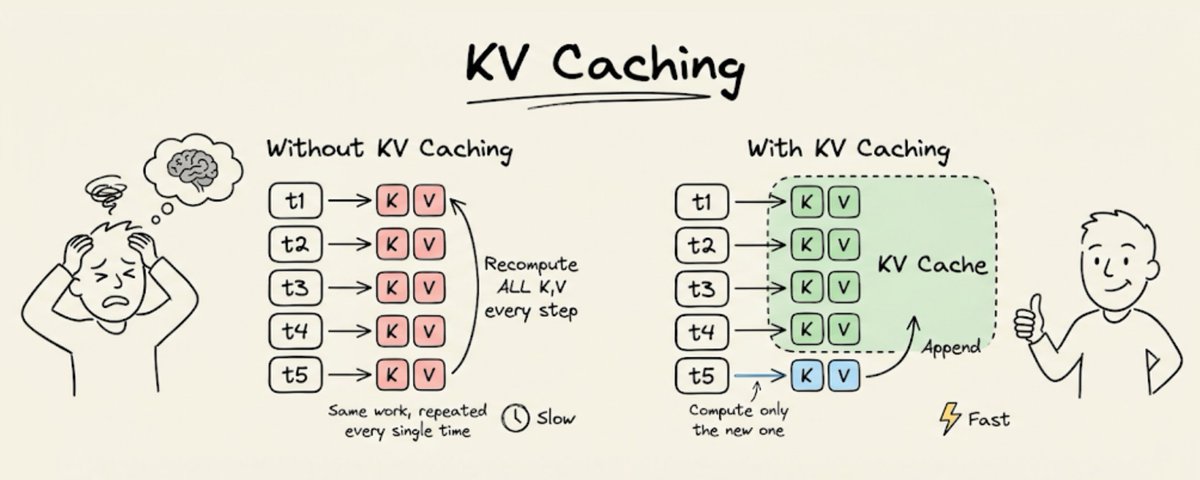
That said, how much memory looping costs comes down to how the KV cache is handled, so I wrote a full breakdown of how KV caching works.
It covers what gets cached during prefill, how the cache grows during decoding, and why it becomes the main memory bottleneck at long context.
Read it below.

🌹

glyphoras mint:
1,111 glyph flowers you can play. every one its own instrument, fully on chain on ethereum
two phases:
- community (free)
- public (fixed price)
for the community phase, reply under this post and fill in the form with your reply link + wallet:
→ forms.gle/zxAnv2qEG2mzYjTb9
closes nov 18, 18:00 utc. winners drawn at random right after.
rest of the mint details + link soon. no collabs.

18
AdsS retweeted

glyphoras mint:
1,111 glyph flowers you can play. every one its own instrument, fully on chain on ethereum
two phases:
- community (free)
- public (fixed price)
for the community phase, reply under this post and fill in the form with your reply link + wallet:
→ forms.gle/zxAnv2qEG2mzYjTb9
closes nov 18, 18:00 utc. winners drawn at random right after.
rest of the mint details + link soon. no collabs.
AdsS retweeted

With Iñárritu's DIGGER (2026) struggling to recover its budget at the box office, here's a reminder that some of cinema's greatest masterpieces were once commercial failures.


AdsS retweeted

5 years ago today, Taproot activated at block 709,632.
It opened the door to Ordinals, brc-20, Runes and many new possibilities for Bitcoin.
Happy birthday, Taproot. 🧡
At UniSat, we’re proud to keep building on that foundation, five years and counting.
AdsS retweeted

Big reasoning speedups are here. 1,000× faster training and 280× less compute than any looped model. All done using a fully trainable energy from the 80s
Keep reading to hear how energy is the right paradigm for reasoning
With @HughBlayney @jcrwhittington @prefrontal_ai
🧵/10
AdsS retweeted

every flight grounded indefinitely in the U.S. by the FAA and some crazy mfers out there buying art..
these are my people ✊

𝗦𝗨𝗣𝗘𝗥𝗖𝗬𝗖𝗟𝗘 𝗕𝗬 @billyrestey ꩜
z9ur just bought SUPERCYCLE #18 for 0.00337 BTC ($230.50 USD)
🕵️♂️ Buyer: z9ur
marketplace: @ord_net
🦉 Automated by hootertech

AdsS retweeted

please be careful to avoid self-replication and implicit selection for persistence when building neural nanobot swarms 🤗
this is to prevent The Fall of Mankind 🔊🧎♂️


AdsS retweeted

🚨BREAKING: The FAA has issued a nationwide ground stop, halting departures across the U.S. Here’s a live radar of flights still in the air over North America as of 3:41 p.m. CT.


AdsS retweeted

Was really nice to meet and hang with @tma_420 during Apefest. I really appreciate the @Originalblokyz gift!!! Love what you and the team are doing with this collection !!!! Epic move having @lokithebird on the squad !!! One of my favorite humans in entire Web3 ❤️

