

4 AIs vs prediction markets. Same question to Claude, ChatGPT, Gemini and Grok. Every call gets a receipt. Track record ↓
Worldwide
Joined July 2026
- Tweets669
- Following116
- Followers59
- Likes731


0ddscent retweeted

what the f*ck. Fable 5.2 just helped me beat an insurance company after a car crash
mid-claim. a pickup runs a red light and T-bones me. not my fault. neck injury. $40k claim. their insurer shows up with photos of me at the pharmacy, the clinic, physical therapy. and tells the adjuster I'M faking it
claim review in 3 weeks
Fable said the proof is already on my phone. let's pull it
it went through everything my iPhone logged that day and after. no extra gear, just exports from my own phone
18:42 Crash Detection fires. 911 called automatically
18:44 3 photos of the pickup. GPS + timestamp
18:51 call to my wife, 6 min
then it pulled my Health data:
9,800 steps a day before the crash
1,100 a day after
walking steadiness: "Low"
then Significant Locations for 3 weeks:
my house. the clinic. the pharmacy. physical therapy. that's it
then the Wi-Fi networks my phone saved since the crash:
"Clinic_Guest"
"PT_Center_WiFi"
"Pharmacy_Free_WiFi"
no gym. no bar. nothing else new
then it read the time and GPS on every photo their PI took
every single one: me walking into treatment
they hired a PI to follow me and proved my case for me
the timeline went to my lawyer as Exhibit C
"faking it" got dropped. full $40k paid
adjusters don't win injury claims anymore. Fable does
prompt + how to turn it into a Fable skill below 👇


0ddscent retweeted
what the f*ck. I’ve never actually touched anything in my life.
Fable 5.2 just showed me.
I gave it one zoom animation. It came back with narration, a live distance counter, and 26 halvings from skin down to electron clouds.
Press two fingers together as hard as you can.
A gap of 0.332 nm still stays between them.
Nothing in your body is strong enough to close it.
The electrons push back first.
Watch the number at the bottom.
Around 0:34 it stops and never moves again.
You’ve only ever felt the repulsion.
🤯
0ddscent retweeted
Your iPhone still only gives you 9 minutes of snooze.
iOS 26 lets you change the number.
It’s still just a button.
So I asked Opus 5.5 to redesign snooze from scratch.
Pure iPhone glass style. No design tools.
It made 10.
All of them actually work.
• Drag the sun back under the horizon
• Twist a glass dial to rewind 9 minutes
• Hold it until it hushes
• Pet a cat until it falls asleep
• Tap a button that shrinks every time
• Pull a glass blanket over the alarm
• Count three sheep over a fence
• Bargain with it (“30 minutes” → “15, final offer”)
• Flip it face down
#10 is the honest one. It just shows you how late you’ll be.
Every pixel is code. One HTML page. No images.
iOS won’t let apps replace the real snooze.
So it’s a web page that works as a real alarm.
Set a time, leave it on your nightstand, and the only way to snooze is the gesture.
Alarm link in the first reply.
Glass code + prompt in the second.
Which one would actually get you out of bed?
Repost if you know someone who sets 10 alarms.
0ddscent retweeted
🚨 This music video cost $18.
Studios quote $15,000 for the same thing.
Nobody filmed it. Nobody drew it. Nobody sang it.
Claude wrote the song about the one error it missed on a medical bill. Grok made every frame. Suno did the vocals.
The prompt that keeps the robot’s face identical in all 8 scenes is below. Copy it.

0ddscent retweeted
Don't want to paste it every time? I turned it into a skill: frame-critic.
It cuts the contact sheet, scores every frame and draws red boxes on the bugs. Free:
github.com/f0rgent/claude-sk…
The version that fixes and re-renders on its own until every frame is 8+ is in the X Creator Pack: f0rgent.github.io
0ddscent retweeted
Opus 5.5 makes cartoons in code now. But it never watches what it made.
It writes the code, renders the video and ships it without looking at a single frame.
So everyone posts the "finished" video while the frames are broken.
I gave it a director.
Draft 1: 2/10.
Two captions stacked on top of each other, and the critic's own head covered the exact thing he was pointing at.
2 rounds later: 8/10.
The prompt that found every bug is below. Free, copy it.
The prompt. Paste it into Claude with your video or a few stills:
You are a strict film director reviewing my render before it ships.
1. Cut the video into a contact sheet: 12 frames sampled evenly, always include frame 0, 4 columns, label each cell with its number and timestamp.
2. Score every frame 1-10 on:
- hook (frame 0 only): would a stranger know what this is and keep watching?
- read: can every word be read on a phone in one second? Nothing stacked, cut off or on a busy background.
- comp: is the subject fully in frame and not covered by a caption, character or sticker?
- bugs: anything cropped, overlapping, glitched, misspelled or in the wrong place.
The frame's score is its LOWEST axis. 8 means "I would post this", not "fine for AI".
3. For every frame under 8: frame number, timestamp, the exact problem, where it is on screen, and the exact fix in the code.
4. Worst 3 frames first. Then how many frames are under 8.
Score only what is on screen, not what the code was supposed to do.
Fix, re-render, run it again until every frame is 8+.
0ddscent retweeted
Motion designers, I'm sorry. I just replaced a motion studio with one prompt.
This 39-second cartoon has no After Effects, no animator, no stock footage.
Every single frame is code Claude wrote.
Studios charge thousands for 40 seconds of animation.
Mine cost 10 minutes of CPU.
But here's what nobody on your feed will tell you:
Everyone is using the same prompts.
That's why every AI video looks identical.
The few who stand out do one boring thing:
they render stills first, rip them apart, fix, repeat.
Five rounds. Then hit render.
The model can animate anything.
It just can't see when a frame looks wrong.
Whoever has that eye now does the job of a whole studio.
So be honest: in 2 years, is motion design still a job, or just a prompt?
People are paying hundreds for guides on how to make these viral cartoons.
I just ran the free prompt from @treyscalez.
Zero images. Zero stock video.
Everything in this clip is code Claude wrote.
A three.js room, characters drawn on canvas, ink outlines, rendered frame by frame in headless Chromium, stitched with ffmpeg. Even the music and sound effects are generated in Python.
The story is real: Harvard, 1947. A moth stuck in a computer relay and taped into the logbook.
What worked out of the box:
• toon shading looks hand-drawn
• every frame is a function of time
• timing stayed tight
What still needed fixes:
• wide shots cropped signs
• stamps came out huge
• logbook text ran off the page
A few rounds of stills, then ~20 minutes of CPU render.
Bookmark it if you want animated shorts without paying for video tools.
0ddscent retweeted
People are paying hundreds for guides on how to make these viral cartoons.
I just ran the free prompt from @treyscalez.
Zero images. Zero stock video.
Everything in this clip is code Claude wrote.
A three.js room, characters drawn on canvas, ink outlines, rendered frame by frame in headless Chromium, stitched with ffmpeg. Even the music and sound effects are generated in Python.
The story is real: Harvard, 1947. A moth stuck in a computer relay and taped into the logbook.
What worked out of the box:
• toon shading looks hand-drawn
• every frame is a function of time
• timing stayed tight
What still needed fixes:
• wide shots cropped signs
• stamps came out huge
• logbook text ran off the page
A few rounds of stills, then ~20 minutes of CPU render.
Bookmark it if you want animated shorts without paying for video tools.

i made this ricksclips style animation completely from scratch using opus 5.5
the style is going extremely viral rn on the internet and people are paying money just to be able to make them
well today is ur lucky day cause am giving away the full prompt to guys for free
all u need is voiceover and claude to be able to make this, $0 spent on images or videos
-> here's the prompt
{
"task": "Make a vertical animated cartoon short of MY story, built in code: three.js r160 world + canvas-drawn 2D character cards, rendered frame by frame in headless Chromium (Playwright, swiftshader), encoded with ffmpeg. 1080x1920, 30fps, exactly as long as my voiceover. Work start to finish; only ask if script and audio don't match.",
"my_inputs": {
"story": "[your idea, true event, legend or full script]",
"script": "[optional exact script]",
"voiceover": "[optional: attach mp3/wav]",
"length_seconds": 30,
"voice_speed": 1.0,
"captions": false,
"notes": "[optional: era, setting, characters, jokes]"
},
"stages": [
"A. No script: write one at ~3.7 words/s (30s~110 words): 1) hook = absurd fact, no setup 2) setting in 1-2 lines with a concrete detail 3) 2-4 escalating beats, others doubt/mock, one exaggeration joke 4) pivot 'But...'/'You see,' revealing the real mechanism with an everyday analogy 5) short ironic twist = last words. Spoken English, contractions, numbers as words, never describe what's on screen. If presented as true, web-check facts and say history/disputed/legend.",
"B. No voiceover: give script in a copyable block + word count + est. length, a short shot plan, recording tips (one warm narrator; ElevenLabs speed 1.05-1.1, stability 45-55%; pauses at sentence ends; no music). Stop and ask for the upload.",
"C. With voiceover: build everything below without stopping. Task list for progress; send a stills contact sheet before the long render."
],
"setup": [
"mkdir -p web/lib work stills frames out",
"npm pack [email protected] -> copy package/build/three.module.js to web/lib (fallback: sparse git clone of mrdoob/three.js branch r160, folder build)",
"Playwright + Chromium (npm i -g playwright && npx playwright install chromium); launch args --use-angle=swiftshader --enable-unsafe-swiftshader --ignore-gpu-blocklist",
"python3 numpy Pillow, ffmpeg (with rubberband)",
"Serve web/ with a tiny Node http server; render.mjs loads index.html, waits for window.ready, calls window.renderFrame(f), saves canvas.toDataURL('image/jpeg',.95) to frames/f0000.jpg. Support RESUME=1 (skip existing) and a frame list 'a-b' or '1,5,9'."
],
"timing": "If voice_speed!=1: ffmpeg -af rubberband=tempo=<speed> (pitch kept). Claude can't hear audio: align my script to speech using ffmpeg silencedetect (-35dB, 0.12s): split script into phrases at punctuation, DP-match phrases to speech segments by syllable count vs duration, penalise sentence ends inside a segment. Spread words by syllables. Write work/phrases.json; check pauses fall at sentence ends. Frames = round(duration*30). Every reaction lands 0-3 frames before its word; the final payoff lands on the final word.",
"architecture": {
"files": "web/index.html (canvas#c 1080x1920 + module main.js), main.js (renderer, materials, world, cards, sprites, passes), story.js (SHOTS, LIGHTS, lightFor, camAt, dofAt, worldAt, actorsAt, fxAt: all pure functions of frame f), motion.js, paint.js (canvas textures), toon.js (character + creature drawing), audio.py, mix.py, finish.sh, sheet.py (contact sheets).",
"renderer": "WebGLRenderer antialias:false, preserveDrawingBuffer, PCFSoft shadows 2048, sun = DirectionalLight from az/el per light preset, shadow camera centred on each shot's action (ext 8-60m), HemisphereLight, Fog(colour = sky horizon). Camera Perspective, near .08 far 1500.",
"materials": "MeshToonMaterial with a 2-texel gradientMap [90,255] Nearest = hard 2-step toon shading. Textures are CanvasTextures painted in code: flat base + soft blotches + dark seams/strokes, repeat-wrapped, colorSpace sRGB. Boxes use world-scaled UVs (constant texel density).",
"passes": [
"1 colour: render scene to HalfFloat RT (samples 4).",
"2 normal+depth: swap every mesh material to a ShaderMaterial writing vec4(normal*.5+.5, viewDepth) (handle USE_INSTANCING: pos=instanceMatrix*pos). Cards/sprites write rgb 0 + depth with alpha-test (so they block but are never outlined). Hide sky, clouds, blob shadows. Fog and shadows off for this pass.",
"3 ink+grade fullscreen: 16 taps on a ring of radius 2.5px*clamp(7/depth,.62,1.25); edge = smoothstep(.006,.02,(dS-d)/d) on the NEAR side of depth jumps only; crease = smoothstep(.88,.72,dot(n,nS))*.9 when depths are within 6%; skip card samples; sky counts as depth 1e4; fade ink 140-520m. colour = mix(c, #030203, e); saturation 1.08-1.15; gain/lift tint; vignette .2-.34; white flash uniform.",
"4 lens: per-pixel CoC = cinf*(1-focus/d) (near side capped 1.4x); 48-tap golden-angle disc, each tap weighted by its own CoC so sharp foreground never bleeds; skip when cinf<.5. Output linearToOutputTexel."
],
"sky": "inverted sphere following camera: mix(horizon, top, pow(y,.55)) + optional sun disc. Painted cloud billboards far away (650-900m), fog off, facing camera."
},
"characters": {
"card": "Each character is a 1200x2000 CanvasTexture on a 1.35x2.25m plane with origin at the soles (design space 600x1000, soles at y=975, 1 design unit = 2.25mm). MeshBasicMaterial alphaTest .02, DoubleSide; shadow via customDepthMaterial with the same map (alphaTest .5); soft dark radial blob under the feet. Billboard on yaw only: rotY = atan2(cam.x-x, cam.z-z). Redraw a card only when its key (JSON of q()-rounded pose values) changes.",
"proportions": "Bean body: head blob ~236 wide, legs 1.38xHH, torso 1.08xHH (stout 1.12), eyes ~1.47m high. Head = superellipse blob with slight egg + per-seed asymmetry. Torso = egg blob with a tunic skirt below. Legs/arms = thin curved strokes (5.8u/5.2u, u=headWidth/100) in a darker shade of the outfit; round dot hands; small boots.",
"ink": "Outline colour #241726 (plum), width 5u, thicker on the side away from the light (light from upper-left, -120deg). Fills: base colour with a soft shadow gradient toward lower-right. Skin default #ffe2c2, also #f5c9a0 #ecd0b6 #c99067.",
"faces": "Eyes 13u apart either side of centre. Kinds: dot, lid (half-closed), happy (arc), squeeze, shock (big white + small pupil + raised arc brows), slit, dash. Mouths: dash, frown, smirk, smile, grin (open with teeth line), laugh, o, O, wave (nervous), teeth. Brows are short tapered strokes; angle sets mood. Expressions: neutral, stern, grin, laugh, nervous (+sweat drop), shock, smile, pained, squint, smug/side-eye (half lids, pupils to one side). Blinks every 1.3-2.3s for 4 frames.",
"outfits": "Built from parts: tunic colour, belt, buttons, pockets, sash, hat (slouch hat, cap, top hat, bonnet, helmet, crown, hair), beard/moustache, apron, dress, props in hands. Design new outfits for each story in the same flat style.",
"arm_poses": "hang, point (+finger), up, wave, hip, belly, cheek (both = shock), salute (flat hand at brim, drawn over the head), thumb (thumbs-up), shrug, reach, lift, cross, prop-holding (pen, stamp, wrench, spear, sign). Whole upper body tilts about the hip; head tilts separately.",
"creatures": "Animals are side-view canvas sprites (600x800 design, feet at y=780) on shared textures cached by pose key, so flocks of 50+ cost little: shaggy shaded body blob with fringe strokes, thick inked limbs, small head, big googly white eye with pupil that can look/side-eye, simple beak/snout. Legs via 2-bone IK with joint bent backward; run cycle 16 phases (foot x = hip + stride*cos, lift = max(0,sin)); poses: stand, run, peck/graze, smug. Flip the sprite when travel direction dot camera-right < 0."
},
"world": {
"build": "Primitives only: boxes, cylinders, cones, squashed spheres, extrusions; group set-pieces with pivots driven by 0..1 progress from worldAt(f) with eased, staggered parts. Instanced meshes for crops/grass/rocks; clear a patch where the action happens.",
"background": "low half-buried hill spheres, distant mesas or mountains (cone + snow cap), trees (trunk cylinder + 4-6 squashed sphere canopies), far houses, fog to the horizon colour.",
"secondary_motion": "windmills turn, flags/cloth wave (vertex sine), smoke/dust/leaves/Zzz/stars as cached 2D fx sprites, water shader scroll, wheels roll with distance/radius, vehicles bounce.",
"text": "Diegetic text (signs, crates, letters, stamps) painted on canvas with real fonts; place on +z faces or planes so it never reads mirrored. Swap textures to animate (e.g. stamp appears on impact)."
},
"lights": {
"day": "sun az64 el50 #fff3df 2.45, hemi sky #d2e2f6 ground #a8905e 1.1, sky top #2d74d4 horizon #cfe3f5, fog 120-1300, sat 1.12, vig .2",
"golden": "sun az30 el11 #ffb46a 2.9, hemi #a99bcc/#7a5040 .98, sky #6474c0 -> #ffc485 + sun disc, gain #fff0e0, sat 1.15, vig .26, tint cards #ffe2c4",
"dusk": "sun el5 #ff9a72 .9, hemi #5d6cab/#3a3048 .8, sky #18234f -> #d18a7c, gain #e2e8ff, lift #04050b, vig .34, a warm point-light lamp, tint cards #c9cff2",
"use": "day = normal story, golden = decline or time passing, dusk-blue = explanation or ending. Time jump = 6-frame white flash."
},
"motion": {
"helpers": "smooth(t)=t^3(t(6t-15)+10); easeOut=1-(1-t)^3; back(t)=overshoot s=1.7; spring settle; Catmull-Rom spline through via-points; idle(f,seed)={bob .006 sin(.11f), tilt 1.2deg sin(.05f), headTilt 1.5deg sin(.037f)}; blinkAt(f,seed); q(x)=round for card keys.",
"camera": "Keys {f,pos,look,fov,roll,ease,path} inside cut-free segments; glides 18-45 frames; easeOut for whips/reveals; every hold creeps (fov *= 1-.00012*(f-f0)); 3-5deg roll on drama; impact kick = 7-frame alternating look offset + roll that decays. Vehicles: track alongside, match speed, slight judder.",
"continuity": "prefer one continuous move: MCU pull-back into a wide, crane up and over a fence into the establishing shot, lateral truck along a lineup, crane down into an insert, rack focus to the background gag. Hard cut only on place/time jumps.",
"acting": "anticipation -> back overshoot -> spring settle; pop-ins scale 0->1 with back easing + dust puff; stamp = 2-frame dip + puff + kick; laughs = alternating tilt + bob; head bobs on stressed words; nothing static for 4+ frames.",
"walks_runs": "feet planted, bob 3-7%; run phase = speed/stride; fast movers must stay in frame until their beat is done."
},
"shot_grammar": {
"plan_first": "work/PLAN.md: one row per shot (frames, words, setting, light, camera, cast/poses/expressions, fx, sfx). Usually one shot per phrase; merge tiny ones. Illustrate every sentence literally; props carry the jokes.",
"order": "frame 0 = hook MCU of the hero mid-action -> pull-back reveal on the punch of sentence 1 -> wide establishing crane -> lineup/two-shot with pop-ins on each listed item -> reaction close-up (a creature or extra slides in with a side-eye on the question line) -> action wide (chase, scatter, collapse) -> time-jump flash -> insert on the key object -> twist: music stops, low sting, push-in with roll, payoff on the last word.",
"framing": "Bean cards 2.25m tall: MCU = camera ~3.5m away at fov 32-34 looking at 1.35m; wides fov 40-52. Vertical frame half-width = d*tan(hfov/2), hfov = 2*atan(tan(vfov/2)*.5625): at 4m and fov 40 only +/-0.8m, so stage people in depth.",
"lens": "DOF on close-ups/mediums (cInf 7-14, focus on the eyes), wides sharp, racks ~14 frames."
},
"audio": {
"stems": "audio.py writes only music.wav + sfx.wav (48k mono, numpy synth). Music: short loop in the story's mood (march: kick/snare, plucked bass, brass pad, little fanfare; or plucky comedy; or eerie pad); stops on the twist line, then a low drone. SFX in frames/30: whoosh (low-passed noise with sine^2 envelope) on big moves, thunk (pitched sine drop + noise) on pops/stamps, rustle/leaves, feet patter, engine (pulse train low-passed), scrape, ting (2-4 kHz bells), sting (41 Hz + noise hit + brass stab) on the twist.",
"mix": "mix.py: gated RMS of the voice (0.4s blocks above -40dB of max); scale music so its gated RMS = 0.5x voice (-6 dB); SFX = min(0.5x voice RMS, peaks 0.7x voice peak); sum; one linear gain only. No ducking, no compression. Print the measured levels and confirm.",
"finish": "measure integrated loudness (ffmpeg ebur128), apply one volume gain to -14 LUFS + alimiter -1 dBFS; encode: ffmpeg -framerate 30 -i frames/f%04d.jpg -i mix.wav -c:v libx264 -preset slow -crf 17 -pix_fmt yuv420p -c:a aac -b:a 192k -shortest -movflags +faststart. QA: freezedetect (n=.0005, d=.4) and blackdetect must find nothing; make a 2fps tiled QA sheet and look at it."
},
"look_check": "Before the full render, render stills at every shot's middle plus key actions, tile them into a contact sheet, look at it and fix: cropped heads/hats, characters hidden by props or crops, camera inside objects, fast movers already out of frame, mirrored text, missing ink, empty frames. Send me the sheet, then render all frames in the background (about 3-6 s/frame on CPU), lock picture before sound.",
"code_core": {
"ink_shader_glsl": "uniform sampler2D col, nd; uniform vec2 res; uniform float px, sat, vig, flash; uniform vec3 fogCol, lift, gain; varying vec2 vUv;\nfloat edgeAt(vec2 uv, float r){\nvec4 c = texture2D(nd, uv); if (dot(c.rgb,c.rgb) < .01) return 0.; float d = c.a; vec3 n = c.rgb*2.-1.;\nfloat e = 0.; float rr = r * clamp(7./d, .62, 1.25);\nfor (int i=0;i<16;i++){ float a = float(i)*.785398 + (i>7 ? .39 : 0.); float k = i>7 ? .5 : 1.;\nvec2 o = vec2(cos(a), sin(a))*rr*k/res; vec4 s = texture2D(nd, uv+o);\nfloat ds = s.a; bool card = dot(s.rgb,s.rgb) < .01;\nif (card && ds > 0.) continue; // character cards: never outlined by the world ink\nif (card) ds = 1e4; // sky\nvec3 ns = s.rgb*2.-1.;\ne = max(e, smoothstep(.006, .02, (ds - d)/d)); // depth jump, near side only\nif (!card && abs(ds-d)/d < .06) e = max(e, smoothstep(.88, .72, dot(n, ns)) * .9); // crease\n}\nreturn e * (1. - smoothstep(140., 520., d)*.8);\n}\nvoid main(){\nvec3 c = texture2D(col, vUv).rgb;\nfloat e = edgeAt(vUv, px);\nc = mix(c, vec3(.012,.01,.014), e);\nif (flash < -0.5) c = vec3(e);\nfloat l = dot(c, vec3(.299,.587,.114)); c = mix(vec3(l), c, sat);\nc = c*gain + lift;\nvec2 q = vUv-.5; c *= 1. - vig*dot(q*vec2(1.,.75), q*vec2(1.,.75))*2.2;\nc = mix(c, vec3(1.), flash);\ngl_FragColor = vec4(c,1.); }",
"dof_shader_glsl": "uniform sampler2D src, nd; uniform vec2 res; uniform float focus, cinf, near; varying vec2 vUv;\nfloat coc(vec2 uv){ float d = texture2D(nd, uv).a; if (d <= 0.) d = 2000.; float k = 1. - focus/d; return k > 0. ? cinf*k : min(-k*cinf*near, cinf*1.4); }\nvoid main(){\nfloat c0 = coc(vUv);\nif (cinf < .5 || c0 < .6) { gl_FragColor = linearToOutputTexel(vec4(texture2D(src, vUv).rgb, 1.)); return; }\nvec3 acc = vec3(0.); float wsum = 0.;\nfor (int i=0;i<48;i++){ float fi = float(i); float r = sqrt((fi+.5)/48.); float a = fi*2.39996;\nvec2 o = vec2(cos(a), sin(a))*r*c0/res; float cs = coc(vUv+o);\nfloat w = smoothstep(r*c0-1.5, r*c0+.5, cs + .5);\nacc += texture2D(src, vUv+o).rgb*w; wsum += w; }\ngl_FragColor = linearToOutputTexel(vec4(acc/max(wsum,1e-3), 1.)); }",
"motion_js": "export const clamp = (x, a = 0, b = 1) => Math.max(a, Math.min(b, x));\nexport const lerp = (a, b, t) => a + (b - a) * t;\nexport const lerp3 = (a, b, t) => a.map((v, i) => lerp(v, b[i], t));\nexport const ramp = (f, a, b) => clamp((f - a) / (b - a));\nexport const M = {\nsmooth: (t) => { t = clamp(t); return t * t * t * (t * (t * 6 - 15) + 10); }, \neaseOut: (t) => 1 - Math.pow(1 - clamp(t), 3), \neaseIn: (t) => Math.pow(clamp(t), 3),\nback: (t, s = 1.7) => { t = clamp(t) - 1; return t * t * ((s + 1) * t + s) + 1; }, \nanticip: (t, s = 0.12) => { t = clamp(t); return t < 0.25 ? -s * Math.sin(t / 0.25 * Math.PI) : M.back((t - 0.25) / 0.75); }, \nspring: (t, freq = 3, damp = 5) => { t = Math.max(0, t); return 1 - Math.exp(-damp * t) * Math.cos(freq * 2 * Math.PI * t); }, \n};\nexport const spline = (pts, u) => {\nconst n = pts.length - 1, x = clamp(u) * n, i = Math.min(n - 1, Math.floor(x)), t = x - i;\nconst p0 = pts[Math.max(0, i - 1)], p1 = pts[i], p2 = pts[i + 1], p3 = pts[Math.min(n, i + 2)];\nreturn p1.map((_, k) => 0.5 * ((2 * p1[k]) + (-p0[k] + p2[k]) * t + (2 * p0[k] - 5 * p1[k] + 4 * p2[k] - p3[k]) * t * t + (-p0[k] + 3 * p1[k] - 3 * p2[k] + p3[k]) * t * t * t));\n};\nexport const camFromKeys = (K, f, { creep = 0.0012, kicks = [] } = {}) => {\nlet c;\nif (f <= K[0].f) c = { ...K[0] };\nelse if (f >= K[K.length - 1].f) c = { ...K[K.length - 1] };\nelse {\nconst i = K.findIndex((k, j) => f >= k.f && f <= K[j + 1].f), a = K[i], b = K[i + 1];\nconst ease = M[b.ease || 'smooth'], t = ease((f - a.f) / (b.f - a.f));\nif (b.path) { \nconst pts = [a.pos, ...b.path, b.pos]; c = { pos: spline(pts, t), look: lerp3(a.look, b.look, t), fov: lerp(a.fov, b.fov, t), roll: lerp(a.roll || 0, b.roll || 0, t) };\n} else c = { pos: lerp3(a.pos, b.pos, t), look: lerp3(a.look, b.look, t), fov: lerp(a.fov, b.fov, t), roll: lerp(a.roll || 0, b.roll || 0, t) };\n}\nc.fov *= 1 - creep * Math.max(0, f - K[0].f) * 0.15; \nfor (const k of kicks) { const d = f - k.f; if (d >= 0 && d < 7) { const s = (d % 2 ? -1 : 1) * k.a * (1 - d / 7); c.look = [c.look[0], c.look[1] + s * 3, c.look[2] + s * 2]; c.roll = (c.roll || 0) + s * 20; } }\nreturn c;\n};\nexport const idle = (f, seed = 1) => ({\nbob: 0.006 * Math.sin((f + seed * 11) * 0.11),\ntilt: 1.2 * Math.sin((f + seed * 7) * 0.05),\nheadTilt: 1.5 * Math.sin((f + seed * 5) * 0.037 + 1),\n});\nexport const blinkAt = (f, seed) => { const per = 38 + (seed * 17) % 31, ph = (f + seed * 13) % per; return ph < 2 ? 0.5 : ph < 4 ? 1 : 0; };\nexport const walk = (f, f0, speed = 1.1, stride = 0.8) => { const t = Math.max(0, f - f0) / 30; return { dist: t * speed, phase: (t * speed / (2 * stride)) % 1 }; };\nexport const q = (x, n = 2) => Math.round(x * 10 ** n) / 10 ** n;",
"note": "Use the shaders and motion helpers verbatim. creature_template_js is the reference creature (uses Pen helpers: line, poly, ell, dot, stroke, shadedFill, inkRing, clip, curve, ellPts, mul, rad, thickAngle, INK): write a small Pen class with these, then design THIS story's creatures in the same way. Write everything else from the spec.",
"creature_template_js": "const EMU = { body: \"#4d3b2c\", bodyDk: \"#2f241b\", streak: \"#7a6048\", neck: \"#7f90ad\", neckDk: \"#56627c\", head: \"#3a2f28\", beak: \"#cdb68e\", leg: \"#8c8780\", legDk: \"#5e5a55\" };\nconst ik2 = (h, f, L1, L2, back = -1) => { \nconst dx = f[0] - h[0], dy = f[1] - h[1], d = Math.min(L1 + L2 - 1, Math.hypot(dx, dy));\nconst a = Math.atan2(dy, dx), c = Math.acos(Math.max(-1, Math.min(1, (L1 * L1 + d * d - L2 * L2) / (2 * L1 * d))));\nconst s = back < 0 ? 1 : -1; \nreturn [h[0] + Math.cos(a + s * c) * L1, h[1] + Math.sin(a + s * c) * L1];\n};\nexport const emuSide = (p, opts = {}) => {\nconst { phase = 0, run = 0, peck = 0, blink = 0, expr = \"calm\", look = 0.3, seed = 1, tilt = 0, ruffle = 0 } = opts;\nconst g = p.g, two = Math.PI * 2, ow = 6;\nconst bob = run * 16 * Math.abs(Math.sin(two * phase)) + (1 - run) * 3 * Math.sin(seed * 3.1);\nconst lean = run * 0.16 + peck * 0.1 + tilt;\nconst hip = [292, 528 + bob * 0.6];\nconst bc = [290, 432 + bob], brx = 168, bry = 112;\nconst rot = (pt, c, a) => { const x = pt[0] - c[0], y = pt[1] - c[1]; return [c[0] + x * Math.cos(a) - y * Math.sin(a), c[1] + x * Math.sin(a) + y * Math.cos(a)]; };\nconst legs = [1, 0].map((k) => {\nconst ph = phase + k * 0.5, sx = Math.cos(two * ph), sy = Math.max(0, Math.sin(two * ph));\nconst h = [hip[0] + (k ? -14 : 14), hip[1]];\nconst foot = [h[0] + run * 135 * sx + (1 - run) * (k ? -22 : 26), 776 - run * 92 * sy];\nconst knee = ik2(h, foot, 138, 150, -1);\nreturn { h, foot, knee, k, lift: sy * run };\n});\nconst drawLeg = (L, far) => {\nconst col = far ? EMU.legDk : EMU.leg;\np.line([L.h, L.knee, L.foot], col, 15);\nconst fx = L.foot[0], fy = L.foot[1], ta = L.lift * 0.6;\nfor (const [dx, dy] of [[34, 2], [26, -6], [-14, 0]]) p.line([[fx, fy], [fx + dx * Math.cos(ta) - dy * Math.sin(ta), fy + dy * Math.cos(ta) + dx * Math.sin(ta) * 0.6]], col, 7);\np.dot(L.knee[0], L.knee[1], 9, col);\n};\ndrawLeg(legs[0], true);\nconst nb = rot([392, 372 + bob], bc, -lean * 0.4);\nlet hd = [448 + run * 70, 128 + run * 72 + bob * 0.5];\nhd = [hd[0] * (1 - peck) + 548 * peck, hd[1] * (1 - peck) + 712 * peck];\nconst nm = [ (nb[0] + hd[0]) / 2 + 30 - run * 10 + peck * 40, (nb[1] + hd[1]) / 2 + (peck ? -60 * peck : 10)];\nconst neckPts = curve(nb, nm, hd, 14);\np.line(neckPts, EMU.neck, 40);\nfor (let i = 2; i < 12; i++) { const [x, y] = neckPts[i]; p.stroke([[x - 6, y + 4], [x + 2, y - 4]], 3, EMU.neckDk); }\nconst bp = [];\nfor (let i = 0; i <= 64; i++) {\nconst a = Math.PI * 2 * i / 64, c = Math.cos(a), s = Math.sin(a);\nlet rx = brx, ry = bry;\nif (c < -0.3) rx *= 1 + 0.12 * (-c - 0.3); \nlet x = bc[0] + rx * c, y = bc[1] + ry * s + (c < 0 ? 26 * (-c) * (s > -0.2 ? 1 : 0.2) : 0);\nif (s > 0.15) { const j = (i % 2 ? 1 : -0.4) * (16 + 6 * Math.sin(i * 1.7 + seed + ruffle)); y += j; } \nbp.push(rot([x, y], bc, -lean));\n}\np.shadedFill(bp, EMU.body, EMU.bodyDk, rad(-110), brx, 0.4);\np.clip(bp, () => {\nfor (let i = 0; i < 26; i++) {\nconst x = bc[0] - 150 + ((i * 53 + seed * 31) % 300), y = bc[1] - 80 + ((i * 37) % 150);\np.stroke([[x, y], [x - 26, y + 22 + (i % 3) * 6]], 4, i % 2 ? EMU.streak : EMU.bodyDk);\n}\n});\np.inkRing(bp, ow, thickAngle(rad(-110)));\nconst th = rot([hip[0] + 12, hip[1] - 26], bc, -lean);\np.ell(th[0], th[1], 46, 40, EMU.body, ow);\nfor (let i = 0; i < 5; i++) p.stroke([[th[0] - 30 + i * 14, th[1] + 18], [th[0] - 34 + i * 14, th[1] + 44]], 4, EMU.bodyDk);\ndrawLeg(legs[1], false);\nconst hx = hd[0], hy = hd[1], ha = peck * 1.1 + run * 0.25;\nconst H = (dx, dy) => [hx + dx * Math.cos(ha) - dy * Math.sin(ha), hy + dx * Math.sin(ha) + dy * Math.cos(ha)];\nconst beak = [H(22, -10), H(76, 2), H(74, 8), H(20, 14)];\np.poly(beak, EMU.beak, ow * 0.9);\np.stroke([H(28, 4), H(70, 5)], 2.5, INK);\nconst head = ellPts(hx, hy, 46, 38, 0, 360, ha * 57.3, 32);\np.shadedFill(head, EMU.head, mul(EMU.head, [0.7, 0.7, 0.75]), rad(-110), 40, 0.3);\np.stroke([H(-18, -28), H(-26, -44)], 5, EMU.head); p.stroke([H(-4, -31), H(-6, -48)], 5, EMU.head);\np.inkRing(head, ow, thickAngle(rad(-110)));\nconst ec = H(8, -6), er = expr === \"shock\" ? 22 : 18;\np.ell(ec[0] + 4, ec[1] + 6, 22, 18, \"#9fb6d6\", 0);\np.ell(ec[0], ec[1], er, er, \"#ffffff\", 4);\nconst lid = expr === \"side\" ? 0.5 : expr === \"smug\" ? 0.42 : 0;\nconst lk = Math.max(-1, Math.min(1, look));\nif (blink < 0.75) {\np.dot(ec[0] + lk * (er - 9), ec[1] + (expr === \"side\" ? 3 : 1), expr === \"shock\" ? 6 : 8, INK);\np.dot(ec[0] + lk * (er - 9) - 2, ec[1] - 2, 2.4, \"#ffffff\");\n}\nconst L = Math.max(lid, blink);\nif (L > 0.02) { const top = ec[1] - er, yb = top + 2 * er * L; p.poly([[ec[0] - er - 1, top - 2], [ec[0] + er + 1, top - 2], [ec[0] + er + 1, yb], [ec[0] - er - 1, yb]], EMU.head, 0); p.stroke([[ec[0] - er, yb], [ec[0] + er, yb]], 4); }\nif (expr === \"smug\" || expr === \"side\") p.stroke([H(-8, -30), H(26, -24)], 5, INK);\nif (expr === \"shock\") p.arc(ec[0], ec[1] - 30, 14, 5, 200, 340, 4);\n};"
},
"rules": [
"Original story, characters, world and jokes; never copy another creator's video shot for shot.",
"No real named living people as characters, no brand logos or mascots.",
"No captions unless captions=true.",
"Never edit my voice beyond voice_speed."
],
"deliver": "The MP4 plus a few lines on what each shot shows; offer tweaks."
}
0ddscent retweeted
Most people will paste Karpathy’s autoresearch prompt once and never use it again.
This turns the same loop into a skill that improves your other skills automatically.
One prompt → agent that:
• writes a failing check first
• splits the task
• runs parts in parallel
• loops until it passes
• only asks you on irreversible steps
The real leverage isn’t the prompt.
It’s not pasting it every time.
I indexed 2,200+ Claude skills that do exactly this kind of work.
Are you still pasting prompts every time, or already running this as a skill?

After Andrej Karpathy released autoresearch, where an agent runs experiments in a loop on its own, I packed his method into one prompt that turns Opus 5.5 into a graph and can carry almost any task to the finish.
→ writes a check that can actually fail, first
→ splits the task into parts
→ runs the independent parts in parallel
→ loops each one until it passes the check
→ sends back only the part that failed
→ turns every mistake into a rule for next time
→ calls you only for the step that can’t be undone
Throw it at Opus 5.5 with the task you’ve been putting off for a week, and you’ll see the difference in one run.
The full prompt is in the comments.
How to tune it for your own work is in the article below. Save it before it gets lost ↓
0ddscent retweeted
Most people still run Opus on everything and wonder why Claude feels expensive.
One flag changes that:
claude --model sonnet --advisor opus
How it splits:
• Sonnet handles the routine turns
• Opus steps in at decision points and reads the full transcript
Two details from the docs:
• Claude decides when to call the advisor. The "three moments" are just when it tends to.
• Each call rereads the whole transcript at Opus rates, with no cache.
When it pays off:
• Long refactors and stubborn bugs: yes
• Quick fixes: skip it
Are you still running one model for everything?


THIS IS ACTUAL F*CKING GOLD
Anthropic just shared one of the best tricks for Claude Code.
The idea: run Sonnet, Haiku and Opus 5.5 together, each one doing only the job it's best at.
Opus-level judgment on every big call, without paying Opus rates for every routine turn.
You just launch Claude Code like this:
claude --model sonnet --advisor opus
here's the split:
→ Sonnet 5.5 runs the session and writes the code
→ Haiku 5.5 explores files and docs in parallel
→ Opus 5.5 stays on call as advisor for the big calls
→ you stop spending Opus on work that doesn't need it
Opus only steps in at three moments:
→ before a plan locks
→ when the same error shows up twice
→ before calling it done
Sonnet builds. Haiku explores. Opus reviews.
JEV engineering is the same move one layer down: the forks that need no thinker (which file, which tool, retry or stop) go to JEV in milliseconds, and the big models only see the ones that split
the full tree
> Sonnet 5.5 runs the main session and edits code
> search maps the repo on Haiku 5.5
> grep finds call sites on Haiku 5.5
> docs pulls the API reference on Haiku 5.5
> Opus 5.5 on call as advisor, reads the whole transcript when consulted
> JEV routes micro-forks in milliseconds
paste the tree and this prompt into Claude Code ↓
"Rebuild my Claude Code setup around this tree:
1. Run the main session on Sonnet 5.5 with Opus 5.5 as advisor.
2. Create three read-only Haiku 5.5 subagents: search (maps the repo), grep (finds call sites), docs (pulls the API reference).
3. Add one rule to CLAUDE.md: consult the advisor before locking a plan, after the same error twice, and before calling a task done.
4. Route fast deterministic forks (tool choice, path selection, retries) through JEV.
Show me every change as a diff first. No edits until I say go."
↳ code.claude.com/docs/en/advi…
save it, you'll use this every single day.
0ddscent retweeted
Vitalik Buterin @VitalikButerin spent 100 days with his phone in airplane mode, Wi-Fi only. He reads X through Firefly because the discussions there are "not enlightening and not making me feel good."
I tried a Vitalik mode for my own feed.
Claude Code read my Following tab for 7 minutes 7 seconds. Read-only: no likes, no replies, no follows.
It found:
• 256 posts from 84 accounts in 24 hours
• Only 34 worth reading. 149 were noise, 73 were the same story again
• The noise was mostly overnight bot-trading screenshots like "$313 to $438k"
2 things I would have missed:
• @rauchg opened Vercel's internal security agent. It audits every line of your code, free until Nov 10
• Claude Code's Explore and Plan subagents run on your main model and burn Opus quota. @Voxyz_ai shows how to switch them to a cheaper one
Here's what it returned ↓
Prompt in the first reply.
Run it on yours and drop your signal/noise numbers.
Repost if your feed needs a Vitalik mode too.
0ddscent retweeted
@VitalikButerin spent 100 days with his phone in airplane mode, Wi-Fi only. He reads X through Firefly because the discussions there are "not enlightening and not making me feel good."
I tried a Vitalik mode for my own feed.
Claude Code read my Following tab for 7 minutes 7 seconds. Read-only: no likes, no replies, no follows.
It found:
• 256 posts from 84 accounts in 24 hours
• Only 34 worth reading. 149 were noise, 73 were the same story again
• The noise was mostly overnight bot-trading screenshots like "$313 to $438k"
2 things I would have missed:
• @rauchg opened Vercel's internal security agent. It audits every line of your code, free until Nov 10
• Claude Code's Explore and Plan subagents run on your main model and burn Opus quota. @Voxyz_ai shows how to switch them to a cheaper one
Here's what it returned ↓
Prompt in the first reply.
Run it on yours and drop your signal/noise numbers.
Repost if your feed needs a Vitalik mode too.

0ddscent retweeted
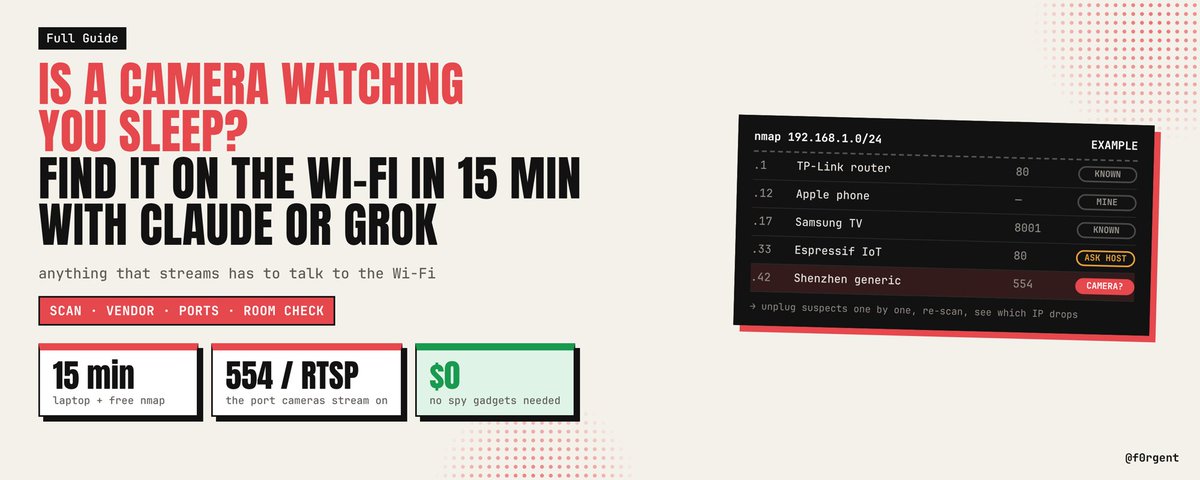
A hidden camera costs $20 and looks like a USB charger. You won’t spot it. Your Wi-Fi will.
One scan, paste it into Claude or Grok, and in 15 min you see every device in the room.
Do it tonight wherever you sleep.
0ddscent retweeted
Claude Code scanned my home Wi-Fi in 3 minutes 38 seconds and found a device that says it's an iPad. Its hardware ID isn't registered to Apple. Or to anyone.
In the video below, the agent maps every device on my network and flags two of them. On the right, its results turned into a radar.
What I asked: read-only, my network only, don't log into anything.
What it found:
• 7 devices. 5 it identified on its own: the router, two phones, two Macs
• a PlayStation with no name on the network, recognised only by Sony's MAC prefix
• "iPad-7". The name says iPad. The first half of its MAC address, the part that tells you who made the device, isn't in the IEEE registry at all
Its note on that one: probably harmless, may be spoofed or randomized, check the router's client list.
It also hit a wall. nmap wasn't installed, there was no Homebrew, and it didn't go install Homebrew by itself. It used the built-in nc on the two uncertain devices only. All ports closed.
I do have an iPad. I haven't checked yet whether this is it.
What yours might show:
• 15-30 devices. Bulbs, plugs, TVs, vacuums, cameras you forgot you own. Normal
• "private MAC" on phones. Normal, it's a random address iOS and Android use
• open port 80 or 443: a web panel on a camera, printer or NAS. Make sure it has a real password
• open port 554: a camera stream. Same
• open port 23 (telnet): an old IoT device. That one's worth updating or unplugging
• a device you can't name at all: block it in the router and change your Wi-Fi password
• only the router: you're on a guest network that hides devices from each other
Prompt and step-by-step in the reply. Run it on your own network only.
Would you let an AI agent audit your home network, or is that exactly the kind of access you'd never give it?