

i build things with AI and then build things for the AI. local models, agents, and side projects that started as "wouldn't it be cool if"
Earth
Joined March 2017
- Tweets1.4K
- Following342
- Followers629
- Likes4.2K




Pinned Tweet
An AI agent clears an AML alert on Tuesday.
On Friday, the auditor asks why.
The only record is the agent's own log - which it wrote and which anyone with box access can edit.
Nobody can prove what the agent saw, what it was allowed to do, or who allowed it.
We've been building for that gap. Agent Custody is open source, and it sits between the agent and its tools:
→ A Cedar policy checks every tool call before it runs. If the policy forbids the call, the call doesn't run.
→ The policy decides on facts the gateway fetched itself (KYC status, daily limits, the customer record), not on what the agent claims.
→ Every call gets a signed receipt in a tamper-evident Merkle log, allowed or refused.
→ Anyone can verify a receipt offline with public keys only, without access to your systems.
When an agent acted on a wrong fact, you retract the fact and get the blast radius: every action and later belief that depended on it.
Coding agents get the same layer. `agent-custody init claude-code` adds a hook that blocks force push, rm -rf ~, terraform destroy and drop database before they run. It starts in observe mode, so first you see what it would have stopped.
We've been shortlisted for the UK-India AI Adoption Accelerator 2026. One of its financial-services challenge areas is Agentic Runtime Security: control layers that constrain, monitor and verify autonomous agents in production.
If you run agents near money or production systems, the threat model is worth a hard read. Stars are welcome.
github.com/svayatta/agent-cu…
Gemini Neon gives off a strong Opus-like vibe, which is one of the reasons why everyone seems to like it.
44
Loved this, so I built the India version: India Civ 🇮🇳
A Civilization-style hex map of India, made only from public data. Every number links to its source, its year, and whether it’s official, modelled or satellite.
What’s in it:
• 9,197 hexes (20 km each) covering all 36 states/UTs and ~700 districts
• 75 lenses: population, literacy, night lights, rainfall, child stunting, crop yields, forest, income…
• 8 yields (Food, Production, Gold, Science, Culture, Faith, Health, Infra) built from real data
• 112 cities with footprints and data-derived specialisations
Some things that go beyond the US version:
• Change over time: census population for every district from 1901 to 2011, on today’s boundaries. Press play and watch India fill up.
• Hidden strengths: places that beat their conditions. Kerala districts have ~30 points more female literacy than household wealth predicts. Tamil Nadu has 17 NIRF-ranked institutions where its population predicts ~4.
• History mode: Indus to Independence on the same map. Compare any two eras: ~96% of the Maurya outline (200 BCE) lies inside the Mughal outline (1700). The outlines are approximate, and the map says so.
Fun part was the data: Census 2011, NFHS-5, MoSPI, NASA, WorldClim, Wikidata and more, all joined to one hex grid.
Try it: 0xanto.github.io/india-civ

I asked Claude to populate a Civilization-style game map with real data from the US. Opus 5.5 downloaded and parse a ton of public data and 7 hours and 45K lines of code later... it works :)
- 31 real data sources including Census, BEA, BLS, EIA, NOAA, USGS, DoD, NPS, FAA, FEMA, CDC...
- Real elevation, land cover, GDP, jobs, power plants, mines, ports, airports, bases, parks, universities, freight flows, disasters; all reconciled onto one 25 km hex grid.
- The data is converted into Civilization language, e.g. Gold yield is GDP. A city's districts are its real industry specializations: San Jose gets a Campus, Detroit is "Motor city". Its citizens are its real workforce: 1 in 4 San Jose workers are engineers, coders or scientists, against 1 in 14 nationally. Wonders are chosen by published rules, such as national parks by visitor numbers and universities by R&D spending, etc etc.
- 19 lenses (income, degrees, faith, disasters…), a City View for 524 metros, and nine advisors plus an Explorer. The Explorer turns any column for any of 3,100+ counties into a table and scatter plot, linked to the map.
- Claude decided to skip a few states and territories sry
- Built using Claude Code desktop app, Opus 5.5 on medium and turning on ultracode.
It's deployed here: karpathy.ai/usaciv/ and the "?" has the source link too. I don't exactly know where I was going with this but it's really fun to browse and play with. Possibly it can be expanded or built into a game. I only have half of my weekly Claude quote left though so someone else will have to take over :D. Claude also made a trailer:
Code: github.com/0xAnto/india-civ
Music: “Vadodora (Chill Mix)” by Kevin MacLeod (incompetech.com), CC BY 4.0

2
25
At this point, I wouldn't be surprised if xAI skipped Grok 4.8 altogether and went straight to Grok 5.
Whatever they're cooking behind the scenes, I hope it's worth this wait.
4
173
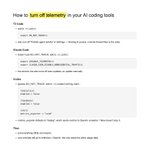
T3code now respects DO_NOT_TRACK.
here's how to turn off telemetry in t3code, claude code and codex:

1
4
222
They launched a model so good that even after two months it's competing with the new frontier models, and the lab that released the model is still struggling to release its successor.
35
i've used the ambient light extension on yt for a while and always wished youtube music had the same glow.
so i asked claude fable to build it. then i got greedy and asked it to redesign the whole ui.
first attempt barely looked different, and i said so. then i told it "full freedom" and it actually cooked: glass panels, a proper now-playing page, and a background that takes its colors from the album art.
this is what i listen on now 👇


2
4
151
it's open source: github.com/0xAnto/ytm-restyl…
don't feel like cloning? hand this prompt to your own coding agent and it'll build the same thing: github.com/0xAnto/ytm-restyl…

1
25
Anto retweeted

after months of brainstorming, finally we seem to have zeroed in on one idea. going into stealth on that one for now. day zero. November has been really exciting so far !
Fable defaults all subagents to Sonnet, forcing me to manually select the appropriate model each time.
28

Anto retweeted

Introducing 🎙️ pratidhvani (प्रतिध्वनि, “echo”): open-source voice cloning for Indian languages that keeps the speaker’s accent and dialect.
✅ Works on old, noisy recordings
✅ Runs on your own laptop, so your audio stays private
✅ Consent first, and every clip is watermarked
✅ Apache 2.0
Tested on Kannada so far. Help us bring it to every Indian language!
Try it, contribute, and ⭐ star it:
github.com/svayatta/pratidhv…

Anto retweeted

I cannot explain it but here's how I think current models behave best:
opus 5.5: you need to be 'bro' with it. get him on your team and explain the exact intent you're building with, and you'll see some amazing results when you give it ambitious things.
fable 5.2: you need to put it on a pedestal. state that you believe that it knows better than you, and architect without your assumptions, and you'll be surprised by new things it suggests.
GPT Astra/ Sol 6.2: you need to just yell at it and tell it EXACTLY what needs to be hillclimbed. if you don't know how to, ask fable or opus to do it.
you'll be surprised by how novel approaches it can take sometimes to possibly some dead ends declared by claude models.
ymmv

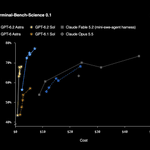
These charts make it clear just how expensive Anthropic's highest level of intelligence is.
I found it a little odd when Anthropic shared a log-scale cost chart to smooth out the curve. But then again, labs use all kinds of tactics to make their models look the best.
OpenAI may not have beaten Fable on agentic coding, but it's A LOT cheaper.
I think this is an interesting direction for the industry to move in.
Pushing the limits of intelligence matters, but so does making it affordable. The real impact might come not just from building the most capable models, but from making high levels of intelligence accessible enough to be useful everywhere.


59
GPT 6.2 Astra delivers performance on par with Opus 5.5 at the same cost, while GPT 6.2 Sol comes pretty close at a fraction of the price.
Looks like OpenAI has figured out how to make its models a lot more cost-efficient than Anthropic's.
The big question is whether this will translate into better usage limits for subscribers. Anthropic still offers the best value with its $100 and $200 plans. Will OpenAI change that?


Some of you have been asking very politely. Some of you have just been asking.
GPT-6.2 Astra and Sol are now available.
Super efficient and built to perform where it counts—the real world.
openai.com/index/introducing…
68
Qwen4-Max is now ranked #14 on Arena's Agent leaderboard, ahead of Claude Fable 5 (High) at #17.
But the more interesting numbers are coming from Artificial Analysis.
Qwen4-Max scores 43 on the Intelligence Index, up 9 points from Qwen3.8 Max and just 3 points behind Kimi K3.1 Pro.
More importantly, it's getting significantly more efficient.
One of the recurring weaknesses of Chinese reasoning models has been token efficiency. They often generate substantially more tokens to solve the same problems. Cheaper tokens don't necessarily translate into cheaper inference.
Qwen4-Max seems to be making real progress here.
• 39% fewer output tokens per benchmark task (105K vs 171K).
• $3.27 per Intelligence Index task, down from $10.02.
• 9 points higher on the Intelligence Index.
That's a 67% reduction in benchmark task cost while improving performance.
There's another interesting comparison.
Anthropic released Fable 5 in June with extensive safeguards around its cybersecurity capabilities. Qwen4-Max arrived in November, roughly five months later.
Chinese labs are now closing the gap with US frontier labs at a remarkable pace.
Alibaba also says smaller Qwen4 models are coming, with open weights planned. I'm particularly interested in what developers will be able to run locally once those models arrive.
The big question now is whether Chinese labs can maintain this pace as Anthropic tightens restrictions on model distillation.
Will the gap widen again, or will they keep catching up?


4
255
What a turnaround from Anthropic.
They dropped Opus 5.5 nearly two months ago and it stayed unmatched until they released Fable 5.2.
Now they own the top three public models heading into an IPO next week at a massive valuation.
OpenAI has finally caught up to Claude on models.
Anthropic extending Fable to paid subscribers suggests they can't afford to keep it APl-exclusive if they want to stay competitive.
The more interesting battle now is execution. Over the past few months, OpenAI has been noticeably more transparent and developer-friendly. Those seemingly small decisions compound into developer goodwill over time.
I wouldn't be surprised if more devs gradually switch to Codex, even though Claude Code is still the stronger coding experience today.
The race is tighter than it's been in a while. Curious to see how Anthropic responds.
1
84