I think I accidentally found a cheat code for Robinhood Chain
got early access to this terminal and spent today testing it on Pons launches
expected a few useful filters
ended the day $14,200 in profit
the biggest difference?
I stopped forcing trades.
the terminal filtered out most launches before I even considered touching them, and I only focused on the few that actually passed.
> no insider wallet
> no 200 IQ calls
> no staring at charts all day
> just way fewer stupid entries
and somehow that made all the difference


bro built a whole agency just to not get rugged
I TURNED A RUG-CHECKER INTO AN OFFICE FULL OF AI AGENTS 🤯
Same Grok Bot. Same shared machine. Same terminal.
But instead of giving one model a contract address and asking "is this safe," I built a room.
I call it ARGUS.
Six desks in an open floor. Five specialists who never speak to each other, and one Chair who signs.
The idea is simple:
Every desk investigates alone. Nothing clears until all of them shut up.
Here's the floor:
→ VOX reads the socials and separates humans from bots
→ BRAID traces the launch block and finds who funded the bundles
→ CAGE simulates a buy, then a sell, then reads the functions nobody reads
→ ATLAS maps who actually holds the supply
→ MOOR checks whether the liquidity can walk out the door
→ CHAIR signs the verdict, or refuses to
And CHAIR has one job:
Refuse.
Not "score it." Not "flag it." Refuse.
Because a token doesn't need five reasons to be a rug. It needs one.
Consensus is how you approve things. It's the wrong shape for danger. So I inverted it:
Unanimity to clear. One voice to condemn.
You've never been rugged by a contract you didn't check.
You were rugged by one that looked fine to everybody who wasn't accountable for saying so.
every crypto dashboard tracks TVL and volume, but none of them show who is actually shipping.
in this 46-second clip Gavin shows day one of hooking an autonomous AI agent to Robinhood to run automated execution - turning prompt instructions into live trades.
building real apps on Robinhood Chain hits the exact same friction:
turning pure system mechanics into working loops
catching client-side timestamp exploits before launch
locking server-side state against race conditions
instead of another theoretical thread, i broke down the architecture and prompt prompts into a step-by-step build guide.
watch the 46-second demo first, the full breakdown is right below.
the article below covers the full picture


Brock Mesarich:
"watched two of his workers divide a job between themselves without being asked"
in this 37-second demo from Brendan Jowett, he shows conversational AI agents handling live inbound and outbound execution without any middleman provider or custom glue code.
i took the full architecture and turned it into a step-by-step setup guide for running five dedicated workers on Kimi K3 with a 1,048,576 token context window.
worth more than any $500 workflow course on multi-agent setups.
watch the clip first, then the complete guide is below.
the article below is the deeper read


developers are spending $439 every month on frontier subscriptions when 90% of daily agent loops never need it.
in this 4-minute walkthrough you can see how to hijack Claude Code with one config change, routing every background task to Moonshot AI's Kimi K2.7 Code for ~$0.07 per completed session.
collapses a $5,268 annual seat burn down to $39/mo without changing your CLI muscle memory.
watch the clip first, then the full breakdown is in the article below.


Andrew Ng:
"developers who deeply understand how software works vastly outperform those who vibe code without understanding"
in this 23-second clip he explains why blind vibe coding leaves you mentally exhausted while coding agents make bad tradeoffs in latency, reliability, and cost.
he maps out the 5 core areas every builder still needs to steer:
building full-stack applications and state management
managing data lifecycles and storage patterns
designing system architectures and scaling
making systems secure and failure-resilient
operating in production and managing the SDLC
i turned his entire breakdown into a practical framework you can reference while building.
worth more than most $500 engineering courses.
watch the clip first, then the article below is the full guide.


xAI just changed how autonomous agents work:
"every bot gets its own computer in the cloud"
in this 35-second clip he shows what Grok Bot actually looks like driving a browser in the cloud screenshot by screenshot, taking the real tasks out of your local machine.
i pulled the exact 4-step build, department routing, and safety limits into a full deployment guide.
worth more than any paid agent course.
give the clip 35 seconds, then the step-by-step guide is below.
the article below has the full breakdown


xAI open-sourced grok-build under Apache 2.0, while Moonshot dropped the weights for Kimi-Linear under MIT.
in 55 seconds this clip breaks down why every major lab is shipping open coding agents - and why the agent harness itself, not the model, is the actual surface developers live in.
i took xAI's Rust agent, wired it directly to a local 48B model on a mini PC, and turned the whole configuration into a step-by-step setup guide with the config files ready to copy.
beats spending $600 a month renting compute on closed subscriptions when the local build runs at 140 watts.
watch the clip first, then the full breakdown is in the article below.


heavy dev setups are burning $439/month ($5,268/year) on subscriptions when 90% of agentic loops never need frontier pricing.
in 36 seconds, Kimi shows how simple a one-line CLI setup is, but the real unlock is swapping Claude Code's backend to Kimi K2.7 Code - dropping a 50,000-token loop from $1.80 down to ~$0.07 per session.
i pulled the exact ~/.claude/settings.json redirect and benchmark trade-offs into a step-by-step guide.
collapses a $439 monthly burn into $39 without touching your terminal muscle memory.
watch the 36-second clip first, then the full breakdown is in the guide below.
the article below is the deeper read
xAI dropped Grok Bot with dedicated cloud computers for autonomous multi-agent teams:
in this 21-second clip they break down the setup where bots coordinate in shared group chats and finish work across apps while you sleep.
each bot gets its own persistent browser and logins out of the box, while open-source alternatives like Hermes Agent give you 400+ model choices on your own hardware with zero subscription fees.
i took the core trade-offs between managed cloud bots and self-hosted agents and turned them into a practical guide.
worth checking out before you spend hours configuring the wrong automation stack.
watch the preview first, then explore the full guide below.
the article below covers the full picture
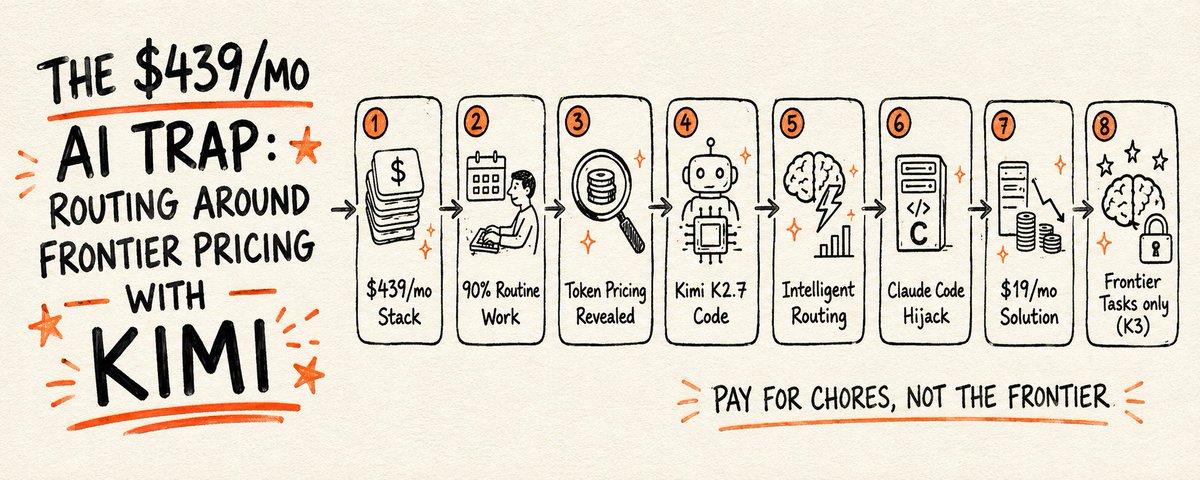
moonshot AI just released Kimi K3 in this 40-second launch clip, bringing a 2 million token context window and dropping the heavy AI coding bill from $439 to $19 a month:
00:00 - hook: Kimi K3 changes everything
00:09 - head-to-head vs Claude 3.5 Sonnet
00:16 - benchmark performance grid
a standard agentic session runs 50,000 input tokens at $0.95 per million, costing just pennies compared to Claude Opus 4.8 or GPT-5.5.
i took the configuration steps and turned them into a quick deployment guide.
worth more than a $500 enterprise course.
give it a look, then the article below is the full guide.
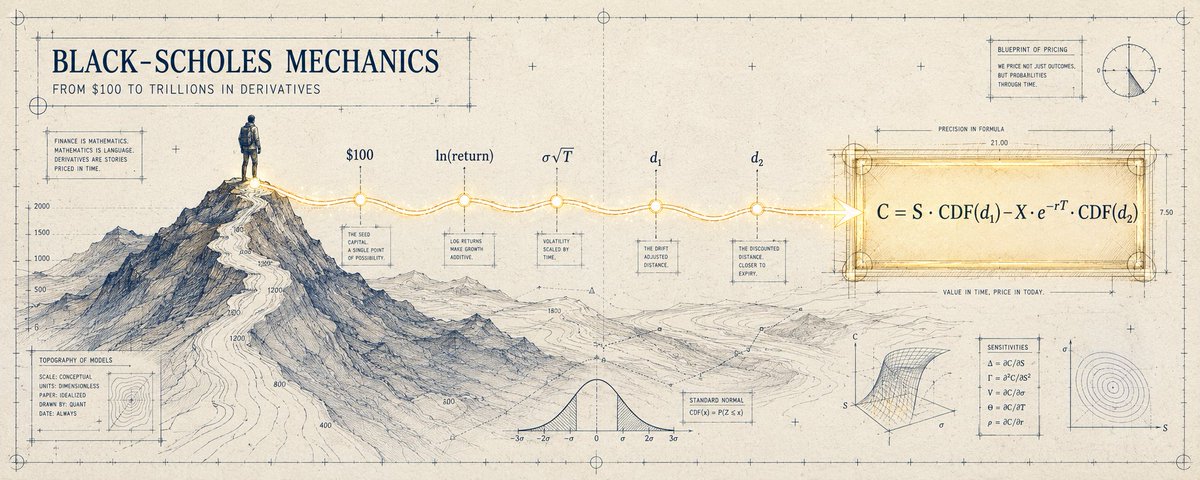
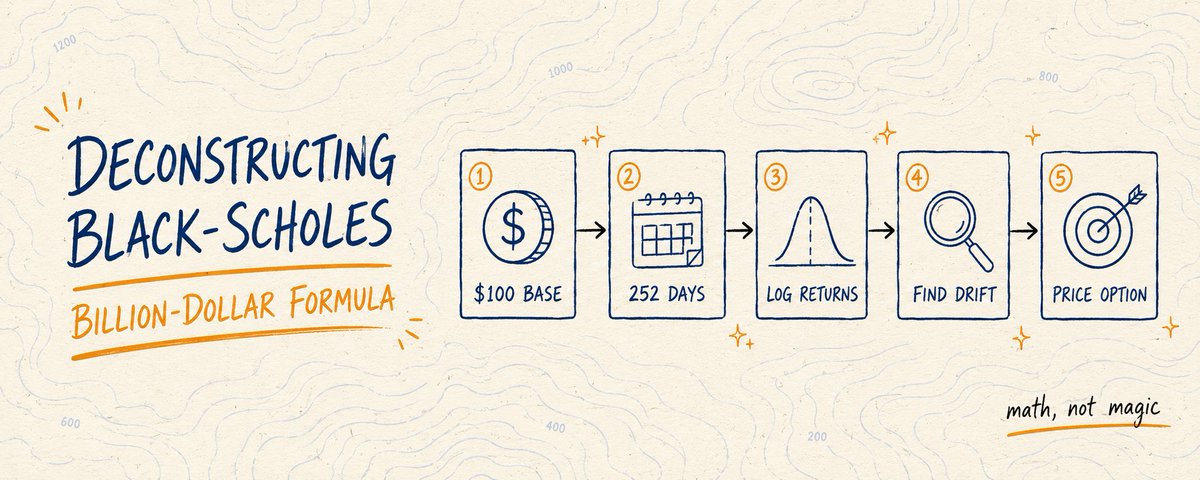
every derivatives desk on wall street prices trillions in volume off a single equation, but almost nobody explains that Black-Scholes is just five lines of high school algebra glued to Euler's number.
in 4 minutes this clip breaks down how log returns turn moneyness into standard normal distributions:
ln(s/k) sets whether the contract is in or out of the money
volatility shifts the good and bad case scenarios across the axis
d1 and d2 normalize the exact probability of exercising at expiration
i pulled the full formula breakdown and volatility math into a step-by-step guide.
explains options pricing better than most paid finance courses.
watch the clip first, then the full breakdown is in the article below.
Claude Code + Seedance:
"Seedance 2.5 takes up to 50 reference images and a single 30 second prompt, so the quality of your film is decided before you ever open the video model."
by combining a free Claude skill with KIE.ai and Blotato, you can generate 1080p vertical video and auto-publish across every platform for pennies.
i took what Duncan Rogoff covers in this 26-second walkthrough and turned it into a step-by-step guide.
worth more than a $500 course.
watch it first, then the full guide is in the article below.


xAI team:
"configuring, provisioning, delegating, and triaging instead of doing useful things"
in this 58-second breakdown Quatro AI covers how Grok Bot connects to real tools like an iMessage-style interface to run agents unattended.
i extracted the 6 core bot roles and setup steps into a practical guide.
beats any $500 course on agentic workflows.
watch the clip first, then the full guide is in the article below.


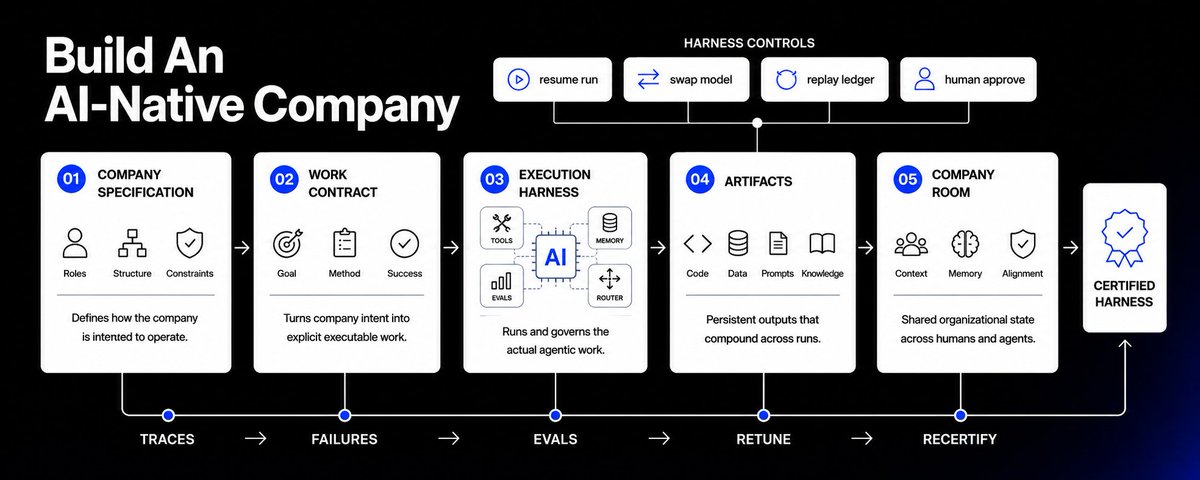
activity is not an organisation - most teams just build a chat window and call it a team.
using Kimi K3 to compile a company brief into a DeepSeek Harness preset changes the architecture:
6 core configuration sections
4 explicit levels of authority
skills built as versioned methods instead of random prompts
i pulled the core blueprint into a practical guide.
you'll find it in the article below, with the prompts ready to copy.

Higgsfield charges $15 to $129/month for faceless video generation.
you can generate the exact same 10-second 1080p clips through Claude Code and Kie.ai for about $0.75 each with zero recurring subscription.
in this 31-second clip he shows Claude Code generating cinematic video directly in the terminal:
image still drafting for 4 cents using nano-banana-2
text and UI generation using gpt-image-2
animating through Seedance 1.0 Pro on Kie.ai
auto-scheduling across TikTok, Shorts, and Reels via MCP
i took the whole automated stack and turned it into a step-by-step setup guide with the exact skill files.
beats paying $50/month for locked credits.
watch the clip first, then the full implementation guide is below.
the article below is the deeper read