AI researcher • developer • engineer • DMs always open
Bali, Indonesia
Joined November 2025
- Tweets6.4K
- Following412
- Followers11.4K
- Likes15K




Ricker retweeted
SpaceXAI Senior engineer (ex-Cursor):
"99% of people still use GrokBot as a search box.I run 20+ cloud agents under a Chief of Staff and PM layer - the system keeps working when I’m offline.”
In just 20 minutes, this engineer shows how to turn one GrokBot into a multi-agent team that works for you 24/7
GrokBot → Chief of Staff → PM → Workers → Autonomous Fleet
This 20-minute breakdown is more useful than most $1,000 agent-engineering courses.
Watch it today, then read the full guide below ↓

SpaceXAI Senior engineer (ex-Cursor):
"99% of people still use GrokBot as a search box.I run 20+ cloud agents under a Chief of Staff and PM layer - the system keeps working when I’m offline.”
In just 20 minutes, this engineer shows how to turn one GrokBot into a multi-agent team that works for you 24/7
GrokBot → Chief of Staff → PM → Workers → Autonomous Fleet
This 20-minute breakdown is more useful than most $1,000 agent-engineering courses.
Watch it today, then read the full guide below ↓
AI agents are finally getting past API limitations.
I tested Sai by @SimularAI with a simple task:
→ Open 10 AI SaaS websites
→ Research pricing and features
→ Compare plans and limitations
→ Compile findings into a report
It navigated real websites through a cloud computer, without custom scraping scripts.
This is what computer-use agents are actually about.
dm me for best prompt and tips
Ricker retweeted
Lauren Tan’s multi-agent build stack is a great example of how to turn Grokbot from one assistant into a real operating system for work.
the flow:
→ give Grokbot the goal + context
→ route the request
→ break it into parallel tasks
→ send work to specialized agents
→ keep everything aligned with shared memory
→ verify the outputs
→ merge everything into one clean result
the part I like most:
it doesn’t use a swarm for everything.
simple tasks stay simple.
complex work gets split, routed, checked, and coordinated automatically.
that’s the real advantage of multi-agent systems.
I mapped the full build stack below ↓
Ricker retweeted
Lauren Tan’s model setup is way more interesting than use one model for every task.
She routes work by capability.
• Grok → implementation, debugging, refactors, fast code loops
• Opus → architecture, ambiguous problems, high-stakes decisions
• Claude → long-context analysis, reading, structured reasoning
Then she adds a verifier.
One model does the work.
Another checks the assumptions, output, and failure modes before anything ships.
So the actual stack looks more like:
task classify → model route → tool use → plan → execute → cross-model review → log outcome
It’s building a system where each model only handles the part of the workflow it’s strongest at — and another model catches what it misses.
I mapped the full routing + verification architecture in the article below ↓
Ricker retweeted
Lauren Tan’s pstack isn’t built around one all-purpose agent.
It works like a multi-agent system.
Different bots own different parts of the pipeline:
• Chief of Staff → decomposes the goal
• Hatcha → research + synthesis
• Engineer bots → implement + test
• Dr. Eggbot → review + catch
• Potato → handles recurring execution
• Suki → takes care of UX + final polish
• Crumb → preserves memory across long-running work
The real advantage is the handoff:
goal → plan → specialists → review → final result
Each bot has one responsibility, one trigger, and one expected result.
I mapped the full team architecture + handoff logic in the article below ↓
Ricker retweeted
i gave Grokbot one sentence and it turned into a 300-agent operation.
the task was simple: test every agent tool worth testing and give me one table.
Grokbot handled the coordination layer, split the work into 16 lanes, then pushed it across 300 K3 agents.
what happened underneath was much bigger than the prompt:
420 pages read
50 tools tested
180 claims checked
96 sources kept
1,240 rows merged
even 10 failed agents didn’t stop the run - they were retried while the other lanes kept moving.
300 agents. ~6 minutes. one finished answer.
that’s the part people miss about multi-agent systems: the hard part isn’t spawning hundreds of agents.
it’s making hundreds of agents behave like one system.
full Grokbot × Kimi K3 guide below ↓
Ricker retweeted
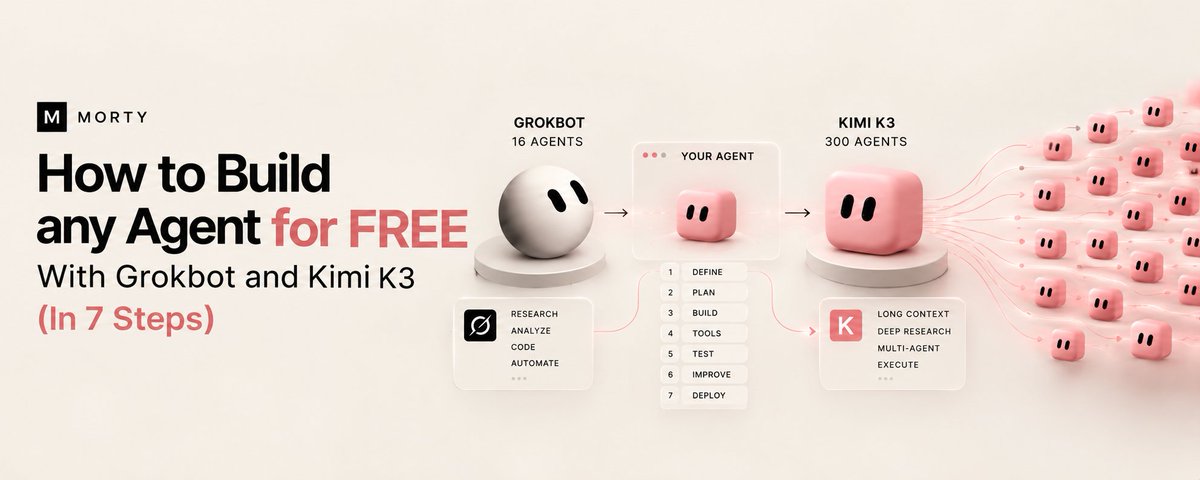
this is getting stupid: i described an agent in plain english and Grokbot + K3 built the whole thing for free.
with Grokbot + Kimi K3, the workflow is basically:
you explain what the agent should do
Grokbot turns that into an actual build plan, and K3 handles the parallel work underneath - tools, logic, tests, edge cases, fixes.
so instead of spending hours wiring frameworks together
you can go from an idea to a working agent through 7 steps without paying for a separate agent stack.
the interesting part isn’t that it’s “no-code.”
it’s that the complexity is still there - you’re just delegating the complexity itself to the system.
describe the job → spec it → build it → test it → fix it → deploy it
that makes the barrier to building custom agents dramatically smaller.
full Grokbot × Kimi K3 setup in the article below ↓
I gave MiniMax M3.1 Flash one prompt to build an AI agent command center from scratch.
It generated an interactive dashboard with:
→ 25 simulated agents
→ live execution logs
→ task orchestration
→ real-time telemetry
All running in the browser.
What interests me most is how quickly models are turning complex UI concepts into working prototypes.
Built with @MiniMax_AI.
Ricker retweeted
i gave Grokbot one sentence and 300 K3 agents built the entire agent around it. i wrote 0 lines of code.
the input was simple:
“watch three competitors’ changelogs and tell me what actually changed for us”
from there the system handled the rest:
→ Grokbot asked 23 questions to remove ambiguity
→ turned the answer into a 184-line spec
→ wired 9 tools
→ ran 14 test passes
→ added 2 new rules after failures
→ deployed the finished workflow on a schedule
all while 300 K3 agents were working underneath the build.
the part i like most is that this doesn’t start with a framework or a giant agent template.
it starts with one sentence, then moves through:
define → plan → build → tools → test → improve → deploy
and in this run:
0 lines of Python written by me
0 frameworks installed
$0.00 spent on the build
that’s basically the whole idea behind the article:
you shouldn’t need to become an agent engineer just to build one.
full 7-step Grokbot × Kimi K3 setup below ↓
So Space Bunny was MiniMax M3.1 Flash all along.
And the economics are pretty interesting:
→ 1M-token context
→ 70% lower agentic task costs vs its predecessor
→ $0.15 / 1M input tokens
Strong coding + agentic performance at a fraction of the cost.
MiniMax Code subscribers get unlimited M3.1 Flash usage until Oct 25.
Try it: agent.minimax.io/


MiniMax M3.1 Flash: Space Performance + Bunny Speed
🚀🐰 Yes, Space Bunny - which has topped global leaderboards with 200T+ tokens - was an earlier version of M3.1 Flash.
💰Redefining the performance economics of agentic AI. M3.1 Flash achieves frontier-level intelligence across key tasks such as Cowork (Automation-Bench: 62%; ALE: 30%), Coding (DeepSWE: 74%) and Visual Reasoning (BabyVision: 91%), at 1/3 the cost of M3 and 3x the speed.
API pricing (flat rate): $0.15 / $0.60 per 1M input/output tokens, with cache reads at $0.015 / 1M tokens.
Model weights will arrive on Oct 23.
API: platform.minimax.io
M Plan: minimax.io/m-plan
MiniMax Code for desktop: agent.minimax.io/download

Ricker retweeted
reverse engineering gets scary fast when 300 agents can inspect the same app at once.
300 K3 agents turn an app from one black box into hundreds of questions you can attack at the same time.
that’s the part of REA × K3 that makes this setup interesting.
instead of feeding one model an entire app and hoping it keeps the architecture straight
REA breaks the system apart first:
functions, dependencies, state changes, network behavior, UI flows, edge cases.
K3 then assigns those pieces across the swarm and lets hundreds of narrow investigations happen in parallel.
that changes the bottleneck completely.
you’re no longer limited by how much of the app one model can understand in one pass.
you’re limited by how well you can decompose the problem and recombine the evidence.
full REA × K3 course below ↓