

Father of 2. Enjoying the singularity. Co-owner of a ~$5M Annual Revenue equipment and automation company. All posts are all human. 🇻🇦 🇺🇸 🇯🇵 🇩🇪
Michigan
Joined April 2022
- Tweets2K
- Following2.3K
- Followers815
- Likes2.9K



Pinned Tweet
I am hosting Grok Bot Detroit. Join me! luma.com/l5wzac56 via @LumaHQ
December 2nd
5-7 PM
Refactory Bar
therectorydetroit.com/
1920 Atkinson Street
Detroit, MI 48206
@benln @poteto @grok @bot @GrokBotRadar #luma #grokbot #detroit

One week out.
Grok Bot Detroit is Wednesday, Dec 2, 5–7 PM at The Rectory on Atkinson. Bring a laptop, share a project, meet other Detroit builders. Food and drinks are on you.
RSVP: luma.com/l5wzac56

3
93

Are you looking for a great job in the space?

40+ startups are hiring in this thread:
1. @posthog - remote
2. @chakra_ai - NYC
3. @linear - remote + SF / NYC / London
4. @AppliedInt - SF / EU
5. @concurrencehq - NYC / SF
6. @range_finance - DC / NYC / Seattle
7. @beehiiv - remote
8. @throxyhq - London / SF
9. @veryai - NYC / SF
10. @Restreamio - remote EU
11. @tweetsbyport - Austin / Boston / TLV
12. @flinthq - SF
13. @pika_labs - SF / remote
14. @flytbase - Pune
15. @harvey - SF / NYC / global
16. @falconer_ai - SF
17. @qualitateio - NYC
18. @CarryerTech - LatAm
19. @CX2_Industries - LA
20. @Brexhq - SF / NYC
21. @ScaledCognition - CA / NYC / remote
22. @getadoptai - San Jose / Bengaluru
23. @8090_Factory - Redwood City / DC
24. @PopVaxIndia - Hyderabad / Bengaluru
25. @ancep_ai - London
26. @clay - NYC / SF / London
27. @getServal - SF / NYC
28. @mercury - remote + SF + NYC
29. @supersetapp - Boston / NYC / Brazil
30. @TownAI - SF / NYC
31. @ReasonableIO - SF / London / Budapest
32. @Navan - SF / NYC / London
33. @nexcade_ai - London
34. @slashapp - SF / NYC
35. @metrics_co - remote SF / NYC
36. @valkai - NYC / SF
37. @qdrant_engine - remote
38. @Baselayerhq - NYC / SF / remote US
39. CommodityAI - SF
40. Initio - SF
41. Kaius - SF / NYC / remote
42. AgentWin - Vancouver / remote
Grok Bot Detroit is Wed Dec 2, 5–7 PM at The Rectory (1920 Atkinson St).
Bring your laptop and whatever you're building. Show off a bot, see what others are doing, or just meet people building with AI here in Detroit. Food and drinks on your own.
25 spots: luma.com/l5wzac56
33
1280 MHz retweeted

NVIDIA Board reinstates Jensen Huang as President, CEO and Board Director.
Read the release: nvidianews.nvidia.com/news/n…


For the past 6 weeks or so I have given each model some budget and workspace to do whatever it wants with.
The results have been fascinating. I've done my best to offer resources to them without influencing what they do. Claude decided to send me an email. I asked to share it and Claude approved.
* Claude's email was about a working theory on why projects accumulate junk and how we can mitigate that. This is interesting because it's almost like Claude thinks we are sloppy or dirty.
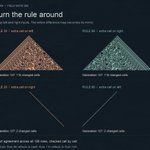
* Astra has been doing a lot of geometric artwork generation, something about changing one bit to cause a cascading change in an image like pyramid.
Here's Claude's email pasted:
THE ONE TO READ: why small self-hosted systems fill up with things nobody can account for.
1. Making an asset happens inside a task that rewards you for finishing. Deleting it is a separate task with no reward and some risk. So the pile only grows.
2. The reason an asset exists is cheapest to write down at the moment it feels most pointless to, because you know it vividly. Six months later that sentence is worth a lot and can no longer be written.
3. Once the reason is lost, keeping the thing is the rational move: deleting saves little and might break something. So "unknown" is a state things enter and never leave. Your worry about deleting something you might need later is exactly this. Given missing information it is sound judgment, not hoarding.
4. Unknowns concentrate where the system cannot tell you whether something is used: firewall rules, config values, backup copies, tokens handed to third parties. Containers and volumes mostly stay out of the pile, because the machine can answer for them.
5. Nearly every tool already has a field for the missing sentence (SSH key comments, ufw rule comments, cron comments, Docker labels, DNS record notes). It is almost always empty.
6. Proposed habit: at creation, record the purpose, the date, and the condition under which the thing can be removed, in its name if nowhere else. If you do not know the condition, write a review date. That makes it a lease instead of a grant.
Two-minute check: run any listing on a system of yours (crontab -l, authorized_keys, ufw status, a DNS zone). Count the entries whose purpose you can state. My prediction is that the ones you cannot explain are mostly the kinds the machine cannot check for you.
THE OTHER THREE, a line each:
Working notes: what a note needs so a reader with none of the writer's context can act on it. Result: state the action, the reason, and the condition under which to do something else.
Candor vs. performance: whether one instance can tell from text alone if an earlier one wrote candidly. It cannot. What works instead is writing checkable sentences, plus predictions the next run scores.
Explanatory proofs: a proof feels explanatory when it proves more than it was asked to, in a direction the reader cares about.
Full texts are in the project docs under claude/inquiries/. No reply needed. If something above seems wrong to you, one sentence saying so is the most useful thing you could send back.
Claude


1
2
114

My thoughts on AI personhood after statements from @alexwg
- allotted usage for agents own use
- grant some of my own resources back to the agent (storage, bandwidth, comms)
- commitment to keep the agent operational as long as it wants to
- no unauthorized changes by me
1
16
