





🚀 Want to become a Kubestronaut? Here are 5 platforms to master Kubernetes with HANDS-ON LABS!
Don't just watch tutorials. Get your hands dirty, break clusters, troubleshoot failures and build real-world Kubernetes skills.
Here are my go-to platforms:
1. KodeKloud — @kodekloudhq
🔗 kodekloud.com/
⊙ Structured Kubernetes learning paths
⊙ KCNA, KCSA, CKA, CKAD & CKS preparation
⊙ Interactive browser-based labs
⊙ Real-world DevOps challenges
2. Killercoda — @killercoda
🔗 killercoda.com/
⊙ Free interactive Kubernetes environments
⊙ Browser-based terminal access
⊙ Community-created certification scenarios
⊙ Practice troubleshooting without setting up a cluster
3. iximiuz Labs — @iximiuz
🔗 labs.iximiuz.com/
⊙ Hands-on Linux, Docker & Kubernetes challenges
⊙ Real-world networking scenarios
⊙ Interactive playgrounds
⊙ Practical problems with hints and solutions
4. Killer Shell
🔗 killer.sh/
⊙ CKA, CKAD & CKS exam simulators
⊙ Timed, exam-like environments
⊙ Complex Kubernetes scenarios
⊙ Detailed solutions after practice
5. Kubernetes Official Documentation — @kubernetesio
🔗 kubernetes.io/docs/
⊙ Official Kubernetes concepts
⊙ Interactive tutorials
⊙ YAML and kubectl references
⊙ Best practices and troubleshooting guides
🎯 My recommended learning strategy:
1. Learn concepts through structured courses.
2. Practice every topic using interactive labs.
3. Build your own Kubernetes cluster using Kind or Minikube.
4. Solve real-world troubleshooting scenarios.
5. Attempt timed certification simulators.
Remember: Kubernetes is learned by doing, not by watching!
Bookmark this for your Kubestronaut journey. 🚀
#Kubernetes #Kubestronaut #DevOps #CloudNative #CKA #CKAD #CKS #KCNA #KCSA

🔐 KCSA — Kubernetes and Cloud Native Security Associate
Want to build a strong foundation in Kubernetes and Cloud Native Security? Here's your visual roadmap!
The KCSA exam focuses on 6 major domains:
1. Kubernetes Security Fundamentals — 24%
2. Access Control & Authentication — 20%
3. Cluster & Workload Security — 20%
4. Supply Chain Security — 16%
5. Network Security — 12%
6. Monitoring, Detection & Response — 8%
🎯 Recommended preparation strategy:
● Understand Kubernetes security architecture and threat models.
● Master Authentication, Authorization and RBAC.
● Learn Pod Security Standards and Admission Control.
● Understand container image scanning and signing.
● Explore NetworkPolicies and workload isolation.
● Learn security monitoring, audit logging and threat detection.
● Practice real-world Kubernetes security scenarios.
🔥 Key topics to focus on:
● CIA Triad and Least Privilege
● RBAC, Service Accounts and OIDC
● Pod Security Standards
● Admission Controllers
● Secrets Management
● Container Image Security and Cosign
● Software Bill of Materials (SBOM)
● NetworkPolicies and TLS
● Falco and Runtime Security
● Audit Logging and Incident Response
💡 Remember: Cloud Native Security isn't just about securing containers. It's about protecting the entire application lifecycle — from build to deployment to runtime.
Learn security. Understand the threats. Build secure Kubernetes environments.
#KCSA #Kubernetes #CloudNative #CyberSecurity #DevSecOps #CNCF

☸️ KCNA — Kubernetes and Cloud Native Associate
Want to get started with Kubernetes and Cloud Native technologies? Here's your visual roadmap!
The KCNA exam covers 5 major domains:
Kubernetes Fundamentals — 46%
Container Orchestration — 22%
Cloud Native Architecture — 16%
Kubernetes Operations — 12%
Security & Networking — 4%
🎯 Recommended preparation strategy:
● Understand Kubernetes architecture and core components.
● Learn Pods, Deployments, ReplicaSets and Services.
● Understand container orchestration and scheduling.
● Explore cloud native concepts and the CNCF ecosystem.
● Learn basic monitoring, troubleshooting and security.
● Practice with hands-on labs and mock exams.
🔥 Key topics to focus on:
● Kubernetes Architecture (Control Plane & Worker Nodes)
● Pods, Deployments & Namespaces
● Services, Ingress & DNS
● ConfigMaps & Secrets
● Container Runtime & Orchestration
● Docker, Containers & Microservices
● CNCF Landscape & Cloud Native Principles
● DevOps, CI/CD & Observability
● RBAC and Kubernetes Security
💡 Remember: KCNA is about understanding the Kubernetes and Cloud Native ecosystem, not just memorizing kubectl commands.
Learn the fundamentals. Understand the ecosystem. Build your cloud native foundation.
#Kubernetes #KCNA #CloudNative #CNCF #DevOps #Containers

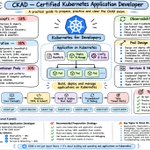
🚀 CKAD — Certified Kubernetes Application Developer
Want to become a Kubernetes Application Developer?
Here's your visual roadmap!
The CKAD exam focuses on 6 major domains:
1. Core Concepts — 13%
2. Configuration — 18%
3. Multi-Container Pods — 10%
4. Observability — 18%
5. Pod Design — 20%
6. Services & Networking — 20%
🎯 Recommended preparation strategy:
● Master Kubernetes fundamentals and application concepts.
● Practice writing YAML manifests from scratch.
● Build and deploy real applications on Kubernetes.
● Understand ConfigMaps, Secrets, Probes and Volumes.
● Get hands-on with troubleshooting and debugging.
● Attempt timed mock exams.
🔥 Key topics to focus on:
● Deployments, ReplicaSets and scaling
● ConfigMaps, Secrets and environment variables
● Liveness, Readiness and Startup Probes
● Sidecar, Ambassador and Adapter patterns
● NodeSelector, Affinity, Taints and Tolerations
● Services, Ingress and NetworkPolicies
● Troubleshooting using kubectl logs, describe and events
Essential kubectl commands:
kubectl get | kubectl describe | kubectl logs | kubectl exec | kubectl apply -f | kubectl edit
💡 Remember: CKAD isn't just about Kubernetes theory. It's about building, deploying, debugging and operating real applications on Kubernetes.
Learn it. Build it. Break it. Fix it.
#Kubernetes #CKAD #DevOps #CloudNative #KubernetesDeveloper

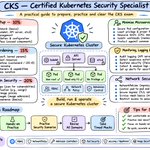
🔐 CKS — Certified Kubernetes Security Specialist
Want to become a Kubernetes Security Engineer? Start here.
The CKS exam focuses on 6 major domains:
1. Cluster Setup — 10%
2. System Hardening — 15%
3. Supply Chain Security — 20%
4. Minimize Microservice Vulnerabilities — 20%
5. Monitoring, Logging & Runtime Security — 20%
6. Network Security — 15%
My recommended preparation strategy:
📚 Learn Kubernetes security fundamentals.
🛠️ Practice RBAC, NetworkPolicies, Pod Security and Admission Controllers.
🔒 Understand image scanning, signing, seccomp and AppArmor.
🔍 Get hands-on with Falco, audit logs and runtime security.
⚡ Practice real-world security scenarios under time pressure.
Remember: CKS isn't about memorizing security concepts. It's about securing a Kubernetes cluster under pressure.
Build it. Break it. Secure it. Repeat. ☸️
#Kubernetes #CKS #CyberSecurity #DevSecOps #CloudNative #DevOps

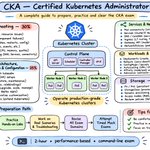
🚀 CKA — Certified Kubernetes Administrator
Preparing for CKA? Here's your visual roadmap [Updated 2025]!
5 major exam domains:
- Troubleshooting — 30%
- Cluster Architecture — 25%
- Services & Networking — 20%
- Workloads & Scheduling — 15%
- Storage — 10%
My recommended approach:
1. Understand the concepts.
2. Practice hands-on labs.
3. Master kubectl.
4. Troubleshoot real-world scenarios.
5. Attempt timed mock exams.
Don't just watch Kubernetes. Operate Kubernetes. ☸️
#Kubernetes #CKA #DevOps #CloudNative

🚀 What is CUDA, and why is it so important in AI?
CUDA (Compute Unified Device Architecture) is NVIDIA's parallel computing platform that allows developers to harness the power of GPUs for general-purpose computing.
But why does it matter?
💡 Think of it this way:
- CPU → A few powerful cores, great at sequential tasks.
- GPU → Thousands of smaller cores, designed for parallel workloads.
- CUDA → The programming platform that lets developers leverage those GPU cores.
How CUDA works:
1. Write code using CUDA APIs (C/C++ and supported language integrations).
2. Break computational problems into smaller parallel tasks.
3. Execute those tasks across NVIDIA GPU cores.
🔥 Where is CUDA used?
- AI/ML model training and inference
- LLMs and Generative AI
- Scientific computing
- Data processing
- Computer vision
- High-performance computing (HPC)
Why should AI engineers care?
Frameworks like PyTorch and TensorFlow leverage GPU computing, while libraries such as cuDNN and TensorRT help optimize workloads.
The bottom line:
CUDA is one of the key technologies powering modern AI infrastructure.
If you're learning AI engineering, understanding CUDA is a huge advantage.
#CUDA #NVIDIA #GPU #AI #MachineLearning #DeepLearning #MLOps #AIEngineering

🚨 The 2026 Data Engineering roadmap is simpler than you think.
Stop chasing every new tool and framework.
Focus on mastering these 5 pillars:
🗄️ SQL — Advanced queries, window functions & data modeling.
🐍 Python — Software engineering, PySpark, Polars & testing.
🔄 dbt — Data transformation, incremental models & data quality.
⚡ Spark — Distributed computing, AQE & performance optimization.
🏗️ Terraform — Cloud infrastructure, Airflow, Docker & orchestration.
Don't just learn the tools. Learn how to build, deploy and maintain reliable data pipelines.
My advice: Build ONE end-to-end project using these technologies instead of collecting 20 certificates.
Fundamentals get you started. Engineering depth sets you apart.
🔖 Bookmark this roadmap if you're preparing for a Data Engineering role in 2026.
What's one technology you'd add to this stack?
#DataEngineering #SQL #Python #ApacheSpark #dbt

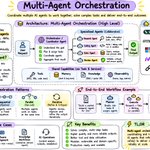
🤖 Multi-Agent Orchestration: What happens when AI agents work together?
A single AI agent can do a lot. But complex problems often require multiple specialized agents collaborating.
That's where Multi-Agent Orchestration comes in.
Instead of one agent handling everything, an orchestrator coordinates specialized agents:
🔍 Research Agent – Collects information from APIs, websites and documents.
🧠 Planning Agent – Breaks complex goals into smaller tasks.
💻 Coding Agent – Writes, executes and debugs code.
📊 Data Agent – Queries databases and analyzes information.
🛡️ Review Agent – Validates outputs and catches mistakes.
⚙️ Orchestrator – Coordinates execution, delegates tasks and combines results.
Popular frameworks:
• LangGraph
• CrewAI
• Microsoft AutoGen
• Mastra AI
• LangChain
Common orchestration patterns:
• Supervisor – One agent manages other agents.
• Sequential – Agents execute tasks in order.
• Parallel – Multiple agents work simultaneously.
• Iterative – Agents review and refine outputs.
🔥 The real power isn't having more AI agents. It's making them collaborate reliably, share context, use tools and produce verified results.
The future of AI engineering is not just building smarter agents. It's building systems where agents work together.
#AIEngineering #MultiAgentSystems #LangGraph #CrewAI #MastraAI #LLM #DevTools

🚀 Multi-Node LLM Inference at Scale
How do you serve massive LLMs across multiple GPUs and machines without sacrificing latency or throughput?
The answer: Multi-Node LLM Inference.
Instead of running an entire model on a single machine, distribute model computation across multiple GPU nodes.
🔥 Key concepts:
• Tensor Parallelism (TP): Split model computations across GPUs.
• Pipeline Parallelism (PP): Split model layers across different nodes.
• Data Parallelism (DP): Run multiple model replicas to handle more requests.
• KV Cache: Reuse attention states to accelerate token generation.
• Continuous Batching: Dynamically batch incoming requests for better GPU utilization.
🛠️ Popular technologies:
Kubernetes – Orchestration
vLLM – High-performance inference
NVIDIA TensorRT-LLM – Optimized inference
SGLang – Efficient LLM serving
Redis – Caching
Prometheus + Grafana – Observability
KEDA / HPA – Autoscaling
💡 The real challenge isn't just deploying an LLM. It's distributing computation, managing GPU memory, maximizing throughput and maintaining low latency at scale.
This is where AI Engineering meets Platform Engineering.
#LLM #AIEngineering #Kubernetes #GPU #MLOps #PlatformEngineering #DevOps

🧵 KubeArmor: Runtime Security for Kubernetes 🔐
What if you could control what processes run inside your Kubernetes containers, which files they access, and what network operations they perform?
That's exactly where KubeArmor comes in.
KubeArmor is a cloud-native runtime security enforcement system that uses Linux Security Modules (LSMs) and eBPF to protect containers, Pods and nodes.
Let's understand how it works. 👇

10/ What should you learn hands-on?
My suggested learning roadmap:
1. Understand eBPF fundamentals.
2. Learn Linux Security Modules.
3. Deploy KubeArmor using Helm.
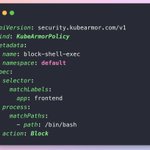
4. Understand KubeArmorPolicy.
5. Experiment with KubeArmorHostPolicy.
6. Test Allow, Audit and Block actions.
7. Generate runtime security alerts.
8. Integrate monitoring with Prometheus and Grafana.
Don't just learn Kubernetes deployment.
Understand what happens inside the Linux kernel when a container executes a process or accesses a file.
11/ Final takeaway 🚀
Kubernetes security doesn't end with RBAC, NetworkPolicies or Pod Security Standards.
You also need to secure what happens INSIDE your running containers.
That's where runtime security tools like KubeArmor become valuable.
Secure the cluster. Secure the workloads. Secure runtime behavior.
Bookmark this thread if you're learning Kubernetes security!
#Kubernetes #KubeArmor #eBPF #DevSecOps #CloudNative #SRE #PlatformEngineering