

Brief glimpses into fights, and fighters, of the 20th century; the great, the near great, the very good, the journeymen, the opponents and much more.
Joined April 2025
- Tweets12K
- Following321
- Followers719
- Likes11.5K


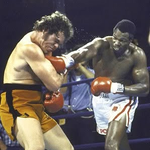



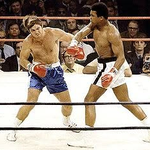
In the 13th defense of his WBC Heavyweight Championship, Larry Holmes takes target practice on Randall "Tex" Cobb for 15 rounds at the Houston Astrodome on October 26, 1982.
The scorecards; 149-136, 150-135, 150-135, didn't nearly reflect the level of mismatch this fight was.
Before the start of the 13th round, Howard Cosell, who called the fight for ABC-TV, said, "This is as brutal a mismatch as I think I've ever seen."
Cosell was so disgusted by the fight that he quit covering boxing. "The Cobb fight did it for me," he later said. "I don't want to be a party to the sleaziness."
When told that his fight with Holmes drove Cosell out of boxing Cobb, the quintessential cut-up boxing character, said:
"If I eliminate heart disease, if I walk on water, if I come up with a cure for crippled kids, I can't image a greater gift to mankind. That is my greatest accomplishment."
This was Holmes first fight after the Cooney fight.

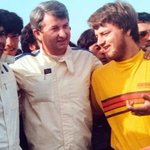
Former WBA Light Heavyweight Champion Victor Galindez with Antonio Lizeviche, center, on October 26, 1980, before the start of the race that both men would die in.
After retiring from boxing, Galindez decided to pursue a career as a race car driver.
His first race was Argentina's Turismo Carretera on October 26, 1980.
Galindez's car broke down near the end of the first lap.
As he and his co-driver, Nito Lizeviche, were walking back to the pits, a car driven by Marcial Feijoo went out of control, spun off the track and slammed into them.
Galindez and Lizeviche were killed instantly. Feijoo, whose car was demolished, was seriously hurt and taken to a hospital. His co-driver, Juan Buesolo, was treated for shock.
Victor Galindez was just 31 when he died.

WBC Super Bantamweight Champion Wilfredo Gomez celebrates his 5th round TKO of Nicky Perez, on October 26, 1979, at Madison Square Garden.
By the time he was done with the Junior Featherweights, Gómez had established a division record of 17 title defenses (in two reigns atop the division), and a world record of the most defenses in a row won by knockout, all of his defenses finishing before the established distance limit.
Gomez will make two more defenses before moving up to Featherweight to challenge WBC Champion Salvador Sanchez in August of 1981.


In a matchup of two young and undefeated welterweights on October 26, 1978, Thomas Hearns (12-0 in white trunks) KO's Pedro Rojas (13-0 coming in) in the 1st round at Olympia Stadium in Detroit.
Rojas, out of Venezuela, whose amateur Record was 95-9 with 75 KO's, along with winning 2 Gold Medals at the Afro-Latino Games and a Bronze at the Centro-American Games, would retire after this bout.

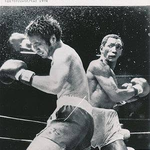
WBA Junior Welterweight Champion Antonio Cervantes, "Kid Pambele", KO's challenger Shinichi Kadota in the 8th round, on October 26, 1974, at the Nihon University Auditorium in Tokyo, Japan, knocking the gutsy challenger down 8 times in the fight.
Kadota, 38-10-1 as a pro with 25 KO's, had wins over Chango Carmona, and had split a pair of fights with Guts Ishimatsu coming into this bout.
This was the 9th title defense of Cervantes' first reign as champ at 140 lbs. He'd lose the title to Wilfred Benitez in March of 1976.
----------------------------------------------------------
On January 31, 1964, Antonio Cervantes Reyes entered the boxing ring as a professional for the first time, beating Juan Martinez by decision in 6-rounds. His first 32 bouts as a professional were in Colombia, and he won 27, lost 4 and drew in one of them.
Realizing his pupil needed publicity outside Colombia, trainer Carmelo Prada then moved with Cervantes to Venezuela, where, on November 25th of 1968, he knocked out Orlando Ruiz in the first round for his first fight abroad. He followed that win with a ten rounds decision over Nestor Rojas only three days later.
On December 23rd of that year, he suffered his first knockout defeat when Cruz Marcano, a fringe contender of the time, beat him in 4-rounds in Caracas.
He won five and lost two in 1969, splitting his fights between Colombia and Venezuela, and losing a ten-round decision to Antonio Gomez, a former world champion.
He won two more in 1970, then he and Prada moved, this time to Los Angeles. In California, he began by beating Jose Rodriguez by a KO in the first round in San Jose, and on December 17, he beat Rodolfo "Gato" Gonzalez by KO in 8-rounds. After this and a 1971 win over Argentine Enrique Jana, Cervantes was ranked as a light welterweight by the WBA. On December 11th of that year, he had his first world title shot, against the great Nicolino Locche, in Buenos Aires. Cervantes would lose a 15-round decision.
After winning three fights in 1972, Cervantes, who had by then returned to Colombia, had another world title try: Alfonso Frazer, who had dethroned Locche of the world title, gave Cervantes a chance on October 28th in Panama City. Cervantes knocked Frazer out in ten rounds and became the world light welterweight champion for the first time.
Cervantes immediately became a national hero in Colombia, and many enterprises made him their spokesman in the coffee producing country, most notably Sanyo, whose name the popular champion advertised on his clothing and fight trunks.
Cervantes made nine title defenses in his first reign, including a 10th round TKO of Locche in their rematch after his corner stopped the fight due to a cut over his left eye, a KO in five of Frazer, also in a rematch, a 15-round split decision win over Josue Marquez in Puerto Rico (in the first world title bout ever held at Roberto Clemente Coliseum) and a 15-round decision over future Lightweight champion Esteban De Jesus. But on March 6th of 1976, in San Juan, he lost a 15-round decision and his world title to 17-year-old Puerto Rican Wilfred Benitez, who with that became boxing's youngest champion ever.
Cervantes won five more fights in a row, including a win over Saoul Mamby, before fighting for the world title again. After Benitez had left the light welterweight belt vacant, Cervantes regained it on June 25th of 1977, with a 5-round KO of Carlos Maria Gimenez, again in Venezuela.
His second reign as world champion took him to such places as Thailand, Botswana and South Korea, among others. He retained the title six times, beating the likes of Adrian Marrero and Miguel Montilla (twice).
By this time, there was much talk about a superfight with World Lightweight Champion Roberto Duran, who was coming up in weight. Duran decided to challenge Sugar Ray Leonard instead, however, and Cervantes-Duran never materialized.
Cervantes would drop Pryor in the 1st round of their title fight but the incredibly resilient "Hawk" would rebound to take the title via 4th round KO.
Cervantes, who'd hung up the gloves after this loss, would come out of retirement due to financial problems and went on boxing until 1983, winning four fights and dropping his last one, a ten-round decision loss to Danny Sanchez on December 9th of 1983, in Miami.
His final record would stand at 67-12-1 (37 KO's).


WBA Light Heavyweight Champion Vicente Rondon (dark trunks) TKO's Gomeo Brennan (84-19-7 coming in) in the 13th round, on October 26, 1971, at the Convention Center in Miami Beach.
The bout, Rondon's second title defense, was stopped in between the 13th and 14th rounds due to excessive swelling from Brennan.
Gomeo Brennan started his boxing career in January of 1956 and didn't step away from the ring until April of 1972.
Fighting out of the Fifth Street Gym in Miami Beach, he was trained by Angelo Dundee and managed by Chris Dundee.
During his long career, he fought 110 fights, losing only 21. In his first year as a fighter, he fought 18 times.
Born in the Bahamas in 1939, he fought as a welterweight all the way up through the light-heavyweight division, at one time winning the middleweight championship of the British Empire.
Some of the fighters he defeated included Wallace "Bud" Smith, Art Hernandez, Charlie Cotton, Eddie Owens, Jerry Evans, Mickey Crawford and Carl Hubbard.
1971 was an outstanding year for Vicente Rondon with a number of title defenses. He became the first and only fighter to stop Gomeo Brennan and many began to feel that Rondon could and would defeat Bob Foster if or when they met.
In 1972, however, Rondon would lose to Foster in two rounds.
Later that year he lost, at heavyweight, to Earnie Shavers, Ron Lyle and Jose Manuel Urtain.
Rondon did better in 1973 as he started to trim down in weight. He looked highly skilled and impressive by scoring a 10 round decision over undefeated prospect Oliver Wright in Miami Beach. Shortly after that he stopped heavyweight Mike "Jim" Boswell in 4 rounds.
An attempt to regain the light heavyweight title, saw him drop a decision to top ranked Len Hutchins, and then he suffered a 9th round technical knockout loss to John Conteh.
In 1974, Rondon weighing 188 pounds went back to the heavyweight division, where he would be largely unsuccesful. He was unable to get off the stool for round three in his fight with Rodney Bobick at Miami Beach, Florida. In his next fight he was knocked out in 2 rounds by former world heavyweight title contender Joe "King" Roman.
Sadly, after his career ended, Rondon suffered severe depression, leading to his being confined to a Venezuelan mental hospital after his ring career had ended.
Further depressed over the death of his mother, Vicente Paul Rondon, died forgotten and broke in poverty in Santa Ana de Carapita, a slum of Caracas. He was only 54.


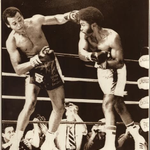
On the undercard to Ali-Quarry I, on October 26, 1970 in Atlanta, Eddie "Bossman" Jones (left) TKO's Willis Earls in the 7th round.
One thing we do here at 20th Century Boxing: Icons, Memories & More is to remember not just the greats but the almost greats, the could have been greats and the not so greats.
Where Eddie Jones or Willis Earls fall in those categories, I'm not so sure, but they both certainly deserve to be remembered by any true boxing fan.
Eddie "Bossman" Jones was considered a slick boxer-puncher. He finished his career at 29-16-3 (12 KO wins) and was skilled enough to have decision wins over Henry Hank, Tom Bethea, Jimmy Dupree and Andy Kendall.
Jones had one title shot in his career, losing a 15-round UD to WBA Light Heavyweight Champion Vicente Rondon in Venezuela, in August of 1971.
"We don't think very highly of the Venezuelan. Bob Foster would knock out Rondon." was the opinion of Jones trainer, Eddie Futch, following that bout.
Eddie Jones would later work as a sparring partner for Heavyweight Champion George Foreman as he prepared for "The Rumble in the Jungle" against Muhammad Ali in 1974.
Willis Earls was a hard-punching club-fighter, a journeyman who, after a rather unsuccessful first 9-years of his ring career, finally found himself and streaked to an impressive winning streak and a top 10 world ranking.
Earls, out of Austin, Texas, turned pro in 1960 and until July 29th of 1969, had compiled a rather dismal record of 4-10-1.
However, a closer look at his opponents, showed that the inexperienced Earls was grossly overmatched early in his career. He was defeated by the likes of heavyweights Sonny Liston, Jerry Quarry, and Dave Zyglewicz.
One thing Willis Earls was noted for was his punching power. He reportedly had Liston on the canvas in the 1st round before being knocked out in two rounds all though I couldn't find a news account of the bout to confirm that.
On December 1st of 1969, Earls moved down to light heavyweight (he had been weighing in in the low 180's for his heavyweight bouts) and launched a comeback.
In eight short months, Earls went undefeated in 9 straight fights, which included upset knockouts over Joe Burns and Paul Patin. Earls even held world-rated 175 pounder Eddie Jones to a draw in June of 1970. Earls earned a #10 world ranking and fought the #1-rated Jimmy Dupree for the right to challenge world champion Bob Foster.
Earls' bubble was burst and he was knocked out in the 1st round.
His career took a nose dive after the loss, and he ended his career with consecutive knockout losses to Eddie Jones, Terry Daniels, Elmo "Tex" Henderson, and Brian Kelly finishing his career at 12-14-2 with 8 KO wins.

In his first fight in 43 months, former Heavyweight Champion Muhammad Ali stops #1 ranked (by The Ring magazine, ranked #3 by the WBA) Jerry Quarry after three rounds, on October 26, 1970, at the Municipal Auditorium in Atlanta.
Ali's fight against Quarry was his first since he knocked out Zora Folley in seven rounds on March 22, 1967.
His layoff was due to his refusal to be drafted into the United States Army and subsequent legal battles. "It is the light of my consciousness as a Muslim minister and my own personal convictions that I take my stand in rejecting the call to be inducted in the armed services," Ali stated after refusing induction on April 28, 1967. "I have searched my conscience and I find I cannot be true to my belief in my religion by accepting such a call."
He was convicted of draft evasion on June 20, 1967.
Ali was sentenced to five years in prison and fined $10,000, the maximum penalty for the offense. He remained free on a $5,000 bond while he appealed his conviction.
Ali was also stripped of the World Heavyweight Championship by the New York State Athletic Commission and the World Boxing Association, systematically denied a boxing license in every state and stripped of his passport.
With help from Georgia State Senator Leroy Johnson, Ali was able to get a boxing license in Georgia.
On September 2nd of 1970, he boxed an eight-round exhibition at Morehouse College in Atlanta. that was the first time Ali had boxed in public since a six-round exhibition in Detroit, Michigan, on June 13, 1967.
A fight between Ali and Quarry was arranged for October 26th at the Auditorium in Atlanta. Contracts were signed in New York City on September 10th. The bout was promoted by House of Sports, Inc., headed by Senator Johnson, and by Sports Action Inc., headed by Harold Conrad.
"People think now that the Supreme Court decision is what allowed Ali to fight, but that didn't come until later," Conrad told author Thomas Hauser for his book "Muhammad Ali: His Life and Times." "All it took was politics and money and three years of trying until we worked things out in Georgia."
As for the fight, Mark Kram of Sports illustrated wrote:
With a cracking right hand, the speed of which seemed hardly impaired since he last fought, Ali cut Quarry over the left eye in the middle of the third round, a wound which would require 11 deep sutures and would not allow the Californian to come out for the fourth round. "It was not a butt," Quarry said before being stitched up, "and I don't want anybody saying that it was. It was a right hand." Referee Tony Perez did not stop the fight. It was Quarry's chief cornerman Teddy Bentham who did so, and with reason. Quarry, puzzled by Ali's unorthodox style and unwilling to commit himself, was unable to launch an effective attack. About all he could do was counter with winging left hooks, most of which missed or were brushed off, although he did land one solid punch—a right hand to the body in the second round. "If he didn't get cut," said Ali, "I think it might have gone 10 rounds." Indeed, Quarry seemed to be gaining confidence until the blood began streaming down his face. . . . In one sense the fight was indecisive, simply because of our uncertainty that Ali could go any distance. The quick appraisal that can be made—and that only because we have not seen him for so long—is that he does not seem to be pulling his head back as quickly as he used to. A much maligned move in his early days, this is one of the most vital aspects of his defense. Quarry did reach him on occasion, but was never in proper balance to be effective. Excepting this flaw, all else about Ali seemed to be intact—the rocking jab, the beautiful combinations and his general ring intelligence.


Muhammad Ali weighs in at 213.5 lbs for his first fight in 43 months, on October 26, 1970, against Jerry Quarry at the Municipal Auditorium in Atlanta, Georgia.


Amercian George Foreman wins Gold in Mexico City, on October 26, 1968, as the referee stops his Heavyweight Final bout with Lithuanian Jonas Cepulis, representing the Soviet Union, in the 2nd round.
Cepulis had TKO'd his first three opponents.
An American heavyweight (Tyrell Biggs was a Super Heavyweight) would not win another Gold Medal until Henry Tillman in 1984, followed by Ray Mercer in 1988, two decades after Joe Frazier and Foreman won back-to-back Gold for the USA at heavyweight.
Correct me if I'm wrong please, but an American heavyweight has not won Gold since Mercer.

American George Foreman faces Lithuanian Jonas Cepulis (representing the USSR), on October 26, 1968, in Mexico City in the Heavyweight Final at the Olympic Games.
Cepulis, who won his first three bouts by stoppages, never won a Soviet title, placing second-third in 1965–66 and 1968 and therefore was not selected for the world and European championships. He won Lithuanian titles in 1963–1964, 1966–1967 and 1969–1970 and retired in 1970 with an amateur record of 203 wins out of 230 bouts.
The referee would stop this contest, in favor of Foreman, in the second round.

Muhammad Ali visited Louisville's Children's Hospital Oct. 26, 1966.
The Heavyweight Champion was in Louisville for an exhibition bout with Doug Jones at Freedom Hall to raise money for the hospital.
The day before the match-up, Ali visited children at Children’s Free Hospital (now known as Norton Children’s Hospital).
As The Louisville Times wrote, he signed casts, practiced kids’ spelling assignments and gave hugs. A planned 20-minute visit turned into an hour.

Cassius Clay signs his first professional boxing contract on October 26, 1960.
(There is some dispute to this date: a few sites claim that Ali signed this contract on the 25th. I'm OK with using either but I will go with the 26th because that is what Hauser used in his well-researched book on Ali)
A group of eleven Louisville businessmen, all white and calling themselves The Louisville Sponsoring Group, were chosen by Ali and his parents to manage the young boxer’s pro career.
In his fantastic and meticulousy well written book, Thomas Hauser called the contract they gave the young fighter “fair and generous for its time.”
Ali got a $10,000 signing bonus and the group also obligated themselves to pay Ali, for the first two years, a guaranteed draw of $333 a month against earnings.
The sponsoring group had options to extend the contract for up to four additional twelve-month periods.
Earnings would be split fifty-fifty for the first four years and sixty-forty in Ali's favor thereafter.
All management, training, travel, and promotional expenses, including a trainer's salary, would come out of the sponsoring group's end. And fifteen percent of Ali's income would be set aside in a pension fund, which he could not touch until he was twenty-five or retired from boxing.
The 1960 Olympic Gold Medalist would make his pro debut, at Freedom Hall in Louisville, on the 29th against Tunney Hunsaker.
The Louisville Sponsoring Group managed Ali's boxing career from 1960 to 1966.
Sports, Boxing, America, and the world, would never be the same.

Canadian Heavyweight Champion Bob Cleroux gets his hand raised by his opponent, Buddy Turman, after his 2nd round KO win, on October 26, 1960, at the Montreal Forum.
Cleroux had beaten George Chuvalo for the Canadian title in August and he'd lose it back to Chuvalo in his next fight.
The end came suddenly, in the second round, when Cleroux landed a big right hand on (35-5-1 coming in) Turman.
Cleroux made up for the only blemish on his record to this point as Turman (out of Texas) had won an 8-round decision over him in May of 1959.
Bob Cleroux, 47-6-1 with 37 KO's for his career, was the Montreal (1956) Golden Gloves Heavyweight Champion.
He was never stopped in his pro career.
He made a comeback in 1968, having retired after a close decision loss to Zora Folley in 1963, and won 9 straight, including an upset UD over Cleveland Williams. However, Cleroux blew a potential title bout with WBA Heavyweight Champion Jimmy Ellis when he lost an upset 10-round decision to 1962 National AAU Light Heavyweight Champion Billy Joiner.

Subbing for an ill Tony Dupas, Randy Sandy (22-15-2 coming in) scores a 10-round split decision win over undefeated (13-0) welterweight Emile Griffith, on October 26, 1959, at The Academy of Music in New York City.
According to The New York Times "Griffith scored in the middle rounds but Sandy was strong in the 8th and 9th round."
The AP would report:
"Veteran Randy Sandy, 156, dealt young Emile Griffith, 150 1/2, his first professional defeat last night - a 10 round split decision at the Academy of Music. Griffith, like Sandy a New Yorker, had won all 13 of his bouts in a 17 month pro career. He started fast against Sandy, but wilted in the last five rounds. Sandy's weight was a big factor."
(Sandy came in at 156, Griffith at 151)
Randy Sandy, despite his unimpressive 25-24-2 (9 KO's) record as a pro, was the 1947 New York Daily News Golden Gloves Champion at Welterweight, and had wins over both Dick Tiger (a disputed decision) and Emile Griffith during his career. In 1959 he handed the then unbeaten (13-0) Griffith his first career loss.
Like many of his era, Sandy just didn't know when to quit, going 6-20-1 in his final 27 fights, after a decent start to his career. His name dots the resumes of many contenders and titlists of the era such as Henry Hank, Jose Torres, Florentino Fernandez, Laszlo Papp, Rudell Stitch, Spider Webb, Rory Calhoun and Joey Giardello.

Yama Bahama TKOs Tony 'Tex' Gonzales in the 3rd-round on October 26, 1956 at Madison Square Garden.
From the IBRO (International Boxing Research Organization) on William Horatio Butler Jr., 77-14-3 with 20 KO wins, aka "Yama Bahama":
Yama Bahama was born William Horatio Butler, Jr. on February 16, 1933 in Bimini in the Bahamas. He was the youngest in a large family consisting of three sisters and four brothers. His father was a first mate on a cargo ship that operated between Bimini and Miami Beach.
At the age of six he began to participate in Battle Royals. Battle Royals consist of six or more boys fighting blindfolded, and the last one standing is declared the winner. At the age of 12 he started to tag along after his brothers Herman and Louis when they went to the local gym to train. Although both were top-notch amateurs neither turned professional. The Butler boys were fight fans and hooked up a short wave set so they could listen to the boxing broadcasts from the United States. Yama always wanted to be a boxer. When he was old enough, he joined the boys club where he began his formal fistic education.
When Yama turned 20 he moved to Florida and started training at the Miami Beach Gym. When he was ready to turn pro his manager George Lyon decided he needed a unique ring name. Lee Evans a reporter on the Miami Herald was also trying to think up a catchy ring name when he happened to glance at Lyon's boat which was named "Bahama Mama". The idea came to him to put the last name first and to change the first letter of the new first name M to Y. And that's how William H. Butler, Jr. became "Yama Bahama."
Yama made his pro debut on November 17, 1953 in Miami Beach with a first round technical knockout over Harry Irwin. He went undefeated in his first fourteen bouts, with only two draws blemishing his perfect record, before losing a six round decision to Jimmy Ford. Yama then shifted his base of operations to Detroit, Michigan where he became a big fan favorite because of his aggressive style and pleasing personality. After winning three fights in a row, he was dropped for the first time in his career and suffered a first round kayo loss to Bob Hoffman. This was the only clean knockout defeat he was to suffer in 89 professional fights.
Showing no ill effects from the knockout loss, Yama won 19 of his next 21 fights over good competition. During that stretch he defeated Battling Douglas (for the welterweight championship of the Bahamas), Mickey Savage, Jimmy Ford (avenging two earlier losses), Hector Peralta, Gene Parker, and Howard Calloway. His stirring knockout victory over Gene Parker convinced his manager that he was ready to step up in competition.
Up until then Yama's biggest victory was winning the welterweight championship of the Bahamas by stopping Battling Douglas in seven rounds. The win over Douglas was the first time Yama had fought before his hometown in two years. Yama didn't disappoint as he dropped the defending champion six times in registering the technical knockout.
Yama made his national TV debut on December 26, 1955 as a last minute substitute for Chico Vejar by pitching a shutout over crafty veteran Paolo Melis. He proved himself to be a shifty well-conditioned fighter, with fast hands and the ability to land an assortment of combinations.
After defeating Melis, Yama rattled off five more impressive wins to run his winning streak to 23 with victories over Leffie Walker, Carlo Sarlo (avenging an earlier defeat), Jimmy Ford (this time by technical knockout), Hardy Smallman and Philadelphia's flashy Gil Turner. The veteran Pat Lowry ended Yama's winning streak with a bizarre upset decision in Saginaw, Michigan. When the fight ended Yama was announced as the victor which did not sit well with the crowd. A half hour after the decision was announced, the commission representative on the scene said that one of the judges scorecard revealed an error and the decision was reversed in Lowry's favor.
Yama finished the year out by destroying tough Tex Gonzalez in three rounds at Madison Square Garden and outpointing veteran Jimmy Martinez in Cleveland.
Stepping up in class, Yama had mixed results in 1957 winning three of six fights, losing decisions to highly ranked Isaac Logart, former victim Gil Turner and Arthur King. The loss to Turner was by split decision. Turner was taken to the hospital after the fight due to severe swelling from a broken blood vessel from temple to temple. One of his three victories, however, was over the very capable veteran campaigner Del Flanagan.
In 1958 Yama fought seven times, winning six. His biggest victories were over former welterweight champion Kid Gavilan and perennial contender Joe Miceli. His victory over Gavilan elevated him to his first international ranking as the number nine middleweight in the world.
During the next two years he went to the post thirteen times, winning eleven. His only defeats were by decision to Victor Zalazar (hotly disputed) and former welterweight champion Luis Rodriquez. He avenged his defeat to Zalazar by handling him quite handily in their rematch. He also won a unanimous decision over Phil Moyer in Phil's hometown of Portland, Oregon.
1961 was a big year for Yama. He started off the year with a disputed majority draw to Detroit's Ted Wright at Madison Square Garden. Yama set a steady pace and seemed to have the fight well in hand. The referee had Yama ahead, but the two judges had the fight a draw.
Yama then reeled off five consecutive victories, the biggest being a unanimous decision over highly ranked middleweight contender Joey Giambra. The victory over Giambra and his later victory over Jose Gonzalez elevated him to the seventh spot among the top ten middleweights in the world rankings.
In July he met welterweight champion Emile Griffith in a non-title fight and lost a clear-cut decision. After the fight, many thought that Yama was now past his prime. But once again he fooled the critics. He ran off four consecutive victories and shocked the fight world with his complete domination of highly touted Argentine middleweight champion Farid Salim at Madison Square Garden in New York to finish the year.
After his victory over Salim, Yama started 1962 off impressively. He met Don Carrano on January 9th in Bimini and dropped him fourteen times en route to a seventh round technical knockout. Four months later he met Luis Rodriquez in a return bout. Yama received a deep cut on his forehead from an accidental butt. The blood dripped into his right eye. In the third round, Luis landed a searing right alongside Yama's left eye, which opened another deep cut. The ringside physician stopped the fight and Yama was declared loser by technical knockout.
Yama only fought three times after the Rodriquez fight, winning all three. He had his last professional fight on March 6, 1963, appropriately in Bimini. His opponent was Harry Monroe and Yama ended his career as he had started - by technical knockout.
Yama Bahama was a durable, willing mixer who was able to shift his style to offset his opponents. His aggressive style and personality made him a big fan favorite with fans both at home and in the arenas of Miami, Detroit and New York. Yama was also a big fan favorite nationally because of his numerous television appearances and the class he exhibited in every fight.
Bahama was inducted into the Florida Boxing Hall of Fame in 2010.

We have written here, and discussed, many times that no man, not even the greatest of champions is immune to the inevitable consequences of time and timing.
And so it was for Joe Louis as well, considered by many to be the greatest Heavyweight Champion of all time, as he faced undefeated (37-0) prospect Rocky Marciano on October 26, 1951 at Madison Square Garden.
Louis, paid $132,000 to Marciano's $44,000, and was actually a 6 to 5 betting favorite coming in.
The Rock's biggest win coming in had probably been his 6th round KO of Rex Layne, who was a 9 to 5 favorite, in July of 1951.
Louis was knocked down by a left hook in the eighth round. He got to one knee at the count of three and took an eight-count before getting up. Marciano moved in for the kill and ended the fight with a right that sent Louis through the ropes and onto the ring apron.
---------------------------------------------------------
From Bernard Fernandez, for The Ring magazine, in 2021:
In boxing, it is often said that to be The Man you have to beat The Man, but that is not always the case. In some instances, it is demonstrably false. For purposes of tracking the true lineage of the heavyweight championship of the world, early 20th century ruler Jack Johnson stands as an example of someone who unquestionably was The Man; his loss to Jess Willard under a hot Cuban sun, still the source of much speculation, did not fully legitimize Willard, at least not on the level of the fighter he had just supplanted. But the snarling beast who dethroned Willard, Jack Dempsey, soon revealed himself to be The Man as much as had that other Jack.
And so has it always been. There are other universally recognized heavyweight champions who have taken their places in the pantheon where only the best of the best reside, but there are yawning gaps in the chain, especially in the era of multiple alphabetized title-holders. Leon Spinks might have usurped Muhammad Ali to briefly end one of “The Greatest’s” reigns, but that massive upset did not – could not – put Neon Leon alongside Ali for the purpose of historical posterity.
Technically speaking, Rocky Marciano’s eighth-round knockout of an aging Joe Louis on Oct. 26, 1951, did not signify a passing of the championship baton.
The 37-year-old Louis, the legendary “Brown Bomber” who occupied the throne for a record 12 years and 25 successful defenses, had retired in 1949, the crown he vacated having been won by Ezzard Charles and then lifted from Charles by Jersey Joe Walcott. Marciano, 28, wasn’t nearly as polished as the Louis who still wore a certain aura of greatness despite not being in his glorious prime, but the “Brockton Blockbuster” was a devastating puncher and increasingly viewed as someone whose power could make up for any technical deficiencies.
Seventy years have passed since Louis and Marciano squared off in Madison Square Garden, and the fact that a bejeweled belt was not on the line scarcely seems to matter now. Such changing-of-the-guard bouts stand as stark testimony that an era has expired and must give way to another, the same in the ring as it is in nature, where an old and proud lion eventually must yield as head of the pride to a younger, stronger version. Ironically, the same scenario had played out during the recently ended baseball season, also in New York City, with a Louis equivalent, Joe DiMaggio, playing out the string in center field for the Yankees while his designated replacement and Marciano stand-in, rookie Mickey Mantle, was temporarily stationed in right field.
Some have suggested that Marciano-Louis was a precursor of sorts to Ali’s doomed-to-failure challenge of WBC champ Larry Holmes, his onetime sparring partner, on Oct. 2, 1980, but the analogy is flawed. The comparison makes sense in certain ways, but the reality at that time was that Ali was a 38-year-old shell of his former brilliance and Holmes, 30, already was the best heavyweight in the world and making the eighth defense of the title he had won on a rousing split decision over Ken Norton 2½ years earlier. Only the most deluded Ali partisans could have believed their faded idol had any chance of upsetting Holmes, who grudgingly administered the beatdown that everyone should have realized was inevitable.
Even in Louis’ pugilistic dotage, however, there were more than a few of his backers who helped send him off as a 7-5 wagering choice over Marciano, and not solely for sentimental reasons. At 6-foot-2 and a career-high 213¾ pounds, Louis was 3½ inches taller and 29¾ pounds heavier than his squatty opponent, a physical prototype of future champs Joe Frazier and Mike Tyson. Perhaps even more significantly, Louis had a stupendous advantage in reach,76 inches to 67. And if all that weren’t enough, several important media observers were continuing to deride Rocky as a clumsy oaf with two left feet who had outlasted lesser foes, but was apt to receive a boxing lesson from the still-capable master.
Ed Fitzgerald, one of the leading sports writers of the era, was among those who didn’t believe 10 scheduled rounds constituted enough time for Marciano to track down and take out so experienced and tactically proficient a fighter as Louis. Still, Fitzgerald expressed admiration not only for Marciano’s vaunted overhand right, which Rocky had dubbed the “Suzie Q,” but for his willingness to absorb copious amounts of punishment in exchange for any chance he had to dish out some of his own.
“Rocky is not in there to outpoint anybody with an exhibition of boxing skill,” Fitzgerald wrote. “He is a primitive fighter who stalks his prey until he can belt him out with the frightening right-hand crusher. He is one of the easiest fighters in the ring to hit. You can, as with an enraged grizzly bear, slow him down and make him shake his head if you hit him hard enough to wound him, but you can’t make him back up. Slowly, relentlessly, he moves in on you. Sooner or later, he clubs you down.”
The career intersection of two remarkable and Hall of Fame-worthy careers, one already firmly established and the other in the process of being so, attracted a full house of 17,241 that generated a gross of $152,845, major bucks for that time.
And why shouldn’t a fight such as this have sold out the arena?
Marciano came in at 37-0, with 32 knockouts, while Louis, fighting for the eighth time in 1951 on the comeback trail (all seven previous bouts were victories), was 66-2 (52). Either the young lion would roar in exultation, or the old king of the jungle would again demonstrate that he was not quite ready to step aside.
It was soon evident, however, that this was not the same Brown Bomber who had likely established himself as the greatest of all heavyweights up to that point. His hair was thinning and, 13 to 15 pounds over his optimal fighting weight, he was a bit thicker around the middle. Even so, he won a couple of early rounds on guile and muscle memory, but, as Fitzgerald had noted, Marciano slowly, relentlessly moved in on him in expectation of clubbing down a fighter whom he had come up worshiping.
The end came, as it surely had to, in the eighth round when Marciano registered two knockdowns. The first merely had the effect of hurting Louis, but the second finished him not only for that night, but for keeps. It was, natch, the “Suzie Q” that provided the exclamation point, which sent Louis crashing through the ring ropes where he lay on his back on the ring apron, semi-conscious and unable to rise.
Referee Ruby Goldstein, who had toured World War II Army bases with Louis, had no hesitancy in saying that Joe was his friend, an admission that in another time might have prevented him from getting that assignment as third man in the ring. Goldstein’s reputation as a conspicuously diligent arbiter presumably put him above any suggestions of partisanship, but it nonetheless pained him to see Louis – who never fought again – go out that way.
“For many people it was a sad affair,” Goldstein allowed. “A great sports figure like Lou Gehrig or Babe Ruth is finished. People idolized Louis. They didn’t want to see him when he was not himself. It wasn’t easy for me. We were friends. But when you’re a referee, you’ve got to steel yourself. You’ve got to realize there are two boys in the ring, and they are trying very hard to win the fight.”
Nor was Goldstein the only involved party who had ambivalent feelings about the way Louis was ushered out of the sport which he once bestrode like the Colossus of Rhodes. Marciano was hesitant to even accept a bout against someone he so admired, but his manager, Al Weill, convinced him that the most direct route to the heavyweight title was through Louis. To make a fight upon which so much presumably hinged, a confident Weill even consented to a contract that guaranteed Louis 45% of the gross receipts and only 15% to Rocky.
“I feel sorry for Joe,” said Marciano, whose reaction to the most important triumph of his career must have seemed strangely muted. “I’m glad I won, but I feel sorry.”
For his part, Louis felt he had nothing to complain about. He had his run, and it was long and terrific, but for every fighter there comes a time when reality, in the form of Father Time as much as any particular opponent, slaps you upside the head.
“This kid knocked me out with what, two punches?” Louis said in his dressing room. “Two punches. (Max) Schmeling knocked me out with must have been a hundred punches. But I was 22 years old then. You can take more then than later on.”
Perhaps the fiercest and least yielding protector of the Louis legend was Arthur Daley of The New York Times, who opined that “the Louis of 10 years ago would have felled Rocky with one punch. Louis losing is more important than Rocky winning.”
That tepid take on what had happened on a cool Bronx evening in October was countered by this, from Seattle-area boxing promoter Jack Hurley, who ventured that although Marciano was “not another Dempsey, he will take the place of Dempsey and bring boxing back to where they’ll want fighters, not just fancy Dan boxers. He’ll be trying for the knockout from the opening bell, tough and strong and trying to knock your brains out every minute, the kind of champ the American people love.”
All that remained was for the rest of the story, the parts that extended beyond the competitive arena, to play out for both Joe and Rocky.
Louis lost big-time on points to the Internal Revenue Service, which seized most if not all of what remained of his boxing earnings, and he spent his later years as a greeter at Las Vegas’ Caesars Palace. Marciano won four more non-title bouts, all by kayo, before wresting the championship from Walcott on a 13th-round knockout on Sept. 23, 1952. Not surprisingly, The Rock trailed on the scorecards before he again connected with the Suzie Q. He defended the championship six times before announcing his retirement, at 32, on April 27, 1956.
Fat and seemingly content in retirement, Marciano, then 34, dropped hints that me might be interested in coming out of retirement after Sweden’s Ingemar Johansson floored Floyd Patterson, who had won the title Rocky had vacated, seven times en route to a third-round stoppage on June 26, 1959. Marciano believed that, given enough time to whip himself back into fighting shape, the Suzie Q would be enough for him to do unto Ingo what Ingo had done to Patterson. New York sports columnist Jimmy Cannon was dismissive of that notion, writing that Marciano was foolish to “consider another fight as he struggles to free himself from the bondage of obesity.”
But before Marciano could act, or not, on his plan for a boxing return he perished on Aug. 31, 1969, the day before his 46th birthday, in the crash of a small private plane in an Iowa cornfield. Since his retirement he had won over new generations of fans through frequent viewings of his fights on YouTube and ESPN Classic. Like Louis, he appears regularly in the top 10 of many so-called experts’ lists of the 10 greatest heavyweights of all time.
