
2Logics® is a global ICT company that provides web presence & software development services to small & large businesses globally.
Nigeria
Joined September 2011
- Tweets970
- Following4
- Followers51
- Likes4





Cohu said on Wednesday that third-quarter GAAP net sales rose 37% from a year earlier to $173.0 million, above the midpoint of its own $170 million ± $7 million guide. The semiconductor test and inspection equipment supplier returned to a GAAP profit of $12.1 million, or $0.22 per diluted share, after GAAP net losses in each of the previous six quarters, according to its earnings releases. Non-GAAP net income was $23.3 million, or $0.43 per diluted share.
Quarter to Sept. 26 vs a year earlier (GAAP unless noted):
Net sales: $173.0M vs $126.2M (+37%); Q2 $149.0M (+16% q/q)
Gross margin: 45.5% vs 43.8%; non-GAAP 45.7% vs 44.1%; Q2 45.4% / 45.5% non-GAAP
Operating income: $12.8M vs a $9.7M loss; Q2 $0.3M
Non-GAAP operating income: $25.5M vs $7.7M
Net income: $12.1M vs a $4.1M loss; Q2 a $0.2M loss
Net income per diluted share: $0.22 vs a $0.09 loss; non-GAAP $0.43 vs a $0.06 loss
Adjusted EBITDA (non-GAAP): $28.8M (16.6% of sales) vs $11.7M
Cohu said bookings rose 126% year over year, with systems up 318% and recurring up 36%. Estimated test cell utilization rose 200 basis points from the second quarter to 82%. Cohu said its annual #AI-driven compute opportunity pipeline grew 18% sequentially to "~ $1.0 billion." Müller said the company is "raising our fiscal year 2026 high-performance computing revenue outlook to approximately $120 million." For the fourth quarter it expects sales "to be up 46% year-over-year and in the range of $178 million +/- $7 million."
Why it matters: CEO Luis Müller said: "With several hundred Eclipse systems currently forecasted for 2027, we are focused on expanding manufacturing capacity and working closely with supply partners to support potential customer production ramps."
Sources: Cohu Q3 2026 earnings release (SEC Form 8-K Exhibit 99.1), Oct. 28, 2026; Cohu Q2 2026 earnings release, July 30, 2026. Image: Cohu Q3 2026 earnings release, SEC Form 8-K Exhibit 99.1 (Cohu).

FormFactor said on Wednesday that third-quarter GAAP revenue rose 38.4% from a year earlier to $280.5 million, above the top of its own $270 million ± $10 million outlook. GAAP and non-GAAP gross margin and net income per diluted share also beat the top of their guided ranges. The semiconductor test and measurement company called it its "fourth consecutive quarterly revenue record."
Quarter to Sept. 26 vs a year earlier (GAAP unless noted):
Revenue: $280.5M vs $202.7M (+38.4%); Q2 $258.2M (+8.6% q/q)
Gross margin: 54.7% vs 39.8% (guide 52.0% ± 1.5%); Q2 50.7%
Non-GAAP gross margin: 56.5% vs 41.0% (guide 54.0% ± 1.5%)
Operating income: $81.6M vs $18.0M; Q2 $57.8M
Net income: $73.8M vs $15.7M; Q2 $56.2M
Net income per diluted share: $0.93 vs $0.20 (guide $0.75 ± $0.09); Q2 $0.71
Non-GAAP net income per diluted share: $1.04 vs $0.33 (guide $0.86 ± $0.09); Q2 $0.82
Free cash flow (non-GAAP): $64.8M vs $19.7M
The company said Foundry & Logic revenue grew 10% from the second quarter and Systems segment revenue grew more than 20% sequentially "on higher demand for co-packaged optics." For the fourth quarter it guides to revenue of $285 million ± $10 million, GAAP net income per diluted share of $0.84 ± $0.09 and non-GAAP of $0.95 ± $0.09. The outlook "assumes consistent foreign currency rates," and its reconciling items "are stock-based compensation, amortization of intangible assets, and restructuring charges, net of applicable income tax impacts." #Semiconductors
Why it matters: CEO Mike Slessor said: "While the productivity gains from our existing manufacturing footprint are moderating as we approach its capacity limits, we are bringing our new Farmers Branch factory online, which will provide additional capacity to support our growth."
Sources: FormFactor Q3 2026 earnings release (SEC Form 8-K Exhibit 99.01), Oct. 28, 2026; FormFactor Q2 2026 earnings release. Image: FormFactor Q3 2026 earnings release, SEC Form 8-K Exhibit 99.01 (FormFactor).

Gen Digital, the Norton and Avast owner, raised its fiscal 2027 outlook on Wednesday after second-quarter revenue rose 12% to $1.369 billion, the same on a GAAP and a non-GAAP basis. Non-GAAP revenue was above the top of its own $1.325–1.350 billion guide, which was a non-GAAP range. Non-GAAP net income per diluted share of $0.74 also beat the top of its $0.71–0.73 guide. Bookings, a non-GAAP measure, rose 10% to $1.347 billion.
Quarter to Oct. 2 vs a year earlier (GAAP unless noted):
Revenue: $1.369B vs $1.220B (+12%); Q1 $1.336B (+2.5% q/q)
Cyber Safety Platform: $858M vs $814M (+5%); Q1 $846M
Trust-Based Solutions: $511M vs $406M (+26%); Q1 $490M
Gross margin: 75.9% vs 78.2% (calculated)
Operating income: $507M vs $438M (+16%); Q1 $443M
Non-GAAP operating margin: 50.1% vs 51.1%
Net income: $287M vs $134M (+114%); Q1 $215M
Net income per diluted share: $0.48 vs $0.21; non-GAAP $0.74 vs $0.62
Paid customers: 83M vs 77M
Gen now expects fiscal 2027 non-GAAP revenue of $5.465–5.515 billion, up from $5.375–5.475 billion. It raised its non-GAAP net income per diluted share guide to $2.93–2.98 from $2.87–2.97. For the third quarter it guides to non-GAAP revenue of $1.365–1.390 billion and non-GAAP net income per diluted share of $0.73–0.75. Gen says no reconciliation is included for the guidance "because most non-GAAP adjustments pertain to events that have not yet occurred." It also declared a quarterly dividend of $0.125 per share. #Cybersecurity
Why it matters: CEO Vincent Pilette said: "We’re building on that momentum to expand how we help people protect and manage their digital and financial lives in an increasingly agentic AI world."
Sources: Gen Digital Q2 FY27 earnings release (SEC Form 8-K Exhibit 99.01), Oct. 28, 2026; Gen Digital Q1 FY27 earnings release, Aug. 6, 2026. Image: Gen Digital Q2 FY27 earnings release, SEC Form 8-K Exhibit 99.01 (Gen Digital).

Fortinet (@Fortinet) raised its 2026 outlook on Wednesday after third-quarter GAAP revenue rose 20% to $2.08 billion, near the top of its own $2.010–2.100 billion guide. Non-GAAP net income per diluted share of $0.91 and a non-GAAP operating margin of 38.2% both beat the top of its July ranges, which were $0.83–0.87 and 35.0–37.0%. Billings, a non-GAAP measure, rose 29% to $2.34 billion against a $2.250–2.350 billion guide.
Quarter to Sept. 30 vs a year earlier (GAAP unless noted):
Revenue: $2.078B vs $1.725B (+20%); Q2 $2.048B (+1% q/q)
Product revenue: $765.0M vs $559.3M (+37%); service $1.313B vs $1.166B (+13%)
Gross margin: 79.0% vs 80.8%; non-GAAP 79.6% vs 81.6%
Operating income: $704.3M vs $547.3M (+29%), margin 33.9% vs 31.7%; Q2 $689.3M
Net income: $635.5M vs $473.9M (+34%); Q2 $606.3M
Net income per diluted share: $0.86 vs $0.62; non-GAAP $0.91 vs $0.74; Q2 $0.82 / $0.90
Free cash flow (non-GAAP): $864.8M vs $567.5M
Fortinet now expects 2026 revenue of $8.125–8.215 billion, up from $8.020–8.180 billion. It raised the billings guide to $9.568–9.718 billion from $9.350–9.550 billion and the non-GAAP per-diluted-share guide to $3.54–3.58 from $3.41–3.47, but trimmed service revenue to $5.150–5.170 billion from $5.180–5.220 billion. For the fourth quarter it guides to revenue of $2.155–2.245 billion and non-GAAP net income per diluted share of $0.93–0.95. Fortinet says its non-GAAP guidance "excludes stock-based compensation, amortization of acquired intangible assets, gain on intellectual property matters, a gain from an escrow settlement and a tax adjustment required for an effective tax rate on a non-GAAP basis, which differs from the GAAP effective tax rate." It also raised its share repurchase authorization by $1.2 billion, leaving $2 billion available. #Cybersecurity
Why it matters: Founder and CEO Ken Xie said: "As AI introduces entirely new attack surfaces, Network Security remains the critical foundation of AI Security."
Sources: Fortinet Q3 2026 earnings release (SEC Form 8-K Exhibit 99.1), Oct. 28, 2026; Fortinet Q2 2026 earnings release, July 29, 2026. Image: Fortinet Q3 2026 earnings release, SEC Form 8-K Exhibit 99.1 (Fortinet).

ServiceNow (@ServiceNow) said on Wednesday that third-quarter subscription revenue rose 21% to $3.988 billion on a GAAP basis, above the top of its own $3.975–3.980 billion guide. Its non-GAAP operating margin of 32.5% beat the 31% it had guided to. GAAP operating income fell 33% to $385 million.
Quarter to Sept. 30 vs a year earlier (GAAP unless noted):
Total revenue: $4.106B vs $3.407B (+20.5%); Q2 $3.987B (+3% q/q)
Subscription revenue: $3.988B vs $3.299B (+21%; +20.5% in constant currency, a non-GAAP measure, vs 20% guided)
cRPO: $13.65B (+20.5%; +21% in constant currency, non-GAAP, vs 20% guided)
Gross margin: 70.5% vs 77.5%; non-GAAP 77.5% vs 81%
Operating income: $385M vs $572M, margin 9.5% vs 17%; Q2 $162M
Non-GAAP operating income: $1.338B vs $1.140B
Net income: $277M vs $502M (-45%); Q2 $298M
Net income per diluted share: $0.27 vs $0.48; non-GAAP $1.00 vs $0.95
Free cash flow (non-GAAP): $822M vs $592M; capex $91M vs $235M
In its reconciliation of GAAP to non-GAAP results, ServiceNow lists amortization of purchased intangibles of $198 million, up from $33 million a year earlier, and severance costs of $87 million, up from $24 million. ServiceNow raised its 2026 subscription revenue guide to $15.780–15.790 billion from $15.760–15.780 billion and its non-GAAP free cash flow margin target to 36% from 35%. It also lifted its 2026 #AI annual contract value target to $1.7 billion. For the fourth quarter it guides to subscription revenue of $4.245–4.255 billion and a 32% non-GAAP operating margin. The company says its GAAP subscription revenue and cRPO growth guidance is "based on the 30-day average of foreign exchange rates for September 2026 for entities reporting in currencies other than U.S. Dollars."
Why it matters: CFO Gina Mastantuono said: "Customers are also rapidly increasing their use of agentic AI, with year-to-date consumption in production up more than 13x year-over-year."
Sources: ServiceNow Q3 2026 earnings release (SEC Form 8-K Exhibit 99.1), Oct. 28, 2026; ServiceNow Q2 2026 earnings release, July 22, 2026. Image: ServiceNow Q3 2026 earnings release, SEC Form 8-K Exhibit 99.1 (ServiceNow).

KLA's fiscal first-quarter revenue rose 29% to $4.14 billion, which the company said was above the $4.0 billion midpoint of its own guidance range of plus or minus $200 million. Non-GAAP diluted EPS of $1.22 beat the midpoint of its $1.16 ± $0.10 guide, and GAAP diluted EPS of $1.18 beat the midpoint of its $1.14 ± $0.10 guide. GAAP net income rose 38% to $1.55 billion. Per-share figures and guides reflect the ten-for-one stock split that took effect on June 11, 2026.
Quarter to Sept. 30 vs a year earlier (GAAP unless noted):
Revenue: $4.136B vs $3.210B (+29%); Q4 FY26 $3.658B (+13% q/q)
Gross margin (calculated): 61.9% vs 61.3%; Q4 61.4%; guide 61.6% ± 1.0%
Operating income (calculated as revenue less costs, R&D and SG&A): $1.862B vs $1.337B, margin 45.0% vs 41.7%; Q4 $1.554B
Net income: $1.549B vs $1.121B; non-GAAP $1.603B vs $1.167B; Q4 $1.363B / $1.386B
Diluted EPS: $1.18 vs $0.85; non-GAAP $1.22 vs $0.88; Q4 $1.04 / $1.05
Free cash flow (non-GAAP): $1.34B vs $1.07B; capital expenditures $194.8M vs $95.9M
Semiconductor Process Control revenue rose 29% to $3.75 billion, up 15% from Q4. Specialty Semiconductor Process grew 16% to $139.5 million but fell 13% from Q4. PCB and Component Inspection rose 28% to $242.2 million. Among the "inflections" CEO Rick Wallace cited was the importance of #AdvancedPackaging.
For the December quarter, KLA guides to revenue of $4.7 billion ± $200 million and non-GAAP EPS of $1.44 ± $0.11 (GAAP $1.41 ± $0.11), with GAAP gross margin of 61.8% ± 1.0%. KLA said the assumptions underlying these guidance metrics are in its Letter to Shareholders, Earnings Slide Presentation and Earnings Infographic.
Why it matters: Wallace said: "Process control, and KLA in particular, continues to be critical to the AI ecosystem buildout and benefits from numerous ongoing inflections."
Sources: KLA FY27 Q1 earnings release (SEC Form 8-K Exhibit 99.1), Oct. 28, 2026; KLA FY26 Q4 earnings release, July 28, 2026. Image: KLA FY27 Q1 earnings release, SEC Form 8-K Exhibit 99.1 (KLA).

Microsoft (@Microsoft) said fiscal first-quarter GAAP revenue rose 19% to $92.3 billion and GAAP net income rose 32% to $36.6 billion, or $4.92 a diluted share. On a non-GAAP basis, which excludes the impact of its OpenAI investments, net income rose 18% to $36.4 billion, or $4.89 a diluted share. #Azure revenue increased 48% to $33.2 billion, on a narrower definition Microsoft adopted in September, and Microsoft Cloud revenue grew 30% to $63.9 billion (31% in constant currency). The release carries no forecast; Microsoft gives its guidance on the earnings call. CFO Amy Hood said results "exceeded expectations across revenue, operating income, and earnings per share."
Quarter to Sept. 30 vs a year earlier (GAAP unless noted):
Revenue: $92.279B vs $77.673B (+19%); Q4 FY26 $90.007B (+3% q/q)
Gross margin: $62.559B, 67.8% of revenue vs 69.0%
Operating income: $45.915B vs $37.961B (+21%), margin 49.8% vs 48.9%; Q4 $40.603B
Net income: $36.629B vs $27.747B (+32%); non-GAAP $36.422B vs $30.833B (+18%); Q4 $35.766B
Diluted EPS: $4.92 vs $3.72; non-GAAP $4.89 vs $4.13; Q4 $4.81 / $4.74
Additions to property and equipment: $39.367B vs $19.394B; Q4 $35.802B
Microsoft now reports two segments, after changes it announced in September that recast prior periods. Agents and Infra revenue rose 25% to $76.8 billion, with operating income of $40.6 billion vs $32.7 billion. Devices and Consumer revenue fell 3% to $15.5 billion, with operating income of $5.4 billion vs $5.2 billion. Commercial remaining performance obligation rose 73% to $677 billion. Microsoft 365 commercial cloud revenue rose 17% as reported, or 18% adjusted for a prior-year benefit. Windows OEM and Devices revenue fell 22%.
Why it matters: CEO Satya Nadella said: "By helping organizations build and own their own intelligence, and earning trust through agent safety and security, we are translating our innovation into growing adoption and real-world impact across every industry."
Sources: Microsoft FY27 Q1 earnings release (SEC Form 8-K Exhibit 99.1), Oct. 28, 2026; Microsoft FY26 Q4 earnings release, July 29, 2026. Image: Microsoft FY27 Q1 earnings release, SEC Form 8-K Exhibit 99.1 (Microsoft).

Alphabet, Google's parent (@Google), said third-quarter GAAP revenue rose 25% to $127.6 billion, with Google Cloud revenue more than doubling, up 103% to $30.7 billion, in what the release calls "record growth." GAAP operating income rose 30% to $40.6 billion, but net income available to common stockholders fell 25% to $26.2 billion, or $2.12 per diluted share, after an $8.7 billion loss on equity securities. A year earlier the same line was a $10.7 billion gain. The release gives no quarterly forecast to measure against.
Quarter to Sept. 30 vs a year earlier (GAAP unless noted):
Revenue: $127.577B vs $102.346B (+25%; +25% in constant currency, non-GAAP); Q2 $119.796B (+6% q/q)
Operating income: $40.576B vs $31.228B, margin 31.8% vs 30.5%; Q2 $40.770B (34.0%)
Net income available to common stockholders: $26.170B vs $34.979B; Q2 $112.107B
Diluted EPS: $2.12 vs $2.87; Q2 $9.11
Capital expenditures (purchases of property and equipment): $51.355B vs $23.953B; Q2 $44.924B
Free cash flow (non-GAAP): –$9.065B vs Q2 –$5.855B
Google Services revenue rose 11% to $96.3 billion, and its operating income rose to $39.2 billion from $33.5 billion. Search & other rose 12% to $63.4 billion, and YouTube ads rose 9% to $11.2 billion. #GoogleCloud operating income rose to $11.1 billion from $3.6 billion, lifting its margin to 36.2% from 23.7%. Cloud revenue was up 24% from Q2. Alphabet said "TPU systems sales were also a meaningful contributor to revenue growth." Alphabet-level activities, mainly shared AI research and development, cost $7.7 billion, against $4.5 billion a year earlier. In the quarter Alphabet also raised $28.7 billion from senior notes and $12.4 billion through its at-the-market share program.
Why it matters: CEO Sundar Pichai said: "Overall, our first-party model APIs are now processing nearly 32 billion tokens per minute, more than four times what we processed a year ago."
Sources: Alphabet Q3 2026 earnings release (SEC Form 8-K Exhibit 99.1), Oct. 28, 2026; Alphabet Q2 2026 earnings release, July 22, 2026. Image: Alphabet Q3 2026 earnings release, SEC Form 8-K Exhibit 99.1 (Alphabet).

Dropbox (@Dropbox) is cutting about 200 roles, roughly 9% of its global workforce, and Chief Technology Officer Ali Dasdan will leave on Nov. 18, the company said on Wednesday. In a memo published on the Dropbox blog, co-CEO Ashraf Alkarmi said the #layoffs span "Engineering, Product, Design, and G&A teams." He added: "For most impacted Dropboxers, today will be their last day."
In an SEC filing, Dropbox put total cash costs at about $27 million to $33 million, mainly severance payments, employee benefits and related costs. It expects $20 million to $25 million of incremental expense, substantially all of it in the fourth quarter and the rest in 2027. The same filing said preliminary third-quarter results are expected to be "in-line with or above" the guidance ranges for revenue, constant-currency revenue and non-GAAP operating margin that it gave on Aug. 6. The figures are unaudited, and full results are due on Nov. 5. Besides severance under his existing change in control and severance agreement, Dasdan will receive a $515,000 pro rata bonus and a lump-sum cash payment of about $1.3 million under a separation agreement.
Departing staff get 16 weeks of pay plus one week for each completed year at the company, Q4 equity vesting, and six months of COBRA subsidy for eligible U.S. employees. Alkarmi said Dropbox "can’t take the same work and spread it across fewer people." He said it will concentrate resources on the product areas with the highest impact.
Why it matters: Alkarmi wrote, "Our business is profitable, and we’ve built real momentum this year." He added that delivering Dropbox's two-year strategy "requires concentrating our resources on the priorities that will have the greatest potential for customer impact and growth."
Sources: Dropbox blog, "An update on organizational changes," Oct. 28, 2026; Dropbox SEC Form 8-K, Oct. 28, 2026. Image: Dropbox blog post page (Dropbox).

GitHub (@github) made Copilot Fusion generally available at its Universe conference on Wednesday. Fusion is a system that picks and combines AI models for each coding task, so developers no longer choose one model themselves. It builds on Project HydraFusion, a research preview GitHub launched in September. GitHub said Fusion Max scored 60 on the Artificial Analysis Coding Agent Index, "within two points of Claude Code with Opus 5.5 Max," at "about half the average API cost per task." Users choose a Standard, High or Max effort level, and paid Copilot plans get a 30% discount on model costs for a limited time.
The Microsoft-owned code platform also changed how it sells Copilot. "Starting today, GitHub Enterprise customers can use all Copilot features without buying a separate subscription," GitHub said, with customers paying for the AI credits they use. For now that is only through GitHub's sales teams, with self-serve coming in stages, and Copilot Business and Copilot Enterprise remain on sale. Other launches include Copilot projects, in public preview in the GitHub Copilot app, which run agent work across multiple repos in parallel sessions, and Copilot code review Max.
GitHub said that so far this year it has added 4 million CPU cores, 160 PB of high-speed storage and 50 Tb/s of network capacity, and that it is moving to a multi-region deployment in #Azure that it expects to finish early next year.
Why it matters: Jay Parikh, Microsoft's executive vice president of CoreAI, whose teams include GitHub, wrote: "I think all the software we’ve written to date will amount to less than 1% of the software we’ll write in the next five years."
Sources: GitHub Blog, "GitHub Universe 2026: Evolving every layer of the stack," Oct. 28, 2026; GitHub Changelog, Copilot Fusion and Copilot app releases, Oct. 28, 2026. Image: GitHub Blog Universe 2026 post (GitHub).

Altera announced Agilex 2X on Wednesday. It is a new #FPGA and SoC portfolio across four families, aimed at what Altera calls Digital AI infrastructure and Physical AI at the edge. Agilex 27, the first family, targets AI infrastructure, terabit networking, 6G and satellite networks, and aerospace and defense. It builds on the prior-generation Agilex 7 with Altera's third-generation HyperFlex fabric, which the company says is "capable of delivering 1.8X gen-over-gen performance/watt improvements."
Agilex 27 offers transceivers at up to 256 Gbps, hardened 800GbE and 1.6TbE Ethernet, PCIe 6.0 and 7.0, LPDDR6 and UCIe for future chiplets. Agilex 25, 23 and 22 cover video and drones, robotics and automotive, and I/O-heavy control. Quartus Prime software support for Agilex 27 reaches early-access customers starting mid-November, and engineering sample silicon is expected in the second half of 2027. Altera calls itself "the largest pure-play FPGA provider."
Why it matters: CEO Raghib Hussain said: "Digital AI and Physical AI are expanding the opportunity for programmable logic uses, as developers build systems that must adapt to rapidly evolving workloads, technologies, and standards."
Sources: Altera press release, Oct. 28, 2026 (Business Wire, 11:00 EDT, and Altera newsroom). Image: Altera newsroom release page (Altera).

PsiQuantum, the quantum computing developer, is taking the photonics behind its planned quantum machines into AI #datacenter networking. On Wednesday it unveiled optical circuit switching (OCS) technology built on its low-loss silicon photonics platform. The device is an 8×8-radix demonstration vehicle. PsiQuantum said lab tests showed typical results of 1.2 dB of insertion loss, 40 dB of crosstalk and less than 3 ms of reconfiguration time, "all exceeding initial targets set for these devices and without amplification."
The Palo Alto company is sharing samples with select prospective customers. It is working toward commercial products that it said "will be announced in the coming months." It has also developed barium titanate (BTO) integration at the 300mm wafer scale and uses a 64×64 BTO switch in its quantum systems, though BTO is not needed for the demonstration vehicle or the initial products. In September it signed definitive documentation with the U.S. Department of Commerce to accelerate R&D and domestic manufacturing of components including optical switches.
Why it matters: CEO Victor Peng said: "This opportunity exists because we chose to solve the hardest scaling problems at the beginning of our roadmap to utility-scale quantum computing."
Sources: PsiQuantum press release, Oct. 28, 2026 (Business Wire and company newsroom); PsiQuantum on X. Image: PsiQuantum newsroom release page (PsiQuantum).

Ceva, which licenses chip design IP, is taking its NeuPro neural processing units into #AI data centers. On Wednesday it unveiled a next-generation NeuPro NPU portfolio that it says delivers up to 2X higher AI throughput per mm² and a 50% improvement in energy efficiency "versus the first generation." The lineup has four engines on one architecture and one software development kit. NeuPro Nano targets always-on sensing, Prime mainstream CNN and transformer workloads, and Max advanced edge AI, robotics and Physical AI. NeuPro Ultra targets large language model inference in cloud and data centers, as well as memory, connectivity and data-processing silicon.
Ceva called the launch its "expansion into AI infrastructure." The architecture adds FP4 and FP8 support, paged KV cache and Mixture-of-Experts support. It is available now to select early-access customers, with general availability planned for the second quarter of 2027. Ceva said more than 15 customers licensed the first generation of NeuPro.
Why it matters: CEO Amir Panush said: "Customers building silicon for these markets can draw on Ceva's architecture, software and experience rather than developing an NPU platform from scratch."
Sources: Ceva press release, Oct. 28, 2026 (PR Newswire, 07:00 ET, and company website). Image: Ceva website, NeuPro press release page (Ceva).

ACM Research has shipped its first 310 × 310 mm Ultra ECP ap-p panel-level horizontal electroplating production tool to a customer in Asia outside mainland China, the Fremont, Calif.-based chip equipment maker said on Wednesday. The tool targets #AdvancedPackaging, where panel-level processing is gaining ground for what ACM calls "its ability to accommodate larger substrates." The shipment follows last year's delivery of ACM's first 515 × 510 mm R&D tool.
CEO David Wang called it "shipment of what we believe is the world's first 310 × 310 mm panel-level horizontal electroplating production tool to a customer in Asia." The system supports copper, nickel, tin-silver and gold plating. Its copper chamber has a high-speed paddle designed for tall copper pillars, and ACM says it achieves good within-die uniformity for 300-micron pillars at high plating rates. A patent-pending design synchronizes the chuck's rotation with a rotating rectangular electric field for more uniform deposition.
Why it matters: Wang said: "As AI drives increasingly complex packaging requirements, we see a significant long-term opportunity for ACM to play an enabling role in this rapidly evolving market."
Sources: ACM Research press release, Oct. 28, 2026 (GlobeNewswire, 06:30 ET). Image: ACM Research release on GlobeNewswire (ACM Research).

AXT, the compound semiconductor substrate maker, said on Wednesday that its majority-owned Chinese subsidiary Beijing Tongmei Xtal Technology has signed definitive agreements for a private equity investment of at least RMB 1.91 billion (about US$285 million) and up to RMB 3.67 billion (about US$545 million). The money will fund more capacity for #IndiumPhosphide substrates, whose end markets include AI/data center connectivity, according to AXT, as well as capital spending and working capital.
The deal is expected to close in December 2026, subject to conditions including required government filings, and AXT says "there can be no assurance that the financing will close." At the maximum amount, AXT expects to keep control of Tongmei with about 73.40% and to keep consolidating it. AXT said the lead investor, a leading Asia asset manager, is committed to helping Tongmei achieve an overseas listing. AXT also agreed to recapitalize Tongmei by subscribing for shares worth the RMB equivalent of US$400 million, and each investor can require Tongmei to redeem its shares if a qualified IPO is not completed within three years of closing, according to AXT's 8-K.
Why it matters: CEO Morris Young said the funds "will be used to advance capacity expansion for indium phosphide wafers at a time when demand for these wafers is outpacing supply."
Sources: AXT press release, Oct. 28, 2026 (SEC Form 8-K and Exhibit 99.1, filed 06:10 EDT; Business Wire). Image: AXT press release, SEC Form 8-K Exhibit 99.1 (AXT).

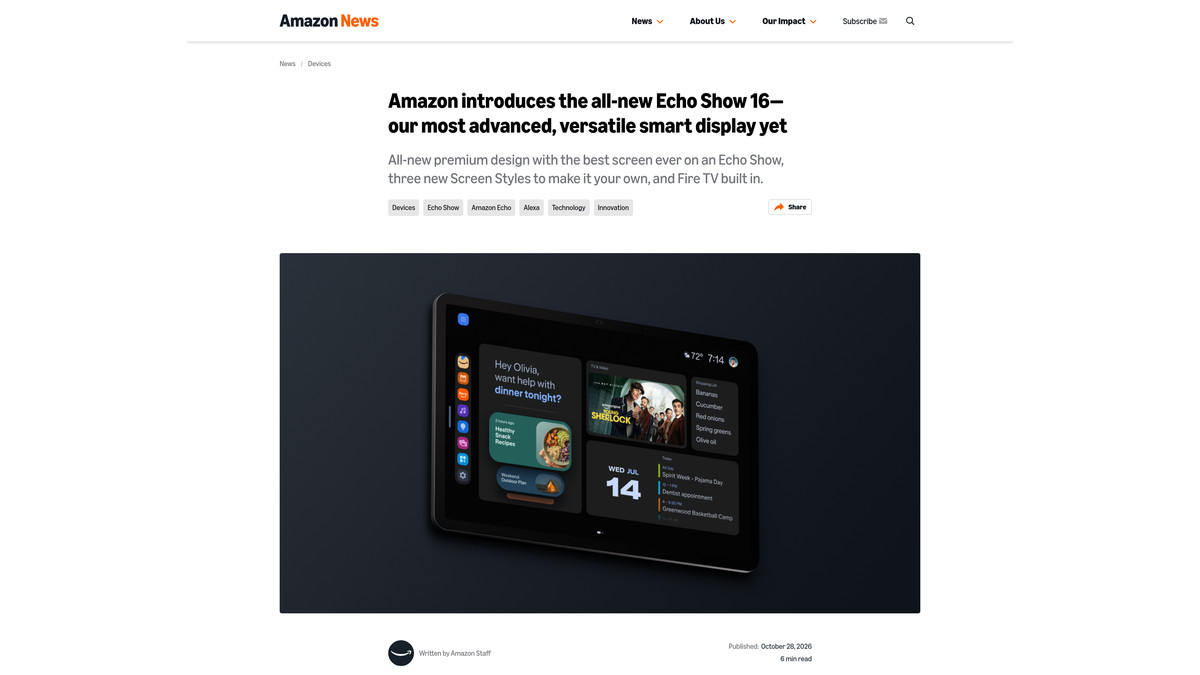
Amazon (@amazon) rebuilt its Echo lineup on Wednesday with five new Alexa+ devices, led by a 16-inch Echo Show 16 smart display with Fire TV built in that costs $499.99, or $569.99 with an anti-glare Nanomatte screen. It is available for preorder now, with $100 off for early buyers, and "will begin shipping later this year," Amazon said.
Amazon says the Show 16 has a 13-megapixel wide-angle camera and, for the first time on an Echo Show, night vision, plus a frame "nearly 40% thinner" and 20% more computing power. The rest of the range is on sale now. The new Echo Dot, at $99.99, is the first Dot to run on AZ3, Amazon's "custom-designed silicon," for on-device processing. It also gets a built-in smart home hub supporting Zigbee, Matter and Thread, plus an eero Wi-Fi extender. The Echo Studio with Home Camera costs $249.99 and lets #AlexaPlus see what is in front of it.
Amazon also launched Echo Time, a $199.99 camera-free bedside clock it calls its first smart alarm clock with Alexa+, and the Alexa Photo Frame, which it calls the first photo frame with Alexa built in. The frame costs $199.99 in black or $229 in birch or walnut and pulls pictures from Amazon Photos. Certain features require Alexa+, which is included with Prime.
Why it matters: Amazon is betting on screens as Alexa+ does more. In its release it said Echo Show "has been our fastest-growing Echo product line, growing more than 25% year over year," without saying whether that is units or revenue, and added: "And as Alexa becomes more capable, the screen becomes even more important."
Sources: Amazon News releases on Echo Show 16, Echo Dot and Echo Studio, Echo Time and Alexa Photo Frame, Oct. 28, 2026; The Verge. Image: Amazon News, Echo Show 16 announcement page (Amazon).
Amphenol's third-quarter sales of $10.23 billion and adjusted (non-GAAP) EPS of $0.80 beat its own guidance, in what it called "record third quarter 2026 results." In July it had guided to sales of $9.3–9.4 billion and adjusted EPS of $1.40–1.42, or $0.70–0.71 after the 2-for-1 stock split; shares began trading split-adjusted on Sept. 3. It guided fourth-quarter sales to $10.3–10.5 billion. GAAP EPS was $0.79. Orders hit a record $12.2 billion, a book-to-bill of 1.19.
Quarter to Sept. 30 vs a year earlier:
Net sales: $10.230B vs $6.194B (+65%; +37% organic); Q2 $8.758B
GAAP operating income: $3.021B vs $1.702B, margin 29.5% vs 27.5%; Q2 $2.585B (29.5%)
Adjusted operating margin (non-GAAP): 29.7% vs 27.5%; Q2 29.8%
Net income: $2.034B vs $1.246B; Q2 $1.769B
Diluted EPS: GAAP $0.79 vs $0.49; adjusted (non-GAAP) $0.80 vs $0.46
Free cash flow (non-GAAP): $1.623B vs $1.216B
Communications Solutions sales nearly doubled to $6.583 billion (+51% organic), with a reported (GAAP) segment operating margin of 33.1% vs 32.7%. Harsh Environment Solutions rose 35% to $2.042 billion (30.1% vs 27.1%) and Interconnect and Sensor Systems 17% to $1.605 billion (20.0%, flat). Q3 operating income included about $15 million of net IEEPA tariff recoveries, which the July guide excluded; Q2 included $80 million. Amphenol pointed to IT #datacom demand, with CEO Adam Norwitt citing "continued exceptional organic growth in the IT datacom market."
For 2026 it expects sales of $36.9–37.1 billion and adjusted EPS of $2.82–2.84 (GAAP $2.64–2.66); Q4 adjusted EPS is guided at $0.81–0.83. The outlook reflects the CommScope connectivity and cable business, bought in the first quarter and now expected to bring $5.1 billion of 2026 sales (up from $4.6 billion), and excludes deals not yet closed, namely AdvancedPCB, Dexgreen and Humanetics Sensors, so it covers Empire Electronics, acquired in early September. Those three and Empire cost about $1.6 billion combined. Amphenol also lifted its quarterly dividend 20% to $0.15 and approved a $4 billion, three-year buyback from Jan. 1, 2027.
Why it matters: Norwitt said: "The revolution in electronics continues to accelerate, with new innovations creating exciting growth opportunities for Amphenol across each of our diversified end markets."
Sources: Amphenol Q3 2026 earnings release, Oct. 28, 2026; Amphenol Q2 2026 earnings release, July 29, 2026; Amphenol stock split release, Aug. 6, 2026. Image: Amphenol Q3 2026 earnings release, page 1 (Amphenol).

UMC lifted third-quarter operating income 24.7% from the prior quarter to NT$18.64 billion as fab utilization reached 92%, and its board approved an additional capital expenditure budget of about US$3.2 billion to speed up expansion in Singapore and Tainan. Revenue rose 8.0% sequentially and 25.6% from a year earlier to NT$74.24 billion. Against its July guidance of high-single-digit shipment growth, utilization above 90% and a "mid-30% range" gross margin, shipments rose 7.3% to a record 1.212 million 12-inch-equivalent wafers and gross margin was 34.0%.
Quarter to Sept. 30, reported (TIFRS), vs a year earlier:
Revenue: NT$74.24B vs NT$59.13B (+25.6%); Q2 NT$68.73B
Gross margin: 34.0% vs 29.8%; Q2 32.5%
Operating income: NT$18.64B vs NT$11.12B (+67.7%), margin 25.1% vs 18.8%; Q2 NT$14.95B (21.8%)
Net income to shareholders: NT$16.43B vs NT$14.98B (+9.7%); Q2 NT$42.26B
EPS: NT$1.32 (US$0.206 per ADS) vs NT$1.20; Q2 NT$3.39
Free cash flow (company measure, operating cash flow minus capex): NT$18.09B
Net income fell 61.1% from Q2 mainly because that quarter carried NT$30.05 billion of net investment gains, against NT$1.16 billion now. UMC does not report segment margins; by application, communication was 39% of wafer sales, consumer 32% and computer 13%. The 22/28nm nodes made up 35% of wafer revenue (37% in Q2), with 22nm at a record 18.3%.
For the fourth quarter UMC guides to low-single-digit shipment growth, firm US-dollar prices, a gross margin comparable to Q3 and utilization in the low-90% range, and keeps its 2026 cash capex guide at US$2.0 billion. The additional budget is NT$102.78 billion in its exchange filing, about US$3.2 billion at the quarter's average rate of NT$31.99, and the filing gives its timing only as "by capital budget plan." Figures are under Taiwan's TIFRS, which differs from IFRS as issued by the IASB.
Why it matters: CEO Jason Wang said specialty-technology revenue will keep growing sequentially, driven in part by the ramp-up of its advanced packaging and #SiliconPhotonics businesses, adding: "We have seen a significant increase in demand for these new business areas, and we are in the process of converting some existing capacity to address near-term unfulfilled demand."
Sources: UMC Q3 2026 earnings release and TWSE filings (SEC Form 6-K), Oct. 28, 2026; UMC Q2 2026 earnings release, July 29, 2026. Image: UMC Q3 2026 earnings release, SEC Form 6-K Exhibit 99.4 (UMC).

Littelfuse posted what it called record net sales of $767 million for the third quarter, up 23%, but that was below its own $780–800 million guide because a one-time $28.5 million (€24.6 million) Dortmund contract amendment fee, disclosed in September, was booked as a reduction of semiconductor sales. Excluding the fee, adjusted (non-GAAP) sales were $795.2 million, inside the range. Adjusted EPS of $5.79, also a record by its count, rose 96% and beat its $4.85–5.05 guide. GAAP EPS was $4.49, up 62%.
Quarter to Sept. 26 vs a year earlier:
Net sales: $766.7M vs $624.6M (+23%; +22% organic); Q2 $738.8M
GAAP operating income: $153.4M vs $97.4M, margin 20.0% vs 15.6%; Q2 $119.7M (16.2%)
Adjusted operating margin (non-GAAP, on adjusted sales): 24.1% vs 16.1%; Q2 19.0%
Net income: $115.4M vs $69.5M; Q2 $89.4M
Diluted EPS: GAAP $4.49 vs $2.77; adjusted (non-GAAP) $5.79 vs $2.95; Q2 $3.49 / $4.19
Free cash flow (non-GAAP): $216M, +64%
Electronics sales rose 19% to $426 million (+27% organic), with a GAAP segment operating margin of 24.0% vs 17.8% and an adjusted EBITDA margin of 33.1%, on passive products and protection and power #semiconductors. Transportation grew 7% to $183 million (GAAP margin 15.0% vs 11.8%; adjusted EBITDA 19.6%), and Industrial jumped 65% to $158 million (21.1% vs 17.6%; adjusted EBITDA 25.2%), with the Basler Electric acquisition adding 38 points and demand from data centers and grid infrastructure. Littelfuse said the amendment of its Dortmund agreements with Elmos is meant to enhance "strategic flexibility" and its ability to optimize the Dortmund Semiconductor GmbH asset over time.
For the fourth quarter it guides to sales of $750–770 million and adjusted EPS of $5.05–5.25. Littelfuse guides only on an adjusted basis, excluding items such as acquisition and integration costs, restructuring and impairment charges.
Why it matters: CEO Greg Henderson said "we continue to see strong demand across our diverse market exposures, and we expect approximately +28% yr/yr revenue growth."
Sources: Littelfuse Q3 2026 earnings release (SEC 8-K Exhibit 99.1), Oct. 28, 2026; Littelfuse Q2 2026 earnings release, July 29, 2026; Littelfuse 8-K on the Dortmund amendment, Sept. 17, 2026. Image: Littelfuse Q3 2026 earnings release, page 1 (Littelfuse).

Flex (@Flexintl) raised its fiscal 2027 outlook on Wednesday to adjusted (non-GAAP) EPS of $4.84–5.16 and sales of $34.9–35.9 billion, from $4.42–4.74 and $33.7–35.2 billion, after second-quarter results topped its own guidance. Flex said the outlook includes acquisitions closed after Sept. 25 and "does not give effect to the planned spin-off" of its Cloud and Power Infrastructure segment. Sales of $8.49 billion beat its $7.95–8.25 billion range and adjusted EPS of $1.18, which Flex called a record, beat its $1.00–1.07 guide; GAAP EPS was $0.70.
Quarter to Sept. 25 vs a year earlier:
Net sales: $8.491B vs $6.804B (+25%); Q1 $7.928B (+7% q/q)
GAAP operating income: $414M vs $296M, margin 4.9% vs 4.4%; Q1 $392M
Adjusted operating income (non-GAAP): $607M vs $409M, margin 7.1% vs 6.0%; guide $535–565M
Net income: $263M vs $199M; Q1 $285M
Diluted EPS: GAAP $0.70 vs $0.52; adjusted (non-GAAP) $1.18 vs $0.79 (+49%); Q1 $0.76 / $1.00
Free cash flow (non-GAAP): $261M vs $305M
Cloud and Power Infrastructure sales jumped 54% to $2.508 billion with a 10.7% adjusted operating margin, up from 8.3%. Integrated Technology Solutions rose 22% to $3.306 billion (5.5% adjusted margin) and Regulated Manufacturing Solutions 9% to $2.677 billion (6.4%). The gap to GAAP included $110 million of "legal and other" costs, mainly $91 million tied to the planned spin-off of the cloud and power unit, and free cash flow absorbed $61 million of separation costs. Flex closed its purchase of EPC Power, a maker of power conversion gear for #AI data centers and grid applications, on Oct. 14, and on Oct. 5 announced a $2.0 billion convertible preferred investment in the spin-off, Axiom, led by General Catalyst. For the third quarter it guides to $8.87–9.17 billion in sales and adjusted EPS of $1.19–1.25.
Why it matters: CEO Revathi Advaithi said the EPC deal "further completes our end-to-end Power portfolio," and said "the unveiling of the Axiom name and anticipated leadership marks another important step toward creating two focused companies positioned for long-term success."
Sources: Flex Q2 fiscal 2027 earnings release, summary financials and earnings presentation, Oct. 28, 2026; Flex Q1 fiscal 2027 earnings release, July 29, 2026; Flex releases, Oct. 5 and Oct. 14, 2026. Image: Flex Q2 fiscal 2027 earnings release, page 1 (Flex).
