

Neurologist | Data Scientist 🧭 🎓 ⚽ is life!
New York, USA
Joined December 2009
- Tweets1.9K
- Following743
- Followers857
- Likes6K






Ali Ezzati retweeted

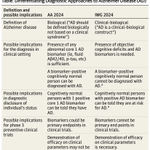
Autopsy findings in Alzheimer's disease clinical trial participants demonstrate a high frequency of off-target coexisting pathologic features. E. Pinar Coskun et al. doi.org/10.1016/j.tjpad.2026… #AlzheimersDisease #ClinicalTrials #Neuropathology #MixedPathology #Dementia #TDP43
Ali Ezzati retweeted

Speed of automation is in inverse proportion to the entropy of the subject domain. Math and coding are structured and orderly, which is why AI is able to do them so well. In order of difficulty:
The hard sciences are next. They may be governed by strict physical laws, but are complicated by dependence on noisy measurements and laboratory experimentation.
Financial markets are more difficult still. They are complex adaptive systems subject to human psychology. While (past) data is abundant, the underlying statistics are non-stationary and highly variable.
Clinical diagnostics and decision-making in medicine are far more difficult than most people realize. It's very high-stakes, it requires synthesizing very fragmented signals, and dealing with idiosyncratic human behavior and biology - it's a nightmare of incomplete information.
The law, jurisprudence, and legal interpretation operate on structured text and precedent (most of the time), but rely heavily on ambiguous language, evolving societal norms, persuasive rhetoric, and human judgement. They won't be automatic anytime soon.
Culture, art, and strategic leadership are an odd mix, but I think all of them are quite safe from automation. They are the pinnacle of disorder and human creativity. They rely on tacit knowledge, intuitive perceptions of the world, emotional intelligence, understanding of cultural consensus, and navigating complex moral trade-offs.
So rejoice - we'll have artists, lawyers, doctors, and CEOs for a long time yet!
Ali Ezzati retweeted

In 1980, 21% of NIH-funded principal investigators were under age 35. By 2015, this proportion was 3%.
The dramatic ageing of independent scientists is bad because old people are simply worse at science than young people.
Latest meta-scientific deep-dive from me 🧵 ⬇️
Ali Ezzati retweeted

Hiring postdocs @EPFL: please reach out and/or apply to the AI Center fellowship epfl.ch/research/funding/epf…. My #NeuroAI group is excited about testing and building models of brain and behavior, from sensory through language to cognition, and from healthy to dysfunction (treatment)!

Ali Ezzati retweeted

📢My lab at NYU currently has two open post-doc positions. We are interested in understanding perception, thinking, and hallucinations.
We employ a range of cutting-edge techniques in human neuroscience (eg, 7T fMRI, MEG, iEEG/DES) and computational approaches (eg, DNN modeling)
Ali Ezzati retweeted

So the @NIH has announced a plan to consolidate K funding mechanisms in 2027. I'm going to assume this has been done with good intentions here, but there are key concerns that I feel need to be addressed... 1/6
grants.nih.gov/grants/guide/…

Ali Ezzati retweeted

Just heard about Next major change for NIH Grant reviews ~
Each reviewer will provide one of two emojis:
👍
Or
😬
Good luck to us all…

Important changes coming to how @NIH reports scores on reviewed grants - while individual reviewers will still provide an overall impact score, the investigators will only receive information on which of three broader categories their grant falls under:
grants.nih.gov/grants/guide/…

Ali Ezzati retweeted

This is absolutely dumb and ridiculous. The K99/R00 Pathways to Independence award is a major mechanism to retain the very best international trainees in biomedical research in US institutes. As a reviewer of this award I know the awardees are absolute stars in each of their subfields. We are talking about the most creative and most productive people here. Now they are closing the door on these young stars who are already highly sought after by other countries. It's saddening and disappointing to watch the "land of opportunity" getting diminished like this step-by-step.

The NIH plans to close the door on one of the few pathways available to international students on visas to forge a career in biomedical research in the U.S. trib.al/XysZTdU

Ali Ezzati retweeted

🚨🇹🇳 𝐁𝐑𝐄𝐀𝐊𝐈𝐍𝐆 | After the 5-1 loss to Sweden, Sabri Lamouchi has been SACKED by Tunisia, reports @Romain_Molina! 👋❌
It's the FIRST managerial sacking of the 2026 World Cup. 😳


Ali Ezzati retweeted

Physician-scientist pipeline is a retention problem, not a recruitment problem. We lose people in years 5–6 when revisions stack and RVUs absorb protected time. This month's JCI editorial names the connective tissue departments don't fund. doi.org/10.1172/JCI206886
Ali Ezzati retweeted

Federal funding for US biomedical research is moribund.
Since October 1 2025, NIH is -80% in new grants and -70% in values (total dollars).
Labs are closing down and researchers are leaving science.
To what end?

Ali Ezzati retweeted

Congress rejected massive cuts to US science budgets for 2026, but much of the money still isn’t flowing to researchers.
The culprit? The White House Office of Management and Budget (OMB) is quietly slow-walking the release of funds. 🧵👇
For @Nature:
nature.com/articles/d41586-0…

Ali Ezzati retweeted

"The term [provider] should not be used to describe physicians, nor should physicians use it to describe themselves, their team members, or their trainees."
acpjournals.org/doi/10.7326/… @AnnalsofIM @ACPIMPhysicians

Ali Ezzati retweeted

The new @NIH SciENcv Biosketch pissed me off so much today (lost 4 hours of my life) that I built a quick NIH Biosketch format converter. It lets you format each section while seeing both the preview and the HTML code at the same time.
It restored my sanity, a little.
Enjoy.

Ali Ezzati retweeted

Want to make the new #NIH #biosketch easier to read?
By default, #SciENcv outputs the Bio with essentially no formatting, which can be hard on reviewers.
You can use simple HTML—<b>...</b> for bold and <br> for line breaks—to improve readability in the BioSketch fields.

Ali Ezzati retweeted

This travel ban has quietly reshaped the personal and scientific futures of many Iranian scholars, including my own. After a full year of planning for a U.S. postdoc, tens of hours of interview preparation, fellowship applications, constant monitoring of whether Harvard’s legal battles would lead to F or J visa revocations, stress over grant freezes, and endless immigration paperwork, the sudden travel ban announced on June 4, 2025 upended everything.
After the draft list for the new travel ban appeared in a New York Times article in March, we rushed to reschedule my PhD defense as early as possible. I ended up preparing for my defense in just two weeks in an attempt to get ahead of the ban, which turned out to be pointless. The ban was announced only weeks after my interview at the U.S. Consulate in Toronto, and I have not heard back since.
This ban is far more expansive than the one in 2017 and includes no exemptions for F or J visas. When I asked about the possibility of an exemption letter, I was told it was unlikely to help, as this administration appears to view science as no longer being in the U.S. national interest.
As @genophoria points out, media coverage and the political response around this ban have been surprisingly limited. I wish more senior academics would speak up. Today, many Iranian and other international students and scholars live in a state of permanent uncertainty, where a single policy change can freeze their careers or force them to leave everything behind. Many do not even feel safe sharing their experiences publicly.
In the current political climate for immigrants in the U.S., it is heartbreaking to admit that I feel almost relieved I did not end up there. When you are living with constant fear about your status, buried in paperwork, and know your life can be overturned overnight, how much bandwidth remains to do actual science?

The new travel ban is far more expansive than the one in 2017, yet the political response this time around has been muted to the point of silence. A Republican congresswoman seems to be the loudest voice raising concerns. The cynic in me can't help wondering whether this is payback for immigrant communities not delivering the turnout some Dem politicians expected in 2020.
My speculations aside, the impact is very real. The U.S. visa process was already a grueling, dehumanizing maze even in the best of times. International scholars and students now face even more uncertainty about something as basic as freedom to move or change jobs.
What’s heartbreaking is how normalized this has become. A century ago, simply landing at Ellis Island meant a chance to start a life by signing your name in a book. Today, the path to "legal entry" is a labyrinth of paperwork, shifting rules, and a political climate where people's lives can be upended overnight depending on who's in office. We should not accept this volatility as the price of wanting to study, work, or build a life in this country.
miamiherald.com/news/local/i…

Ali Ezzati retweeted

It’s a very bad day for Alzheimer’s treatment research. J&J’s tau antibody had a lot of hopes riding on it.
fiercebiotech.com/biotech/jj…

Ali Ezzati retweeted

🔥 Are you an applied mathematician or CS MS student interested in working on the mathematics of generative AI for medical imaging? Ideally at University of Southern California here in Los Angeles** or at least in the US, or we could apply for funding together if you're not in the US, or if you have funding you can just join us in Marina del Rey, we have a nice lab on the Pacific Ocean (and a fun, creative, supportive environment). We have active projects on VLMs, calibration, Stein/Matérn flow, Malliavin calculus, Chernoff bounds, fractional PDEs, diffusion models, extensions of the Dvoretzky–Kiefer–Wolfowitz inequality (DKW inequality) with Stein correction, information-theoretic flows on fields of PDFs. Curious + creative applied mathematicians and CS MS students are welcome, esp if you are interested in computer vision. PhDs in applied math or physics are welcome. I am happy to teach you stochastic calculus, PDEs, functional analysis, information theory and extend it together. No neuroscience* knowledge needed.
*Disclosure: we are a neuroscience lab also.
**Disclosure #2: Los Angeles is much nicer than it is portrayed in the news, our lab is by the boat harbour and is safe and peaceful.

Ali Ezzati retweeted

The most important piece of career advice: Be the person who can figure it out. You’ll be given tasks you have no idea how to complete. There's nothing more valuable than someone who can just figure it out. Do some work, ask key questions, get it done. People will fight over you.