

Plataforma formativa y educativa para entrenadores, analistas y amantes del fútbol, con base de datos, análisis tácticos y recursos audiovisuales.
Joined July 2024
- Tweets365
- Following150
- Followers3.8K
- Likes53


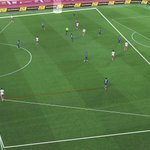


Al hilo de esto voy a hablar del Bayern de Múnich
Kompany ha construido un equipo muy imprevisible y que al ojo del espectador parece caótico, sin embargo, no lo es.
Fijaos en la imagen adjuntada del Bayern, como mientras su equipo construye sus jugadores mantienen distancias muy cortas favoreciendo lo siguiente:
-Rotaciones entre sus jugadores constantemente gracias a estas pequeñas distancias
-Se reducen distancias lo que facilita estas relaciones por dentro (enfoque relacionista). Además, esto favorece la sobrecarga de carriles.
-Estas distancias cortas acercan a sus jugadores a la portería rival, fijaos en Olise, como gracias a su ubicación puede recibir en ubicaciones que son más peligrosas que si estuviera pegado a la banda.
-Estas ubicaciones con una amplitud óptima permiten invadir carriles y atacar la profundidad constantemente y desde ubicaciones diferentes, lo que genera este caos e imprevisibilidad.
-Sus jugadores lejanos tienen una ubicación que les permite estar perfectamente ubicados en caso de que se produzca una pérdida (Amplitud óptima). Asimismo, las pequeñas distancias entre sus jugadores les permiten presionar la pérdida rápidamente.
-Estas ubicaciones permiten al Bayern ser peligroso cuando tiene el balón pero también ser MUY peligroso cuando tiene el balón y lo recupera ya que pilla desordenado al equipo rival y sus mejores jugadores están más cerca de la portería.
Es por ello que a equipo como el Bayern hay que entenderlos como un sistema móvil y complejo y no como un sistema estructurado y lineal. Donde todos sus jugadores desempeñan un rol en función del balón, obviamente según sus características individuales (no vas a ver a Upamecano recibiendo entre líneas), pero si puedes ver a Kane descendiendo para construir porque es un gran pasador. Es por esto que esta reducción de distancias permite generar muchas ventajas, gracias a rotaciones, sobrecargas... provocando que sus jugadores expresen al máximo sus cualidades individuales.
Por el contrario, en la siguiente imagen de la publicación se ve otro enfoque empleado por el Mónaco


Hansi Flick's Barcelona Doubling Down on Short Distances and High Mobility.
FC Barcelona after the arrival of Hansi Flick has gone from being a typical team with large distances and low mobility towards a team that plays with very short distances and high mobility.
The change from Lewandowski to players like Gordon and Gabriel Jesus makes this evolution towards high mobility even clearer.
It is increasingly common to see teams moving away from traditional, rigid positional play, with large distances and low mobility, towards a style based on shorter distances.
Xabi Alonso's Bayer Leverkusen was one of the first teams to reduce distances significantly, successfully winning the Bundesliga in 2024. Francesco Farioli said in an interview that one of the things he took from relationism was shorter distances. His Porto played with much narrower fullbacks in 2025 than before, successfully winning the Portuguese league very comfortably. Porto and Leverkusen didn't play with the same mobility as Barcelona, but simply reducing distances helped them defensively, allowing them to avoid transitions more often and concede very few goals.
Hansi Flick wants to reduce distances to increase mobility. But Barcelona is focused on attacking centrally, which is quite different from Arsenal or PSG, who also use a lot of mobility but tend to do so through wide triangles rather than by looking to do it centrally.
By mobility, I mean that players are continuously moving, offering a double threat: running in behind or asking for the ball to feet, while exchanging positions between them. For example, you can suddenly see Gordon, as a left winger, moving into the striker position while Gabriel Jesus moves to the left, the left fullback stays between the lines and the attacking midfielder gives support deeper. In the next situation, their positions can be mixed again. Barcelona basically does this in the left half-space and centrally. If we divide the pitch into five lanes, starting from the left, the main movements take place in lanes two and three.
On the right, Lamine Yamal stays in position. Barcelona looks to overload the ball area on the left half-space or centrally, attract opponents there and then isolate Lamine Yamal on the right, allowing him to receive with less traffic. Spain used a similar idea with Baena moving inside and a striker like Oyarzabal supporting those overloads.
The interesting thing about Yamal's position is that he doesn't need to provide the full width. He applies a concept called optimal width, which means staying as wide as necessary to remain a threat and force the opposing fullback to respect the possibility of a run in behind. With this idea, Yamal stays closer to the box, attracts the fullback's attention and prevents him from closing inside. It also reduces the distance he needs to cover to counter-press. If you look at the fullbacks, their positioning is also very narrow.
Attacking centrally carries a risk. Losing the ball in these areas can expose the team more than losing it in wide areas. This is one of the reasons why teams like Arsenal or PSG, who use a lot of mobility try do it more through wider combinations than centrally.
Flick keeps insisting on reducing distances because he knows that the only way to play with this level of mobility is to have players close enough to each other to counter-press immediately after losing the ball.
In a press conference, he said:
“When we analyzed the game against Girona, I always speak about positioning, the right distance between the players and the opponent. It's very important, and if you're far from that, you lose, you have to run too much, give the opponents a little bit more time to play out and this is also what kills us in the defense.”
His point is clear: if Barcelona wants to play with high mobility, it needs very short distances. Otherwise, players have to run too much, giving opponents more time to escape the pressure.
There is another important benefit to reducing distances. Players feel more comfortable taking risks with short combinations in congested spaces. They know that if they lose the ball, they have teammates nearby who can recover it quickly. The second attack can then be even more dangerous than the first because the opposition is more disorganized.
FC Barcelona is doubling down on short distances and very high mobility, and this season's signings reflect that direction. More teams will likely adopt similar ideas in the coming seasons.


Después del PSG-FC Barcelona se confirmó la nueva corriente a la que parece acercarse más el fútbol, la defensa desde una perspectiva mucho más individual.
Durante el partido vimos como ambos equipos incluso desde situaciones de bloque medio y bloque bajo, buscaban rápidamente emparejar al hombre para defender posteriormente hacia delante. Apenas hubo en el partido momentos donde ningún equipo se replego y se mantuvo ordenado.
Esto, como ya comentó Cesc Fábregas en una charla viral modifica completamente la manera de entrenar, es por ello que os traigo diferentes maneras (que no todas) que se vieron durante el partido para resolver presiones individuales.
Este enfoque es cada vez más posible debido al alto nivel físico que muestran los jugadores, sin embargo, este enfoque también exige mucho a los jugadores. Como vimos ambos equipos sufrieron bajas por lesión.
Si que es cierto que la calidad de plantilla y alta rotación sumado a la superioridad aplastante en su liga puede favorecer al PSG y este estilo de juego. Asimismo, el Barcelona, debido al nivel del Real Madrid también se puede permitir muchas rotaciones, pero en menor grado que el PSG.