

Official Account of Ahmadiyya Muslim Youth Association Canada. Auxiliary organization of the Ahmadiyya Muslim Community Canada.
Canada
Joined January 2013
- Tweets7.1K
- Following298
- Followers6K
- Likes9.8K







Muslim Youth Canada retweeted

Islam’s Role in Mathematics
What if the mathematics we use every day was shaped by Muslim scholars?
During the Islamic Golden Age, Muslim mathematicians made major contributions to algebra, arithmetic, geometry, trigonometry, and algorithms. Scholars such as Al-Khwarizmi helped develop systematic methods for solving mathematical problems, while Muslim scholars also preserved, expanded, and transmitted knowledge from earlier civilisations.
Many of these developments later influenced the growth of mathematics in Europe and beyond.
#MTAi #Islam #InsideAhmadiyya
Muslim Youth Canada retweeted
Islam’s Charity & Welfare System
What if helping those in need was not just encouraged, but built into a society’s system?
Islam places strong emphasis on charity, social responsibility, and supporting vulnerable people. Through concepts such as Zakat and Sadqa, Islamic tradition developed mechanisms for wealth redistribution, community support, education, healthcare, and assistance for those in need.
A look at how Islamic principles approach poverty, welfare, and social responsibility.
#Islam #MTAi #InsideAhmadiyya
Muslim Youth Canada retweeted
Islam's Contribution to Trade & Commerce
How did Islam shape trade, business, and commerce across the world?
Trade has played a major role in Islamic civilisation. Islamic teachings established principles around honest dealing, fair contracts, fulfilling agreements, and avoiding exploitation, while Muslim merchants connected markets across Africa, Asia, Europe, and the Middle East.
From bustling marketplaces to long-distance trade routes, commerce helped spread not only goods and wealth, but also ideas, knowledge, and culture.
#MTAi #InsideAhmadiyya #Islam
Muslim Youth Canada retweeted
Islam’s Contribution to Physics
Did Muslim scholars help lay the foundations of modern physics?
During the Islamic Golden Age, Muslim scientists made important contributions to optics, mechanics, astronomy, and the study of motion. Ibn al-Haytham’s work on light and vision helped establish a more systematic approach to scientific investigation, while other scholars studied balance, motion, gravity, and the behaviour of physical objects.
Their work preserved, developed, and expanded earlier scientific knowledge and later influenced scholars in Europe.
#MTAi #InsideAhmadiyya #Islam
Muslim Youth Canada retweeted
Islam’s Contribution to Architecture
How did Islam influence the way buildings, cities, and sacred spaces were designed?
Islamic civilisation developed distinctive architectural traditions that combined beauty, functionality, geometry, and craftsmanship. Mosques, madrasas, palaces, gardens, and public buildings featured innovations such as domes, arches, courtyards, geometric patterns, calligraphy, and intricate tilework.
From the Alhambra to the great mosques of Cairo, Istanbul, and Samarkand, Islamic architecture left a lasting influence across Europe, Africa, and Asia.
#MTAi #InsideAhmadiyya #Islam
Join us for a special Tabligh Q/A session where Khuddam will have the opportunity to ask questions, discuss challenges, and receive guidance related to Tabligh with Respected Murabbi Razi Qudrat Sb and Respected Murabbi Shahrukh Abid Sb, Sadr MKAC
meet.google.com/qiy-mvfp-mky

Muslim Youth Canada retweeted
Was the Mi'raj Spiritual or Physical?
Did the Prophet Muhammad (sa) ascend to the heavens physically, or was the Mi'raj a spiritual experience?
The Isra and Mi'raj is one of the most significant events in Islamic tradition. According to the mainstream classical understanding, the Prophet Muhammad (sa) experienced the journey physically and spiritually—not merely as a dream or vision. The Qur'an describes the night journey from Masjid al-Haram to Masjid al-Aqsa, while numerous hadith narrations describe his ascent through the heavens and his encounters with the prophets.
The event remains a profound part of Islamic belief, raising important questions about revelation, miracles, and the nature of the unseen.
#MTAi #InsideAhmadiyya #Islam
Muslim Youth Canada retweeted
Islam’s Impact on Astronomy
How did Muslim scholars help shape our understanding of the skies?
During the Islamic Golden Age, Muslim astronomers made significant advances in observing and calculating the movements of celestial bodies. They developed detailed star catalogues, improved astronomical instruments, built observatories, and refined methods for measuring time and position.
Astronomy also had practical importance in Muslim societies, including determining prayer times, the direction of the Kaaba, and the Islamic calendar.
#MTAi #InsideAhmadiyya #Islam
Muslim Youth Canada retweeted
Islam’s Role in Healthcare
How has Islam influenced healthcare and medical knowledge? This video explores the contributions of Muslim scholars, physicians, and institutions to medicine, hospitals, pharmacy, and the pursuit of knowledge throughout history.
A look at the lasting impact of Islamic civilisation on healthcare and medical advancement.
#MTAi #InsideAhmadiyya
Muslim Youth Canada retweeted
Are Muslims Backwards?
Are Muslims really “backwards,” or is this stereotype based on misconceptions and selective perceptions? This reel examines the claim, explores the diversity of Muslim societies, and looks at how culture, history, education, politics, and religion shape different communities.
#MTAi #InsideAhmadiyya


Muslim Youth Canada retweeted

📢 Hazrat Mirza Masroor Ahmad (aba) instructs prayers for Ahmadi Muslims facing persecution in Pakistan and Malaysia.
His Holiness highlighted the injustices, unjust imprisonment, and restrictions they face, urging Ahmadis to recite Durood and Istighfar and offer voluntary prayers.
“May Allah the Almighty swiftly bring about the means to hold these wicked individuals and mischief-makers to account.”
By the Sheer Grace of Allah Almighty, on Sunday October 11th, Syedna Hazrat Khalīfatul Masīh V (May Allah be his Helper!) graciously granted a Mulaqaat with Office Bearers from Prairie Region of Majlis Khuddamul Ahmadiyya Canada.


Muslim Youth Canada retweeted

How do children learn whom not to like? A child does not come into this world knowing that one person is acceptable and another is not. They learn these things from us – through what we say, what we teach and sometimes through what we do not say at all.
For an Ahmadi Muslim who experienced bullying and exclusion because of their faith in Pakistan, even a simple greeting of peace could be met with silence because of who they were. Prejudice makes a person decide something about another before taking the time to know them.
Hatred can have much quieter beginnings: a joke that nobody challenges, a textbook that describes one community through stereotypes, a teacher who casually repeats something they themselves were taught, a parent who tells a child to stay away from “those people”, or a classroom where one child’s identity is treated as something shameful.
A textbook is not just a book. To a child, it is an authority. What a child absorbs about another human being can stay with them for years.
Yet children are not naturally hateful. They are remarkably curious. We can teach them that difference is frightening, or that difference is something to understand. We can teach them to inherit our suspicions, or teach them to question them.
Education should not merely tell children what to think. It should teach them how to think: how to question a stereotype, distinguish between faith and prejudice, disagree without humiliating another person, and hold firmly to their own beliefs without believing that someone else’s dignity has to be taken away.
Perhaps the greatest responsibility we have toward children is not to pass everything we inherited on to them. Some things deserve to be preserved, some questioned, and some – especially hatred – should end with us.

Muslim Youth Canada retweeted

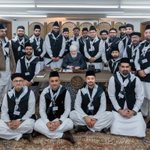
Last Sunday National, Regional, and Local Qaidin (youth leaders) from across Canada were honoured with the opportunity to meet Hazrat Khalifatul Masih V (May Allah be his Helper).
A truly inspiring and memorable occasion for our youth leadership
#MuslimYouth


Muslim Youth Canada retweeted

The remembrance of Allah fills the heart with faith, gratitude, and peace, drawing us closer to Him through dhikr.
@muslimtv @LajnaCanada @AMWSACanada @AMYACanada #Hadith #Islam #Taqwa #Sunnah #HolyProphet


By the Sheer Grace of Allah Almighty, on Sunday October 4th, 2026, Qaideen, Regional Qaideen, and the National Amila for Majlis Khuddamul Ahmadiyya Canada, were graciously granted the opportunity to have a Mulaqaat with Syedna Hazrat Khalīfatul Masīh V (May Allah be his Helper!)


Muslim Youth Canada retweeted

Qaideen of Muslim Youth Peace Village West & Muslim Youth Peace Village Centre West @AMYA_PVCW
During the Qaideen Tour of Islamabad, UK 🇬🇧
✨ Especially blessed with a Group Mulaqat with Huzoor-e-Anwar (AA) ✨

Muslim Youth Canada retweeted
A lady asked Huzoor (aa) whether it was true that Hazrat Khalifatul Masih II (ra) possessed the ability to know what was in people’s hearts or to exert a spiritual influence upon others.
“Allah the Exalted alone is the Knower of the unseen and He alone knows what is in people’s hearts. Thus, Allah the Exalted states in the Holy Quran, ‘He is Allah and there is no God beside Him, the Knower of the unseen and the seen.’ (59 : 23) He also states, ‘And with Him are the keys of the unseen; none knows them but He.’ (6 : 60)
“No human being can ever be the Knower of the unseen. Accordingly, at various places in the Holy Quran, Allah the Exalted instructed the Holy Prophet (sa) to declare that he did not claim to possess knowledge of the unseen. (6 : 51; 11 : 32)
“Nevertheless, it is also true that God Almighty’s chosen servants know matters of the unseen to the extent that Allah the Exalted informs them of them. As Allah the Exalted states in the Holy Quran, ‘[He is the] Knower of the unseen; and He reveals not His secrets to any one, except to him whom He chooses, namely a Messenger [of His].’ (72 : 27-28)
“Hazrat Khalifatul Masih II (ra) was also a human being. As a human being, therefore, he certainly did not possess knowledge of what was in people’s hearts. However, as explained above, Allah the Exalted grants His beloved servants as much knowledge of the unseen as He pleases. Thus, if Allah the Exalted granted him some knowledge concerning someone and he conveyed it in accordance with that divinely bestowed knowledge, there is nothing objectionable in this.
“Furthermore, the Holy Prophet (sa) said, ‘Beware of the believer’s discernment, for he sees with the light of Allah.’ (Tirmidhi) In this respect too, Allah the Exalted had blessed Hazrat Khalifatul Masih II (ra) with extraordinary discernment. By virtue of this divine gift, he could gauge people’s inner states from their faces with extraordinary discernment. Explaining this saying of the Holy Prophet (sa), the Promised Messiah (as) states:
“‘A speaker’s words possess a certain grandeur and awe in proportion to his stature. Observe how, even when approaching worldly officials, one feels some unease and apprehension, conscious that they hold the pen of authority in their hands. Likewise, those who recognise that God is with a believer abandon their opposition to him. If they do not understand, they sit alone and reflect upon the matter, drawing comparisons.
“‘It is essential that others follow the one who knows the way and possesses light. This is the intent and meaning of the hadith اِتَّقُوا فِرَاسَةَ الْمُؤْمِنِ, “Beware of the believer’s discernment.” That is, when a believer speaks, one should fear God Almighty, for whatever he says is from God Almighty.
“‘The point is that when a believer loves God, divine light encompasses him. Although that light enfolds him within itself and consumes his human nature to a certain degree, just as iron becomes like fire when placed in it, his servitude to God and his humanity do not cease to exist. This is the secret embedded in قُلْ إِنَّمَا أَنَا بَشَرٌ مِثْلُكُمْ, “Say, ‘I am only a man like yourselves.’” (18 : 111)
“‘His humanity remains, but it is concealed beneath the divine hue. All his faculties and limbs, devoted to God’s cause, become so imbued with God Almighty’s purposes that they reflect His wishes. This is the distinction that makes him responsible for the spiritual nurturing of tens of millions of people and makes him a manifestation of perfect divine providence. Were this not so, a Prophet could never guide and lead so vast a multitude.’”

