

Founder https://teapawt.net/t.co/uMuX33Lo82
Boston, MA
Joined March 2023
- Tweets194
- Following105
- Followers1.9K
- Likes129

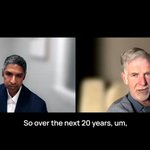


Netflix co-founder and long-time CEO (and current Anthropic board member) Reed Hastings called Netflix's IPO in 2002 "one of our big mistakes."
Here's what he told my MBA students when we hosted him in class recently:
"[Going public] allowed Blockbuster to read the financials, and they were like, 'Wow, this business works.'"
"What we should have done is realized that eventually, competition from the incumbent's gonna be a big deal, and the longer they underestimate us, the better."
"So we should have kept all the business press away about how successful we were."
Here's my full interview with Reed (with a transcript) for those interested:
worldlypartners.com/in-conve…

2
484
Netflix co-founder & Anthropic board member Reed Hastings gave my MBA students this advice for navigating a job market that he believes could become dominated by AI:
"Over the next 20 years, AI will eat up a bunch of jobs.... At that point, society will reorganize itself. Maybe it'll be universal basic income, maybe it'll be retirement at 50 and then you get on social security."
"I think we'll have a lot of money because the economy will be very strong, but you don't want to be in the first 20% to get made redundant. You'd rather be in the 80% that are still working."
"And I think the key to that is AI skills. Every organization is going to hold on to people who are AI sophisticated. So that will be the thing that keeps you employed in the difficult transition phase."
I recently hosted Reed in my MBA class as a guest speaker. Here's the full discussion for those interested: worldlypartners.com/in-conve…
3
1,683
Reed Hastings studied AI at Stanford in the '80s before co-founding Netflix.
Now he serves on the board of Anthropic. He says that with more compute, AI could become superhuman:
"In the '80s, there were neural nets around, but because the amount of computation was small, they couldn't do anything interesting."
"30 years later, the computation had expanded one millionfold, and with a million times more computation, it started to get interesting."
"Now we probably need another millionfold expansion for it to be superhuman."
2
793

Thanks @ApplePodcasts for naming our Formula 1 episode one of the Best Episodes of 2026!
apple.co/2026review
11
818
Reed Hastings (Netflix co-founder & Anthropic board member) on why frontier AI companies may have an enduring competitive advantage:
"OpenAI has the biggest compute scale, and right behind it is Anthropic."
"The bigger the compute gets, the smarter the AI gets, and if those power laws continue to hold, then it's a real scale business for the leading-edge intelligence."
"And just as you pay up to hire the best employees and pay up to get the best doctors, I think you'll pay up to get the best AI a lot of the time."
I hosted Reed as guest speaker in my MBA class two weeks ago. Here's our full conversation for those interested: worldlypartners.com/in-conve…
456
Sequence of returns = mathematically irrelevant for buy-and-hold investors.
Consider two funds, A and B, which post the same yearly returns in a different order.
Over 10 years, both generate the exact same cumulative return, turning $1 into $2.70.
(Graph from: worldlypartners.com/sequence…)

2
3
541
Numerous studies have shown that fund flows are correlated with past performance.
This means that by Year 7 (or much sooner), Fund B would be facing redemptions, while Fund A would be enjoying substantial inflows.
1
1
118
And yet those whose pile into Fund A after six years of positive returns will end up losing 70% of their money in the remaining four years.
Patients investors, on the other hand, (who stay put in either Fund A or B) will end up with the same wealth outcome: $2.70 for every $1 invested.
(Graph from: worldlypartners.com/sequence…)

81
Brad Jacobs and his team have created fantastic value over time.
If you had invested alongside them in their three prior public companies (United Waste, United Rentals, and XPO), reinvesting the proceeds from one to the next, you would have turned $1 into $311 from 1992 to 2025.
That's 10x the S&P 500 over the same period.

But the path to 311x was not smooth (as is typical of the best multi-decade investments).
Check out those drawdowns:
-87% from 1998 to 2002
-59% in 2011
-61% from 2015 to 2016
-65% from 2018 to 2020
-58% from 2021 to 2022
1
466
Brad joined my MBA class to discuss the temperament required for multi-decade compounding and his playbook for consolidating industries.
Here's the interview for those interested:
worldlypartners.com/in-conve…

2
290
Brad Jacobs on how he avoids overpaying for assets:
"The trick is, don't be looking at just one deal or two deals at a time. You want to be looking at dozens of deals at once."
"If you're looking at lots of deals at the same time and only have the capacity to do a small percentage of them, you can afford to be more disciplined."
Great advice that applies as much to M&A and investment selection as buying a used car.
Here's my full interview with Brad for those interested:
worldlypartners.com/in-conve…
1
404
More Polymarket data (from Bloomberg):
From Jan 2025 to Apr 2026, high-frequency accounts (i.e. bots) "collectively turned a profit of $131 million, mostly concentrated among 823 users that netted more than $100,000 each."
"The less active traders, meanwhile, lost the equivalent amount" over the same period.
Polymarket = a relocation center where money flows from casual bettors to sophisticated traders using algorithmic strategies.
bloomberg.com/news/articles/…


@FT just published an article showing that 2/3 of participants lost money on Polymarket.
A separate Bloomberg analysis found that the top 1% of Polymarket accounts captured 3/4 of the winnings.
Retail investors should perhaps think twice before dabbling in prediction markets.
ft.com/content/47831fae-3ecd…
bloomberg.com/news/articles/…


2
532