

We envision an Africa in which energy and extractive resources are utilised for economic transformation and sustainable inclusive development.
Agbogba, Accra, Ghana
Joined June 2014
- Tweets4K
- Following2.2K
- Followers5.8K
- Likes1.1K






Well-informed media is one of the most important checks on how public resources are raised and spent. Yet, in Ghana, consistent and in-depth reporting on fiscal governance remains insufficient. Complex issues such as national budgeting, debt servicing, revenue mobilisation and sector finances are often underreported or misrepresented, partly due to gaps in fiscal literacy and the technical nature of public finance documents.
Recognising the role of the media in promoting fiscal accountability, the Africa Centre for Energy Policy (ACEP) held an engagement for the third cohort of the Media Fellowship on Fiscal Accountability, aimed at strengthening journalists’ capacity to report on public finance and resource governance.
The two-day workshop focused on building media literacy in fiscal governance and public financial management, strengthening investigative journalism on corruption and mismanagement, and promoting evidence-based reporting using official documents, including budget statements, audit reports and public data.
We are grateful to our facilitators @Manasseh_Azure, Ezra Abban, Deborah Nana Ama Abbey and Eric Nii Yartey.
#ACEP #MediaFellowship #FiscalAccountability #PublicFinancialManagement


Despite being Ghana’s largest demographic group, young people remain largely absent from the fiscal governance processes that shape their lives and futures. The gap between awareness of governance issues and active civic participation risks leaving young voices out of decisions on taxation, budgeting and the management of public resources.
To help bridge this gap, the Africa Centre for Energy Policy (ACEP) through the third cohort of the Youth Champions for Fiscal Accountability (YCFA) Fellowship, in a two-day workshop equipped young people with the practical skills and support needed to participate meaningfully in fiscal governance.
We are grateful to our facilitators Phillip Banahene Thompson, Jennifer Moffatt, Samuel Harrison-Cudjoe and Deborah Nana Ama Abbey
#ACEP #YCFA #FiscalAccountability #YouthEngagement
🤖 Made with AI


@AcepPower engaged media bloggers on the Auditor-General’s Performance Audit Report on the National Petroleum Authority (NPA), equipping them with the technical knowledge to understand the audit findings, identify operational lapses and ask informed, relevant questions.
From gaps in petroleum product tracking and marking to weaknesses in retail outlet monitoring and fuel quality assurance, the engagement explored key findings that demand public attention and institutional accountability.
We encouraged media bloggers to use the evidence in the audit report to scrutinise the NPA’s operations, demand answers from the relevant authorities and keep these issues in the public conversation until meaningful action is taken. Public resources and consumer interests must be protected, and accountability must go beyond the findings on paper.
#ACEP #PublicAccountability #PetroleumSector #Ghana


𝐅𝐄𝐂 𝟐𝟎𝟐𝟔| 𝐂𝐨𝐧𝐟𝐞𝐫𝐞𝐧𝐜𝐞 𝐑𝐞𝐩𝐨𝐫𝐭
From thought-provoking discussions on Africa’s industrial transformation to new partnerships and connections built to last, the Future of Energy Conference 2026 brought together voices committed to shaping the continent’s energy future.
Now, the 𝐅𝐄𝐂 𝟐𝟎𝟐𝟔 𝐂𝐨𝐧𝐟𝐞𝐫𝐞𝐧𝐜𝐞 𝐑𝐞𝐩𝐨𝐫𝐭 captures the key moments, conversations, insights, and outcomes from two days of engagement on how Africa can build energy systems that drive value addition, industrial competitiveness, and economic transformation.
The conversations continue, and the report keeps the insights and outcomes within reach.
Read more here: acep.africa/2026-future-of-e…

Africa Centre for Energy Policy (ACEP) retweeted

Session 1 | How can Ghana create and retain more value from its expanding solar market? The Ghana case study examines opportunities in local assembly, components, operations and maintenance, and end-of-life solar-panel management.
Presenters: Charles Gyamfi Ofori, African Center for Energy Policy @AcepPower and Prosper A. Amuquandoh, World Energy Council’s Future Energy Leaders @WECouncil
Discussant: Dr Gloria Boafo-Mensah, CSIR-Institute of Industrial Research @csir_iir
iej.org.za/event/making-afri…
#MakingJETWork

𝐁𝐞𝐲𝐨𝐧𝐝 𝐭𝐡𝐞 𝐓𝐮𝐥𝐥𝐨𝐰 𝐀𝐫𝐛𝐢𝐭𝐫𝐚𝐭𝐢𝐨𝐧: 𝐖𝐡𝐚𝐭 𝐭𝐡𝐞 𝐎𝐮𝐭𝐜𝐨𝐦𝐞 𝐓𝐞𝐥𝐥𝐬 𝐔𝐬 𝐀𝐛𝐨𝐮𝐭 𝐆𝐡𝐚𝐧𝐚’𝐬 𝐈𝐧𝐯𝐞𝐬𝐭𝐦𝐞𝐧𝐭 𝐄𝐧𝐯𝐢𝐫𝐨𝐧𝐦𝐞𝐧𝐭
Following the conclusion of the arbitration between Tullow Ghana Limited and the Government of Ghana, our Executive Director, Benjamin Boakye makes the following observations on the outcome and its broader implications for Ghana’s commercial and investment environment:
1. The outcome is significant for Ghana’s fiscal interests. The Tribunal dismissed Tullow’s claims and upheld the Ghana Revenue Authority’s US$393.09 million assessment.
2. A commercial dispute should not turn a partner into an adversary. Commercial relationships will inevitably produce disagreements. Where those disagreements cannot be resolved between the parties, independent mechanisms such as arbitration exist to determine them. Losing an arbitration should not transform a commercial partner into an enemy of the State.
3. Ghana needs both revenue and investment. Government’s recognition that Tullow remains an important partner is therefore significant. Ghana needs the revenues generated from Jubilee and TEN, but it also needs the continued investment and production that generate those revenues.
4. Tullow’s response is instructive. Although disappointed with the outcome, the company has indicated that it will engage Government on the implications and next steps. This is how civil and commercial matters should work: make your case, submit to the agreed process and pursue whatever lawful remedies remain available.
5. Commercial disputes must be distinguished from criminal conduct. A company challenging the State through arbitration is not, by that fact alone, an adversary of the State. Ghana must strengthen its ability to resolve commercial and civil disagreements through the appropriate civil processes.
6. Civil remedies matter to investor confidence. They may not always produce politically satisfying outcomes, but they exist to protect rights, resolve disagreements and reduce unnecessary uncertainty in the investment environment.
7. Ghana’s arbitration ambitions require institutional credibility. Becoming a credible seat of international arbitration cannot be achieved simply by declaring Ghana one. Trust is built over time through predictable courts, independent adjudication, respect for contractual processes and confidence that political or state power will not be used to circumvent civil processes.
8. The Tullow-Ghana arbitration is therefore about more than the outcome of one tax dispute. It is also a reminder that Ghana’s investment environment must provide space for the State to defend its interests while allowing commercial and civil processes to function independently.
#Tullow
#Ghana
#Arbitration
#ACEP

Africa Centre for Energy Policy (ACEP) retweeted

PART 2/2
10. The experience of other jurisdictions is instructive. The UK Government, for example, does not need to intervene simply because a British company has lost an arbitration against another sovereign state. The commercial dispute belongs to the parties and the agreed process. That separation between the interests of the State and the commercial fortunes of individual companies is part of what gives established arbitration centres their credibility.
11. This is why I was concerned by the PDS case. What was fundamentally a commercial and contractual relationship between PDS and ECG became criminalised by the State, without the public case clearly demonstrating how the alleged criminality arose from the underlying contractual dispute. Whatever ECG believed it was owed could have been subjected to reconciliation, contractual remedies, arbitration or the courts. A commercial disagreement should not automatically become a criminal matter simply because the State has the power and agencies to make it one.
12. Of course, where there is evidence of criminal conduct, the appropriate institutions must investigate and prosecute. But there must be a clear demonstration of what the criminal conduct is and how it arises, rather than allowing a contractual disagreement to become criminalised by default.
13. Ghana has had occasions where commercial disputes have travelled through our judicial system, including to the Supreme Court, and favourable domestic judicial outcomes have subsequently been overturned or displaced through international arbitration. We should ask ourselves why.
14. There was a time when some argued that Ghana was losing arbitration cases simply because they were being heard outside Ghana. But that misses the bigger question: why should businesses sometimes have greater confidence in an external forum?
15. A seat of arbitration is not created by proclamation. It earns credibility over time through the confidence of businesses in the independence, predictability and integrity of its institutions.
16. I have discussed some of these institutional issues with the Attorney General, who has acted on similar issues raised through public commentary. I am hopeful that these conversations will contribute to the necessary reforms to strengthen Ghana’s commercial dispute resolution and arbitration framework.
17. The judiciary also has an important role. Our judgments must be sufficiently rigorous, predictable and durable to withstand scrutiny, irrespective of where they are reviewed. This is not simply a judicial issue. It is also an investment and economic governance issue.
18. Perhaps this is also something for the constitutional review process: how do we build institutions that give commercial actors confidence that their rights and obligations can be fairly determined in Ghana?
19. I remain hopeful that Ghana can, over time, become a credible seat of international commercial arbitration, at least for the subregion. That credibility will be earned through institutional practice, not political declaration.
20. Winning an arbitration should not be treated as winning a war against a company. It is simply the conclusion of a process through which the parties agreed to resolve a disagreement. That, ultimately, is the culture of governance and institutional maturity Ghana needs to build.
And, finally, a confession: I just remembered that I have a certificate in International Commercial Arbitration that somehow never made it onto my CV. 😂
Africa Centre for Energy Policy (ACEP) retweeted
PART 1/2
A few observations on the Tullow arbitration:
1. First, congratulations to the Ministry of Finance, the GRA, the Attorney General’s Office and the legal team on the outcome. The Tribunal dismissed Tullow’s claims and upheld the GRA’s US$393.09 million assessment.
2. But what is equally important is the tone of Government’s statement. It is firm on Ghana’s fiscal interests while being notably conciliatory towards Tullow.
3. Commercial relationships will inevitably produce disagreements. Where those disagreements cannot be resolved between the parties, independent mechanisms such as arbitration exist to determine them. Losing an arbitration should not turn a commercial partner into an enemy of the State.
4. Government’s recognition that Tullow remains a vital partner, and that the continued operation and investment in Jubilee and TEN matter to Ghana, is therefore commendable. Ghana needs its revenues, but it also needs the investment and production that generate those revenues.
5. Tullow’s response is equally instructive. Although disappointed with the outcome, the company has indicated that it will engage Government on the implications and next steps. That is how civil and commercial matters should work: make your case, submit to the agreed process and pursue whatever lawful remedies remain.
6. There is a bigger institutional lesson here for Ghana. We need to better distinguish commercial and civil disputes from criminal conduct. A company challenging the State through arbitration is not, by that fact alone, an adversary of the State.
7. Civil remedies may not always be politically satisfying, but they exist to protect rights, resolve disagreements and eliminate unnecessary fear and uncertainty from the investment ecosystem.
8. Companies do not have the police, EOCO, FIC and the other instruments of state power. Their protection is the confidence that the courts and agreed dispute resolution mechanisms will provide an independent and credible avenue for resolving disputes.
9. This is why becoming a credible seat of international arbitration cannot be achieved simply by declaring Ghana one. Trust is built over time through predictable courts, independent adjudication, respect for contractual processes and confidence that political or state power will not be used to circumvent civil processes.
𝐂𝐚𝐥𝐥 𝐟𝐨𝐫 𝐀𝐩𝐩𝐥𝐢𝐜𝐚𝐭𝐢𝐨𝐧𝐬| 𝐌𝐞𝐝𝐢𝐚 𝐅𝐞𝐥𝐥𝐨𝐰𝐬𝐡𝐢𝐩 𝐨𝐧 𝐅𝐢𝐬𝐜𝐚𝐥 𝐀𝐜𝐜𝐨𝐮𝐧𝐭𝐚𝐛𝐢𝐥𝐢𝐭𝐲 𝐚𝐧𝐝 𝐀𝐧𝐭𝐢-𝐂𝐨𝐫𝐫𝐮𝐩𝐭𝐢𝐨𝐧
Are you a journalist or content producer looking to strengthen your reporting on public finance and accountability?
The Africa Centre for Energy Policy (ACEP) is inviting applications for the third cohort of the Media Fellowship on Fiscal Accountability and Anti-Corruption.
The fellowship equips journalists, editors and content producers with the tools to report public finance with greater depth and rigour, build compelling accountability stories from budgets, procurement records, audit findings and public data, and bring complex fiscal issues to wider audiences.
𝐖𝐡𝐨 𝐬𝐡𝐨𝐮𝐥𝐝 𝐚𝐩𝐩𝐥𝐲?
Practising journalists, editors and content producers across print, broadcast and online platforms who currently cover, or are seeking to cover, the economy, governance and public finance.
The training will be on 21–22 October 2026 in Accra.
𝐀𝐩𝐩𝐥𝐲 𝐛𝐞𝐟𝐨𝐫𝐞 𝟏𝟎 𝐎𝐜𝐭𝐨𝐛𝐞𝐫 𝟐𝟎𝟐𝟔.
If you are ready to sharpen your fiscal accountability reporting and turn public data into stories that matter, apply to join the third cohort.
Apply: bit.ly/4z3c5Zn
#MediaFellowship #FiscalAccountability #AntiCorruption #PublicFinance #Journalism #ACEP

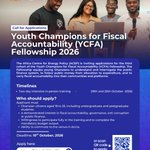
𝐂𝐚𝐥𝐥 𝐟𝐨𝐫 𝐀𝐩𝐩𝐥𝐢𝐜𝐚𝐭𝐢𝐨𝐧𝐬| 𝐘𝐨𝐮𝐭𝐡 𝐂𝐡𝐚𝐦𝐩𝐢𝐨𝐧𝐬 𝐟𝐨𝐫 𝐅𝐢𝐬𝐜𝐚𝐥 𝐀𝐜𝐜𝐨𝐮𝐧𝐭𝐚𝐛𝐢𝐥𝐢𝐭𝐲 𝐅𝐞𝐥𝐥𝐨𝐰𝐬𝐡𝐢𝐩 𝟐𝟎𝟐𝟔
Are you a young Ghanaian passionate about fiscal accountability, public finance, governance, or anti-corruption? This opportunity is for you.
The Africa Centre for Energy Policy (ACEP) is inviting applications for the third cohort of the Youth Champions for Fiscal Accountability (YCFA) Fellowship.
The fellowship equips young Ghanaians with the knowledge and skills to understand and interrogate the public finance system, follow public money from allocation to expenditure, and champion fiscal accountability within their communities and on their platforms.
𝐖𝐡𝐨 𝐬𝐡𝐨𝐮𝐥𝐝 𝐚𝐩𝐩𝐥𝐲?
Young Ghanaian citizens aged 18–35, including undergraduate and postgraduate students, with an interest in fiscal accountability, governance, anti-corruption or public finance.
The training will be on 19–20 October 2026 in Accra. The application deadline is 10 October 2026.
If you are ready to deepen your understanding of public finance and use your voice to advance accountability, apply to join the third cohort of YCFA.
📷 Apply here : bit.ly/YCFA-C3
#YCFA2o26 #FiscalAccountability #PublicFinance #YouthLeadership #ACEP #ghana

We celebrate our Executive Director, Mr @benboakye, on his special recognition at the @NRGInstitute Changemaker Awards in New York.
The distinction recognises the exceptional impact of his work across Africa, particularly his ability to combine rigorous research and technical expertise with bold, public-interest advocacy to challenge decisions affecting some of the continent’s most important natural resource and energy assets.
We celebrate this well-deserved recognition. Congratulations, Benjamin, from all of us at ACEP!
#Changemaker
#ACEP

𝐋𝐀𝐔𝐍𝐂𝐇 𝐎𝐅 𝐂𝐋𝐈𝐌𝐀𝐓𝐄 𝐈𝐍𝐍𝐎𝐕𝐀𝐓𝐈𝐎𝐍 𝐇𝐔𝐁
Last week, @AcepPower launched the Climate Innovation Hub, a catalytic platform supporting innovations that can advance Africa’s climate and development goals.
Innovation goes beyond technology. Finance, policy, regulation, business models, institutions and digital systems can determine whether climate solutions reach scale.
The first cohort comprises six young innovators developing solutions to some of Africa’s pressing climate and development challenges.
We are grateful to @oxfaminghana for their support.
#ClimateInnovationHub #ACEP #ClimateInnovation


ALT #KwameNkrumahMemorialDay #KwameNkrumah #Osagyefo #Ghana #NkrumahLegacy #PanAfricanism #AfricanUnity #GhanaHistory
The Africa Centre for Energy Policy participated in the 14th Conference on Climate Change and Development in Africa (CCDA-XIV), hosted by the United Nations Economic Commission for Africa (UNECA) in Addis Ababa.
As a continental strategy-setting platform ahead of COP31, CCDA-XIV focused on strengthening African agency in global climate governance: moving beyond what Africa should seek from the global climate process to what Africa can propose, shape and advance.
Against this backdrop, ACEP Executive Director Benjamin Boakye moderated a session on Just Transitions and Critical Minerals Governance, highlighting the need for sound economic decisions, competitive value chains, effective industrial policy and financing to translate Africa’s mineral wealth into lasting economic value.
Africa Centre for Energy Policy continues to follow and contribute to the conversations leading up to COP31, COP32 and beyond.


𝐅𝐄𝐂 𝟐𝟎𝟐𝟔 𝐚𝐭 𝐚 𝐆𝐥𝐚𝐧𝐜𝐞
Two days of rich conversations, diverse perspectives and strong participation as policymakers, industry leaders, researchers, innovators and development partners came together to discuss Powering Africa’s Industrial Transformation.
From participation and gender representation to the number of speakers and sessions, the numbers capture the scale and diversity of a conference that brought Africa’s energy and industrial future into focus.
Here’s FEC 2026 in numbers.

𝐖𝐡𝐚𝐭 𝐬𝐭𝐚𝐲𝐞𝐝 𝐰𝐢𝐭𝐡 𝐨𝐮𝐫 𝐬𝐭𝐚𝐤𝐞𝐡𝐨𝐥𝐝𝐞𝐫𝐬 𝐚𝐟𝐭𝐞𝐫 𝐅𝐄𝐂 𝟐𝟎𝟐𝟔
From the conversations that challenged conventional thinking to the ideas that could shape Africa’s energy and industrial future, FEC 2026 brought together some of the continent’s leading voices to engage, exchange and reflect on what must change.
In this video, hear from some of our stakeholders as they share their experience, key takeaways and reflections from the conference.
Their perspectives capture the depth of the conversations at FEC 2026 and the urgency of turning ideas into action.
#FEC2026
𝐌𝐞𝐞𝐭 𝐭𝐡𝐞 𝐍𝐞𝐱𝐭𝐆𝐞𝐧 𝐑𝐞𝐬𝐨𝐮𝐫𝐜𝐞 𝐆𝐨𝐯𝐞𝐫𝐧𝐚𝐧𝐜𝐞 𝐋𝐞𝐚𝐝𝐞𝐫𝐬 𝐂𝐨𝐡𝐨𝐫𝐭 𝟏𝟏!
Africa’s resource future needs leaders with the knowledge, skills and courage to drive change. Our NextGen Resource Governance Leaders bring diverse expertise, fresh perspectives and a shared commitment to building stronger, more accountable resource governance systems across the continent.


𝐓𝐡𝐞 𝐄𝐧𝐞𝐫𝐠𝐲, 𝐈𝐝𝐞𝐚𝐬 𝐚𝐧𝐝 𝐂𝐨𝐧𝐯𝐞𝐫𝐬𝐚𝐭𝐢𝐨𝐧𝐬 𝐨𝐟 𝐅𝐄𝐂 𝟐𝟎𝟐𝟔
What does it take to power Africa’s industrial transformation?
At the Future of Energy Conference 2026, policymakers, industry leaders, researchers, innovators and development partners came together to explore this question and more.
From powerful insights and engaging panel discussions to bold ideas and meaningful exchanges, FEC 2026 created space for conversations that matter for Africa’s energy and industrial future.
Watch the highlights and catch a glimpse of the conversations, connections and energy that defined FEC 2026.
#FEC2026 #FutureOfEnergy #EnergyForIndustrialisation #Africa #EnergyTransition
Closing the AFRIEKH Summer School on a High Note!
About 50 participants from across Anglophone Africa came together for an impactful week exploring Africa’s extractive future in the energy transition.
From bauxite refining and critical mineral value addition to methane management, just energy transitions, community impacts and financing Africa’s energy future, participants engaged with the opportunities and challenges shaping the continent’s resource and energy landscape.
They also joined the Future of Energy Conference 2026, connecting classroom insights with real-world conversations on energy, industrialisation and Africa’s development.
The week may be over, but the conversations, connections and ideas continue. Until the next AFRIEKH Summer School!
#AFRIEKH #SummerSchool #EnergyTransition #CriticalMinerals #Africa
🤖 Made with AI


