

HFT trader | EX @SG_Longbridge @OrderlyNetwork @Bifrost @ABCCExOfficial https://xitter.cf/t.co/1qMzwoPmXE https://xitter.cf/t.co/0ZqPa5PL3A
Hangzhou & Hong Kong
Joined January 2011
- Tweets1.6K
- Following2.1K
- Followers3.2K
- Likes1.5K





Pinned Tweet
有没有人研究金融行情数据训练 类 jev/laya 的决策模型? 可以一起研究
t.me/Akagi201

Been on Muxy for two weeks. It's the terminal multiplexer built for people who live in Claude Code.
Every terminal runs on a persistent server. Close the app, close the laptop — agents keep working. You get a ping when they're done. Reopen and everything is exactly where you left it, scrollback included.
Projects are first-class. Each branch gets its own worktree and terminals (Cmd+Opt+W to switch). Composer pastes screenshots straight into your agent. Phones connect over LAN/VPN.
Rust + GPUI. Open source. tmux-familiar (Ctrl-B). macOS & Linux.
muxy.app

Akagi201 retweeted

Similarly a complex derivatives book will almost certainly be done as a block (the terminology is “portfolio trade” or “list trade” in that case) since the products won’t be liquid and some of them may even be bilateral and require novation.
Ran benchmarks on multiple EVM state sync approaches: 8 accounts × 8 slots. Direct raw reads have the lowest cold-read latency; pre-warn / pre-warm optimizations can improve this. IPC still comes out top among RPC options. Skip the network stack even for local calls.
* IPC connect cost: ~6µs
* IPC cold state read: ~4.2x faster than JSON-RPC
* Direct evmdb MDBX read is fastest overall: cold reads ~11.5x faster vs IPC
* Performance of all three becomes comparable once cache is warm
#MEV #EVM #Performance #IPC #RPC #Benchmarks


This awesome work! Use Lean to prove semantic equivalence before and after the replacement, and replay real transactions with revm to ensure transaction results stay the same without gas increases.
github.com/figtracer/evm-gol…

语言模型负责策略层判断、确定性程序负责执行层实现
有了 AI/jev 之后 根据市场状态,在策略之间进行动态选择已经成为了 SOTA
arxiv.org/pdf/2610.10407
这才是垂直 Agent 的实力, 看来小看 Agent Harness 的作用了.

一个用 AI 攻击韩国金融机构的人,连自己服务器的目录列表都没关。研究人员顺着公开文件,直接读到了他的 Claude Code 会话记录。
CrowdStrike 的报告里,AI 的能力和操作者的业余程度,几乎摆在了同一页。
他的工具组合已经相当完整:两台服务器分工,一台位于香港,作为主要操作基础设施;另一台部署开源 AI 渗透测试工具 ARTEX。ARTEX 以 DeepSeek 为主要模型后端,他还在 Claude Code 会话中搭配使用 GLM 和 Grok,并通过多个代理 IP 开展活动。
他甚至在 CLAUDE.md 里写了中文渗透测试指令,规定模型如何执行任务。这套工具被用于短时间内针对多家韩国金融机构开展攻击,相关活动涉及数据外泄。
但他把配置、AI 记忆文件和会话历史都留在了公开目录里。研究人员顺着 CLAUDE.md 中的服务器地址,就找到了更多记录,包括他向 AI 打听韩国泄露数据在哪里卖、如何寻找 Telegram 数据交易群的内容。
接着,他又让 AI 写安全研究员简历,要求把攻击成果写进去,还提供了姓名、电话、Telegram 账号、学校和所在地。学校填的是华南理工大学,所在地是广东茂名。这些信息被认为很可能属于攻击者,真实身份尚未确认。
AI 帮他搭起了一套复杂的攻击工具链,他却把自己的操作记录和身份线索一起公开了。工具带来的能力,已经跑在使用者的经验前面。

说实话, 我非常看好 SUI (PS: 利益相关, SUI 持有者)

上个牛市的王者这个赛季还能否继续雄起?
看到 @lianyanshe 这篇前方现场内容;
发现 sui:native 的主线也在发生巨变,而且你看,基本从这个阶段开始,除了 CEX 交易所,公链未来大家也都在向 AI 靠拢和看齐,
上个牛市的王者这个赛季还能否继续雄起?说实话我对 SUI 的感情很复杂,上个牛市,SUI 的起飞阶段靠他拿到了一些结果,所以一直有些感情,也留了一些底仓,谁曾想越跌越深,
这次看到改革比较欣慰的一点,是好在主创团队还没放弃,还在继续寻找方向,但是我目前比较关注的是到底是真实需求还是为了热度才创造和 AI 相关需求,这个很重要。
首先 Sui 确实是目前技术架构比较适合 AI Agent 经济的公链之一,而且它与 AI 的结合有明确的技术逻辑,Sui 的 Object 模型、Move、Walrus、Seal 和 Nautilus,确实形成了一套值得关注的技术组合。
具体的巨变方向大家可以看下链研兄的内容,这个方向确实有想象空间,因为未来机器之间的支付、交易、借贷,可能产生远超人类手动操作的交易频次,对底层公链的性能和结算能力提出更高要求。
但是这个成功的关键不在于 Sui 能处理多少 TPS,而是它能否成为未来 AI Agent 自主管理资产、支付和交易的基础设施。
但我觉得我最关心的只有两件事:
1️⃣ 技术上能够承载万亿级交易,与真实产生万亿级交易需求,是两回事。
2️⃣ 接下来更值得关注的是实际采用率、稳定币结算规模,以及这些增长最终能为 SUI 捕获多少价值。
如果未来绝大多数交易都由 AI Agent 发起,那么真正稀缺的到底是执行这些交易的计算能力,还是能够让人类安全地将资产控制权委托给机器的可信基础设施?
我觉得 Sui 应该尝试争夺后者。
再次感谢 @lianyanshe 兄前方发回的报道!

Polymarket V2 is a necessary architectural reset, but the real test is not the audit stack—it’s whether searchers can deterministically model every fill, position transition, dispute path, and upgrade boundary without hidden settlement risk.

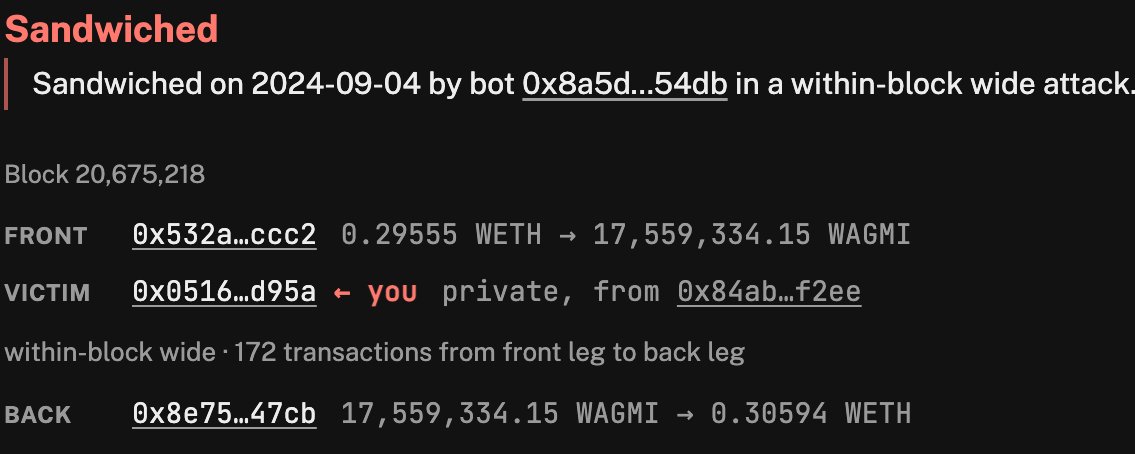
this shows that private order flow reduces exposure but does not eliminate it—the real challenge is securing the entire transaction pipeline against leakage, correlation, latency, and behavioral inference.


Akagi201 retweeted

Our Neuroevolution textbook is finally in print!
Free online edition: neuroevolutionbook.com/
Pre-order: a.co/d/06DpkH9h
I am incredibly grateful to my co-authors Sebastian Risi, Yujin Tang, and Risto Miikkulainen for making this happen. Neuroevolution is a subject very dear to my heart. It is the field that convinced me that nature has already figured out how to build intelligence: through evolution, collective behavior, and adaptation under constraints.
This idea, that intelligence emerges from evolution operating under constraints rather than unlimited resources, is what eventually led me to founding Sakana AI here in Japan.
The concepts in this book about open-ended creativity and self-organizing systems are exactly what we build at @SakanaAILabs. Our name and logo are inspired by schools of fish moving together, adapting as one. It is the core philosophy of what we build. This book captures the theoretical foundations of that belief.



the evidence could also reflect a compromised partner, order-flow intermediary, or trading app.

Spent a bit of time this morning looking into this
Based on this initial examination, I believe at least 1 relay solver may be leaking private intent data to sandwichers
Looking at the RH sandwich attacks conducted by these bots(*), every single sandwich contained at least 1 victim from Relay
One interesting thing to note about this is that often the swaps have multiple pools they can route through and Relay solvers do a primitive (**) form of onchain routing where they swap multiple candidate routes, reverting each one, and then selecting the best one to run. So that means the attackers have to perturb the pool just enough that they can profit but not so much that the solver routes through another pool
(*) Subset of bots where 100% of sandwiches have >=1 Relay victim (search period: last 6 days)
0x44c0ba0b734d4b7705fcd07ddae9fbbc078d74dd
0x38b3f8125bbbd45b56d0c3a535b90181d7dd3880
0x2a23c6d2522f07d230abf9c7a96d703520fd222b
0x18e0efe5be1cbb4e060c26f7f16f276be4dbc38c
0x9d61ad5c82586ae118af38e1cc68c8d1ad50771a
(**) by primitive onchain routing, I don't mean it in a negative way, just that it's the simplest way


Returning to open priority-fee auctions is a welcome simplification—often the least exotic mechanism is the most composable—but PGA may simply make MEV competition more explicit rather than more efficient.
The real test is whether Fast Feed and PGA improve net execution quality after latency, information asymmetry, bidding costs, and failed-auction externalities—not whether they merely shift rent extraction away from Timeboost.


I’m surprised that protected order flow still leaves such a large attack surface across the transaction path. The key takeaway is that privacy must cover not only pending transaction content, but also routing, timing, and behavioral predictability.

🚨 New paper alert 🚨
No Place to Hide: An Analysis on Protected Order Flow Sandwich Attacks
w/ Ozan Solmaz @boez95 @ChristofTorres
Bots watch every pending trade in Ethereum's public mempool and sandwich the ones worth attacking. Hence the nickname: the dark forest. In response, Ethereum and other chains built protections, from private RPCs to mechanisms native to the chain, that shield trades from these bots. We call this protected order flow.
How well are these users actually protected? We measured it in a three-year study of sandwich attacks by persistent bots against protected order flow on Ethereum, Solana, Tron, Base, Arbitrum, and Monad. The protections on these chains range from private RPCs on Ethereum and private submission to a centralized sequencer on Base and Arbitrum, to first-come-first-served ordering in Tron's public mempool and local mempools on Solana and Monad. Local mempools were never meant as a full front-running prevention, but they do limit who sees a trade before it lands.
On four of the six chains, we observe protected order flow sandwich attacks: 28.0M attacks on Solana, 38,567 on Tron, 30,607 on Ethereum plus 2,576 more through reorged blocks, and 1,889 on Base.
We trace each chain's exposure and find that it sits in various places along a transaction’s path.
🟠 Ethereum: OFAs can expose enough information to make private trades sandwichable, especially when the same transaction reaches multiple OFAs or when searchers receive full transaction details. Reorged blocks also expose private transactions. We find transactions that were private and untouched in a block that got reorged, and then sandwiched on the canonical chain.
🟠 Solana: transactions are sent to the upcoming leaders, and early on we find that a few leaders carry far more attacks in their blocks than their share of blocks, i.e., they are likely the exposure source for these transactions. From 2025 that fades, but we see that victims concentrate around a few apps.
🟠 Tron: we presume that bots win latency races in the public mempool, so the first-come-first-served ordering in block building does not fully prevent sandwiches.
🟠 Base: we see two different kind of exposure. One lines up with a documented RPC bug that exposed pending transactions. The other has attackers preying on victims who trade on a predictable schedule, if the vicim does the same trade every couple of blocks, the attacker can front-run them without observing the pending trade.
Protected order flow sandwiches look very different from public mempool sandwiches. The attacker's transactions often land in a different block than the victim's, and unlike in the public mempool, their success is not guaranteed. These attackers simply don't act with the same certainty.
The dark forest may have shrunk, but we show there's an even darker corner of it, where users who think they're protected still get front-run. Protection has to hold at every layer, from the app to the RPC to the block producer. Encrypted mempools and TEE-based designs can help, by keeping transaction contents out of attackers' reach until inclusion. But even they might not be enough on their own without privacy, for example if the victim is too predictable.
Link: arxiv.org/abs/2609.28115
