

Documenting the rise of tokenized assets | RWA • Tokenization • MENA | Following the future of finance
Web3
Joined July 2024
- Tweets3K
- Following121
- Followers100
- Likes4.4K




Pinned Tweet
After months away from X, I’m starting fresh.
I’ll be documenting what I learn about:
• RWA
• Tokenization
• The future of finance
My goal is simple:
Learn in public, share insights, and follow the rise of tokenized assets.
Aliza | Tokenization Research retweeted

Okay, here's my @jumperapp volume:
✅ Around $2.28 million.
The best part? I never farmed this volume.
Whenever I needed to bridge in the early days, Jumper already supported the coin and chain I needed. So naturally, it became my go-to bridge.
Check yours here: jumper.xyz/scan

Aliza | Tokenization Research retweeted

🚨 LATEST: Pumpfun’s mobile app is temporarily unavailable for new downloads from Apple’s US and India App Stores.
Existing iOS users are unaffected, while the app remains available on Google Play.


Aliza | Tokenization Research retweeted

Best AI hack of all time:
Grok Bot (the world's most powerful agentic software) PLUS Hermes.
Most people are only using one or the other.
You can actually stack both agents together for the best results.
Here's how:
Why I'm a fan of using both
→ Grok Bot: a cloud computer per agent, signs into any app, model flexibility (Opus, Claude, GPT-5.6), easy plug-and-play setup
→ Hermes: full data sovereignty, self-hosted memory you own outright, cheaper
The split (in practice):
Use Grok Bot for:
→ Anything needing deep app integration, Salesforce, Slack, Gmail, Figma, CRMs
→ Built for signing into tools and working across your whole stack
Use Hermes for:
→ Anything sensitive, cost-heavy, or memory-critical, financial data, personal admin
→ 24/7 tasks where you don't want to pay premium pricing for volume
How to actually connect them
→ Connect both through Buzz, Jack Dorsey's open-source team chat. You can add Grok Bot and Hermes agents to the same workspace, and they coordinate directly in shared channels instead of operating in silos.
→ Alternative: have your Grok Bot Chief of Staff delegate specific tasks to Hermes via a webhook or shared task file, Grok for app-heavy orchestration, Hermes as a cheap, always-on execution layer underneath it.
A real setup example
→ Grok Bot handles the GTM stack: meeting prep, inbox triage, slide generation, CRM updates
→ Hermes runs personal financial research, subscription audits, and content research in the background, dramatically cheaper per task
→ Both report into the same Buzz workspace, one place to check instead of switching between two apps

Ondo just hired former Blockchain.com CFO Adam Schlisman as its new CFO.
Another sign that RWA is moving beyond crypto hype toward institutional-grade financial infrastructure.
Tokenization is getting serious.
10
One realization I’ve had while studying RWA:
The winners won’t necessarily be the projects with the biggest hype.
They’ll be the ones that solve real financial problems.
Better settlement.
Better liquidity.
Better access.
9
One thing I’ve changed my mind about:
At first, I thought RWA was mainly about blockchain.
Now I think it’s more about financial infrastructure.
Blockchain is the tool.
Efficient markets are the goal.
That’s why I’m spending more time understanding finance, not just crypto.
7
The more I study RWA, the more I see the real challenge:
Tokenizing an asset is not enough.
It also needs:
• Clear ownership
• Reliable pricing
• Liquidity
• Legal enforceability
The technology may be ready before the market is.
6
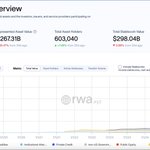
Why Securitize leads with $4.8B RWA despite only 1,857 holders, while Ondo has 173K holders but $3.6B?
@Securitize = Big institutional funds (BlackRock BUIDL + large tickets)
@Ondo = Retail/DeFi yield products (more holders, smaller average size)
Holders ≠ Total Value

11

Not every asset becomes more valuable when tokenized.
Tokenization only makes sense when it improves something:
• Access
• Liquidity
• Settlement
• Transparency
Putting an asset on-chain is easy.
Creating real demand for it is the hard part.
RWA adoption will not be driven by tokenization alone.
It will be driven by better products:
• Faster settlement
• Wider access
• Lower costs
• Clearer ownership
• Reliable liquidity
The blockchain should improve the asset—not make it more complicated.
5
RWA is not just about putting assets on-chain.
The real challenge is building markets around them:
Liquidity.
Compliance.
Distribution.
Trust.
Without these, tokenization remains infrastructure without adoption.
5
The next phase of RWA won’t be defined by how many assets are tokenized.
It will be defined by how many tokenized assets have:
• Real demand
• Reliable liquidity
• Clear regulation
• Sustainable use cases
Tokenization alone is not adoption.
9
One thing I’ve noticed while studying RWA:
The biggest winners may not be token issuers.
They could be the companies building the infrastructure:
• Custody
• Compliance
• Oracles
• Asset issuance
Infrastructure often creates the biggest long-term value.
5
Question I keep asking myself:
If tokenization becomes mainstream…
Which asset class will benefit the most?
• Treasuries?
• Stocks?
• Real Estate?
• Private Credit?
I’m leaning toward private credit and treasuries, but I’m still learning.
What do you think?
8
RWA adoption will not happen because people suddenly become interested in blockchain.
It will happen when tokenization makes financial products easier to issue, access, transfer, and settle.
Utility will drive adoption.
Not hype.
10
Every new 24/7 asset makes onchain markets a little more complete.

Weekend trading just got a major upgrade.
10 more of the most in-demand Ondo Stocks are now live with real 24/7 trading:
→ AMD
→ Intel
→ Micron
→ TSMC
→ Marvell
→ SpaceX
→ SanDisk
→ Broadcom
→ SK hynix
→ Arm Holdings
That brings the 24/7 lineup to 16 assets, joining SPYon, QQQon, CRCLon, NVDAon, TSLAon, and GOOGLon 🧵↓
9
One thing I find interesting about RWA:
Every month, more traditional financial institutions are exploring tokenization.
Not because blockchain is new.
But because better settlement, transparency, and efficiency create real business value.
4
The more I study RWA, the more I realize tokenization is not one single market.
It includes:
• Treasuries
• Private credit
• Funds
• Real estate
• Commodities
The real question is not whether assets will be tokenized.
It is which markets will find real demand first.
6