

New Algebraic Geometry papers from https://teapawt.net/t.co/NdAXln9ImP: algebraic varieties, stacks, sheaves. Thank you to arXiv for use of its open access interoperability.
- Tweets2.5K
- Following25
- Followers421
- Likes1


ALT We study kappa classes on the normalization of the main component of the Kollár–Shepherd-Barron–Alexeev(KSBA) moduli space of stable toric pairs. Using a toric model obtained by a lattice modification, we compute all kappa classes on the moduli space by giving a combinatorial formula for their intersection numbers with all torus-invariant cycles. In particular, we identify the first normalized kappa class with the GKZ polarization of the toric variety corresponding to the secondary polytope. For interval configurations, we also obtain a closed formula for all top intersection products of normalized kappa classes.

ALT Butler's conjectures predict that, on a general smooth curve C of genus g≥3, a general coherent system [O_C⊗ VxrightarrowϕE] with semistable underlying bundle E and dim V>rk(E) has surjective evaluation map ϕ and stable kernel. In this paper, we prove Butler's conjectures for g≥8 in the two cases in which the Brill-Noether geometry of a general curve is known, namely rank one and the range μ(E)>2g-2. By deformation and openness, it suffices to establish the result on a single Brill-Noether-Petri general curve. We do so for curves on K3 surfaces of Picard rank one, using the wall-crossing theory of coherent systems developed by the first two authors.

ALT We study the specialization of torsion points in one-parameter degenerations of elliptic curves with singular fibers of Kodaira type. We describe the resulting torsion curves, their ramifications, intersection multiplicities, and irreducible and connected components.

ALT Let Fₙ be the Fermat curve of degree n over ℚ, and let Dₙ=Fₙ/S₃ be its quotient by coordinate permutations. We prove that Dₙ has trivial geometric automorphism group for every n≥ 11 with \gcd(n,6)=1. Its Jacobian has complex multiplication. For n=11, this Jacobian is absolutely simple of dimension five. We construct an isogeny over ℚ of degree 11⁵ from Jac(D₁₁) to the Jacobian of y¹¹=x(1-x)². For primes p≡ 1±od 3, we also consider the metacyclic quotients Cₚ of Fₚ over ℚ. By a theorem of Carocca, Lange and Rodríguez, their Jacobians are absolutely simple and have complex multiplication. We prove that Cₚ has trivial geometric automorphism group if and only if p≥ 19. Write p=r²+rs+s² with r,s positive integers. The natural degree-three cover Yₚ→ Cₚ satisfies gon(Yₚ)=r+s, so gon(Cₚ)≥ ⌈(r+s)/3⌉. Since g(Cₚ)=(p-1)/6, both the genus and the gonality of Cₚ tend to infinity with p.

ALT We determine all roots and their multiplicities in the Bernstein–Sato polynomial of every generic Pfaffian ideal. In the nonmaximal case, the roots lie in explicit rational windows indexed by the rank strata. Integral roots retain their label multiplicities, whereas every nonintegral root is simple, including values with several labels. The proof combines graph-module relations, skew Capelli operators, central characters, and a weighted Mellin integral. We deduce the strong motivic monodromy conjecture for Pfaffian ideals, with pole orders bounded by Bernstein–Sato root multiplicities. For Pfaffians of size 2r, the largest possible root multiplicity as the matrix size varies is ⌊(√(8r+1)-1)/2⌋. In the nonmaximal case we also prove that the nonunipotent part of the Verdier specialization has zero nilpotent monodromy. Keywords. Bernstein-Sato polynomial, Pfaffian ideal, root multiplicities, strong monodromy conjecture.

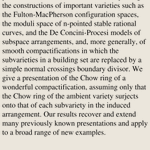
ALT The theory of wonderful compactifications provides a common framework encompassing the constructions of important varieties such as the Fulton-MacPherson configuration spaces, the moduli space of n-pointed stable rational curves, and the De Concini-Procesi models of subspace arrangements, and, more generally, of smooth compactifications in which the subvarieties in a building set are replaced by a simple normal crossings boundary divisor. We give a presentation of the Chow ring of a wonderful compactification, assuming only that the Chow ring of the ambient variety surjects onto that of each subvariety in the induced arrangement. Our results recover and extend many previously known presentations and apply to a broad range of new examples.

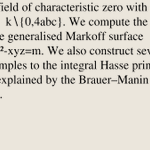
ALT Let k be a field of characteristic zero with a,b,c∈ kˣ and let m∈ k∖{0,4abc}. We compute the Brauer group of the generalised Markoff surface ax²+by²+cz²-xyz=m. We also construct several counterexamples to the integral Hasse principle, which are explained by the Brauer–Manin obstruction.

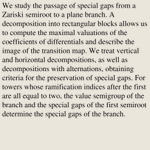
ALT We study the passage of special gaps from a Zariski semiroot to a plane branch. A decomposition into rectangular blocks allows us to compute the maximal valuations of the coefficients of differentials and describe the image of the transition map. We treat vertical and horizontal decompositions, as well as decompositions with alternations, obtaining criteria for the preservation of special gaps. For towers whose ramification indices after the first are all equal to two, the value semigroup of the branch and the special gaps of the first semiroot determine the special gaps of the branch.

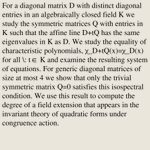
ALT For a diagonal matrix D with distinct diagonal entries in an algebraically closed field K we study the symmetric matrices Q with entries in K such that the affine line D+tQ has the same eigenvalues in K as D. We study the equality of characteristic polynomials, χ_D+tQ(x)=χ_D(x) for all \: t∈ K and examine the resulting system of equations. For generic diagonal matrices of size at most 4 we show that only the trivial symmetric matrix Q=0 satisfies this isospectral condition. We use this result to compute the degree of a field extension that appears in the invariant theory of quadratic forms under congruence action.

ALT We introduce a class of interesting algebraic varieties — odd biisotropic symplectic Grassmannians S₂Gr(k,2n+1) and study them with an emphasis on the case of the submaximal odd biisotropic symplectic Grassmannians S₂Gr(n,2n+1), which we call catalecticant varieties. The main result of the paper is a construction of a full exceptional collection in the derived category of the catalecticant sixfold S₂Gr(3,7).

ALT We develop effective calculation tools for constructing categorified invariants of tangles and knots, following the work of Cautis and Kamnitzer. These invariants, originally constructed by means of Fourier-Mukai transform functors between derived categories of coherent sheaves on certain iterated flag varieties, can be given an alternative algebraic description by using tilting bundles. We use this method and provide several examples of its application, in the hope of showing its utility to explicit pen-and-paper computations. This tilting-bundle method also allows us to lift the construction from derived to homotopy categories of complexes of modules, reducing the calculation of tangle invariants to a type of categorified matrix algebra, where the matrices in question have maps between their elements and calculations get turbocharged with chain homotopy.

ALT In this paper, we develop an explicit calculation of ordinary topological Euler characteristics of the coarse moduli spaces underlying Hassett spaces in the minimal all-light chamber and the Deligne-Mumford compactification. For genus g≥2, we organize the calculation through a decomposition indexed by stabilization graphs and their decorations. The Burnside-Lefschetz formula allows us to compute the resulting contributions, taking into account graph symmetries and their fixed loci. The calculation in genus two illustrates the method explicitly and, in the Deligne-Mumford case, recovers the generating function of G. Bini, G. Gaiffi, and M. Polito (arXiv:math/9806048), with the corrections of G. Bini and J. Harer (arXiv:math/0506083), providing a check on the construction. We also carry out the calculation in genus three in an appendix. Together with an elementary genus-one calculation based on collision partitions and rational necklaces, these formulas yield complete asymptotic expansio

ALT We study G-Mori fibre space models of G-del Pezzo surfaces, focusing on surfaces over non-closed fields. We construct explicit examples of birationally rigid sextic del Pezzo surfaces and give a negative answer to a generalization of Kollár's question on birational rigidity and field extensions: a sextic del Pezzo surface of Picard rank 1 can fail to be birationally rigid over its ground field but become birationally rigid after an algebraic field extension. We interpret this phenomenon in terms of the failure of injectivity of natural maps in nonabelian Galois cohomology induced by the inclusion of automorphism groups into birational automorphism groups. We also show that finite pliability is unbounded: for every integer d≥slant2, we construct a sextic del Pezzo surface of index 3 over a field of characteristic zero whose pliability is exactly 3ᵈ+1.

ALT Let G be a connected reductive group with Borel subgroup B, flag variety ℬ=G/B, and Weyl group W. We define the Hessenberg functor on the geometric Hecke category by microlocalizing along the diagonal in ℬ×ℬ and pushing forward along the Springer map. It induces the Hessenberg character of the Iwahori–Hecke algebra, with values in graded W-representations. On Kazhdan–Lusztig basis elements indexed by smooth elements of W, this character recovers the cohomology of the associated regular semisimple Hessenberg varieties. We identify the Hessenberg functor with the microlocalization of Lusztig's character functor and compute the Hessenberg character using Lusztig's nonabelian Fourier pairing. More generally, for families of Hessenberg schemes defined by pure-dimensional B-stable closed cones in the tangent space T_eBℬ, we show that monodromy on the intersection cohomology of regular semisimple fibers factors through W. When the cone is the tangent cone of a Schubert variety, we give a loca

ALT A prolongation variety of a polynomial differential system S is an algebraic variety defined by the equations of S and their derivatives up to a given order. We compute the geometric degree of the prolongation varieties associated with the system x₁'=x₂², x₂'=x₁² in terms of the prolongation order, thereby proving a conjecture stated by Gleb Pogudin in Section 2, Question 6 of "Some Open Problems in Differential Algebra". Our approach is motivated from the beginning by doing computational experiments in OSCAR in order to find the number of solutions of a zero-dimensional system using algebraic Thomas decomposition. The result will follow from a coprimality condition on a family of polynomials with integer coefficients, which is verified by showing that their roots satisfy a strong interlacing property. Finally, we propose an extension of the conjecture for the systems x₁'=x₂ⁿ, x₂'=x₁ⁿ with n>2.

ALT We determine the universal constant in the large-genus asymptotic expansion of super Weil-Petersson volumes. The argument adopts the uniform-transport strategy for shifted theta intersection numbers. The uniform large-genus theorem for normalized BGW numbers of Guo-Norbury-Yang-Zagier determines the amplitude at a simpler endpoint. The result is C=π⁻⁹/². We give a proof of the Griguolo-Papalini-Russo-Seminara conjecture for fixed boundary lengths and fixed descendant degrees. The boundary formula is uniform when the sum of the lengths is o(√ g), and we exhibit an obstruction at the √ g scale. We also compute the first four inverse-genus coefficients by two exact recursive methods and derive general polynomial structure results. Finally, we show that, for each fixed genus, the super Weil-Petersson volume divided by n! is a polynomial in the number n of marked points.

ALT In this article, we use Wu's method to prove Budur's multi-variable n/d-conjecture for completeness.

ALT We provide an algorithm for enumerating ordinary K3 surfaces over a fixed finite field based on Taelman's theorem. We use this algorithm to prove that there exist no K3 surfaces without rational points over Fq for every prime power q≥ 13. For elliptic K3 surfaces, we give a geometric proof of this non-existence without computer assistance. On the other hand, we also provide explicit pointless K3 surfaces over Fq for every prime power q≤ 11.

ALT We consider the comparison between a Milnor fibre of a function f and its section by the zero locus of a second function s in a general ambient variety X. We give a formula that generalizes those of Lê and Siersma, expressing the difference of their Euler characteristics as a sum of local contributions associated with the critical points of the restriction of s. We provide an algebraic formula in the case that X is smooth of pure dimension outside f⁻¹(0), and show some applications and examples.

ALT We prove that a finite surjective post-critically finite self-map of a variety in characteristic zero remains post-critically finite on every preperiodic integral effective divisor after passing to its periodic image with its return map. Iterating this result proves PCF all the way down. A detailed report on AI usage is contained in the manuscript.