

CEO NCRLA. SBA Admin🇺🇸‘21-‘25 KY, TN, MS, AL,NC,SC,GA,FL• 3 Term Greenville NC Mayor‘11-‘17 Cofounder IQMax• Exec NC Global TransPark, EVP FlyExclusive‘17-‘21
North Carolina, USA
Joined February 2011
- Tweets13K
- Following796
- Followers3.5K
- Likes10.8K




Allen Thomas retweeted

On this day in North Carolina history October 26, 1895.
North Carolina helped change football forever, and it happened because a desperate player broke the rules.
UNC was playing Georgia in Atlanta when fullback Joel Whitaker faced a Georgia rush that threatened to block his punt. Instead of kicking the ball, he threw it forward to teammate George Stephens.
Stephens caught it and ran 70 yards for a touchdown.
Georgia's coach, legendary Pop Warner, protested. The forward pass was illegal, but the referee never saw the throw. The touchdown stood, and UNC won 6 to 0.
The forward pass wouldn't become legal until 1906.
Think about that the next time you watch a quarterback throw a touchdown. A play that helped shape modern football started with a desperate decision by a Tar Heel.
North Carolina history is full of stories like this one. 🏈

Allen Thomas retweeted

Everyone in Japan remembers the American aircraft carriers and helicopters that flew across the sky during Operation Tomodachi in March 2011.
Almost nobody knows about the Americans who crawled across the pitch-black bottom of the freezing ocean so northern Japan would not freeze to death.
After the tsunami of March 11, snow was falling across northern Japan. Tens of thousands of survivors in shelters had no electricity and were running out of kerosene for their heaters. Japanese fuel tankers loaded with heating oil were waiting offshore, but they could not dock.
Why could the fuel ships not enter the harbors at Hachinohe and Miyako?
Because the tsunami had swept thousands of cars, semi-trucks, tangled fishing nets, and crushed houses onto the harbor floor. If a fuel tanker tried to enter, submerged steel wreckage would rip open its hull. And surface cranes could not simply scoop the debris out blindly because heavy fishing nets and steel beams were tangled together on the bottom in thirty-six-degree water thick with black fuel oil and silt.
You could not see one inch in front of your face underwater.
That was when the U.S. Navy sent in Underwater Construction Team Two and Mobile Diving and Salvage Unit One.
Wearing sixty-pound diving helmets and heavy rubber drysuits to keep out the toxic oil and chemical runoff, young American Navy divers stepped off snow-covered piers into the freezing black water.
Down on the harbor floor in total darkness, where a single jagged piece of car metal or a shifting truck could trap a diver or slice his air hose, the Americans worked entirely by the touch of their gloved hands.
Inch by inch, feeling their way across crushed family cars and twisted steel cables in thirty-six-degree water, they cut the wreckage apart with hydraulic saws and hooked crane cables to hundreds of tons of debris until the shipping channels were clear.
When the first Japanese fuel tanker finally glided safely into port bringing heat and light back to the freezing towns, the American divers just washed the black oil off their suits and moved to the next harbor.
True allies do not just stand beside you in the sunlight. They dive into the freezing dark where nobody is watching.
🤖 Made with AI

Allen Thomas retweeted

In 1823, a 24 year old fur trapper named Jedediah Smith was leading a group through the Black Hills when a grizzly bear charged out of the brush and slammed into him.
The bear took his entire head into its mouth. It broke his ribs, tore his scalp open from his eye to his ear, and nearly ripped his ear completely off.
When the bear finally ran off, his men stood around in shock. Nobody knew what to do. So Smith, bleeding and barely conscious, told one of them to get a needle and thread and sew him back together.
The man stitched his scalp back down. Then he told Smith the ear was too far gone. Smith told him to sew it on anyway. So he did.
Ten days later, Smith was back on his horse. For the rest of his life he wore his hair long to cover the scars.
Then he went on to become one of the greatest explorers in American history.
In 1826, he led a party across the Mojave Desert and became the first American to reach California over land from the east. The Mexican governor thought he was a spy and ordered him out.
On his way back, he became the first person of European descent known to cross the Sierra Nevada from west to east, and then crossed the Great Basin desert, hundreds of miles with almost no water. At one point a man in his party collapsed from the heat, and they buried him in cool sand just to keep him alive while Smith went looking for water.
The next year, on another trip through the Mojave, his party was attacked and ten of his men were killed.
The year after that, in Oregon, he left camp one morning to scout ahead. While he was gone, his camp was attacked and fifteen of his men were killed. Smith and three others were the only survivors.
He carried a Bible everywhere, and was known for not drinking, not smoking, and not cursing, in a profession full of men who did all three.
By his early 30s he had walked, ridden, and paddled more of the American West than almost anyone alive.
In 1831, he was guiding a wagon train down the Santa Fe Trail. They were out of water, so he rode ahead alone to find some.
He ran into a band of Comanche warriors at the Cimarron River and was killed. He was 32.
His body was never found. His friends only learned what happened when Comanche traders showed up in Santa Fe trying to sell his rifle and pistols.


Coming back to North Carolina with prize——🥧 @ChickfilA original👍 lemon pie. Thank you leadership and government affairs team for the opportunity to meet and engage at the Atlanta campus / HQ and experience first-hand what makes CFA’s operations unique. @ChickfilANews

Allen Thomas retweeted

Tomorrow! 🗓️ Join NCRLA and Asure Software at 10 a.m. for our complimentary webinar, HR Trends for 2026: Building a More Agile, Future-Ready Workforce.
There's still time to save your spot. Register now: us06web.zoom.us/meeting/regi…
#NCRLA #HospitalityHR #HRTrends #NCRestaurants

Allen Thomas retweeted
New Bern, we’re coming your way! 📍 Join NCRLA on Nov. 9 for our Hospitality Summit, featuring a fireside chat with Rep. John Bell IV and policy expert Dan Gerlach. 9 a.m.–12 p.m. at the DoubleTree by Hilton.
Register: portal.ncrla.org/events/hosp…


The birth of the Pirate 🏴☠️ goes back to 1934 @ECUAthletics @ECUPiratesFB

On this day in North Carolina history, October 6, 1983.
East Carolina University finally put a pirate on the sideline and Pee Dee The Pirate was born
Teams had been the Pirates since ’34, back when the school was still East Carolina Teachers College and the nickname was the Teachers. Students wanted something with some spirit. Blackbeard had run this coast. Bath. Ocracoke. They named him Teachy in the yearbook and called the teams Pirates.
Sideline didn’t match for 50 years. A wildcat in 1930. Then dogs. Great Dane named Buc, 1958 to ’61. French poodle named Brandy in ’68. Little terrier called Pete, or Wild Dog, 1972 to ’74, and he hated Carolina’s ram. Blackbeard’s coast and for some wild ass reason the school were running dogs out there.
Senior art major David Franks drew the suit. East Carolinian put it on the front page that day. Pitt County elementary schools named him the next spring. A fifth-grade class at G. R. Whitfield in Grimesland won with Pee Dee, after the river. Made it official at halftime of the 1984 Purple and Gold game.
Students pitched a fit they didn’t get a vote. Chancellor dropped the name. Supposed to just be The Pirate.
Didn’t take. Dowdy-Ficklen still yells Pee Dee. The kids still run up to hug Pee Dee and snap a photo.
That’s Pirate Nation. Greenville didn’t invent the legend. We kept it.


Allen Thomas retweeted

I don’t want to hear about how good any running back today is until he bulldozes an All-Pro linebacker like he’s a third-grader and then leaves the field without his jersey because the defense had to rip it off his back just to slow him down.
Allen Thomas retweeted

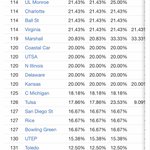
Bottom 5 Average Attendance
Kent St: 10,656
Ball St: 10,067
Buffalo: 8,830
Akron: 7,820
E Michigan: 7,052
Top 5 Average Attendance
ECU: 41,923
Fresno: 39,600
Colorado St: 39,014
Memphis: 38,236
USF: 36,847


The McRib next generation

🇺🇸 3D-printed meat is now appearing on American grocery shelves, as engineered alternatives move from labs and restaurants into everyday retail.
Five companies have received approvals for cultivated animal products, including chicken, salmon and pork fat, though most remain limited to restaurants and small-scale launches for now.
Industry insiders say cultivated meat could become very common in supermarkets by the end of the decade.
If everything wasn’t fake enough already, now you can look forward to artificial steak joining the grocery list.
Writer: Mhedi

Allen Thomas retweeted

Minnesota beat Michigan earlier today, and this might the best postgame locker room video I've ever seen 😲😲
