

Self-evolving digital employees for professional services.
Joined March 2026
- Tweets167
- Following6
- Followers766
- Likes221







An AI employee should learn the method, not copy yesterday's answer.
Our bar for Alloomi: expert feedback must transfer to a new matter with changed facts—without importing the previous client's terms. Test the next decision, not just recall of the last one.


One approved exception must not become an AI employee's standing rule.
At Alloomi, our context design keeps the source, scope and validity of a decision. The test: reuse the right lesson on the next task without turning a one-off approval into a permanent policy.

Introducing MemCurrent, a persistent memory architecture designed to help production agents stop starting from zero.
MemCurrent combines episodic memory with derived memory across three access patterns:
• Plugins to log and load context automatically
• Tools the agent calls on demand
• An offline “dreaming” pipeline that consolidates memory in the background
Agents carry forward user preferences, prior corrections, metric definitions and successful workflows instead of rediscovering them every session.
On our internal benchmark built from real enterprise data, MemCurrent triples the agent's pass rate while using 31% fewer tokens and running 26% faster. It's built into Agent Bricks' Memory offering and already powers memory in Genie.
Read the research: databricks.com/blog/memcurre…
An AI employee's memory should preserve professional judgment—not just past conversations.
At Alloomi, we design context around the work: what applies now, where it came from, and who can use it. Corrections update the working state without erasing its history.

Announced today at #GeminiAtWork from @GoogleCloud:
✨ Gemini is becoming your universal agent for work. It answers your questions, handles your knowledge work, creates images and media, and writes and runs code, all grounded in your business context. No need for step-by-step instructions — just delegate an outcome and return to finished work.
✨ Gemini works inline in @GoogleWorkspace — directly inside Gmail, Drive, Docs, Slides, Sheets, Chat, and Calendar, with the same memory, skills, and controls it has everywhere else.
✨ New data and analytics skills let technical teams and everyday business users ask questions in natural language and get actionable insights in minutes.
✨ Specialized industry-specific skills, tools and connectors are rolling out for financial services and legal teams.
✨ Built-in security and governance give IT teams peace of mind with enterprise-grade data protection, privacy controls, and central oversight.
Learn more: goo.gle/4jNzpFP

ALT Text reads "Google Cloud" above the Gemini at Work logo.
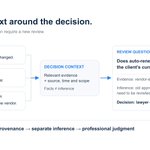
The hardest context isn't in the document. It's the old detail the user didn't know to retrieve.
Our design principle: assemble context around the decision, not just the latest file.
That means:
→ Recall across documents and conversations.
→ Keep source, time and scope attached.
→ Separate evidence from inference.
→ Leave unresolved judgment with the professional.
Take an unchanged auto-renewal clause. It was approved last year—but a project email six weeks ago mentions leaving the vendor.
That email is a reason to revisit the decision, not proof that approval was revoked.
Alloomi is built to surface that connection without making the user reconstruct it first.
Retrieval finds the detail. Decision context explains why it matters.

A self-evolving agent can compound expertise—or compound error. The difference is safeguards.
Real-world feedback is noisy, contradictory, and sometimes adversarial. Letting every successful-looking trajectory become training data is not learning. It is an uncontrolled feedback loop.
Our safeguards operate across the full learning cycle:
→ Before learning: provenance and quality filters decide which (context, decision, feedback) experiences enter the pool
→ During learning: expert anchoring and cross-task replay reduce self-reinforcement and catastrophic forgetting
→ Before deployment: a validation gate evaluates task reward, calibration error, and reasoning-trace consistency
→ After deployment: versioned checkpoints, continuous monitoring, and automatic rollback keep changes auditable and reversible
In a 10-task retention evaluation, the full system retained 51.3% across five skills, versus 33.6% for the same-backbone no-replay control.
The goal is not autonomous change. It is controlled, verifiable, and reversible improvement.
What safeguards would you require before an agent could learn from your organization's work?

Most agents can finish a task. The harder question is whether run 100 is better than run 1.
Alloomi filters and replays feedback from real work for post-training, anchors learning to expert standards, and carries that experience into the next delivery.


An agent that remembers across tools is useful.
An agent that remembers the wrong version across tools is worse.
Durable memory needs provenance, freshness, and correction—not just consolidation.
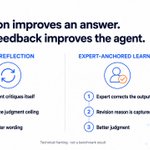
Self-reflection has a ceiling: the model is still grading itself with the judgment it already has.
It can catch an inconsistency or rewrite a weak answer. But another reasoning pass cannot teach the model why an expert rejected a clause, changed a recommendation, or approved an exception.
Our learning unit is a (context, decision, feedback) triple. Before it enters the experience pool, a quality filter checks confidence, feedback sufficiency, and diversity. Accepted experience is then combined with cross-task replay, teacher-target distillation, and LoRA updates.
In our same-backbone CL-bench comparison, the full system reached 47.6%: +23.1 points over FewShot and +8.2 points over the strongest retrieval baseline.
Reflection improves an attempt. Grounded experience improves the policy that produces the next attempt.
Where should expert judgment enter an agent loop: before execution, during revision, or after the outcome is known?

Worktrees isolate code. They don't keep agents aligned.
Give every agent its own worktree and the real failure mode remains: one thread changes the plan while another keeps coding against the old decision. The branches are isolated. The shared understanding isn't.
That's not a Git problem. It's a context problem.
OpenContext keeps project truth outside any one session or worktree: where a decision came from, which version is current, and what it replaced.
Each agent can work in its own branch. The truth they work from shouldn't live inside one.
Parallelism is easy. Coherence is the hard part.

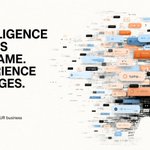
The next phase of AI agents won't be decided by how smart the model is.
Every frontier model is brilliant out of the box — and identical for everyone.
What nobody can copy is the judgment an agent absorbed inside YOUR business.
Intelligence is where every agent begins. Experience is where they diverge. That's what we're building for.

OpenContext holds 67% on BEAM at 10M tokens. RAG collapses to 24.9%, and the best published system to 26.6%.
Your agent forgets why it made decisions.
OpenContext fixes that.
Holistic context with temporal timelines, belief revision, and experience that compounds into context instead of resetting.
Context is the missing layer. Retrieval answers what happened. OpenContext answers how it became what it is.
GitHub: github.com/melandlabs/openco…

A 1M-token context window is not memory. It is a larger desk.
It can hold more history, but it still cannot tell an agent which facts are current, which have expired, or which only apply to one customer.
Holistic Context assigns each memory a scope across task, conversation, channel, person, and validity interval. It consolidates fragments into entity timelines, resolves conflicting evidence, and preserves superseded beliefs for audit and as-of-time queries.
At 10M tokens of history, our system reached a 67.0% BEAM nugget-pass rate using a 1M-context backbone. The full history could not fit inside the model window; the right state had to be maintained and retrieved outside it.
The next frontier is not longer context. It is context with state, time, scope, and provenance.
What breaks first in your production memory system: stale facts, conflicting sources, or scope leakage?
#AgentMemory #ContextEngineering

Here's our bet: agents should learn from the work itself.
Not context sitting in a database — experience written back into the model's weights.
Every task finished → data earned.
Every judgment captured → next delivery better.
The work makes the agent better. The better agent makes better work.

Agreed. But most compilers still retrieve-then-forget. Context is a scratchpad, RAG is the default. Ask, pull, answer, drop it. That's a nicer filing cabinet, not compilation.
Real compilation starts from a context that never turns off. Tracked, checked against itself, learning as it goes what's worth keeping. It filters the noise and compiles the good parts straight into the model. The memory. The hard-won experience. Not into a doc it has to go find.
We don't recall context on demand. We grow it into the model.
Every judgment compounds into the next delivery.


The most valuable training data for an agent can't be scraped off the internet.
It's the stuff that lives in one person's head: why that revision happened, what "good" actually looks like, which customer means what.
Private. Dynamic. Produced only through real work.
This is exactly where a general-purpose LLM hits its ceiling.

Every developer's trying to fix "agents don't learn" the same three ways:
→ Wrappers — connect tools, but the model underneath stays frozen
→ RAG — more facts, but never the judgment behind a decision
→ Fine-tuning — slow, expensive, always a step behind the business
All three hand the agent more information.
None of them make the agent more capable.

Everyone's racing to make AI agents smarter — bigger models, longer context, more tools.
But nobody says the uncomfortable part out loud: for most agents, the 100th time doing a task is no different from the first.
Humans compound through reps. Agents reset every time.
That's not a model problem. It's an experience problem.

Computer use is a breakthrough. But clicking faster does not make AI a better lawyer.
The gap is judgment.
Alloomi:
→ builds temporal matter context from meetings, emails, prior drafts, client preferences, and precedents
→ completes the review and redline, escalating judgment calls for approval
→ turns every approve, reject, and edit into a filtered (context, decision, feedback) signal for replay and post-training
So matter 100 does not start like matter 1.
Astra gives agents hands. Alloomi makes professional judgment compound.
