

Sharing the most fascinating and inspiring Nature.We analyse and fact check to bring you the best in real genuine nature research
United kingdom
Joined February 2020
- Tweets10.4K
- Following9.9K
- Followers338K
- Likes27.5K






Desperate Mama Dog Begs a Stranger for Help, Leads Her Rescuer Home, and Finally Reunites with Her Puppies 🐶❤️
Beavers pause while chewing through trees, listening for warning cracks that could signal a falling trunk. 🦫🌳
A remarkable survival instinct that helps them stay out of danger!
🦊 THE UNEXPECTED PASSENGER: A FOX'S JOURNEY ACROSS THE ATLANTIC! 🚢
Imagine discovering a wild fox aboard a massive cargo ship, thousands of miles from the forests and fields it calls home.
It sounds like something from an adventure movie, but animals occasionally become accidental passengers on ships, trucks, and other forms of transport.
A curious fox searching for shelter or food could unknowingly wander into a vessel before departure, turning an ordinary exploration into an extraordinary journey.
Stories of animals traveling unnoticed remind us how closely human transportation networks and wildlife can intersect.
But such journeys are far from harmless. A stowaway animal may face dehydration, hunger, stress, and unfamiliar surroundings. If discovered, it needs appropriate care and safe handling.
🌍 Sometimes, the world's most surprising travelers never intended to leave home.
The image illustrates a fox aboard a cargo ship; the specific claim that this fox secretly crossed the Atlantic has not been independently verified.
Would you believe your eyes if you spotted a fox in the middle of an ocean voyage?
#

🦧 A BRIDGE BETWEEN TWO WORLDS: HELPING ORANGUTANS CROSS SAFELY! 🌿
High above the forest floor, an orangutan carefully makes its way across a suspended bridge.
For an animal that spends much of its life in the treetops, crossing an open gap can be a serious challenge.
Orangutans are extraordinary climbers, using their powerful arms and remarkable grip to move through the rainforest canopy. But when roads, plantations, or other human activities divide their habitat, their natural pathways can disappear.
That's where specially designed wildlife bridges can make a difference.
By connecting separated areas of forest, these structures may help orangutans move more safely without descending to the ground or crossing dangerous roads.
And there's something remarkable about watching an intelligent wild animal explore a structure created to help it.
💚 Protecting wildlife isn't always about building walls. Sometimes, it's about building bridges.
Would you like to see more wildlife crossings built around the world?
Image: Artistic illustration of an orangutan using a wildlife bridge.
#

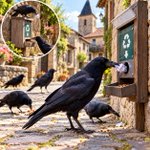
🐦⬛ THE CROWS THAT LEARNED TO TRADE TRASH FOR FOOD! ♻️
What if the solution to littering came from one of nature’s smartest birds?
In France, an unusual experiment showed just how clever crows can be. At the Puy du Fou historical theme park, trained rooks learned to collect small pieces of litter and drop them into a specially designed box in exchange for food.
The idea was simple: pick up a discarded item, deposit it in the machine, and receive a tasty reward.
But the real story goes beyond cleaning up rubbish.
Crows and their relatives belong to the corvid family, famous for their remarkable intelligence, problem-solving abilities, and capacity to learn new behaviors.
This experiment offered a fascinating glimpse of what can happen when animal intelligence meets human creativity.
🌿 Sometimes, the smartest environmental helpers aren't humans at all.
Would you like to see more cities experiment with clever ideas like this?
#

🕊️✈️ When Humans Took to the Sky to Save Endangered Birds!
How do you teach a bird to migrate when it has no experienced flock to follow?
Conservationists found an extraordinary solution: lead the way in an aircraft!
In remarkable wildlife conservation projects, pilots have flown ultralight aircraft alongside endangered cranes, guiding young birds along migration routes they had never traveled before.
Some conservation workers even wore crane-like costumes while raising the chicks, helping prevent the birds from becoming accustomed to ordinary human contact.
One famous example was Operation Migration, which helped young whooping cranes learn routes between Wisconsin and Florida.
These flights demonstrated just how far humans could go to help protect a species threatened with extinction.
🌍 Sometimes, saving wildlife means becoming part of its journey.
Would you ever imagine that an airplane could become a bird's migration guide?
Image: Artistic recreation inspired by real crane conservation efforts.
#

What If Paradise Had Pink Sand? This Incredible Beach Has a Secret! 🩷🌴
A hidden tropical cove. Crystal-clear turquoise waves. Towering palm trees. And a shoreline glowing with a delicate shade of pink.
It looks like a dream, but pink sand beaches really exist in the Bahamas!
One of the most famous is Pink Sands Beach on Harbour Island, where nature creates an extraordinary contrast between the Atlantic Ocean and the rosy shoreline.
But here's the surprising part.
The pink color comes partly from tiny sea creatures! 🐚
Microscopic organisms called foraminifera produce shells that can contain reddish or pink pigments. When their shells break apart and mix with pale sand, they help give the beach its distinctive blush.
Over countless waves and tides, these tiny fragments become part of the coastline.
The actual sand is usually a subtle pink rather than a brilliant bubblegum color, and its appearance changes with sunlight and moisture.
It's a remarkable reminder that even the smallest ocean creatures can help shape some of Earth's most beautiful landscapes.
An entire beach touched by pink, thanks to life almost too small to see. 🌊✨
Would you rather spend a peaceful morning here or watch the sunset turn the shoreline golden?
Artistic recreation inspired by the pink sand beaches of the Bahamas. The depicted cove and its vivid colors are illustrative.
#


There's a Mysterious Blue Eye Hidden in Croatia… and Nobody Can See Its Bottom From Above! 👁️💙
From the sky, it looks like a giant eye staring back at the world.
A brilliant turquoise circle surrounds a dark blue center, creating the illusion of a mysterious opening deep inside the Earth.
But this isn't a scene from another planet.
Welcome to Cetina River Spring, often called the Eye of the Earth, near the village of Cetina in Croatia.
What makes this place so extraordinary is what lies beneath its beautiful surface.
The spring is the entrance to a deep underwater cave system, where crystal-clear water emerges from underground limestone formations.
Divers have explored the submerged passage to depths exceeding 100 meters (328 feet), revealing just how dramatically the spring descends beneath the surface.
Its striking colors come from the combination of clear water, sunlight, underwater rock formations, and the increasing depth of the cave.
The shallow edges glow turquoise, while the deeper center appears almost black.
And that's what makes this natural wonder so mesmerizing: the darker the blue, the deeper the mystery.
From above, the Eye of the Earth looks peaceful and almost unreal. Beneath the surface, however, lies a complex underwater world that scientists and cave divers continue to explore.
🌍 Would you dare swim above this mysterious underwater opening, knowing how far it extends beneath you?
Images are artistic recreations inspired by Croatia's real Cetina River Spring.
#EyeOfTheEarth #Croatia #NaturalWonders #AmazingNature


This Tree Looks Like It's Bleeding… But Its Red “Blood” Has an Extraordinary Secret! 🩸🌳
On a remote island in the Arabian Sea, trees grow in shapes that look almost alien. Their branches spread outward like giant umbrellas, and their trunks hide something even more surprising.
A deep-red resin that looks remarkably like blood.
Welcome to Socotra, Yemen, home of the extraordinary Dragon Blood Tree (Dracaena cinnabari).
When the tree is injured, it can release a crimson resin known as dragon's blood. For centuries, people have valued this unusual substance as a pigment and in traditional remedies.
But the tree's remarkable appearance isn't just for show.
Its dense, umbrella-shaped crown helps provide shade and reduce moisture loss, an important adaptation to Socotra's harsh, dry environment.
Even more fascinating, the Dragon Blood Tree is found naturally only on Socotra, making it one of the island's most distinctive living treasures.
Sadly, these remarkable trees face growing threats from climate change, habitat degradation, and poor regeneration.
A tree that looks like it belongs on another planet is actually one of Earth's most extraordinary examples of evolution.
And the most incredible part? Nature created all of this without a drop of actual blood. ❤️🌍
Would you travel to Socotra to walk beneath these strange, umbrella-shaped trees?
Images are artistic recreations inspired by Socotra's real Dragon Blood Trees and their red resin.
#DragonBloodTree #Socotra #AmazingNature #EarthWonders


This Cave Looks Like It's Filled With Glowing Blue Light… But There's No Electricity! 💙🌊
Hidden beneath the rocky coastline of Capri, Italy, lies a sea cave where the water appears to glow an almost impossible shade of electric blue.
It's called the Blue Grotto (Grotta Azzurra), and stepping inside feels like entering another world.
But here's the fascinating part: the water isn't glowing on its own.
The secret is sunlight.
Most of the light enters through an underwater opening beneath the cave's narrow entrance. As sunlight passes through the seawater, longer wavelengths such as red are absorbed more strongly, while blue light penetrates farther and illuminates the cavern.
The result is extraordinary.
The water shines with brilliant blue tones, while the surrounding limestone walls reflect an almost magical glow.
And there's another surprise.
The cave stretches approximately 60 meters (197 feet) into the rock, yet its entrance is so low that visitors often have to lie back in small rowboats to pass through safely.
Once inside, the darkness of the cave makes the luminous blue water appear even more spectacular.
No artificial lights. No special effects. Just sunlight, seawater, and the extraordinary physics of light.
It's one of those rare places where nature creates something that looks almost too beautiful to be real.
💙 Would you dare enter this mysterious glowing cave, knowing that its entrance is barely above the water?
Images are artistic recreations inspired by the real Blue Grotto on Capri, Italy.
#BlueGrotto #Italy #AmazingNature #NaturalWonders


A simple touch. A surprising effect. 🐶❤️
Scientists have found that petting your dog may help your body handle stress before it even begins.
The most fascinating part? You might not even notice it happening.
Discover what the new research reveals. 👇

Antarctica Has a Waterfall That Looks Like It's Bleeding… and the Truth Is Even Stranger! 🩸❄️
Deep in Antarctica's frozen wilderness, something extraordinary emerges from a glacier.
A mysterious red liquid seeps through the ice, staining the brilliant white landscape with a color that looks almost impossible.
It's called Blood Falls, and despite its unsettling appearance, there's no blood involved.
Located at the Taylor Glacier in Antarctica's McMurdo Dry Valleys, this remarkable phenomenon has fascinated scientists for more than a century.
The secret lies beneath the ice.
Hidden within the glacier is an ancient reservoir of extremely salty, iron-rich water. When this brine reaches the surface and its dissolved iron reacts with oxygen, tiny iron-rich particles give the outflow its distinctive rusty-red appearance.
In other words, the glacier appears to bleed because of a natural chemical reaction!
But the story gets even more fascinating.
Scientists have discovered microorganisms surviving in this dark, salty, oxygen-poor environment, revealing how life can persist under conditions that seem almost impossible.
These discoveries also help researchers investigate whether similar environments beneath the icy surfaces of Mars or Jupiter's moon Europa could potentially support life.
A blood-red stain on Antarctic ice has become an extraordinary window into Earth's hidden microbial world.
If life can survive beneath Antarctica's frozen surface, what might be waiting beneath the ice of other worlds? 🌌
Images are artistic recreations inspired by the real Blood Falls. The actual phenomenon is a relatively small, intermittent brine outflow, not a giant rushing waterfall.
#BloodFalls #Antarctica #AmazingNature #Science


In Matmata, Tunisia, generations have lived beneath the desert surface in remarkable underground homes. Carved around deep, open-air courtyards and connected by tunnels, these centuries-old dwellings offer natural protection from the region’s extreme temperatures.
Why Does the Moon Look So HUGE When It Rises? 🌕🔥
There’s something almost unreal about watching a giant orange Moon slowly emerge from behind a dark forest.
But here's the fascinating part: the Moon isn't actually growing bigger as it rises!
When the Moon appears near the horizon, our brains often perceive it as larger than when it's high overhead. Scientists call this the Moon illusion.
Its fiery orange color has a different explanation. Near the horizon, moonlight travels through more of Earth's atmosphere, which scatters shorter blue wavelengths and allows warmer colors to dominate.
Two remarkable effects combine to create one unforgettable sight. 🌍✨
And as the Moon climbs higher, it often appears smaller and gradually returns to its familiar pale-white glow.
The Moon hasn't changed size. Only our perception and the light reaching our eyes have changed.
Have you ever seen a Moonrise so beautiful that you stopped everything just to watch it? 🌙
Artistic visualization.
#

This Place Looks Like You're Walking Through the Sky… But It's Actually on Earth! ☁️🌍
What if you could stand on the ground and see clouds floating beneath your feet?
In Bolivia, there's a place where the horizon seems to disappear, cars appear to drive across the sky, and people look as though they're walking between two worlds.
Welcome to Salar de Uyuni, the largest salt flat on Earth.
Stretching across approximately 10,582 square kilometers (4,086 square miles), this extraordinary landscape was formed as ancient lakes gradually dried up, leaving behind an immense crust of salt.
But its most magical transformation happens during the rainy season.
When a thin layer of water covers the remarkably flat surface, it creates one of nature's most spectacular optical effects: a giant mirror reflecting the sky almost perfectly.
Clouds above become clouds below. Mountains seem to float in the distance. And the boundary between Earth and sky nearly vanishes.
The effect is so remarkable that Salar de Uyuni has earned the nickname “The World's Largest Natural Mirror.”
And there's another fascinating secret beneath this surreal landscape: enormous deposits of lithium-rich brine, making the region important for modern battery technology.
No special effects are needed to create the real mirror phenomenon. Nature does it all. ✨
If you could visit this incredible place, would you rather explore it beneath a brilliant blue sky or watch the stars reflected across its surface at night? 🌌
Images are artistic recreations inspired by the real Salar de Uyuni in Bolivia.
#


A Giant Hole in the Desert Has Been Burning for Decades… and Nobody Meant to Create It! 🔥🌍
Deep in the Karakum Desert of Turkmenistan lies a place so extraordinary that people call it the Door to Hell.
At first glance, it looks like the entrance to another world: a massive crater filled with flames, glowing against the darkness of an otherwise silent desert.
But the real story is even more fascinating.
Known as the Darvaza Gas Crater, this enormous pit is approximately 70 meters (230 feet) wide. Its flames are fueled by natural gas escaping from underground.
The crater is widely believed to have formed during Soviet-era gas exploration, although the exact circumstances and date remain uncertain. The commonly repeated story says it was deliberately set on fire to burn off escaping gas.
What was expected to be a temporary fire continued burning for decades.
And here's the surprising part: this isn't a volcano. There is no molten lava beneath those flames. The fire comes from combustible gas rising through the ground.
In recent years, efforts to reduce the escaping gas have reportedly weakened the flames, raising the possibility that this extraordinary sight may eventually disappear.
For decades, a remote desert crater has looked like a gateway to the underworld—all because of the chemistry hidden beneath our feet.
Would you dare stand at the edge of the Door to Hell, or would you rather admire it from a safe distance? 🔥
Images are artistic recreations of the Darvaza Gas Crater in Turkmenistan.


🦍❤️ Koko the Gorilla and the Kitten That Captured the World's Heart! 🐱
A giant gorilla with extraordinary strength. A tiny kitten small enough to fit in her arms. What happened between them became one of the most touching animal stories ever told.
In 1984, Koko, a gorilla famous for learning to communicate through signs, received a kitten she named All Ball.
Instead of treating the little animal as a toy, Koko showed remarkable gentleness, holding, cuddling, and caring for her new companion.
Their unusual friendship fascinated people around the world and offered a glimpse into the emotional lives of great apes.
When All Ball later died in an accident, Koko's reported response suggested a deep emotional attachment.
Sometimes, the most powerful moments in nature aren't about strength or survival. They're about tenderness.
Do you think animals can experience love and grief in ways similar to humans? ❤️
Image: Artistic recreation of Koko's story.
#

🐈⬛ Meet the Neighborhood’s Most Adorable Glove Thief! 🧤
Some cats bring home mice. Others bring home toys. But this mischievous black cat has developed a rather unusual obsession — collecting gardening gloves!
One glove at a time, this furry little thief has apparently turned the neighborhood into its personal shopping center.
Cats sometimes carry objects because of their natural hunting instincts, curiosity, or playful behavior. But this little collector seems to have taken things to another level!
The funniest part? Its owner reportedly had to put up a sign asking neighbors to reclaim their missing gloves. 😂
If your cat kept bringing home stolen treasures, what would you do?
#
