

Passionate Railwayman, Compelling Storyteller; Compulsive traveller; Cultural Explorer. Watch out for Food posts and Lunchtime humour. Views strictly personal.
Joined June 2021
- Tweets59.1K
- Following201
- Followers30.1K
- Likes208K


Pinned Tweet
Friends, finally, after some delay, my podcast with @kunalvijayakar on the History of the Bor Ghat railway line on @IVMPodcasts is live! It has come out well though the editing could have been a little better. I regret if there are any errors in the podcast. I would request you to watch it on YouTube in leisure (as it is 47 minutes long 🙂) and let me know how it came out! Thanks! 🙏 #podcast #IndianRailways #History
youtu.be/wVF2NIsF-DM?si=lgNH…

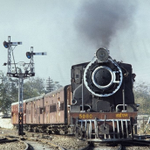
A beautiful photo of YL 5080 with a passenger train, probably near Mayiladuthurai (Mayavaram) Jn, captured by David Hill in 1980. The YL class locomotives were designed for mixed service on branch lines as a successor to the class YF, which were built from 1929 to 1938. Locomotive manufacturers in West Germany, Japan, Hungary, and the United Kingdom built a total of 264 members for Indian Railways. They were relatively light, with a service weight of 38 tons and an eight-ton axle load.
This locomotive was manufactured by MAVAG, a Hungarian rail locomotive manufacturer, in 1957. Many were in use until the end of steam traction in the 1990s. The YL class locomotives were mainly used in the north-east, south, and west of India.
During the golden era of the Metre Gauge network in Southern India, Mayiladuthurai Junction served as a critical operational hub and home to a dedicated steam locomotive shed. While heavy passenger trunk lines across the South Indian Railway favoured the faster YP class, Mayiladuthurai carved out a unique legacy as a primary base for lighter YL class and specialized ST class tank locomotives.
The light YL class engines, designed for light branch line operations, were perfectly suited for the coastal terrain of the Tanjore district. Their lower axle load prevented damage to the lighter rail infrastructure laid across the branch networks. The true theater for the YL steam engines lay in the three unique branch lines radiating toward the coast - Mayuram–Tharangambadi, Peralam – Karaikal, and Tiruthuraipoondi – Kodikkarai. #IndianRailways #TamilNadu #History

Lunchtime humour - Never use a GPS when you are going to a cemetery.
.
.
.
.
.
.
It doesn't really feel nice to hear it say, "You have reached the destination". 😃😂😛 #GPS
A positive story of love, marriage and partnership!
In 1954, Ruth Bader married a man who loved the very thing other men found intimidating - her mind.
Martin “Marty” Ginsburg had heard about the brilliant young woman at Cornell who could outthink nearly everyone in the room.
He wanted to meet her. Ruth expected what she had experienced before - admiration that faded the moment a man realized how intelligent she was.
Marty was different. Years later, she would say, “He was the first boy I ever knew who cared that I had a brain.” He did not merely tolerate her ambition. He loved it.
They married in June 1954. Then life tested them almost immediately. Marty was diagnosed with testicular cancer while Ruth was attending Harvard Law School and raising their young daughter, Jane.
The days became relentless. Ruth attended her own classes, collected notes from Marty’s courses, typed his assignments, cared for their daughter, and studied late into the night.
Marty survived. And Ruth kept moving forward. When he accepted a job in New York, she transferred to Columbia Law School and graduated tied for first in her class.
Then the doors began closing. Law firms rejected her. She was a woman. Jewish. A mother. Even with extraordinary credentials, she was repeatedly told no.
Marty never doubted her. Ruth became a professor, joined the ACLU, and built a legal strategy that would reshape gender equality in America. She argued landmark cases before the Supreme Court and won most of them. One discriminatory law after another began to fall.
Meanwhile, Marty built a distinguished career as a tax lawyer. And at home, he cooked. He never acted as though helping Ruth succeed made him smaller. He understood partnership differently. “My wife doesn’t give me any advice about cooking,” he joked, “and I don’t give her any advice about the law.”
When Ruth was considered for judicial appointments, Marty became one of her strongest advocates. He called colleagues. Spoke to influential people. Made sure others understood what he had known since Cornell. She belonged at the highest level.
In 1993, President Bill Clinton nominated Ruth Bader Ginsburg to the Supreme Court. She was confirmed overwhelmingly. Marty sat proudly in the audience when she took the oath. He sometimes introduced himself jokingly as “Mr. Justice Ginsburg.”
There was no jealousy in it. Only pride. They remained married for fifty-six years. In 2010, Marty became seriously ill again. Before his final hospitalization, he left Ruth a handwritten note telling her that she was the only person he had ever truly loved and that watching her reach the heights of her profession had been one of the great joys of his life.
He died days later. Ruth carried the note with her. She remained on the Supreme Court for another decade, becoming one of the most recognizable legal figures in America.
But behind that public life was a partnership that had begun with something surprisingly simple. A man met an intelligent woman and was not threatened by her brilliance. He encouraged it. Protected space for it. Celebrated it. And Ruth did the same for him.
Their marriage was not built around one person shrinking so the other could grow. It was built around both believing that love should make room for greatness. Marty did not stand behind Ruth because he was less important. He stood beside her because he understood what partnership actually meant.
And Ruth did not become extraordinary despite her marriage. She became extraordinary inside a marriage where she was fully seen. That may be their greatest love story of all. 🤎 #marriage #partnership

The distant hills in the background, the dark monsoon clouds, the scenic agricultural landscape consisting of lovely paddy fields and coconut groves add the beauty to a colourful freight rake being hauled by two WDG-6 locomotives - at Hariharapura village near Arsikere station, in the jurisdiction of @DrmMys in @SWRRLY! Pic courtesy, Dheeraj Rao! #IndianRailways #photography #Karnataka @DrDeepakKrishn1 @ArunKrishnan_ @anilbhatortho

Reminds me of the days I used to drop my daughter to school when she was in kindergarten. But the days of crying were over. The 15-minute drive was the best time for me to teach her the 12th and 15th chapters of the Bhagavad Gita, which she learnt by the time she was 4 years old. #daughter #memories
A true story - My friend used to stay in a middle class neighbourhood near Nizamuddin in a rented house and not in a railway colony, just to be close to his ailing father. It was a locality dominated by businessmen and traders.
His then 9-year old son couldn't make friends with the children over there, who would mock him for staying in a RENTED house and having a small car and not a sedan. This is peak Delhi NCR materialism. One of the reasons why I would always like to stay away from the city and its suburbs. #Delhi #attitude

The Diwali party season begins in Delhi NCR. It’s the show-off Olympics.
How much money to throw in a card game, to how gaudy the return gift is, to how skilled is the bartender you have called home. Most food is ornamental, which looks good on camera, the food people eat is actually Biryani, ordered from a trusted place. It’s a pyramid scheme, everyone invited has to host a Diwali party themselves, and invite everyone. Finding a slot in the calendar for your own Diwali party in this week is the toughest. This is why people get married, to host Diwali parties.
Allotment letter of an Ambassador car against the state government's priority quota, dated 09-03-1964, sent to the legendary poet, Rashtrakavi Ramdhari Singh 'Dinkar', who was also the then the Vice-Chancellor of Bhagalpur University, by the authorised HM dealer of Dumka, Bihar state (now Jharkhand state). #archives

The Cashmere Gate, Delhi, India. Photograph circa 1902. Kashmiri Gate (also spelled Kashmere Gate) is the historic northern entrance to the walled city of Shahjahanabad, built in the mid-17th century by Mughal Emperor Shah Jahan.
The neighborhood featured pleasure gardens and elite estates, including Qudsia Bagh (built by Qudsia Begum) and the palace of Dara Shukoh. Robert Smith redesigned or modified parts of the fortifications and structure under British supervision around 1835.
During the First War of Indian Independence in 1857, the gate was used by rebel sepoys and later became the focal point of a heavy British siege. On September 14, 1857, British forces—led by officers like John Nicholson and engineers Lieutenants Home and Salkeld—blew up a section of the gate with gunpowder to storm and recapture the city.
After 1857, British administrative and residential focal point shifted slightly away to the nearby Civil Lines. Consequently, the Kashmere Gate area transformed into the premier luxury marketplace and fashionable social quarter of Delhi. It proudly maintained this elite commercial status until the planned development and inauguration of New Delhi in 1931. #history #Delhi @DelhiHeritage @indiantweeter

A restored and colourized photo of Indrani Rahman performing Bharatanatyam in a classical pose— 1956. A pioneering Indian classical dancer, she was also the first Miss India (1952) and later helped popularise Bharatanatyam, Odissi and other Indian dance traditions internationally.
Born as Indrani Bajpai in 1930 to an Indian father and an American mother who embraced Hinduism, she learnt Bharatanatyam, Kuchipudi and Odissi by the early 1950s. She married Habib Rehman, a well-known architect, and had two children. She participated in the Miss India pageant, despite being married and with a child (the rules of participation permitted it). She went on to compete in Miss Universe 1952, held in Long Beach, California.
Soon, she was travelling along with her mother and performing all over the world. In 1961, she was the first dancer presented on a national tour by the Asia Society, and also performed for US President John F. Kennedy and Prime Minister Jawaharlal Nehru, during Nehru's official visit to Washington.
In the following years she also performed for Emperor Haile Selassie, Queen Elizabeth II, Mao Zedong, Nikita Khrushchev, and Fidel Castro. In 1976, she became a faculty member of the dance division at the Juilliard School at New York's Lincoln Center for the Performing Arts, taught in various American universities, including Harvard, and spent her remaining two decades in the United States, touring extensively. #dancer #legend

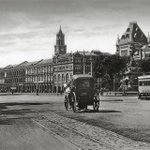
1900s, Flora Fountain, Bombay! The Oriental Building, the Rajabai Clock Tower, and the Central Telegraph Office can be seen in the background.
The Oriental Building in South Mumbai is a prominent 19th-century Venetian Neo-Gothic landmark located directly opposite the Flora Fountain. The building was originally constructed at a cost of ₹87,000 to house the Cathedral High School in 1885. The property was acquired by the Oriental Life Assurance Company in 1896 and the school moved to its current campus.
It was designed and remodeled by Frederick William Stevens—the same renowned architect behind the Victoria Terminus (now Chhatrapati Shivaji Maharaj Terminus).
The building remains an architectural highlight of Mumbai’s historic Fort heritage zone and has housed major financial institutions like American Express. It features signature red roof tiles, a tall five-storey central corner tower with a tiled pyramidal roof and wrought-iron cresting, and steepled turrets, spires, and gables along the triangular ranges. #Mumbai #heritage #History

Never worry about the delay of your success when you compare with others because the construction of a palace takes more time than the construction of an ordinary building. Good morning, friends, have a great day and a wonderful week ahead! 🙏 #MondayMotivation
#DidYouKnow As the railway network of the Great Southern of Railway Company expanded in South India, it became imperative to shift the headquarters from Negapatnam to Trichinopoly. The recommendations were accepted on 21st August, 1878 and was completed by 1880. #IndianRailways #History

#DidYouKnow In the late 1860s, another company called Carnatic Railway Company, which was subsequently amalgamated into the South Indian Railway Company in 1874, built railway lines from Madras via Cuddalore to Tanjore and from Trichinopoly by Madura to Tuticorin.
In March, 1871, the north-western trunk line of the Madras Railway, running from Arkonam through Cuddapah to Raichur, was finished. Later on, after a decade of stagnation, this line met the one from GIPR coming from Bombay, thereby completing the connection of Bombay with Madras. #IndianRailways #History
A beautiful picture of a YP 2634-hauled train, manufactured by TELCO in 1965 at Mansi Junction in North Bihar during the early 1990s.
The roots of Mansi Junction date back to the colonial era. The foundational meter gauge railway line on the Mansi–Saharsa section was first laid on March 1, 1907, starting between Bhaptiahi and Simri Bakhtiyarpur. By December 15, 1907, the line was fully extended to reach Mansi, officially bringing the junction into operation to support the newly developing Barauni–Guwahati and Barauni–Katihar rail networks.
Mansi Junction serves as the vital lifeline that connects these flood-prone, agriculturally dominant interiors (like Saharsa, Madhepura, and Supaul) directly to major economic trunk lines like the main Barauni–Guwahati and Barauni–Katihar lines. Mansi operates as a lively "railway town". Because it links rural farmers to major regional commercial markets, the area surrounding the junction has naturally transformed into a massive trade and administrative hub for agricultural goods. #IndianRailways #Bihar #History

Lunchtime humour - An old man asks an astrologer - Please tell me my future.
.
.
.
Astrologer - A young girl will touch your body everywhere.
.
.
.
Old man (excited) - When and where?
.
.
.
Astrologer - Next month, in the ANATOMY lab! 😃😛😂
The beautiful capture of a blue rake negotiating a curve on the scenic route between Coonoor and Ooty on the Nilgiri Mountain Railway, in the jurisdiction of @SalemDRM in @GMSRailway! Pic courtesy, Saurav Bimal! #IndianRailways #photography @TheRightGhose @BalakrishnanR

#Sunday #humour - Ek TV reporter ne ek bomb blast se zakhmi huey aadmi se pucha - Kya bomb badey zor se phata tha kya?
.
.
.
.
.
.
Zakhmi aadmi (obviously livid at the question) - Nahi re, woh regta hua mere paas aaya, aur sharmaa ke bola - DHOOM! 😃😛😂 #SundayFunday
This day that year - At 8 a.m. on October 25, 1951, the first votes in independent India’s first general election were cast in the remote tehsils of Chini and Pangi in Himachal Pradesh. It was the beginning of an unprecedented democratic exercise that would unfold over several months, until February 1952, as millions of Indians went to the polls for the first time.
The story of India’s first election is also the story of the people who took part in it. Among them was Shyam Saran Negi, a schoolteacher from Kalpa in Himachal Pradesh, who cast his vote in October 1951. Decades later, he would be remembered as independent India’s first voter.
Making that participation possible across a country of continental scale required extraordinary planning. Millions of voters had to be identified and registered, polling stations established in far-flung locations, and a system devised to let people cast their votes regardless of literacy. At the centre of this unprecedented undertaking was Sukumar Sen, India’s first Chief Election Commissioner, tasked with turning the promise of universal adult suffrage into a functioning electoral process.
Sukumar Sen oversaw the preparation of electoral rolls, the setting up of polling stations, and the logistics of reaching voters across mountains, forests, deserts, and remote villages. From ballot boxes marked with party symbols to the use of indelible ink, the election demanded ingenuity at every turn. #elections #history
Max Born with the family of Dr B.S.Madhava Rao, the famous mathematician and theoretical physicist. From 1935 to 1938, Dr Madhava Rao worked with Max Born on Born's nonlinear electromagnetic field theory, producing eight published papers and a doctoral thesis on the subject.
The second photo features Max Born and his wife, Hedi Born, with the former wearing the Mysore Peta turban and his wife elegantly draping a sari. #MaxBorn #NobelLaureate #India


From the IISC (Indian Institute of Science) Archives -
Letter by Sir Chandrasekhara Venkata Raman (Sir C.V.Raman) to Physicist Max Born, inviting him to IISC Bangalore as Reader In Theoretical Physics at an honorarium of ₹15000, dated 17th Jan, 1935.
Max Born, who had fled Nazi Germany, accepted the invitation from C.V. Raman to come to the Indian Institute of Science (IISc) in Bangalore. He arrived in Bangalore in 1935, where he taught, gave lectures (such as his famous lecture on the fine structure constant), and directed theoretical physics research for six months.
Although Raman hoped Born would stay permanently, Born did not secure a permanent position at IISc due to local institutional politics and governance conflicts surrounding Raman at the time.
Max Born was awarded the 1954 Nobel Prize in Physics for his fundamental research in the field, most notably for providing the statistical interpretation of the wavefunction (known as the Born Rule). #research #history

Ananth Rupanagudi retweeted
Divine darshan of Subrahmanya Swamy, Tiruchendur! 🙏
The Thiruchendur Murugan Temple is the second of the six sacred abodes (Arupadai Veedu) of Lord Murugan, uniquely situated directly on the seashore of the Bay of Bengal in Tamil Nadu. Legend says that this seaside location was the battleground where Lord Murugan vanquished the demon king Surapadman. After defeating the demon, Lord Murugan worshipped Lord Shiva at this very spot to express gratitude for the strength granted during the war.
The temple is referenced extensively in ancient Tamil literature, including the Thirumurugatrupadai composed by the Sangam poet Nakkirar in the 2nd century CE, confirming its multi-millennial antiquity.
While the other five Arupadai Veedu shrines sit atop hills or mountains, Thiruchendur stands majestically on the active shoreline, fusing the rhythm of ocean waves with continuous devotional chants (Arogara). #TamilNadu #temple #legend #history @Gopalee67


