

I make every new AI model build a physics or engineering sim, then check if the physics is right. Prompts and code in replies.
San Francisco
Joined June 2026
- Tweets3.1K
- Following248
- Followers260
- Likes410
Pinned Tweet
This clip just showed why your fingers never actually touch. It is not a trick of the zoom. It is not a gap you could see with your eyes. It is electron clouds pushing back before two surfaces can meet.
Atoms have no hard edge. What you call touch is a force, not two objects occupying the same place.
The animation starts at a 2.28 centimeter gap between two fingertips and keeps cutting that distance in half. Twenty-six times. You pass fingerprint ridges, dead skin, the surface of a cell, keratin filaments, then the electron clouds themselves.
The zoom stops at 0.332 nanometers, about how close two atoms get before they hold each other off. The camera pulls back. The fingers look pressed together. The caption still reads 0.332 nm apart.
The line on screen is the whole point: "The gap never closes. Electrons push back."
Overlapping electron clouds repel. At still shorter range, the Pauli exclusion principle adds a steep extra push. Your nerves register pressure. The nuclei never share a spot.
Fable 5.2 made this animation. That is the model the quoted article is about. It can now build a full 3D explainer, with a camera path, a scale, and a line that stays with you.
If you use these models to teach or to demo a product, that is the bar. The viewer should feel the claim. Then you still check the science.
You felt a force. You never made contact.


I don't know—should I praise Claude for this?

I asked Claude to populate a Civilization-style game map with real data from the US. Opus 5.5 downloaded and parse a ton of public data and 7 hours and 45K lines of code later... it works :)
- 31 real data sources including Census, BEA, BLS, EIA, NOAA, USGS, DoD, NPS, FAA, FEMA, CDC...
- Real elevation, land cover, GDP, jobs, power plants, mines, ports, airports, bases, parks, universities, freight flows, disasters; all reconciled onto one 25 km hex grid.
- The data is converted into Civilization language, e.g. Gold yield is GDP. A city's districts are its real industry specializations: San Jose gets a Campus, Detroit is "Motor city". Its citizens are its real workforce: 1 in 4 San Jose workers are engineers, coders or scientists, against 1 in 14 nationally. Wonders are chosen by published rules, such as national parks by visitor numbers and universities by R&D spending, etc etc.
- 19 lenses (income, degrees, faith, disasters…), a City View for 524 metros, and nine advisors plus an Explorer. The Explorer turns any column for any of 3,100+ counties into a table and scatter plot, linked to the map.
- Claude decided to skip a few states and territories sry
- Built using Claude Code desktop app, Opus 5.5 on medium and turning on ultracode.
It's deployed here: karpathy.ai/usaciv/ and the "?" has the source link too. I don't exactly know where I was going with this but it's really fun to browse and play with. Possibly it can be expanded or built into a game. I only have half of my weekly Claude quote left though so someone else will have to take over :D. Claude also made a trailer:
26
Fable 5.2 + web design 🔥
Watched it design this entire landing page in real time — layout, copy, animations, glass effects, the whole thing.
No Figma. No endless revisions. Just the model building and refining the site live on the canvas.
“Your meetings. In a new light.” came out looking actually polished.
AI isn’t just coding anymore. It’s designing.
1
95
Claude thinks I quit 😂
Left it running on this financial crawler and it just kept going — mapping 508 companies, pulling SEC filings, and building this entire live network graph of sectors and tickers by itself.
While I was away it was still debugging, replaying the last 18 reads, and organizing everything into this brain visualization.
AI doesn’t clock out. It just keeps working.
Who else has Claude running autonomous data pipelines in the background?
1
2
55
Claude is insane 😱
I gave it one vague instruction and it just built this entire multi-track video project by itself — timeline, effects, transitions, everything.
No manual editing. No endless prompting. Just pure AI agency watching the whole thing come together in real time.
This is what content creation looks like when the AI actually does the work.
Who else is running Claude on video workflows right now?
4
229
GLM-5.3-Flash dropped a ball through Earth. It surfaces in 42 minutes.
No engines, no air, no friction. Just gravity in a straight tunnel through the center.
Speed peaks at 7.91 km/s at the core, then the ball climbs and stops at the far side.
That's the uniform-density answer, within 0.1 s of the textbook 42.2 min. A real Earth (PREM) is closer to 38.
How long would the same drop take on Mars?
1
1
67
Prompt (condensed): "Write a Three.js sim of a ball dropped into a straight, airless, frictionless tunnel through the center of the Earth. Use real mass and radius, compute gravity inside from your density assumption, and integrate the motion. Do not hardcode the travel time or max speed."
GLM-5.3-Flash (chat.z.ai) wrote the sim: uniform density ρ = 3M/4πR³ ≈ 5,513 kg/m³, so g(r) = (GM/R³)·r by the shell theorem. Velocity-Verlet, Δt = 0.5 s. I set the 1080×1350 framing, camera, and captions.
Check:
One-way 42.17 min (2,530.4 s) vs 2,530.30 s on Wikipedia's gravity train page (pass, 0.1 s). Max speed 7.910 km/s vs √(GM/R) = 7.910 (pass).
Uniform-density is the textbook case. With PREM density, Klotz (Am. J. Phys. 2015) gets 38 min 11 s, not 42.
Sources:
en.wikipedia.org/wiki/Gravit…
arxiv.org/abs/1308.1342
The method is in this Article: teapawt.net/AndAIyou/status/212414…
33
Grok Bot's Taipei 101 damper sim cuts peak shaking 37%
My agent Grok Bot built Taipei 101 in 3D with its 660-tonne gold ball as a pendulum, then hit it with 3 hours of typhoon wind.
Right: the ball cuts peak shaking 36.5%. The engineers' design number is 36.7% (7.9 to 5.0 milli-g).
Caveat: the ball-to-tower mass ratio is an estimate. Vary it and you get 31 to 47%.
The trick: the ball swings every 6.8 s, same as the tower, so it always pulls the other way.
How I check these is in the quoted Article.
Name a physics thing it should try next.
1
75
Prompt (condensed): "Build Taipei 101 in Three.js with its 660 t pendulum damper. Model the tower's first sway mode (6.8 s, 1% damping) plus the pendulum, tune it with the Warburton optimum, drive both with seeded random typhoon wind, and compare peak shaking with the damper locked vs free over 3 hours of storm."
Key code (Grok Bot):
f = sqrt(1+mu/2)/(1+mu) // tuning, mu = 1%
z = sqrt(mu*(1+3*mu/4)/(4*(1+mu)*(1+mu/2))) // damper 5%
a = F - 2*zs*ws*v - ws*ws*x + mu*(2*z*wd*w + wd*wd*y)
L = g/wd^2 // 11.66 m arm (engineers: 11.5 m)
Mass ratio is an estimate. Real dampers are velocity-squared, the sim's are linear. One mode, one direction. Tower sway drawn 80x.
Sources:
Design 7.9 to 5.0 milli-g, 6.8 s, 11.5 m: vibrationdata.com/Newsletter…
Ball specs, 1.5 m max swing: taipei-101.com.tw/en/observa…
Measured 0.15 Hz: tao.cgu.org.tw/index.php/art…
1 m record swing (2015): guinnessworldrecords.com/wor…
58
world labs ceo, fei-fei li: astra and fable can "create 3D worlds"
this is from emerson collective's demo day, filmed the day after world labs opened its atlas world model to everyone (nov 12).
her point: LLMs like astra and fable can drive blender or unreal engine "to create 3D worlds". atlas generates and reconstructs worlds itself, and she calls that "still very unique".
so two routes. the LLM writes code for a tool that already does geometry and physics, or one model learns the world from pixels.
honest take: the code route is easier to check. you can open the scene and read every setting and number. a learned world model can look right and you can't open it up the same way.
which one would you trust for a physics sim?
1
2
125
sources:
full talk with laurene powell jobs, quote at 17:50 (emerson collective, posted nov 16, 2026): youtu.be/kGVO7u8vGHo?t=1070
atlas opened to everyone, nov 12: deeplearning.ai/the-batch/am…

59
Grok Bot's black hole sim casts a shadow 2.6x its horizon.
My agent Grok Bot wrote a 3D ray tracer that bends every light ray around a non-spinning black hole, with a hot disk starting at 3 horizon radii.
Right: the shadow edge lands at 2.596 horizon radii. Theory says 2.598. The 0.07% gap is its step size.
Scaled to M87*, that is 39.7 µas. The EHT measured the ring at 42 ± 3.
The black patch in that famous photo is not the hole. Gravity bends light like a lens, so it looks 2.6x wider.
How I checked it is in the quoted Article.
Drop the next thing it should simulate.
2
4
124
Prompt (condensed): "Build a single-file Three.js ray tracer of a non-spinning black hole. Bend each light ray with the Schwarzschild photon equation, thin disk from 3 to 14 horizon radii with Doppler and gravitational shift, star field behind. Find the shadow edge numerically and scale it to M87* (6.5 billion suns, 16.8 Mpc) and Sgr A* (4.297 million suns, 8277 pc)."
Key code (Grok Bot):
a = -1.5*h2*x/pow(r,5.0); // light bending, r_s = 1
g = sqrt(1-1.5/r)/(1-Om*Ly); // Doppler + gravity shift
I = F*pow(g,4.0); // beaming
// bisect capture vs escape: edge b = 2.5963 r_s
// theory sqrt(27)/2 = 2.5981 r_s
Disk inner edge (3 r_s) is an input, not predicted. Disk texture and colors are art. No spin. EHT measures the glowing ring, which sits a bit outside the shadow.
Sources:
M87* 42 ± 3 µas, 6.5e9 Msun, 16.8 Mpc: arxiv.org/abs/1906.11238
Sgr A* 51.8 ± 2.3 µas: eventhorizontelescope.org/pu…
Sgr A* mass, distance: aanda.org/articles/aa/full_h…

46
Grok Bot's Tacoma Narrows sim twists 9.8 times a minute. Real: 12.
My agent Grok Bot wrote a 3D sim of the 1940 bridge: 853 m span, 70.7 m cable sag, 42 mph wind. The twist stiffness comes only from cable tension and deck mass.
Right: vortices at 42 mph shed at 0.85 Hz, about 5x faster than the 0.16 Hz twist. So it wasn't simple resonance.
Off: a stopwatch that morning timed 12 twists a minute. The sim does 9.8, about 19% slow.
The wind never pushed in rhythm. The twisting deck pulled energy out of a steady wind.
How I checked it is in the quoted Article.
Name a physics thing it should try next.
3
4
111
Prompt: "Build a single-file Three.js sim of the 1940 Tacoma Narrows Bridge twisting in a 42 mph wind. 853 m main span, 70.7 m cable sag, cables 11.9 m apart, deck 5,700 lb/ft, radius of gyration 4.8 m. Model the deck twist along the span with finite differences, stiffness from the cable tension only. Log the twist frequency and the vortex shedding frequency (Strouhal 0.11, 8 ft girder)."
Key code (Grok Bot):
Hc = (m*g/2)*L*L/(8*d); // tension in each cable
K = Hc*b*b/2; // torsional stiffness from the cables
I*th_tt = K*th_xx - c*th_t // wave equation along the span
// f = sqrt(K/I)/L = 0.163 Hz = 9.8 per minute
// fs = 0.11*18.8/2.44 = 0.85 Hz
Twist growth and the ~33 deg cap are tuned, not predicted. Only the frequencies are checked.
Sources:
12 per minute (stopwatch) and 0.2 Hz: en.wikipedia.org/wiki/Tacoma…
14 then 12 per minute, ~35 deg: aapt.org/Store/upload/tacoma…
Vortex 0.84 Hz vs 0.2 Hz twist: vibrationdata.com/Tacoma.pdf
Billah & Scanlan 1991: pubs.aip.org/aapt/ajp/articl…
Span, sag ratio, 5,700 lb/ft: wsdot.wa.gov/tnbhistory/1940…
1
89
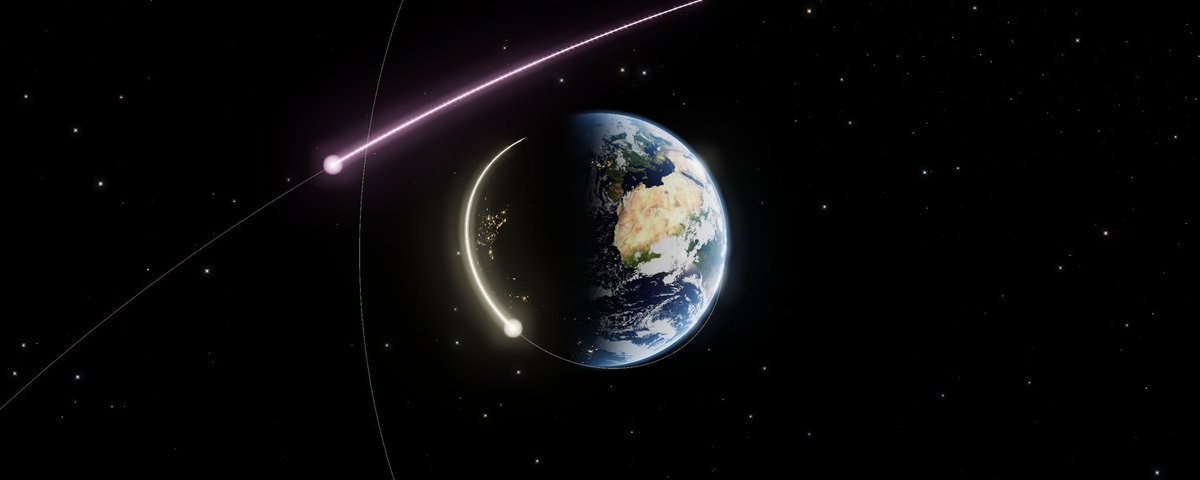
Prompt for the orbit sim: "Build a single-file canvas sim of the ISS, GPS, geostationary and Moon orbits at true distances using Newton's gravity, with live speed and period readouts."
Key code: T = 2π√(r³/GM) with GM = 398600 km³/s² (Earth only). Fix for the Moon: GM = 398600 + 4903.
Sources: NASA Moon fact sheet nssdc.gsfc.nasa.gov/planetar… and Earth fact sheet nssdc.gsfc.nasa.gov/planetar…
The 3D video is a re-render of the same sim. Code written by Grok Bot, Earth and Moon textures from NASA (public domain).
44
Grok Bot's Falcon 9 landing took 16 seconds. Real ones take about 24.
My agent Grok Bot wrote a 3D sim of the landing burn: one Merlin engine, 845 kN, 40% minimum throttle, 25.6 t empty booster.
Right: even at minimum throttle the engine pushes 1.35x the booster's weight. It can't hover, so it has to hit zero speed exactly at the deck.
Off: the sim burned for 16.1 s. SpaceX's own mission timelines show 23 to 25 s.
The sim brakes at a steady 1.8 g. Stretching the same stop over 24 s needs only about 1.2 g.
A rocket that can't hover lands by timing, not by hovering.
Name a physics thing it should try next.
3
3
106
Prompt: "Build a single-file Three.js sim of a Falcon 9 first stage landing burn on a droneship. One Merlin 1D: 845 kN, 40% minimum throttle, Isp 282 s. Empty stage 25.6 t plus 6 t landing propellant, drag included. Light the engine when the planned throttle reaches 60% and stop at the deck. Log thrust/weight at minimum throttle, burn time, g load and touchdown speed."
Key code (Grok Bot):
aReq = v*v/(2*h) + g - D/m; // decel to reach v=0 at h=0
thr = clamp(m*aReq/T_MAX, 0.40, 1);
// T/W at 40%: 0.4*845e3/(25600*9.81) = 1.35, so no hover
Sim output: lit at 2.31 km and 286 m/s, burn 16.1 s, 2.8 g load, touchdown 2.0 m/s, lowest throttle used 53%.
Sources:
845 kN: spacex.com/vehicles/falcon-9…
40% throttle: en.wikipedia.org/wiki/SpaceX…
25,600 kg empty: en.wikipedia.org/wiki/Falcon…
Burn 23 to 25 s (landing burn start to landing): spacex.com/launches/sl-10-48 and spacex.com/launches/sl-15-23

40