

I am an Associate Professor at Yale. I study the information environment of U.S. municipalities and natural capital accounting.
Joined May 2009
- Tweets90
- Following490
- Followers323
- Likes388





Pinned Tweet
Publishing data from papers.ssrn.com/sol3/papers.…
In this paper, we find that systematic changes in corporate governance regulation help explain the spread of shareholder activism worldwide.
1/4
📣 Call for Papers: The Muni Conference is back, and this year it’s going to New Orleans.
After 2 editions at Yale, Stephanie Cheng and I are hosting the 2027 Yale–Tulane Municipal Conference.
📅 Apr 16, 2027
📝 Submissions due: Feb 12, 2027
🔗 : lnkd.in/gT57imFV

Anya Nakhmurina retweeted

When govts stop publishing public notices in newspapers, citizens disengage. Research from Prof. Anya Nakhmurina @Annut found meeting attendance dropped up to 18% & construction permits surged 35% after Florida weakened its newspaper notice requirement. yalesom.io/47BAklZ

Very happy that my work with Dale Manning and Eli Fenichel on the fiscal impact of biodiversity loss and a pathway for conservation finance is out in Science today.
science.org/doi/10.1126/scie…

1
69
These findings matter beyond bats. The Kunming-Montreal Global Biodiversity Framework identifies a $700 billion annual biodiversity funding gap.
1
51
When governments stop publishing notices in newspapers, does anyone notice?
We study Florida's 2023 public notice law, the first modern law allowing municipalities to post notices on county websites instead of newspapers.
promarket.org/2026/03/06/whe…

1
49
Consistent with this, cities with access to county notice websites issued significantly more commercial zoning permits after the reform than cities that continued newspaper publication.
1
30
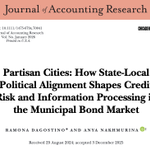
Excited to see (w/ Ramona Dagostino) printed in @JOARChiBooth!
TLDR: In an era of rising polarization, partisanship isn't just about policy disagreements. When cities and governors are on opposite sides of the partisan divide, it costs those cities. 🧵
onlinelibrary.wiley.com/doi/…

1
1
97
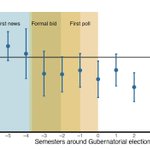
How do we pin this down? We focus on cities that never switch parties. So when alignment changes, it's because a new governor took office, not because the city changed. City fixed effects absorb any time-invariant differences between D and R cities. (See the paper for details)
1
41