

Let food be thy medicine, and medicine be thy food. {Hippocrates} | Meat Eater | Science Nerd | Independent Thinker | Dog Momma 🐾 | Political Orphan 🇺🇲
Metro Detroit, MI
Joined September 2022
- Tweets12.6K
- Following237
- Followers762
- Likes75.1K


April of the North retweeted

C.S. Lewis died 63 years ago today, about an hour before John F. Kennedy was shot.
Barely anyone noticed.
The man who gave us Narnia passed away at The Kilns, his home outside Oxford, at 5:30 p.m., one week shy of his 65th birthday.
By suppertime every newspaper on Earth was racing to Dallas. (Aldous Huxley died that day, too.)
His road to Narnia ran through two wars.
A shell caught him at Mont Bernenchon in France in April 1918. His Oxford friend Paddy Moore had already been killed, and the two young men had promised to look after each other's parent if one didn't make it home.
Lewis kept that promise for more than 30 years.
War came again. This time, three London schoolgirls were evacuated to his house in September 1939. A bachelor of 40 who barely knew any kids (brave guy), he scribbled a few lines on the back of another manuscript about four children sent away from the air raids to stay with an old professor.
The scrap grew into The Lion, the Witch and the Wardrobe.
He dedicated it to his goddaughter Lucy Barfield: "But some day you will be old enough to start reading fairy tales again."
The news that night belonged to Dallas, and fair enough. But Lewis left you a wardrobe you can still climb into whenever the headlines get negative and annoying. Books like his are where I went when I quit doomscrolling, and the view's been sooo much better.
Embrace beauty, reject doom, my friends ✨

April of the North retweeted

What the heck happened to chocolate milk?
It’s like your childhood crush went full goth while you weren’t looking. One minute she’s all sweet, innocent and girl-next-door-ish. Next thing you know she’s hanging out with dextrose, carrageenan and a guy with a blue Mohawk named Guar.
How did we go from milk, cocoa and sugar to cornstarch, artificial flavors and 14 grams of added sugar in one cup?
The cow on the front is still smiling like nothing happened but I’m starting to question what I ever saw in her.


April of the North retweeted

On Easter Sunday in 1963, Betty White received a stuffed white bunny with diamond earrings clipped to its ears. A note from Allen Ludden asked her to say yes. He had proposed for months, and she had refused. That evening, when his usual phone call came, Betty answered with one unexpected word. “Yes.”
Betty had already survived two disappointing marriages. Her first, to Dick Barker, ended within months in 1945. Her second, to talent agent Lane Allen, ended in 1949. He wanted her to leave show business, something she couldn't imagine doing. By the time Ludden appeared, she was wary of marriage and fiercely protective of the life she had built.
Allen hosted "Password" (1961), where Betty appeared as a celebrity contestant. Their romance blossomed in 1962 while they performed in a summer theater production in Maine. Allen was a widower raising three children, and Betty adored his wit and ridiculous sense of humor. Even his children joined in courting her, making his affection feel like an invitation into a whole family.
But Allen lived in New York, and Betty loved California. She refused to move across the country or risk another failed marriage. His proposals became an almost daily ritual. Sometimes he barely bothered with hello before asking her to marry him. She answered no so consistently that the exchange became a joke, although Allen's feelings were anything but casual.
After one rejected proposal, Allen wore the engagement ring on a chain around his neck. Whenever Betty saw him, the ring was there. Then came that Easter bunny. Allen knew her weakness for animals, and his gift was more personal than jewelry alone. Betty later joked that it was the bunny, not the earrings, that finally persuaded her.
They married at the Sands Hotel in Las Vegas on June 14, 1963. For Betty, accepting Allen also meant finding her place in his family. The woman who had spent a year guarding her independence discovered that marriage didn't have to mean surrendering herself. Allen loved the quick wit, stubborn streak, and enthusiasm that had made her difficult to persuade.
Marriage brought its own little courtship. Allen would telephone Betty during the day and ask her out on a date, even though they shared a home. He might barbecue chicken, open wine, and play records so they could dance together. There was something wonderfully youthful about a husband who continued asking his wife to spend the evening with him.
Betty's television career flourished, including her role as Sue Ann Nivens on "The Mary Tyler Moore Show" (1970). At home, Allen remained the man who made her laugh. Then stomach cancer interrupted their plans. They were finishing a dream house in Carmel, California, a place they hoped to enjoy together. Allen lived in the completed house for only two nights.
He died on June 9, 1981, just three days before their eighteenth wedding anniversary. Betty was 59. Days afterward, she went upstairs and found their dogs lying on Allen's robe. The sight undid her. She sat on the floor with them, overwhelmed by the absence of a man whose ordinary habits had filled her days with affection.
Betty continued working and eventually delighted audiences as Rose Nylund on "The Golden Girls" (1985). She never remarried. She could still enjoy other people's company, but she didn't expect to love another man as she had loved Allen. Years later, she confessed that her greatest regret was spending a year refusing his proposals, a year they might have shared.
Betty died on December 31, 2021, more than forty years after Allen. She had carried their relationship through decades of laughter, work, and quiet missing. The stuffed bunny had won her yes, but it was the time she lost saying no that stayed with her.
She wished she could have given Allen one more ordinary year.

April of the North retweeted

Once we normalized the taking of innocent life, additional parental rights was easy to take away.
April of the North retweeted

People my age have gone from rotary phones to smartphones, from cassette tapes to streaming, and from encyclopedias to having the entirety of human knowledge in our pockets.
And what do we use this miraculous technology for?
Arguing with strangers about whether “Die Hard” is a Christmas movie.
Humanity has peaked…
April of the North retweeted

Pork is not a red meat, and I am tired of it turning up to the meetings.
It knows it isn't. In 1987 the American pork industry spent millions on a slogan telling the world that pork was the other white meat. Their words. On billboards. They looked at the pig, looked at the chicken, and said: that's us, we're with him.
Then the red meat started getting the good press again, and suddenly pork is at the door in a borrowed jacket explaining that technically, on a myoglobin basis, it has always been one of the lads.
Cook a pork chop. Look at it. It is the colour of a hotel towel.
Red meat is a ruminant. It ate grass for two years, ran it through four stomachs, and built fat so stable it will sit on your worktop for a month. A pig has one stomach, eats what a bin eats, and stores it as received. Feed a pig soya and you get soya with a tail.
And this is where it stops being funny. Every study that convicts "red and processed meat" has put a ribeye in the dock next to a gas-station hot dog and a ham sandwich, and read out one verdict for all three. Beef has been doing pork's time for forty years.
I like bacon. Bacon is welcome. Bacon is there for morale.
But it comes in through the white meat entrance, with the chicken, and it does not get to sit at the top table.


April of the North retweeted
Two American bioethicists have published a paper arguing that a tick which makes people allergic to red meat ought to be helped to spread.
It appeared in the journal Bioethics in July 2025 under the title Beneficial Bloodsucking. The authors are Parker Crutchfield and Blake Hereth of the medical school at Western Michigan University.
The tick is the lone star tick. Its bite can leave you with alpha-gal syndrome, after which beef, lamb and pork bring on hives, vomiting and, in the bad cases, a closing throat, usually some hours after dinner and often in the middle of the night. Milk can do it too. So can the gelatine in a tablet. The CDC thinks as many as 450,000 Americans have it, and last year doctors reported the first confirmed death, a man in New Jersey who had eaten a hamburger.
The paper looks at all that and sees a teaching aid. If eating meat is wrong, it reasons, then spreading the syndrome is "strongly pro tanto obligatory", and it notes that editing ticks for the purpose is already feasible.
Dr Crutchfield has form. In 2019 he argued that making the public more moral by medical means should be done covertly.
Asked about the tick, he said it was a thought experiment, and that he is not himself a vegetarian.
It passed peer review. The tick was not consulted, but is understood to be willing.


April of the North retweeted
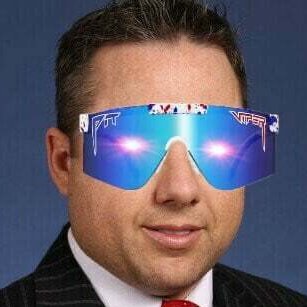
To win in 2016, Trump said "no amnesty." To win in 2024, he promised "mass deportations." He's canceled the mass deportations, and is now considering amnesty. How does one man pull a Benedict Arnold like this?


April of the North retweeted

Russell Brand was just sentenced to over 10 years in prison today.
This is what Charlie Kirk said about him.
April of the North retweeted
John Keats was 25 and dying of tuberculosis in Rome in the winter of 1820 when his doctor put him on a diet of one anchovy and a piece of bread a day, bled him after he coughed up blood, and went on to become physician to Queen Victoria.
Keats had trained as a surgeon and apothecary himself. In February 1820, coughing in bed in Hampstead, he looked at the blood on the sheet, recognised it as arterial, and told his friend it was his death warrant. His mother and his brother Tom had both died of consumption. He was told to escape the English winter, and in September he sailed for Italy with the young painter Joseph Severn.
In Rome they were met by James Clark, a young Scottish doctor building a practice among the English. Clark decided the trouble lay in Keats's stomach, brought on by too much mental exertion, and prescribed riding and fresh air. When the bleeding came in December he took more blood, to relieve the inflammation, and then cut the food. To slow the flow of blood to the stomach, the most gifted young poet in England was to live on a single anchovy and a morsel of bread a day.
Keats was starving and begged Severn for food. The laudanum he had brought to end it if the pain became too much was taken off him. He died on 23 February 1821, in the room above the Spanish Steps, wasted to almost nothing, and asked that his gravestone carry no name, only that here lies one whose name was writ in water.
Clark went home and flourished. In 1837 he became physician to the young Queen Victoria and was made a baronet. Two years later a lady-in-waiting, Flora Hastings, developed a swollen belly, and Clark told the court she was pregnant. She was unmarried and a virgin, and the scandal badly damaged the new Queen. When Lady Flora died that summer, the post-mortem found a tumour on her liver.
Within a few decades the sanatoriums of Europe were treating consumption with the opposite of Clark's diet: rest, mountain air, and as much milk, eggs and meat as the patients could get down.
The doctor who starved a dying poet was given the most prestigious practice in the kingdom.
Being wrong at the top of medicine has never once disqualified anybody. It has only ever cost the patient.


April of the North retweeted
A wild donkey in the Arizona desert will dig a well six feet deep with its front hooves, and for half a century the United States government has been shooting it as a threat to the desert.
August on a dry wash in the Sonoran. The creek has been gone since May. The sand is hot enough to cook on and every animal for miles is standing in what shade it can find, waiting for a rain that is not coming. A burro walks down the wash, stops at a bend for no reason anyone else can see, puts its head down and smells. Then it starts digging. Front feet, one after the other, like a dog after a bone, until it is in up to its shoulders and the bottom of the hole goes dark and wet.
It drinks and walks off.
Within the hour there is a queue. Mule deer. Javelina. A bobcat. A scrub jay standing on the rim. In 2021 a biologist called Erick Lundgren published the count in Science: 59 species of vertebrate drinking at donkey wells, 64% more species than at the dry stretches of the same streams, and in the driest months the donkeys were raising the amount of open water in the desert by 300% on average and by up to 1,450%. When the wells were abandoned, cottonwood and willow seedlings came up in them. The donkey had been planting the riverbank.
Asked about his methodology, the donkey had another drink and left.
When a beaver builds a pond, a film crew is sent. When a donkey digs a well, the Park Service sends a marksman. The burros came up from Mexico with the Spanish and the prospectors, carried the ore out of every mine in the West, and were turned loose when the mines closed. Then they were reclassified. In 1979 the National Park Service planned to shoot all 577 in the Grand Canyon. A writer called Cleveland Amory raised more than $500,000 and lifted 582 of them out by helicopter, slung underneath, the most expensive taxi ride a donkey has ever taken. Death Valley shot 400 between 1987 and 1994.
Lundgren said that when he started, people did not think a donkey digging a hole was worthy of scientific attention.
The animal was listed as a threat to the desert's water.
It was the one bringing the water up.
Fifty-nine species knew.
The ones with the rifles had never sat by the hole.

April of the North retweeted

Mentally ill professors are teaching your sons and daughters at college. How’s that tuition bill feeling?
April of the North retweeted

An 11-year-old boy watched the movie Jaws. Then he helped clear the name of a dead man the US Navy had blamed for a terrible disaster.
In 1996, a boy named Hunter Scott was watching the film Jaws at his home in Florida.
One scene particularly fascinated him.
The shark hunter Quint recalled the sinking of the USS Indianapolis during the Second World War.
Hunter had never heard of the ship.
He asked his father whether the story was true.
It was.
On July 30, 1945, a Japanese submarine torpedoed the USS Indianapolis in the Pacific Ocean.
The American warship had just completed a secret mission delivering components for the atomic bomb that would devastate Hiroshima.
Within approximately 12 minutes, the ship sank.
Of the 1,196 men aboard, only 316 survived.
Hundreds had escaped the sinking, only to spend days floating in the ocean, suffering from dehydration, exposure, injuries and shark attacks.
Nobody had raised the alarm when the ship failed to arrive at its destination.
The survivors were discovered almost by accident.
And then came another tragedy.
The US Navy court-martialled the ship's captain, Charles McVay, accusing him of negligence for failing to steer a zigzag course to avoid enemy torpedoes.
Yet McVay had not been informed of important intelligence concerning Japanese submarines in the area. His request for an escort had been denied.
Even the Japanese submarine commander testified that zigzagging would not have changed how he fired his torpedoes.
Many survivors considered McVay a scapegoat.
He carried the burden of the disaster for the rest of his life.
In 1968, he died by suicide.
Almost three decades later, an 11-year-old boy decided to investigate what had happened.
Hunter began what was supposed to be an ordinary school history project.
He read books and military documents. He contacted survivors, asking them to describe the disaster and what they thought of their captain.
Eventually, he reached out to all 154 survivors still alive in 1996.
More than 80 responded.
Many were elderly. Some had rarely spoken about their experiences.
They told Hunter about the men they had watched die. About their captain. About the injustice they believed had been done.
The boy kept investigating.
He wrote to President Bill Clinton. He assembled documents. He challenged the official version of events.
His research attracted national attention and helped persuade members of Congress to take up the case.
In 2000, Congress passed legislation calling for McVay's exoneration.
In July 2001, the Secretary of the Navy ordered that the congressional declaration of McVay's innocence be placed in his official military record.
More than half a century after the sinking, the captain's name had finally been officially vindicated, although the original court-martial conviction was not formally overturned.
And the boy?
Hunter Scott eventually became a US Navy officer himself.
There is something profoundly moving about this story.
Hundreds of sailors survived a nightmare. For decades, they struggled to get their captain's name cleared.
Then an ordinary schoolboy watched a film, became curious and refused to stop asking questions.
Sometimes history changes because someone powerful makes a decision.
And sometimes it changes because a child refuses to accept that the adults have already established the truth.
