

Advocating for systemic reform in long-term care & nursing homes. Creator of The Moss Files 📁. The Power of ONE. Ask Better Questions. Views my own.
USA Long Term Care Advocate
Joined March 2014
- Tweets11.5K
- Following4.7K
- Followers1.2K
- Likes5.2K



Pinned Tweet
This is granular. Going over the basics here. Statues and Regulations are what most people have a working knowledge of. It is the guidance -the "sub regulatory" where the trouble lies. Unfixed and can change overnight.

Deborah Buchanan retweeted

What happens when a state think tank decides its work doesn't stop at the state line?
The Cardinal Institute is launching the Center for Appalachian Renewal, an ambitious effort focused on expanding educational opportunity, developing future leaders, and advancing original research across one of America's most important regions.
Learn more: spn.org/cardinal-institute-l…

“Sunlight is the best disinfectant,” Justice Louis Brandeis wrote.
But how good is sunlight at solving a problem?
Exposure can reveal what needs attention. It can also distort an issue, trigger defensive reactions, and divert energy from the work required to change the conditions that produced it. Publicity can make a problem visible without making its causes easier to understand—or its solutions easier to implement.
In 1974, Mary Adelaide Mendelson published Tender Loving Greed, documenting troubling practices in the nursing home industry. In September 1975, Senator Frank Moss conducted his undercover investigation of nursing homes.
More than 50 years later, we are still confronting deeply troubling questions about long-term care.
𝐖𝐡𝐚𝐭 𝐝𝐨𝐞𝐬 𝐭𝐡𝐚𝐭 𝐩𝐞𝐫𝐬𝐢𝐬𝐭𝐞𝐧𝐜𝐞 𝐭𝐞𝐥𝐥 𝐮𝐬 𝐚𝐛𝐨𝐮𝐭 𝐚 𝐬𝐲𝐬𝐭𝐞𝐦’𝐬 𝐜𝐚𝐩𝐚𝐜𝐢𝐭𝐲 𝐭𝐨 𝐥𝐞𝐚𝐫𝐧 𝐟𝐫𝐨𝐦 𝐞𝐱𝐩𝐨𝐬𝐮𝐫𝐞, 𝐜𝐨𝐫𝐫𝐞𝐜𝐭 𝐢𝐭𝐬 𝐜𝐨𝐮𝐫𝐬𝐞, 𝐚𝐧𝐝 𝐫𝐞𝐧𝐞𝐰 𝐢𝐭𝐬𝐞𝐥𝐟?
𝐂𝐚𝐩𝐚𝐜𝐢𝐭𝐲 𝐟𝐨𝐫 𝐬𝐞𝐥𝐟-𝐫𝐞𝐧𝐞𝐰𝐚𝐥 𝐢𝐬 𝐦𝐞𝐚𝐬𝐮𝐫𝐞𝐝 𝐛𝐲 𝐰𝐡𝐚𝐭 𝐚 𝐬𝐲𝐬𝐭𝐞𝐦 𝐥𝐞𝐚𝐫𝐧𝐬 𝐭𝐨 𝐝𝐨 𝐝𝐢𝐟𝐟𝐞𝐫𝐞𝐧𝐭𝐥𝐲—𝐧𝐨𝐭 𝐬𝐢𝐦𝐩𝐥𝐲 𝐛𝐲 𝐰𝐡𝐚𝐭 𝐢𝐭 𝐢𝐬 𝐰𝐢𝐥𝐥𝐢𝐧𝐠 𝐭𝐨 𝐫𝐞𝐯𝐞𝐚𝐥.
Disclosure can open the door. Structural change requires evidence, accountability, follow-through, and the capacity to turn what we learn into better conditions for the people receiving care.
What must follow disclosure to ensure that exposure produces structural change rather than merely moving the problem somewhere harder to see?
@LTCconsumer @CMAorg @WydenPress
Ask Better Questions.
Disruptive Healthcare Consultant | Helping Physicians Break Away from Corporatized Medicine & Build Independent, Ethical, Patient-Centered Practices | Founder, Provision Farmacy (#Food-as-Medicine Solutions)
@MelissaStarowitz writes:
I want to handle a piece of research honestly, because it complicates a story I tell often, and I’d rather engage with it than ignore it.
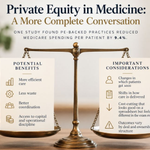
A study looking across physician practice models found that private equity-backed practices reduced Medicare spending per patient by 9.4%. If you’re used to hearing that PE in medicine is all downside, that number deserves a straight look.
So let me give it one. Lower Medicare spending per patient can be a genuinely good thing. It can mean more efficient care, less waste, better coordination. PE-backed groups often bring real operational discipline and capital that small practices can’t easily access, and pretending otherwise isn’t honest advocacy, it’s just cheerleading.
But a single number never tells the whole story, and this is where you have to read carefully. Lower spending per patient can come from efficiency. It can also come from other things, from changes in which patients get seen, from shifts in how care is delivered, from cost-cutting that looks good on a spreadsheet and feels different in an exam room. The number alone doesn’t tell you which. And separate research has found that hospital acquisition of practices tends to raise prices, so “consolidation lowers costs” is clearly not a universal rule either.
My actual view hasn’t changed, but it’s more specific than “PE bad.” It’s that ownership structure determines whose interests win when efficiency and patient care pull in different directions. Sometimes they align, and everybody benefits. Sometimes they don’t, and then it matters enormously who has the final say.
I bring this up because physicians deserve the real picture, not a cartoon. Some PE-backed arrangements run well. The question to ask isn’t whether the model ever works.
It’s what happens, in your specific deal, when the money and the medicine disagree. Read for that.
@BobBlancato @CoryBooker
Melissa can be found on Linkedin linkedin.com/in/melissa-miss…

Wishing you a great session today at General Dynamics IT, @MarkCCrowley . Reaching a live + virtual audience of 3,000+ people is a powerful platform—exactly the kind of expanded footprint that lets your message on heart-led leadership and employee well-being travel farther and land deeper.
Your work continues to make a real difference on this little globe by helping leaders build workplaces where people can actually thrive. Enjoy the room (and the worldwide virtual one), and thank you for keeping the conversation humane and impactful.
As always, you’ve got this!

📁MF #117 Listening Is More Than Hearing
Listening is a form of organizational work.
In long-term care, information arrives through many channels. A CNA notices a change in a resident’s behavior. A family member recognizes a familiar expression of distress. A resident explains what makes a daily routine comfortable—or what makes it difficult. A nurse connects observations with clinical judgment.
Each person holds a different piece of the picture. The organization’s capacity depends, in part, on whether those pieces can reach one another.
Hearing information is the beginning. Listening requires attention, interpretation, and a willingness to consider what the information might mean. It also requires a pathway from observation to action. When people repeatedly share what they know and see no response, the flow of information can diminish. When their observations contribute to better decisions, the organization gains another source of learning.
Self-renewal begins with this kind of attention: the willingness to learn from the people closest to the work and the people whose lives are shaped by it.
What might become possible if listening were treated as a working capacity rather than a personal courtesy?
@LoriPorterNAHCA @mtaylorstark
Ask Better Questions.
Deborah Buchanan retweeted

Thank you @karenklink4 for the reminder that this is worth watching again - and we (that MUST be a "corporate WE as this effects all of us) will keep ROARing on for reform! @DavidCGrabowski @CMSGov @MarthaDeaver1 @MarianHolling @ApronsUnite
youtube.com/watch?v=2xlol-SN…

When a physician and an insurer disagree about payment, should the insurer’s own contracted rates become the controlling benchmark? How do we guard against inflated provider charges without giving insurers excessive leverage?
When we restrict physician ownership in the name of preventing conflicts of interest, what happens if those restrictions also limit competition while larger corporate systems continue to consolidate?
These questions point to something larger than payment disputes or ownership rules. They ask how we balance financial stewardship, fair competition, and the professional judgment of those responsible for patient care.
We need bipartisan support for a health care system that works in practice—not simply agreement on legislation.
How do we distinguish appropriate financial stewardship from a system in which financial architecture begins to shape the practice of medicine itself?
Ultimately, the relationship worth protecting is that of physician and patient—not investor and consumer.
What evidence would help us determine which policies bring that relationship closer to the center of health care?
@SenCapito @CoryBooker @CMAorg
Ask Better Questions.
West Virginia’s Certificate of Need (CON) laws are intended to serve the public interest. But how do we know they do?
Who defines need—and whose needs count?
How are unmet patient needs measured when existing providers cannot meet demand?
What evidence shows that restricting new providers improves access, quality, or affordability?
Who benefits from limiting competition—and who bears the cost when patients have fewer options?
When a regulation restricts access to health care services, who is accountable for the consequences?
A policy designed to protect the public must be able to demonstrate that it does.
Ask Better Questions.
@JoeyGarciaWV
wvnews.com/news/wvnews/healt…
Deborah Buchanan retweeted

mail.google.com/mail/u/0/?og…
This is a great article by @wendellpotter, where he discusses the importance of healthcare whistleblowers and the fact that this is a bipartisan issue.
H.Res. 1586 (non-binding) resolution marks the 27th anniversary of Olmstead and reaffirms that people with disabilities should get services in the most integrated community setting appropriate—not be forced into segregated institutions like nursing homes, psychiatric hospitals, or segregated schools when they can be served at home or in the community.
mcknightsseniorliving.com/ne…
@EssentialCgC @CMAorg
#Olmstead #DisabilityRights #CommunityLiving

And you, my father, there on the sad height,
Curse, bless, me now with your fierce tears, I pray.
Do not go gentle into that good night.
Rage, rage against the dying of the light.
Dylan Thomas born October 27, 1914
W/o a doubt, when our tax dollars are helping fund these hospital systems, we should have a clearer picture of what we’re actually getting in return — better access, better care, or just bigger systems. Appreciate you digging into this. @jldobrinsky
Patients first is the right priority. @wvsenate @JoeyGarciaWV @AmyMSummers @kaylayoungforwv @DutchRojas

The Surgeon Who Chose Rural West Virginia
Dr. Erik Stapleton came to Greenbrier County to build the orthopedic care it lacked. His firing has become a lawsuit against the hospital, owned by CAMC and Vandalia Health.
@RayCanterbury @GregoryAWatt @JackDWoodrum @PushkinPress @jldobrinsky
jessicadobrinsky.substack.co…
Brigham (~4,000): Still live. Nurses rejected MGB’s “last, best, and final” offer last week, mainly over Across-the-board COL/wage increases on top of the existing step system (5% annually to year 20). Strike was postponed; no new date set. Hospital notes starting pay ~$86.7k and top-of-scale ~$220k+, already high for the market.
Allegheny General (~1,500): 99% authorization led to a deal. They just ratified a 3-year contract with nearly 16% average raises ($35M wage investment), staffing commitments, protected benefits/pension, end to forced rotating shifts, and AI language. Leverage produced a settlement.
Santa Rosa (~800): Two-day strike underway this week (98% authorization) over benefits, differentials, retirement, and reliance on travel nurses. Hospital has replacements lined up; wage talks described as early-stage.
McLaren Lapeer: 94% authorization in September, then a 3-year contract ratified in early October (strike averted). Hospital had offered ~15%.
Wages and cost of living are front and center in high-COL markets, and the shortage gives nurses cards. At the same time, looks like #staffing ratios appear as the top issue in most recent nurse walkouts (far more often than pure pay), and many hospitals—especially #nonprofits—face tight margins, fixed reimbursements, and rising overall labor costs. High authorization votes force movement; they don’t automatically produce unlimited raises. Deals are getting done where both sides compromise.

Deborah Buchanan retweeted

four nurse bargaining fights live right now: 4,000 at Brigham rejected the final offer last week. 1,500 at Allegheny General authorized at 99%. Santa Rosa striking this week. McLaren Lapeer at 94%.
mostly wages and cost of living. the leverage is real this cycle.
A major antitrust lawsuit against HCA Healthcare and Mission Hospital has hit a critical roadblock in NC business court.
@susanrmims @MountainXpress @DutchRojas @MyNCSenate
Judge Mark Davis denied class action certification, ruling that plaintiffs relied on broad assumptions and failed to prove common, system-wide impacts on healthcare quality.
The motion was denied without prejudice, giving the plaintiffs an open door to adjust their economic models and file again.
Read the full breakdown on how this impacts healthcare costs and monopoly pushback in Western NC: northcarolinahealthnews.org/…
