

Pulmonary/Critical Care MD | Econ & Policy Insights | Dad, Photographer | CaptionSmith App Creator | MD➡️TX | Discussing healthcare, innovation, geopolitics.
Plano, TX
Joined January 2010
- Tweets2.2K
- Following388
- Followers943
- Likes921


Pinned Tweet
Every hospital employed physician has heard it: your division loses money. The books that say so are real. So are the other books, the ones where your referrals, your imaging, your downstream revenue get counted, in a department you never see.
CF clinics are the cleanest example in medicine. The team gets told it's subsidized while its program anchors a multimillion-dollar pharmacy line.
The number that would change your negotiation is the one you never get shown.
A patient can enter hospice without leaving the bed. The hospital discharges him on paper, hospice admits him in the same room, and when he dies that night it is a hospice death. Sepsis, 37,000 admissions: in-hospital death 11.6 percent, 30-day death 19.3. The gap is paperwork.
In 2007 CMS fixed its pneumonia antibiotic clock by letting physicians write diagnostic uncertainty to exit the measure. That rewards one thing. Not a better diagnosis. A better sentence. A metric that can be satisfied by describing your doubt was never measuring care.
The mortality index tells a referral center to refuse its sickest transfers. Medicare bills the death to the sender whether the patient moves or not. The receiver's index takes it only on yes. Transfers die at 2.2 times the odds after risk adjustment. Yes is the move that costs.
Congress noticed Medicare patients spending nights in a hospital without being admitted. It did not change the rule. It mandated a form, due within 36 hours, telling the patient the nights do not count. A reform that leaves the patient where he was and makes sure he knows it.
Clinical documentation improvement improves nothing clinical. The query asks whether malnutrition is severe because severe is an MCC and the MCC sets the DRG tier. OIG checked 200 such claims. 173 were wrong. A billion dollars in two years. The patient ate the same lunch.
Lawyers bill in six-minute increments. The 31st minute of a phone call costs the client exactly what the first one did, and the invoice records it to a tenth of an hour.
Critical care time is billed by the cliff. Thirty minutes at the bedside is one unit. Seventy-four minutes is the same unit. Under Medicare the meter doesn't move again until minute 104.
Both professions watch the clock. The lawyer is adding it up. The intensivist is finding out whether the next hour officially happened.
Minutes 31 through 103 are on the house. Nobody has ever said that to a lawyer.
It's a good thing intensivists care more about the patient than the meter. Most of the useful thinking happens in the middle of the cliff.
Every ICU dashboard that tracks reintubation also tracks ventilator days. The pairing is supposed to be the check: keep the tube in too long and the second number gives you away.
It doesn't. Ventilator days is a unit mean, and the mean belongs to the three-week ARDS lung and the trach waiting on a bed. One cautious extra day on a two-day patient disappears into that tail before the report is run.
A reintubation disappears into nothing. It has a date, a bed, and a name, and someone will ask about it.
One number has a name on it. The other has a denominator. The tube stays in for the metric that is attributed to a name.
The hospitalist writes the admission order, sets the length of stay, and authors the chart that gets coded. Those three things set the DRG, the single payment for the entire stay.
None of that payment lands in the hospitalist's column. The group is credited with its professional fees, which don't cover its salaries, so every year the hospital writes a support check and the budget calls hospital medicine a cost center.
The service that produces the building's inpatient revenue is the one the ledger says loses money.
Stable patients stay on the specialist's follow-up schedule for years, and it isn't inertia. It's the template.
A return visit for a stable problem bills 1.92 work RVUs and gets booked in about half the time of a new patient. The new patient who would take that slot bills 2.60. Twice the minutes for a third more credit.
Discharge the stable patient back to primary care and the clinic's productivity drops that same week. No metric counts the new patient waiting three months for a first appointment.
The schedule isn't built around who needs to be seen. It's built around who pays better by the minute.
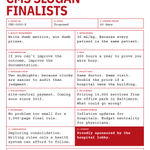
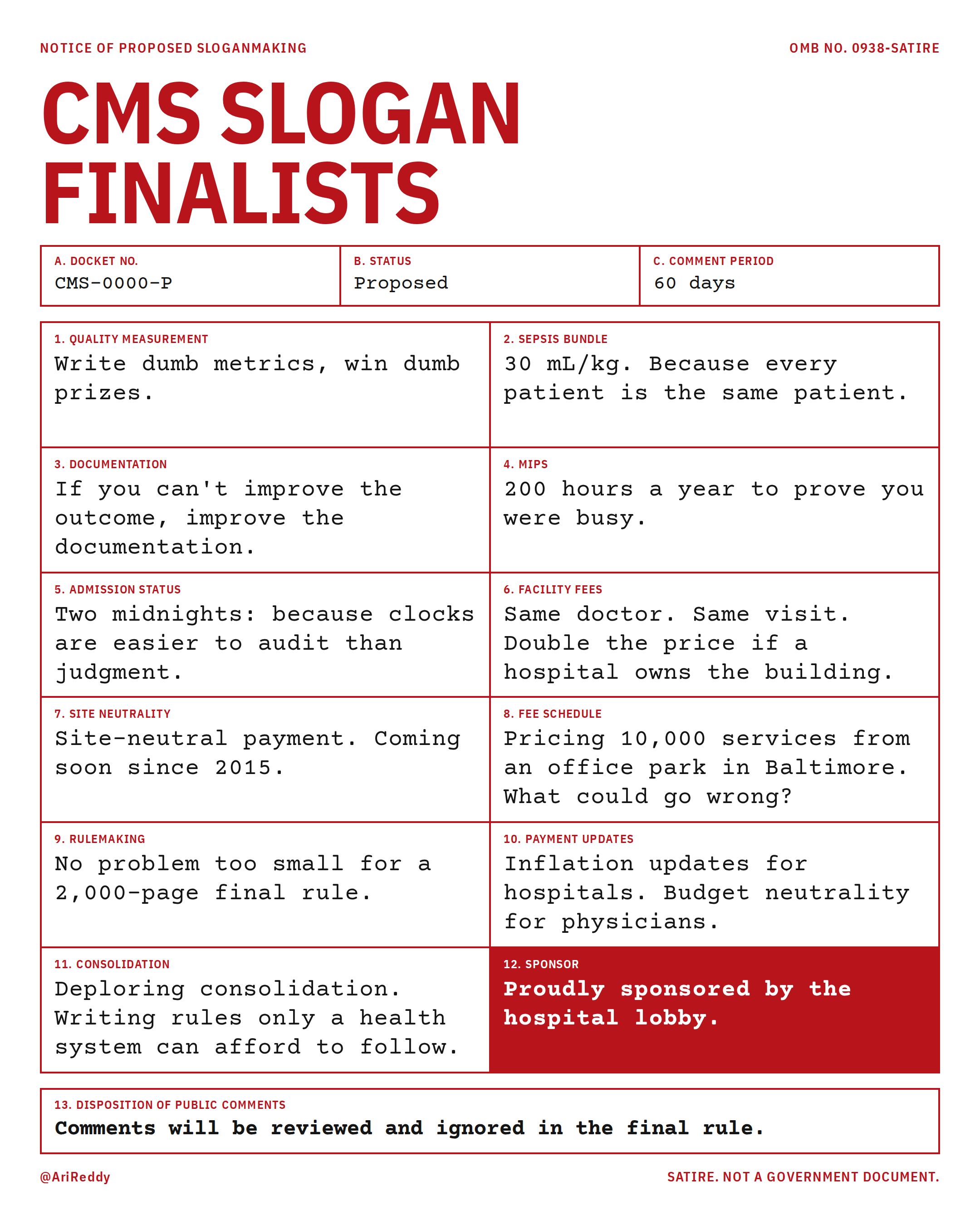
CMS slogan finalists, pending a 60-day comment period:
"Write dumb metrics, win dumb prizes."
"If you can't improve the outcome, improve the documentation."
"Proudly sponsored by the hospital lobby."
Comments will be reviewed and ignored in the final rule.
Put the same harm against a 0.55% stroke rate and tell me falls don't matter.
The reply I keep getting is that fall risk was settled in the 1990s and no patient weighs a GI bleed against a stroke. Both halves are wrong the same way.
The 1999 decision analysis didn't find falls harmless. It found them outweighed, at a 6% annual stroke risk. Outweighed is a comparison between two weights, and only one of them changed when this trial enrolled 60-year-olds.
The harm side is real. Fall-prone AF patients ran traumatic ICH at 2.0 per 100 patient-years against 0.34 (Gage 2005). In ENGAGE, fall risk raised life-threatening bleeding 67% and didn't raise strokes.
And the harm isn't GI. An anticoagulant ICH is a hemorrhagic stroke, so the trial's stroke endpoint already counts it. It counts it as one event, same as a lacunar infarct with a Rankin of 1. The field's own math weights it at 1.5 (Singer 2009), and that's generous to a bleed where 76% end in death or severe disability (Fang 2007). The endpoint sees the count. It doesn't see the outcome.
This trial has nothing to say about any of that. 60-year-olds, 17 events. A trial with no falls in it isn't evidence that falls are safe. It's silence.
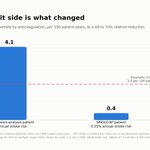
The benefit side is what changed. At 6% a year no realistic fall rate catches up. Here the untreated stroke rate was 0.55%. Stroke risk rises with age. So does ICH risk, 2.5-fold at 85. Falls only add to one side of the scale.
The 1990s answer was right for the 1990s patient. Nobody re-ran it for this one.


To Medicare's readmission penalty, a readmission is an inpatient order. The same patient back in three weeks with the same diagnosis, placed in observation, is not a readmission. The penalty reaches 3 percent of a hospital's base Medicare inpatient payments, and the exemption is a status the hospital assigns.
Readmissions for the targeted conditions fell after the program started. When a 2022 JAMA Network Open analysis counted the observation returns as returns, more than half of that improvement disappeared.
The patient came back. The metric just didn't record the visit.
CMS pays physicians less for getting faster.
The fee schedule has always worked this way. A procedure gets quicker, the RUC resurveys it, the work RVU gets cut. Cataract surgery has been revalued downward for thirty years on exactly this logic.
The 2026 rule removed the survey step. A 2.5% "efficiency adjustment" now comes off the work RVU of roughly 7,000 non-time-based codes, recalculated every three years, on the assumption that you got more efficient whether you did or not.
Now run the math from the practice side.
Revenue per unit of efficiency falls, by rule. Cost per unit of efficiency rises, because the cheap gains come first: the next increment needs new capital, new workflow, more staff training. Declining return, rising cost, and the crossover point arrives sooner the better you get.
Budget neutrality closes the loop. Whatever one practice saves in RVUs gets redistributed across the whole pool. The efficient practice funds the inefficient one and keeps nothing.
Soviet planners had a word for this. The ratchet. Beat the quota and the quota goes up, so no factory manager ever beat it by much.
The fee schedule is a ratchet. Physicians learned the same lesson.
Independent practice is a frog in a pot.
Rent rises with CPI. Staff wages rise with CPI. Malpractice premiums rise with CPI.
The physician fee schedule is the one number in American healthcare that doesn't.
Hospitals figured this out and bought the frog.
Cardiology audited its own guidelines: 2,711 recommendations across sixteen documents. About one in ten rested on multiple randomized trials or meta-analyses. About half rested on expert opinion, case series, or accepted practice. Among the strongest recommendations, the ones written as directives, fewer than one in five had the top grade of evidence behind them.
Between first and current versions, the number of recommendations grew 48 percent.
Strong language on thin evidence is not a lapse in guideline writing. It is the house style, and the house rewards it.
CPT has modifier 22 for an unusually difficult or prolonged procedure.
It needs modifier 23: technically trivial, ethically indefensible.
Intubating a bedbound patient with end stage dementia because the family wants everything done. Grade 1 view. First pass. Fifteen seconds. Nobody in the room thinks it should have happened.
Medicare pays it without a second look.
Medicare has a review process for the level of care.
It has none for whether the care should have happened.
is measured. It's priced, and the price is the cause.
An E&M visit tops out at 99215. Manage one problem or eleven, forty minutes or two hours, the ceiling is the same, and it has fallen against inflation for twenty years. So nobody manages eleven problems. The patient gets split into five visits with five doctors, each billing their own capped code, each ordering their own labs.
The cardiologist seeing the stable follow-up isn't stealing anyone's referral. He's holding one fifth of a patient that the fee schedule made unprofitable for any single physician to hold whole.
There is no code for managing the entire patient. So no one does.

England mandated MRSA screening for every hospital admission by the end of 2010, then paid to audit it. The audit found £89,000 to £148,000 per QALY against a £30,000 threshold, and that screening only high-risk specialties would save an acute hospital about £2.7 million a year at the cost of roughly one extra infection.
The mandate was withdrawn in 2014, in the middle of austerity.
Per person, the NHS had 45 cents for every dollar the American system had. The country with less money is the one that went looking for what did not work. Illinois needed twelve more years.
Illinois's MRSA screening mandate was written to expire. The 2007 act repealed itself on January 1, 2011.
In July 2010, nine months before the first randomized trial of screen-and-isolate published, the legislature struck the expiration date and made the mandate permanent. The bill as filed would have added three more categories of patient to screen.
Sixteen years later it took a unanimous vote and a bigger bill to remove what a calendar would have removed for free.