

TEDx & Global Keynote Speaker | Wellbeing Champion | HR Strategist #POVfromPrudence
Greenwich, CT
Joined May 2012
- Tweets1.2K
- Following250
- Followers113
- Likes549








Pinned Tweet
I joined @SHRM’s All Things Work podcast live at #SHRM26 for a conversation about How to Keep Climbing the Career Ladder in the Age of AI.
One point I continue to believe:
AI won’t replace leaders.
Leaders who know how to use AI while developing people will outperform those who don’t.
The organizations that will thrive are investing in:
• Leadership readiness AND technical skills
• Succession planning, versus replacement planning
• Human-centered decision making alongside AI
• Well-being as a business strategy, versus an employee perk
It was a privilege to join this conversation with Anne, John and Yogi
If you are navigating leadership development, succession planning, or preparing your workforce for the future of work, I’d love to hear what you’re seeing in your organization.
Watch this clip where I highlight my employee wellbeing framework: pearrm.com/leadership-assess…
🎧 Watch the full podcast here: podcasts.apple.com/us/podcas…
#SHRM #Leadership #AI #FutureOfWork #SuccessionPlanning #LeadershipDevelopment #HumanResources #KeynoteSpeaker #POVfromPrudence
1
3
219
🗳️ The election may be over, yet the leadership responsibility continues.
Political uncertainty doesn’t have to become workplace division. How leaders respond can either strengthen trust or erode it.
I appreciated joining Duke University’s Dialogue Project, in collaboration with @SHRM and the Page Society, for an important conversation on navigating political uncertainty and maintaining workplace civility.
Three takeaways I shared:
🔹 Culture reveals itself during difficult moments. Trust and psychological safety matter most when tensions rise.
🔹 Listen beyond the loudest voices. Leaders need genuine, two-way dialogue to understand what employees are experiencing.
🔹 Lead with consistency, not politics. Address workplace behaviors, reinforce organizational values, and ensure internal and external messages align.
Leadership isn’t about getting everyone to agree. It’s about creating an environment where people can disagree respectfully and still thrive together.
Thank you to Bob Feldman, Charles Sipkins, and Ryann DuRant for a thoughtful discussion.
📖 Read the Duke Dialogue Project article:
dialogueproject.fuqua.duke.e…
💬 What are you doing to help leaders navigate difficult conversations in the workplace?
#Leadership #WorkplaceCivility #HumanCenteredLeadership #OrganizationalCulture #ExecutiveLeadership
1
7
🔹 An irreplaceable CEO may be a company's greatest strength, and one of its greatest governance risks.
Succession planning isn't about replacing a leader. It's about ensuring the organization can thrive when leadership changes.
I appreciated this timely perspective from Brett Stephens, CEO of RSR Partners, on the board's responsibility for CEO succession and leadership readiness.
💡 One point particularly resonated with me: Boards must define the leadership capabilities the business will need tomorrow before deciding who should lead it.
This aligns closely with conversations at The Continuity Table, a recent gathering I hosted with board directors and senior executives.
Three questions deserve greater attention in every boardroom:
🔹 Are we developing leaders for today's business or tomorrow's strategic realities?
🔹 Do we have genuine leadership readiness, or simply a list of potential successors?
🔹 If an unexpected transition occurred tomorrow, could the organization maintain momentum and execute its strategy?
Succession is not an event. It's an ongoing governance responsibility.
And leadership continuity must extend beyond the CEO to the critical roles, institutional knowledge, and capabilities that sustain the enterprise.
Thank you, Brett and RSR Partners, for advancing this important conversation.
💬 Board directors and CEOs: How often does your board test succession readiness against future business scenarios, rather than today's organizational structure?
#POVfromPrudence #BoardGovernance #CEOSuccession #CorporateGovernance #LeadershipContinuity #SuccessionPlanning #BoardOfDirectors
Full article: rsrpartners.com/insights/per…
1
1
16
Thank you, Stephen, for such a meaningful conversation! 🎙️
One lesson that fundamentally changed my approach to employee wellbeing came when I introduced an employee resilience program.
Employees challenged it: Why are you asking us to become more resilient instead of addressing the workplace conditions creating the stress?
That feedback was powerful. Since we had created an environment of psychological safety, employees felt comfortable telling us what we needed to hear.
It reinforced something I believe deeply today: We cannot keep asking employees to adapt to unhealthy systems. We must design healthier systems.
That's where meaningful, sustainable wellbeing begins.
Full episode here: journey.live/ep21-from-welln…
#POVfromPrudence #EmployeeWellbeing #Leadership #WorkplaceCulture #Journey @stephensokoler
4
✨ What if workplace wellbeing isn't a people problem, but a DESIGN problem?
Last week, I had the pleasure of speaking on the Fordham Gabelli School of Business stage at WOBI's World Business Forum in NYC! 🎤
My session, "Designing Workplaces Where People Thrive: Human-Centered Leadership in the Age of AI," challenged leaders to rethink the relationship between wellbeing, performance, and the future of work.
We explored three essential leadership practices:
🛡️ Psychological Safety — Creating environments where people feel safe to speak up.
❤️ Purposeful Legacy — Connecting people to meaning while developing tomorrow's leaders.
📊 Data-Driven Flexibility — Using AI and human intelligence to make work better for people.
And our live audience poll reinforced why this matters!
When asked what creates unnecessary workplace stress or disconnection:
🔹 42% identified policies and processes.
🔹 33% pointed to workload and priorities.
Together, these accounted for 75% of responses!
💡 My takeaway: We cannot expect people to thrive in systems that make thriving difficult.
I also introduced the PEARRM Leadership Well-Being Maturity Curve™, encouraging leaders to move beyond reacting to workplace challenges and begin intentionally designing environments where people flourish.
Thank you to WOBI and Fordham Gabelli School of Business for the opportunity to contribute to this important conversation!
As we prepare for 2027, here's my question:
💬 If you could redesign ONE thing about how work gets done, what would it be?
#POVfromPrudence #WOBI #WorldBusinessForum #FordhamGabelli #HumanCenteredLeadership #FutureOfWork #WorkplaceWellbeing #PEARRMServices PEARRM Services @wobi_en @FordhamNYC Gabelli School of Business


1
26
🤔 Are we making business decisions without listening to the people who matter most?
I recently came across a post criticizing a prominent AI company for announcing layoffs.
The author's argument was provocative: How can a company justify eliminating jobs when its own product is still falling short of customer expectations?
That made me think.
Not necessarily about whether the layoffs were justified. I don't have enough information to make that judgment.
Instead, I started thinking about the voices that influence business decisions, and the ones that may be missing from the conversation.
💡 Here's my perspective:
Not every business decision can accommodate every customer's preference. And not every employee recommendation can or should shape strategy.
Yet, three sources of intelligence should be difficult for any leadership team to ignore:
🔹 Customer intelligence: What are customers actually experiencing? Are their needs changing? What patterns are emerging in their feedback, behavior, and willingness to stay?
🔹 Competitive intelligence: Where are competitors delivering greater value? What are they doing differently? Are they responding to market shifts or simply reacting to financial pressures?
🔹 Employee intelligence: What are the people closest to the work saying? What do they see that may never reach the executive team or boardroom?
🎯 Leadership isn't about listening to every voice equally. It's about knowing which voices need to inform which decisions.
💬 I'm curious: When organizations make significant workforce decisions, how much weight should customer experience and employee insights carry alongside financial performance?
#AI #Leadership #BusinessStrategy #WorkforcePlanning #CustomerExperience #EmployeeVoice #CorporateGovernance #FutureOfWork #ExecutiveLeadership
1
9
✨ Powerful leaders. Bold conversations. Meaningful connections!
What an incredible evening at The Continuity Table!
The fourth PEARRM Services partnership event, first locally in Westchester, and first fully sponsored leadership dinner! 🎉
An extraordinary group of executives and board leaders together for candid conversations about succession, leadership readiness, and organizational continuity.
💡 The biggest takeaway? Succession isn’t just about who comes next. It’s about preparing organizations to thrive through change.
🏡 A HUGE thank you to my wonderful sponsor, AVE Hamilton Green, and Talia Malizia for the beautiful venue, exceptional hospitality, delicious food, and incredible partnership!
❤️ To everyone who joined us, thank you for your insights, energy, and authentic connections.
The first Continuity Table of many! 🥂
#POVfromPrudence #TheContinuityTable #PEARRMServices #Leadership #SuccessionPlanning #BoardGovernance #WestchesterNY #AVEHamiltonGreen


11
🎤✨ TODAY IS THE DAY! | WOBI New York City
Excited to take the stage at the World Business Forum (WOBI) to share a conversation I'm passionate about:
🌱 Designing Workplaces Where People Thrive: Human-Centered Leadership in the Age of AI
As AI continues to transform how we work, I believe one thing remains essential: People must remain at the center of how we lead.
We'll explore three important leadership priorities:
🛡️ Psychological Safety — Creating environments where every voice matters.
❤️ Purposeful Legacy — Building cultures where people find meaning and connection.
📊 Data-Driven Flexibility — Using human and artificial intelligence to help people thrive.
🌟 I'm also looking forward to hearing Indra Nooyi speak this afternoon on business transformation. I know it will be an opportunity to learn, connect, and exchange ideas with leaders shaping the future of business!
📍 WOBI | New York City | If you're attending, I'd love to connect!
#POVfromPrudence #WOBI #WorldBusinessForum #Leadership #HumanCenteredLeadership #FutureOfWork #AI #EmployeeWellbeing #ExecutiveLeadership
wobi.us/breakout-stages-nyc/

19
📈 The leadership approach that helped you succeed with five people may not be the one that helps you lead fifty.
I came across this Harvard Business Review article by Julie Zhuo, As Your Team Gets Bigger, Your Leadership Style Has to Adapt, and it reinforces something I’ve seen throughout my career.
As organizations grow, leaders must grow differently, too.
Early in their leadership journey, success often comes from being highly responsive, personally involved, and close to every decision.
Yet as teams expand, those same strengths can become limitations.
🔹 Being accessible cannot mean becoming the bottleneck for every decision.
🔹 Being accountable cannot mean holding on to responsibilities others need to own.
🔹 Being supportive cannot mean protecting managers from the opportunity to develop their judgment.
🔹 Being effective increasingly means creating the conditions for others to succeed.
Through executive coaching and DiSC facilitation, I’ve seen how often capable leaders continue relying on behaviors that worked at an earlier stage of their careers.
The challenge isn’t that those behaviors were wrong.
It’s that the leadership assignment has changed.
💡 This is why leadership development and succession planning must go beyond identifying high performers. We need to prepare people to lead at the next level of complexity.
That requires intentional development, feedback, self-awareness, and the willingness to lead differently.
A question for leaders: What is one leadership habit you’ve had to change as your responsibilities grew?
📖 hbr.org/2019/03/as-your-team…
#POVfromPrudence #LeadershipDevelopment #ExecutiveCoaching #SuccessionPlanning #AdaptiveLeadership

8
🗳️ When politics follows people into the workplace, how should leaders respond?
Last week, I had the opportunity to join the SHRM Civility Call Series, hosted by Bob Feldman of Duke University's The Dialogue Project, for a timely conversation about navigating political tensions in the workplace.
💡 My biggest takeaway
Most organizations don't need a new election playbook. They need to consistently apply the leadership principles, policies, and practices they already have.
Here are three perspectives I shared:
🔹 1️⃣ Consistency matters more than the topic.
Whether the disagreement involves politics, religion, or even a sports rivalry, leaders need to focus on workplace behavior, not personal beliefs.
The standard for respectful conduct shouldn't change based on the subject. Consistency helps prevent everyday tensions from escalating into employee relations concerns.
🔹 2️⃣ Two-way communication requires more than an open-door policy.
Telling employees to "share your concerns" isn't enough.
Be specific. Can they speak with their manager? HR? Another member of the leadership team?
Employees need multiple trusted channels, especially when their concern involves the person they report to.
And leaders must be prepared to listen and respond.
🔹 3️⃣ Leaders don't always know what they don't know.
The executive team's perception of workplace culture isn't necessarily the employee experience.
📊 Surveys provide valuable insights.
- Skip-level conversations, listening sessions, and informal engagement reveal what the data alone may miss.
If leaders only hear from their direct reports, they're getting an incomplete picture.
- One additional reminder: When uncertainty creates anxiety, ensure employees know how to access existing support resources, including confidential Employee Assistance Programs (EAPs).
Here's what I hope leaders remember:
Civility isn't built during election week.
It's built through the trust you establish, the behaviors you reinforce, and the culture you shape throughout the year.
And when external pressures enter the workplace, that culture gets tested.
💬 For my fellow leaders: How are you preparing managers to navigate difficult conversations while maintaining trust, respect, and business continuity?
Thank you to Bob Feldman, The Dialogue Project at Duke University, SHRM, and my fellow panelists for an engaging and thoughtful conversation. Ryann DuRant Charles Sipkins
#POVfromPrudence #Leadership #WorkplaceCivility #HumanCenteredLeadership #CHRO #WorkplaceCulture #EmployeeExperience
2
1
31
"The long-term CEO is disappearing."
That line from Teneo’s new research, based on interviews with 42 directors across the U.S., UK and Canada, is powerful.
Succession has always been the board's most important decision. What's changing is the target. The leader a company needs in five years may look nothing like the one it needs today.
🔗 Three shifts stood out: lnkd.in/eXxtS4Hy
1️⃣ Start with the future business, not the role.
Traditional succession begins with a fixed job spec. The better starting point is where the company is going and what leadership that will require. When the strategy changes, the spec and the pipeline have to change with it.
2️⃣ Look at the person behind the résumé.
Boards are giving more weight to judgment, adaptability and performance under pressure than to credentials. That calls for evidence, not impressions.
3️⃣ Look earlier and further down.
Mapping the market shows who is available today. The harder question is whether you're building the pipeline you'll need tomorrow, well below the C-suite.
🔹 FROM THE BOARDROOM SIDE
As a former CHRO, and as a nonprofit board director with compensation-committee experience, I've seen this gap firsthand. The succession plans were thorough on names yet built for the business as it was.
That's why I created Succession Architecture™. It treats succession as enterprise continuity and leadership risk, governed by the board, not handed off as an HR event.
One more finding I'm taking to heart: the average U.S. director now brings 3.5 areas of expertise, up from under 3 in 2010. Boards want "utility players." My own range covers human capital, benefits strategy, succession and family-business governance, and I'm rethinking how I tell that story.
Three questions every board should be able to answer:
▸ How early are we building visibility into potential successors, inside and outside the company?
▸ How far below the C-suite does our view of future leaders extend?
▸ What evidence do we have of how those successors perform under pressure?
Which one is hardest for your board to answer today?
@Teneo Martha L. Carter, PhD Diane McIntyre Sean Quinn
#POVfromPrudence #BoardGovernance #SuccessionPlanning #CorporateDirectors #HumanCapital Harvard Business School
42
🔥 Passion should fuel us, not consume us.
I am deeply passionate about employee wellbeing and creating workplaces where people can thrive. However passion, even when rooted in purpose, can come at a cost when we lose sight of our own wellbeing.
An insightful @PsychToday article by @AnnaSverdlik, PhD explores two types of passion:
💚 Harmonious passion enriches our lives while leaving room for relationships, rest, and other priorities.
🔥 Obsessive passion can become all-consuming, negatively affecting our wellbeing, relationships, and performance.
This distinction matters tremendously in the workplace.
We often celebrate leaders who give everything to their work. Yet sustainable leadership isn’t about how much of ourselves we’re willing to sacrifice. It’s about creating meaningful impact without sacrificing our health or humanity.
💭 My POV: Employee wellbeing and organizational performance should never be competing priorities. Leaders have a responsibility to model that belief, not simply promote it.
A special thank you to @ssalentine MPH, PCC, CPCC for sharing this thought-provoking article in her Weekend Boost newsletter. Her reminder to tend the flame while taking good care of ourselves resonated with me.
What if we measured leadership commitment not by how much we sacrifice, but by how sustainably we contribute?
Full article here: lnkd.in/gY8_2Tj7
#POVfromPrudence #LeadershipWellbeing #EmployeeWellbeing #HumanCenteredLeadership #FutureOfWork
4
Some leadership experiences remind you exactly why you love the work you do.
This was one of them.
Nearly 30 directors.
Different personalities, perspectives, and leadership styles.
Yet what stood out most was the genuine willingness to understand one another.
After three decades in HR and leadership development, I can say this was one of the most engaged, thoughtful, and collaborative leadership teams I’ve had the privilege of working with.
Everyone leaned in.
The most effective leaders recognize when someone else needs something different from them. That’s where awareness becomes adaptability, and adaptability strengthens leadership.
None of this happens by accident.
It starts with the right partner in the room.
Chris Curtin has a rare gift. He helps leadership teams step back, name what is actually slowing them down, and think through practical ways to remove those blockers so the business can move forward. He brings clarity to complex conversations and makes it safe for leaders to be honest about what needs to change.
What Chris has built through Connected Approach and Leadership Center Connecticut is something special: a place where leaders do the real work of growing together.
If your team is ready to move from friction to momentum, Chris is the person to call: theconnectedapproach.com/abo…
Chris, thank you for your trust and for the opportunity to collaborate. I thoroughly enjoyed being part of it, and I look forward to what’s next.
Check out Chris’ post on LinkedIn
#POVfromPrudence #LeadershipDevelopment #AdaptiveLeadership #DiSC #LeadershipWellbeing


7
The future of work may be powered by technology, yet the future of leadership must remain deeply human.
I’m excited to join an incredible lineup of thought leaders at the World Business Forum NYC, hosted by @wobi_en, on November 5!
My session, “Designing Workplaces Where People Thrive — Human-Centered Leadership in the Age of AI,” explores how leaders can create environments where people feel safe to contribute, connected to purpose, and empowered to thrive alongside emerging technology.
🗣️Innovation means little if we lose sight of the people behind it.
WOBI has generously provided me with a limited number of complimentary guest registrations!
DM me for a complimentary registration code. I’d love to see you there!
📅 November 5 | 9:15–10:00 AM
📍 World Business Forum | NYC
wobi.us/breakout-stages-nyc/
#POVfromPrudence #WorldBusinessForum #HumanCenteredLeadership #FutureOfWork #LeadershipWellbeing

9
AI-linked layoffs are climbing. The labor data isn't backing it up.
New tracking shows a growing share of 2026 job cuts are being pinned on AI, even as broader hiring and unemployment numbers stay mixed. That gap is a problem for CEOs, because boards and investors are starting to ask the obvious question: is this transformation, or is this cover?
If you're the HR leader in the room when that question lands, "we're optimizing for efficiency" isn't an answer. A number is.
This is exactly the credibility gap I built "The 5 Metrics That Will Get Your CEO's Attention in 2027" to close, the handful of workforce metrics that let you walk into that conversation with proof, not a narrative.
Check out my 2027 business plan offerings: pearrm.com/2027-hr-business-…
What's the metric your CEO actually trusts right now? Curious what's working in your org.
#POVfromPrudence #HR #FutureOfWork #WorkforceStrategy #HRLeadership #AIatWork
PEARRM Services

9
Stress and joy can sit in the same room
🌍 One of the most important findings in Gallup's new report isn’t about social media at all.
Globally, negative emotions remain well above where they were in 2006:
📈 Physical pain: +10 points
📈 Worry and sadness: +8 points each
📈 Stress: +7 points
Yet positive emotions have held up remarkably well. The share of people who say they learned or did something interesting has risen 10 points, and feeling treated with respect is slightly higher. ✨
Gallup’s point is that positive and negative emotions are not opposite ends of one scale.
People can feel both at the same time, even under very hard circumstances.
That changes how leaders should read their people data. 🔍
❌ A stressed team is not automatically a disengaged team.
❌ Lowering stress alone won’t create a thriving culture.
✅ Track both sides. Are people learning? Do they feel respected? Do they have moments of enjoyment in their week?
In my experience, the best leaders don’t wait for pressure to disappear before investing in growth and recognition. Those are often exactly what help people carry the pressure.
What’s one positive signal you watch for on your team?
Check out my TEDx Talk on Loneliness: youtube.com/watch?v=mUmbXNnt…
Read the full Gallup report: gallup.com/analytics/349280/…
#POVfromPrudence #Resilience #Leadership #EmotionalHealth #HR

10
Last week, I had the pleasure of being invited to attend the Forbes Future of Work Summit in New York City, joining business leaders, innovators, and executives for conversations about the future of work.
🌎 One message came through clearly:
AI is changing how we work, yet human judgment, leadership, and trust will determine how successfully we navigate that change.
🔸 AI fluency is becoming the baseline. As Deepali Vyas emphasized, technical fluency may get you considered, but judgment and other distinctly human capabilities will differentiate talent.
🔸 Employee wellbeing cannot be an afterthought. As organizations accelerate transformation, leadership must pay equal attention to resilience, psychological safety, and the conditions in which people are expected to perform.
🔸 Leadership development must evolve alongside AI. If the experiences that once prepared employees for leadership are disappearing, organizations must intentionally create new pathways.
🎯 My biggest takeaway?
We cannot transform technology without transforming how we develop, support, and lead people. And we cannot expect tomorrows leaders to emerge from yesterdays talent-development systems.
This is why I remain passionate about Succession Architecture™, leadership continuity, and helping organizations build the human capabilities needed to sustain performance through change.
Thank you to Forbes and the speakers for bringing together such thoughtful perspectives. I appreciated the opportunity to listen, learn, and reflect alongside leaders shaping what comes next.
💬 As AI reshapes work, what are you doing differently today to prepare the leaders your organization will need tomorrow?
#POVfromPrudence #ForbesFutureOfWork #FutureOfWork #LeadershipDevelopment #AITransformation #SuccessionPlanning #HumanCapital #BoardGovernance


1
2
26
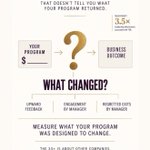
Every budget season, someone in the room asks what leadership development actually returned. Too often, the answer is a story instead of a number.
Allison Allen, ACC makes the point well: research about other companies won't answer your CFO's question. Your own data will, but only if you set a baseline before the program starts.
As 2027 plans take shape, pick the measure now, agree on it with finance, and capture where you are today. Then the results conversation in 12 months is a review, not a defense.
#POVfromPrudence #LeadershipDevelopment #HRStrategy

1
2
12
🌱 Wellbeing and succession planning?
YES, they go hand-in-hand!
Many organizations treat them separately. One lives with benefits. The other lives in the boardroom.
After 30 years in HR, I know that they share the same foundation.
🚀 People stay where they can see their future.
@McKinsey research shows career development and advancement is the #1 reason people choose a new role. When someone can see their next step, their energy and commitment grow with it.
🤎 The manager relationship is the bridge.
Managers are where wellbeing and readiness meet. Great managers notice capacity, open doors, and actively build the person who will one day fill a critical role.
🔋 Energized leaders build strong benches.
A leader who is running on empty has little left to develop a successor. A successor who feels supported is ready to step up.
Protecting wellbeing protects your pipeline.
📊 @SHRM found that when employees trust their organization's commitment to wellbeing, the likelihood of turnover falls by 87%.
💬 Two points to remember:
✨ "Burnout isn't just about the hours worked." — SHRM
✨ "Succession planning needs to evolve to be more adaptive, more equitable and more human." — @Gartner_inc
💡 My take: Succession is a wellbeing strategy, and wellbeing is a succession strategy.
Here are three questions for leaders:
✅ Does every high performer know their next step?
✅ Do your managers have the time and tools to grow their people?
✅ Is your succession plan designed for leaders who are thriving?
What's one way your organization connects growth and wellbeing? I'd love to hear it.
#POVfromPrudence #SuccessionArchitecture #EmployeeWellbeing #SuccessionPlanning #Leadership #FutureOfWork #HRLeadership #PEARRM

1
2
28
After 30 years in human capital leadership, I’ve seen how even experienced executives can become limited by what has worked before, who is in the room, and the assumptions no one is brave enough to challenge.
AI gives us an opportunity to challenge our thinking before our decisions become commitments. Human judgment allows us to consider alternatives, question assumptions, anticipate consequences, and recognize possibilities we might otherwise overlook.
I see tremendous potential for this in succession planning and boardroom governance. Imagine being able to test different leadership scenarios, challenge assumptions about who is ready to lead, and identify capabilities the organization will need three to five years from now.
AI cannot replace the courage to ask difficult questions, the wisdom to recognize what matters, and the accountability to make the final decision.
The real opportunity is to make better decisions because we’ve been willing to think beyond what we already believe. @HarvardBiz
#POVfromPrudence #BoardGovernance #Leadership #StrategicDecisionMaking #SuccessionPlanning #AI

2
9
✨ What a night at 50/50 Women on Boards Boston
Last week the room was full of sitting directors and board-ready women who came out despite the rain and traffic, ready to do the work. The energy was exactly what was needed.
Women hold too few board seats across the Russell 3000, and progress slowed in recent years.
Many seats will open as directors retire or reach term limits. Whether they go to women depends on whether a board plans who replaces its directors, or waits until a chair is empty and calls the people they already know.
That is a succession problem. Many boards would never accept that approach for their CEO. 🔑
The most practical advice of the night came from our table coach Patricia Flynn: go where the openings actually are, including boards many candidates overlook.
Proud to serve on the Boston planning committee.
Thank you to Mary Ellen De Winter, and the entire committee, as well as the panelists and coaches, and of course Bentley University for hosting. 🙏🏽
We have work to do and we are taking the steps needed to get to where we need to be 💪🏽
#WomenOnBoards #POVfromPrudence #BoardSuccession #CorporateGovernance #5050WOB @5050Wob /50 Women on Boards


1
13