Do your own research. Tweets not advice
Joined June 2010
- Tweets455
- Following429
- Followers70
- Likes14.1K


SG ⌀ retweeted

Masterclass de @montebourg chez @Le_Figaro qui assassine l'UE devant un @ThierryBreton qui encaisse difficilement.
SG ⌀ retweeted

Tout est vibration, tout est rythme, tout est un.
Voilà ce que l'Égypte savait il y a quatre mille ans.
Sept principes hérités de l'hermétisme égyptien.
Une philosophie qui irrigue depuis quatre millénaires la pensée occidentale, et que les élites continuent, selon Jiang, d'utiliser comme grille de lecture du monde.
SG ⌀ retweeted

On me demande beaucoup ce que je pense du risque d'interdiction des ETF synthétiques dans le PEA.
J'ai regardé nos données ce matin: sur les PEA synchronisés sur Finary, 84% contiennent au moins un ETF synthétique. Parmi ceux qui détiennent un ETF, c'est 97%...
Le message par le gouvernement 7,3 millions de détenteurs de PEA: le système des retraites est au bord du gouffre, mais ceux qui prennent leur épargne en main seront sanctionnés. La preuve avec la hausse prélèvements sociaux passés de 17,2% à 18,6% en janvier, et qui a touché le PEA.
Mais pourquoi ce sujet des ETF synthétiques est-il sans cesse ramené sur le devant de la scène ?
Car il ferait "fuir" les capitaux hors d'Europe à l'heure ou la souveraineté est un enjeu capital.
Pourtant, un ETF synthétique sur PEA détient un panier composé à 75% minimum d'actions européennes. De vraies actions, qui financent des entreprises européennes.
Interdire ces ETF, c'est couper le robinet qui alimente ces paniers, voire forcer leur liquidation. L'Etat organiserait la vente d'actions européennes au nom du financement des entreprises européennes.
Le coût pour l'épargnant est énorme. Entre 2015 et aujourd'hui, et pour 1000€ investis, cela représente un manque à gagner de 70%:
🇺🇸 S&P -> 3550€
🇪🇺 Stoxx 600 -> 2100€
Si cela se fait, l'Etat risque de combler, en aides sociales, le rendement qu'il aura retiré à l'épargne privée. Cela ne fera qu'empirer la situation des finances publiques.
Pendant ce temps, nos voisins encouragent l'investissement en Bourse:
🇬🇧 UK: 20k GBP par an dans l'ISA (équivalent PEA), 0% d'impôts à la sortie
🇸🇪 Suède: 0% d'impôts jusqu'à 27.000€, puis 1,065% forfaitaires
🇩🇪 Allemagne: 26,375% sur les plus-values, 5 points sous notre flat tax
🇳🇱 Pays-Bas: pas d'imposition des plus-values, et forfait sur le patrimoine au-delà de 57.000€
Au-delà de l'Etat, qui va gratter quelques recettes, ce sont les assureurs qui vont y gagner. L'assurance-vie pèse 2.162 milliards d'euros, dont 1.470 milliards en fonds euros, très largement investis en dette d'Etat. Affaiblir le PEA, c'est rapatrier des encours vers le seul produit qui finance le déficit.
Politiquement, cette enveloppe sera très difficile à toucher car les encours sont massivement détenus par les 60 ans et plus, les faiseurs de rois des élections.
Ce ballon d'essai sur les ETF n'est pas nouveau. Vu l'état des finances publiques, il pourrait finir par passer... Nous allons tout faire pour que cela n'arrive mais !
Par contre, on peut compter sur les candidats à la présidentielle pour en proposer d'autres "idées" fiscales encore plus contraignants. Il n'y a qu'à voir le niveau des débats autour de la dette française.
C'est pour ça qu'il faut diversifier ses enveloppes autant que ses actifs afin de se protéger de... l'Etat.
Un PEA, une assurance-vie, un compte-titres. Prendre date sur une AV coûte quelques centaines euros d'aujourd'hui et protège d'une future loi.

SG ⌀ retweeted

Barry Plunkett @BPIV400, Co-CEO of Cosmos, demonstrates an interbank transfer over IBC.
With one product that interoperates with any network, banks avoid the cost of separate integrations for every counterparty or rail they need to reach.
Banks preserve privacy and security throughout.
SG ⌀ retweeted

We have partnered with @cosmos to bring digital ledger infrastructure across Latin America and Spain.
The agreement formalizes a multi-year collaboration by designating @Peersyst as a key provider of Cosmos-based solutions for central banks, financial institutions, and governments across the region, covering deployment, integration, and ongoing support.

SG ⌀ retweeted

Two weeks ago, Ethereum researchers met in Berlin to continue charting the protocol's long-term trajectory, following along discussions with client teams in Svalbard in April.
The updated strawmap is at strawmap.org, and I attached a picture of it to this post.
My own high-level takeaways:
* "Lean Ethereum" is not a single one-shot upgrade, it is a collection of improvements that will come online to the Ethereum network over the course of three or four years. But make no mistake, this IS the third major iteration of Ethereum in the same way that the Merge was the second. Almost every major piece of the protocol will be replaced:
- Verification through recursive STARKs, rather than direct re-execution. Recursive STARKs become an enshrined first-class core component of the protocol
- Replacing everything quantum-vulnerable with quantum-safe alternatives
- Consensus: decoupled available chain and finality, one or two-round finality. Theoretically optimal security properties, simpler than today, and faster than today
- Multidimensional gas
- State: not just tree structure, but what *types* of state are available
- Changes to client architecture
...
At the same time, simplification, cleanup and future-proofing. And this will all be done in a way that minimizes disruption to existing application. We've done this before (the Merge), we can do it again.
* H-star (aka Hegota) is probably Ethereum's last thematically "pre-Lean" fork. Starting from I-star, most of everything we do will have a very strong "Lean" feel to it in one way or another.
* Privacy is no longer an afterthought, it is a first class goal. When designing Frames, the mempool, additions to the state tree, we explicitly ask the question "okay, how do quantum-safe, intermediary-free privacy protocol transactions go through this, and what is the overhead?"
* Formal verification of everything for security.
* FV also makes us much more comfortable with canonicalization (having pieces of the protocol that are directly defined as a piece of bytecode expressed in some language). evm-asm is being written in part to become a canonical proof system for the EVM.
* Quantum safety has shifted up a LOT in priority. This adds a lot of work (eg. finalizing a quantum-safe blobs design has become urgent; this work has already been ongoing for months)
* Probably the single most disruptive part of the plan is the changes to state. There is growing consensus around leaving present-day-style "dynamic state" mostly unchanged, but scaling it only a medium amount, and adding new types of state that are more scalability-friendly (eg. no need for builders to sync/store all of it) but more restrictive, and that will scale a large amount.
eg. possible Ethereum in 2030: 2 TB of present-day-style (dynamic) state, and 100 TB of new-style (scalable but restrictive) state
This "new-style" state would work very well for ERC20s, NFTs, many defi use cases, but not eg. highly "central" objects like Uniswap contracts, or onchain order books, or other complex things (which are crucial for Ethereum but which only take up a small percentage of state)
Hence, it will not be *necessary* to rewrite any apps, but it will be *very cost-effective* to eg. rewrite an ERC20 token into a newer design that uses a new type of UTXO storage that is currently being explored, so that it will have >10x lower txfees.
Design of these new state types (current ideas: keyed nonces, ring buffers, UTXOs, statically accessible state, temp state) is an area where we will need a lot of feedback from application developers (incl. privacy-friendly application developers) and probably several rounds of rethinking and iteration.
* In the context of a much larger total state size, we need to figure out the incentive issues around who stores this state and what motivates them to. Even saying "each node stores 1%" is not good enough - why do they store that 1% and why are they willing to serve it? This is being elevated as a first-class research area.
* Ethereum will need to have a "VM" other than EVM in one form or another - at the very least, we need something like leanISA for recursive STARKs - and the gains are large in exposing it to users so that we support programmable privacy and better scalability. Right now, the most likely contenders are leanISA and RISC-V.
My own ideal is that in this world, we adjust the protocol so that the EVM becomes a high-level-language compiler-level feature, and the protocol only "sees" RISC-V / leanISA directly. But this is still far away.
* Gas limit increases, blob increases and slot time decreases will happen many times over the next ~5 years. We expect a large gas limit increase with Glasterdam. Each step of increased scale or decreased slot time is a matter of getting to the point where it is safe to do it, which comes from a combination of client optimization and protocol changes.
Ethereum is CROPS.
Ethereum is scaling.
Ethereum is reinventing itself.
Onward.

SG ⌀ retweeted

Quelques comptes utiles pour le suivi du conflit en cours (liste évidemment incomplète !) :
@Historionome
@vtchakarova
@restitutorII
@inside_IL_intel
@Osint613
@sentdefender
@SONARROW_OSINT
@MOSSADil
@BenniKim
@oilgastourist
@staunovo
@HFI_Research
@Rory_Johnston
@anasalhajji
@chigrl
@crudechronicle
@The_Oilholic
@EnergyRealist25
@EnergyCynic
@KobeissiLetter
@bravosresearch
@acquirersx
@StealthQE4
@C_Barraud
Wishing $ATOM a powerful Year of the Fire Horse — may the new #Gaia26 mainnet launch ignite performance, strengthen sovereignty, and accelerate #Cosmos-wide adoption.
#Web3 #Blockchain #Interoperability #DeFi #Crypto $ETF

The Gaia v26.0.0 upgrade is live on Mainnet.
The upgrade introduces the tokenfactory module to the Cosmos Hub. Permissionlessly mint new token denoms on the Cosmos Hub starting today!
Special thanks to @HyphaDoesCosmos for the technical implementation and upgrade coordination.
SG ⌀ retweeted

The Gaia v26.0.0 upgrade is live on Mainnet.
The upgrade introduces the tokenfactory module to the Cosmos Hub. Permissionlessly mint new token denoms on the Cosmos Hub starting today!
Special thanks to @HyphaDoesCosmos for the technical implementation and upgrade coordination.
SG ⌀ retweeted
Vitalik announced that the rollup-centric roadmap is over.
For Optimism, Arbitrum, Base, and the rollups built on their frameworks, this raises urgent questions about platform risk, independence, and longterm commercial viability.
Cosmos was built for this moment.
Read more ⬇️

SG ⌀ retweeted

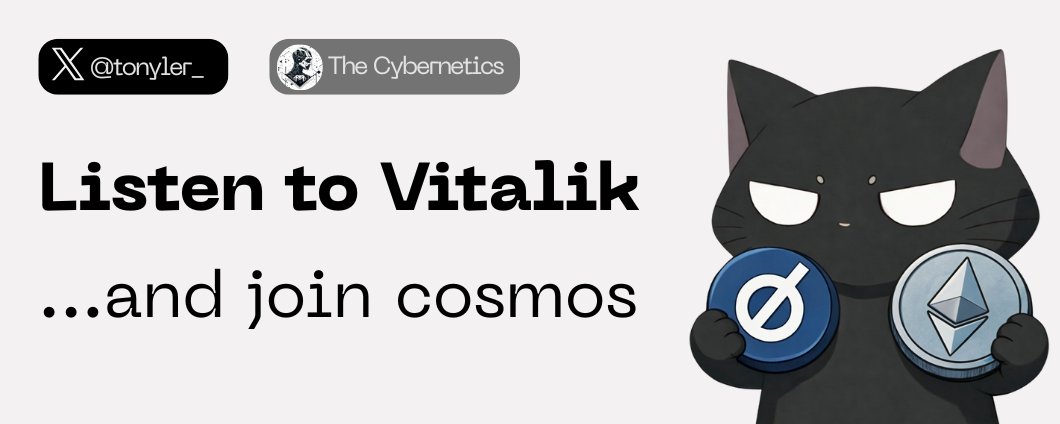
A clear, step-by-step guide to transition an Ethereum L2 to a EVM L1, with native & free interop with ETH mainnet:
1. Spin up a single node L1 with EVM and 200ms block times (github.com/cosmos/evm)
2. Pause L2 sequencer
3. Extract all smart contract bytes from L2
4. Set up a genesis for L1 with smart contract bytes
5. Replay any individual transactions as needed if can't be captured in genesis (rare)
6. Move wallet RPC endpoints to L1 RPC
7. Shut down L2.
8. Set IBC connection (comes pre-loaded) to point at Ethereum
8. OPTIONAL: set your token to be native gas token for your L1
9. OPTIONAL: enable staking of native token for security. Otherwise, just keep running nodes yourself if you had a centralized sequencer.
Whole process takes few days. No visible changes for your users. Now you have a fully EVM-compatible L1 with native interop with Ethereum, and your token is a gas token.
DM with questions, we'll do it for you.



SG ⌀ retweeted

Ethereum is talking today about how L2s should be “dedicated app-chains.” Privacy, private VMs, low latency, interoperability…
The Cosmos ecosystem has been doing this for years. IBC, app-chain vision, modular architecture… It’s all alive and working.
Great ideas, but a little late 😉
While some were drawing up roadmaps, others had already built the road.
$ATOM $ETH $BTC @cosmos @ethereum
🤖 Made with AI
SG ⌀ retweeted
The world 𝘄𝗶𝗹𝗹 run on blockchain.
It's happening now: from loans (@Figure), banking (@progmat_en), and global markets (@OndoFinance), to Artificial Intelligence (@Fetch_ai).
Blockchain is disrupting every market, and institutions are choosing Cosmos as the operating system.
SG ⌀ retweeted
Thank you @realDonaldTrump for your unwavering leadership in standing up for the interests of the American people, and peace. What you said is absolutely true: Zelensky has been trying to drag the United States into a nuclear war with Russia/WW3 for years now, and no one has called him on it. Thank you, Vice President @JDVance for speaking out so forcefully and clearly, about the necessity of diplomacy.
SG ⌀ retweeted

L’ukraine ne pouvait gagner la guerre sans entraîner l’OTAN dans la guerre et entraîner une 3eme guerre mondiale qui eut été à nouveau mortelle pour’l’Europe, Trump cherche à éviter cela…


SG ⌀ retweeted

If the election outcome is as I expected, it should cause the large minority of the country who supported @KamalaHarris and predicted her victory to begin to question their sources of truth.
Half the country has believed that @X is filled with mis- and disinformation, and that they could only therefore rely on The NY Times, MSNBC, CNN and other mainstream media for their news. And they did.
If, however, you have been active on @X for the last year, you have known the truth days, weeks and often months before the facts appear in the MSM.
The MSM excerpted, clipped and cut to defame @realDonaldTrump while claiming that @JoeBiden was fit as a fiddle. Then when Biden’s polls collapsed, @KamalaHarris was anointed the candidate and her hagiography was written with glowing acclaim from the press. But this could not hold as she ducked the media and held fast to the teleprompter.
Citizen journalists with their phone cameras in hand captured the real Kamala forcing her to defend her record and her plans in more media appearances. It did not go well and the public demanded to learn more so @KamalaHarris had to risk more unscripted media.
The doom loop was underway with perhaps 60 Minutes as one of the more dramatic examples, even after CBS tried to save her, most glaringly by excerpting one answer to replace a word salad response to another. But the citizen journalists on @X quickly caught and outed this fraud and demanded a transcript.
As many who supported Kamala began to realize that they have been misled, they became open to Trump as an alternative, but they didn’t want to rely on the media to understand him because they did not want to be misled again.
They wanted to hear the candidate in his own words and that is where @lexfridman and @joeroganhq long form podcasts came to the rescue. When Kamala was offered the same opportunities to explain herself, she rejected them. And the voting public could only draw a negative inference.
When the story of this election is written, I expect it will be as much about how half of America woke up to the reality that they have been manipulated by the media. This should lead to an abandonment by many of the MSM as their primary source of information. It will push more people to @X, to podcasts and other empirical sources, and it will lead to a more informed public.
The other outcome I hope happens is the implosion of the Democratic Party. The Party lied to the American people about the cognitive health and fitness of the president. It prevented, threatened, litigated and otherwise eliminated the ability of other candidates for the primary to compete, to get on ballots, and to even participate in a debate. The Party and the administration used lawfare in an attempt to imprison, bankrupt or otherwise kill off Trump as a candidate. These acts are collectively grave threats to our democracy. With the highest irony in order to hide these acts, the Party accused the opposition candidate of being the grave threat to democracy.
The Democratic Party proved itself to be fundamentally undemocratic. It needs a complete reboot. The leadership should be thrown out and those responsible should apologize to the American people.
Honest Abe said it best:
You can fool some of the people all of the time, and all of the people some of the time, but you can not fool all of the people all of the time.

I believe that @realDonaldTrump will win in a decisive victory and potentially a landslide Electoral College outcome tomorrow. I could of course be totally wrong, but that helps elevate an important point.
Approximately half the country will be unhappy about the election outcome, potentially devastatingly so. In this context, I think it is important to remember that we are one country, and we will survive whoever is our next president.
What we must avoid, however, is a world where our fellow citizens who are disappointed raise hell or otherwise revolt about the outcome. The peaceful transfer of power is a critical feature of our democracy that must be maintained for us to succeed.
The system is stronger than any one candidate. We will thrive long term no matter the outcome of this election because the system will heal itself. That’s been a feature of our democracy for nearly 250 years and I expect it to continue.
Let’s therefore be civil and accept the collective will of our democratic process. We have many enemies that want internecine battles in America to weaken us. We cannot let this happen. The world is a dangerous place and we need to be unified to protect our country and our children.