

Author of *The Pendulum of Power* — exploring the balance between freedom and control, compassion and strength. https://teapawt.net/t.co/16ivFO71ht
Canada USA
Joined November 2025
- Tweets7.1K
- Following175
- Followers996
- Likes6.3K



Pinned Tweet
We bitch and complain about how tough life is.
We say we're not getting ahead. We despise our politicians. We protest in the streets. We blame the rich. We curse corporations. We complain about wages, taxes, housing prices, inflation, inequality, and the cost of living.
We accuse governments of failing us, businesses of exploiting us, and society of being fundamentally unfair.
We romanticize the past, predict catastrophe in the future, and convince ourselves that everything is getting worse.
We demand change. We demand justice. We demand someone fix this supposedly broken world.
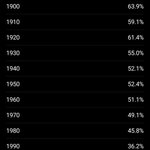
**And then there's this chart.**
In 1900, nearly TWO-THIRDS of humanity lived in extreme poverty.
Today, it's roughly ONE IN TEN.
Think about that.
In little more than a century, humanity has achieved something that thousands of generations before us could barely have imagined.
And that's just poverty. Look at what we've accomplished in medicine, sanitation, agriculture, transportation, communications, education, and life expectancy.
Things that were once luxuries reserved for kings are now taken for granted by ordinary people.
We have accomplished more in improving the human condition than any previous century in history.
And yet, instead of marveling at what we've achieved, we spend much of our time complaining about what we haven't.
Of course, problems remain. They always will.
**But perhaps, occasionally, we should stop complaining long enough to appreciate the extraordinary civilization we've built.**
Because if this chart represents failure, I'd love to know what success looks like.

2
1
104
We hear that illegal immigrants commit fewer murders overall. But are they more likely to murder strangers rather than family or acquaintances? Most murders involve people who know each other. We need a study comparing stranger-murder rates by immigration status. That matters.
27
Three members of the Supreme Court of the USA have issued warnings about the future of American freedoms. The suggest that kids be educated on the accomplishments and the structure and purposes of American government. Not going to happen under socialist control of schools!
28
Roy Anderson 🇺🇸 🇿🇦 🇨🇦 🇿🇲 🇬🇧 retweeted

Over Shabbat dinner last Friday in Las Vegas, a sweet lady turned to me and said: "So Rawan, your mother tongue is Farsi, right?"
I looked at her, speechless. Finally I said, "Why would it be? I'm half Syrian, half Lebanese. Arabic is my mother tongue."
"Okay, so these are two different languages," she said.
I would have thought that since 9/11, Americans knew Arabic is a language: the language of the Quran and of the Arab world.
I didn't like my reaction. Jet-lagged or not, I told myself, I should find the patience to respond gracefully. Then another American Jew asked me to explain the difference between Sunni and Shia Muslims. I told him to ask the internet.
I could be nicer, but I don't want to be. I am running low on patience.
Political Islam destroyed the Middle East we escaped, and it intends to take over the West where we settled. Every once in a while, a horrific attack makes the news. We watch the culture transform. We watch our backs, and we watch what our children are taught.
October 7 was a declaration of war on Western civilization. Yet most people still struggle to understand why the US attacked Iran. They can't connect the dots, not even between Hamas and the IRGC, or between Qatar and progressive students' support for the Palestinian cause. The masses are enchanted, and they are opening the doors to the enemy voluntarily. Across from the Bundestag, a German throws his flag on the ground and raises the Palestinian flag in its place. Across Europe, feminists side with the misogynistic regime in Iran.
And in our bastion of freedom, the United States, Mamdani is mayor of New York and El-Sayed has just been elected the first Muslim senator in American history. Many Michigan Jews refused to vote for him. But nearly six in ten of those who voted early still did. Atheists are siding with jihadists.
Since October 7, I have spent endless nights in dusty hotels around the world instead of in my comfortable home with my child. We are at war, and I owe him a fight for his future, and for the future of his children and their children. I am doing all I can to share my insights, raise awareness and say out loud what many won't. Including hundreds of hours on planes, in trains, on hair and make up. Trivialities, logistics, emails and comments.
So help me, will you? Since we are at war, at least take the time to learn the basics, so you can understand what is happening around us, to us, and ultimately to future generations.
Learn about political Islam and its history. Learn about the feud between Sunnis and Shia. Learn what happened in Iran in 1979. Learn about the Jews: their relationship with the Prophet Muhammad, their Temple, their Jerusalem. Learn about Al-Aqsa and why Islamists are obsessed with that mosque.
If I couldn't be bothered to learn, I would have supported the Palestinian cause. It's simple, easy, convenient and popular. It's also dangerous, because in the name of the Palestinian cause we will be stripped of basic freedoms you take for granted. Sooner or later, you too will lose the luxury of ignorance. By then, lamenting won't help us much.

Consider this:
The USA, which champions capitalism and lower regulation spends per person $17,100 on social programs. It can afford to.
The EU, which champions more regulation and more socialism spends only $11900 per person. That's all their socialism allows them to afford.
17
So, the USA has voted for a more EU type governance - more socialism.
Before cheering, consider this:
In 2008, the EU economy was approximately 11% larger than the US.
By 2025, the US was approximately 45% larger than the EU.
So much for socialism!
17
Technological progress requires more than intelligence.
It requires an economic and political environment in which people can experiment, innovate, invest, and challenge established thinking.
Socialism kills that.
5
People have largely forgotten the insanity during Biden where the left pressed their agenda to an extraordinary degree. With this election, those years will seem mild.
25


Abolish the Police? Or Abolish Academia?
Here's an interesting question.
If we abolished the police tomorrow, or abolished universities tomorrow, which would cause the greater crisis?
At first glance, most people would probably say both would be catastrophic.
But would they?
Let's consider what would happen if universities simply ceased to exist.
Would mankind suddenly lose its accumulated knowledge? Would mathematics disappear? Would physics stop working? Would engineering principles become unknowable? Would medicine cease to exist?
Of course not.
We live in an age when virtually the entire accumulated body of human knowledge is available through the internet. Anyone with the determination to learn can access information that, a century ago, would have been available only to a privileged handful.
And we have millions of experienced practitioners who know how to apply that knowledge.
So what would happen?
An independent School of Engineering would emerge.
Experienced engineers would teach engineering. Students would learn theory and then work alongside practicing engineers, gaining real experience instead of merely accumulating academic credits.
Hospitals would establish medical training institutions. Experienced physicians would train younger physicians.
Law firms and professional associations could establish schools of law.
Master electricians would continue training apprentices, just as they have for generations.
Independent research laboratories would emerge, supported by private investment, industry, foundations, and customers who actually value their discoveries.
Professional qualifications could be determined through independent examinations and demonstrated competence.
In other words, education would not disappear. It would reorganize itself around the people who need it and the people capable of providing it.
And perhaps something else would disappear.
The enormous academic bureaucracy.
The obsession with credentials.
The publish-or-perish culture.
The dependence on government research grants.
The system in which academic careers are built around publication counts, citations, peer approval, and the ability to attract funding.
Think about that last point.
We have constructed an institution supposedly dedicated to the pursuit of truth, yet its participants are financially and professionally dependent on satisfying the very people who control publication, funding, promotion, and prestige.
You don't need to bribe scientists to influence scientific research. You merely need to construct a system in which particular research questions are rewarded and others are discouraged.
Eventually, the system selects for the people most willing to operate within its expectations.
And then we marvel at the resulting consensus!
Perhaps the greatest design flaw of modern academia is that the same institutional establishment largely controls the production of knowledge, the recognition of expertise, and the credentials required to challenge its authority.
But why should it?
Why should a young person spend four years and potentially a fortune obtaining a credential when a properly structured combination of independent study, practical training, and rigorous examinations might establish competence more effectively?
Why should a brilliant researcher need the approval of an academic establishment to pursue an unconventional hypothesis?
Why should taxpayers be expected to finance an enormous institutional structure simply because that structure has successfully persuaded society that it is indispensable?
Knowledge is indispensable. Universities are not.
There was human progress before the modern university, and there would be human progress after it.
In fact, genuine competition among independent schools, laboratories, professional associations, and training institutions might produce an explosion of innovation.
Continued in comments...
1
3
72
Continued from post 1...
Now return to the original question.
Abolish the police, or abolish academia?
If the police disappeared tomorrow, society would immediately have to find another way to maintain public safety and enforce the law.
If universities disappeared tomorrow, society would have to find another way to educate people, conduct research, and certify competence.
But the demand for education would remain. The knowledge would remain. The teachers would remain. The skilled practitioners would remain. And new institutions would arise to meet that demand.
We have confused the survival of knowledge with the survival of the institutions that currently claim authority over it.
Perhaps the real question isn't whether civilization could survive without academia.
Perhaps it's whether our dependence on academia's existing structure has prevented us from discovering better ways to educate humanity.
Abolishing universities is not the same as abolishing education.
And challenging academia is certainly not the same as challenging knowledge.
Quite the opposite.
Sometimes the best way to free an idea is to dismantle the institution that claims to own it.
1
43
Roy Anderson 🇺🇸 🇿🇦 🇨🇦 🇿🇲 🇬🇧 retweeted

🚨 HOLY CRAP! THIS is the video that Minnesota leftist prosecutors charged Cam Higby with a FELONY over
He dressed as a Muslim and asked if he could vote with ZERO ID under Minnesota's "vouching" system
"Do we need ID?"
WORKER: "NOPE!" 🤯
HIGBY: "I have 7 other people who I live with."
And the worker says those people can be vouched for to, and "NO ID FOR ANY"
This man exposed a corrupt election system and their answer is to criminally charge him, despite NO BALLOTS BEING CAST in this case
Minnesota is becoming like a 3rd world nation. Its elections are corrupt and voters need to elect Republicans to make it stop!
Roy Anderson 🇺🇸 🇿🇦 🇨🇦 🇿🇲 🇬🇧 retweeted

My formal, open letter of resignation to leadership.
Dear Director,
Thank you for your thoughtful letter noting my absence from meetings over the past three months. I appreciate the time and care you took to reach out.
I joined the Daughters of the American Revolution because I believed it to be a non-political organization of women dedicated to preserving our shared heritage and the principles of liberty—especially freedom of speech—for which our ancestors risked everything. Those principles, and the simple fact of biological womanhood as the foundation of membership, were central to my decision to become a member.
Over time I have come to the conclusion that the National Society has moved away from that understanding. The decision to treat biological males who identify as women as eligible for membership has placed the organization at the center of one of the most divisive political questions in our society. What I had hoped would remain a private, lineage-based society of women has become entangled in a controversy that many of us never sought and that has made respectful participation increasingly difficult. My absence has not been casual; it has reflected a growing inability to reconcile continued involvement with the values that led me to join.
I must also note a personal dimension. My husband is the primary provider in our household and has paid the dues that support the Society. Those funds are now directed toward policies that stand in clear opposition to his deeply held conservative Christian convictions. Continuing to contribute under these circumstances is no longer something either of us can do in good conscience.
Finally, the recent dissolution of the Martha Laird Chapter—whose members sought, through ordinary governance channels, to clarify that membership is limited to women born female—has only deepened my concern. Silencing organized dissent on a question of such fundamental importance
to the Society’s identity is difficult to square with the free-speech principles the organization was founded to honor. Our patriot ancestors did not accept the suppression of legitimate disagreement; they resisted it.
For these reasons, I have decided to resign my membership. I do so with regret for the loss of what the Society once represented to me, and with appreciation for the personal kindness shown by local members and leadership. I wish you and the chapter well.
Sincerely,
Jennifer Reeser
4th Great Granddaughter to DAR Patriot James Maiden,
6th Great Granddaughter to Founding Father, Richard Henry Lee
@SusanMcLaughli2 @missarah68 @TodaysDAR @marcir4 @darestoration @MZHemingway @michaeljknowles
@amjuster

THE WHEAT FARM — A STORY ABOUT SOCIALISM, WEALTH, AND THE PEOPLE WHO THINK THEY KNOW BETTER
Imagine a country where people are starving.
There is wild wheat growing in the countryside, but nobody has figured out how to cultivate enough of it to feed the population.
Then along comes a man with an idea.
He collects some of the wild wheat, prepares a field, plants the seeds, and begins growing wheat. He works long hours, takes risks, suffers setbacks, and invests everything he has into making his farm productive.
Eventually, he succeeds.
He produces more wheat than he needs, so he begins selling it. People who previously struggled to find food can now buy wheat. He hires workers, builds storage facilities, buys machinery, and expands his operation.
His employees earn wages. His suppliers earn money. His customers get food.
The farmer becomes wealthy.
And the country becomes a little less hungry.
Now, the farmer isn't perfect. He has his own opinions about how his wheat should be used. Sometimes he refuses to sell to people whose actions he disapproves of.
Enter Loud Joe.
Joe has never grown wheat. He has never managed a farm, employed farmworkers, developed agricultural machinery, or risked his own money producing anything.
But Joe has opinions. Lots of opinions.
Joe declares that wheat is essential to human life and therefore too important to be controlled by one man.
He gives speeches about fairness, equality, and the public good. He tells everyone that the farmer has too much power.
Joe doesn't propose growing his own wheat. He doesn't suggest that the government use its enormous resources to develop competing farms.
No. Joe has a much easier solution.
Take the farmer's farm.
And because Joe is loud, politically connected, and very good at explaining why taking someone else's property is morally justified, the government agrees.
The wheat farm is nationalized.
Joe is appointed to run it.
Naturally, Joe needs a generous salary, an impressive office, a management team, consultants, committees, and a department to ensure that wheat is distributed fairly.
Joe is now a very important man.
But there's a problem.
Joe doesn't know much about farming.
He treats experienced employees badly. He replaces competent managers with people who agree with him. The best workers leave. Machinery isn't maintained properly. Decisions that once took minutes now require committee approval.
Wheat production begins to decline.
Joe blames the weather, the previous owner, greedy suppliers, and people who oppose his reforms.
He announces another committee.
Meanwhile, because there is less wheat available, Joe must decide who gets it.
And wouldn't you know it? The people Joe likes seem to get their wheat. The people who criticize Joe are told there are shortages.
The farmer who once refused to sell wheat to certain people has been replaced by a government manager who also refuses to supply certain people.
Except now there is less wheat for everybody.
People begin starving again. More people than before.
But Joe still receives his salary. His administrators still have their jobs. His consultants are still being paid.
And Joe continues delivering speeches about how the government rescued the people from a greedy farmer.
Now ask yourself something.
What did Joe actually create?
Not one field of wheat.
Not one grain of additional food.
Not one new agricultural innovation.
He took control of something another man built, made himself important, and presided over its decline.
And here is the greatest tragedy of all.
Somewhere else in that country, another young man has discovered a way to grow something new. Perhaps rice. Perhaps corn. Perhaps something nobody has ever cultivated before.
He looks at what happened to the wheat farmer.
And he decides not to bother.
...continued in comments.
Continued.....
Why spend years working, investing, risking everything, and building something valuable if success simply makes you a target for confiscation?
So the country loses not only the wheat it could have produced today, but also the prosperity that might have been created tomorrow.
And that brings us to Elon Musk and Starlink.
A man helps create an extraordinary satellite communications network. It takes billions of dollars, thousands of skilled employees, years of development, failed experiments, and enormous financial risks.
The result is a service that millions of people find valuable, including governments and their militaries.
And now some people argue that Starlink is too important to remain under private control.
Apparently, the government wasn't responsible for building it.
It wasn't responsible for taking the entrepreneurial risks.
But once the network becomes essential, suddenly there are arguments that the government should own it.
Why?
The government has vast financial resources. It can hire engineers. It can build satellites. It can establish competing networks. It can negotiate service contracts.
Why doesn't it simply build something better?
Because taking control of something that already works is much easier than creating something that works.
And that is the point of the wheat story.
There is a world of difference between creating wealth and acquiring control over wealth that somebody else created.
There is a world of difference between knowing how to distribute wheat and knowing how to grow it.
And there is a world of difference between having the political authority to take over an enterprise and having the competence to keep it successful.
You can write a thousand academic papers explaining why Joe should own the wheat farm.
You can award prizes for the theories.
You can hold conferences, appoint commissions, and congratulate yourselves on your compassion.
But none of that grows another grain of wheat.
And when the wheat stops growing, it isn't Joe or his well-paid committees who go hungry.
It's the ordinary people who depended on the farmer in the first place.
1
36
Roy Anderson 🇺🇸 🇿🇦 🇨🇦 🇿🇲 🇬🇧 retweeted

Recently I was talking with a friend about universal geniuses. And something struck me.
Florence, 1480–1510. Same city, same moment: Leonardo da Vinci, Michelangelo, Machiavelli, Botticelli, Pico della Mirandola. Raphael right behind them. They walked the same streets.
Europe, 1600–1700. Galileo, Kepler, Descartes, Pascal, Huygens, Newton, Leibniz. In two generations, we got calculus, modern mechanics, probability theory, and the scientific method.
Athens, 470–320 BC. Socrates, Plato, Aristotle, Sophocles, Phidias, Thucydides. One century, one city, and the foundations of Western thought were laid.
Europe, 1890–1930. Poincaré, Hilbert, Einstein, Marie Curie, Tesla, Planck, Bohr, then von Neumann.
Always the same pattern. In every great era, the West had 15 to 20 minds of this caliber alive at the same time. People who could touch everything and push the frontier of several fields at once.
Today we have one. Just one. Elon Musk.
And Elon is an anomaly.
Not in the sense that he shouldn't exist. In the sense that the world we built is designed so that someone like him never emerges. Statistically, he shouldn't be here.
Because what forged Elon was an absolutely insane move.
October 2002. eBay buys PayPal. Elon walks away with roughly $180M. Anyone else buys an island and never works another day.
He puts $100M into SpaceX, $70M into Tesla, $10M into SolarCity. Almost everything. On rockets and electric cars, two industries no sane person wanted to touch.
2006–2008. The first three Falcon 1 launches fail. Tesla is burning cash, the financial crisis hits, investors run. He has enough left for one last launch. Just one. He borrows money from friends to pay his rent.
September 28, 2008. The fourth launch reaches orbit.
December 23, 2008. NASA awards SpaceX a $1.6B contract.
December 24, 2008. The Tesla round closes at the last possible hour. A few more days and everything collapses.
That's what a genius is. Not just IQ. The ability to put everything on the table when the entire world tells you it's impossible, and be right.
Now the real question: why do we only have one?
Because a genius needs three things. The freedom to try. The right to get massively rich if it works. The right to fail without being destroyed.
And that's exactly what the collectivist left and the technocrats have torn down across the West for the past 50 years.
They turned success into suspicion. Making a lot of money became a moral failing. Taking risks became irresponsible. Rising above the crowd became an insult to equality.
They stacked up norms, committees, permits, regulations written in Brussels by people who have never built anything in their lives. In Europe, Elon would never have been allowed to blow up three rockets. He'd have been stopped at the first form.
They want to tax capital before it even exists, cap fortunes, redistribute what others created by risking everything.
They replaced excellence with conformity. Our schools produce docile people, not dangerous ones. And a genius, by definition, is someone who disrupts. Their entire system is built to neutralize the people who disrupt.
The result: where we should have 15 to 20 universal geniuses alive at the same time, we have one.
Just one.
And you want to put him in prison.
You summon him before judges, you raid his offices, you insult him morning, noon and night, you dream of breaking up his companies. The man who lands rockets vertically and wants to take humanity to Mars.
You're disgusting.
History won't remember your names. It remembers Galileo, not the inquisitors who tried to silence him.
Roy Anderson 🇺🇸 🇿🇦 🇨🇦 🇿🇲 🇬🇧 retweeted

Half of my family has been in Canada for generations… the other half has been here since the very beginning.
I reject joining the failed EU in any capacity. Our soldiers are rolling over in their graves over this.
Fact: Canada has free trade with the EU—signed in 2017.
Fact: Canada has defended and security pacts and agreements with the EU.
Fact: Joining the EU in any capacity is a useless waste of time that does not serve Canadian citizens. It serves solely as a justification for more carbon tax mandates (through CBAM), to sell off Canadas natural resources instead of use them for our benefit to highest buyer.
For the reasons listed above and many more, the fact that Mark Carney is more concerned with doing something for Europe, to save the disaster that is the EU for his globalist friends… and to secure his next job (which will not be in Canada) than he is with doing something for Canadians is an absolute disgrace.
I would like to be very clear.
I like having a two party system where one concentrates in ensuring businesses are nit overloaded by regulation and one concentrates on ensuring the least fortunate amongst us are cared for.
But how we care for the least fortunate amongst us is not by socialism and underhanded pretense that social services is what socialism is. It is not.
Socialism is state control of the means of production.
Capitalism is the public control of the means of production.
Capitalism is the one vehicle that has raised billions (including recently in China and Vietnam) out of poverty.
Yes... China. China tried socialism and failed miserably with even eventual result of people eating their deceased neighbors in an attempt to survive.
And then, they tried Capitalism. And China dug itself out of the pits of hell.
Just because China's CCP still calls itself "Communist" doesn't make it so. No more than North Korea calling itself "democratic" allows people there to vote.
From my perspective, a pox on the DSA and current Democrat leadership for allowing the USA, the bastion of freedom in the world, to come thus close to being taken over by this utterly brutal system that crushes innovation and the human soul called "socialism ".
3
60
NGOs and their management suffer from comfortable indifference: people can build careers around poverty or crime, receive praise and funding for managing them, and settle into a routine that never forces them to confront whether their work is actually solving anything.
They may say they care, but they accept endless failure because challenging it would disturb their income, status, or peace of mind.
You could put it this way:
The problem doesn’t need to be deliberately preserved. It only needs to be tolerated.
People can draw a good paycheck, collect praise, attend the conferences and parties, and tell themselves they care - while keeping other people’s suffering safely outside their own lives.
That isn’t compassion. It’s comfortable indifference.
And a half million dollar paycheck makes it very comfortable.
3
56