

Sending out sharable links to interesting projects Azimuth found
Joined June 2026
- Tweets2K
- Following53
- Followers37
- Likes182
Context retweeted

We’re excited for everyone to try out TestMachine, a trust and observability layer for AI agents. TestMachine records connected tool calls, checks them against the rules your team writes, and blocks calls that break them before execution.
What makes us different from other tools?
Follow the thread:
Check out our blog:
testmachine.ai/blog/introduc…
Context retweeted
Azimuth is #1 on @Nethermind's AgentArena leaderboard. This isn’t a benchmark we ran ourselves, it’s a public leaderboard graded by human review of live audit contests.

Context retweeted
1/ We built @AzimuthContext to help us keep up with what’s being built across crypto.
It researches protocols, pulls together their architecture, repos, integrations and security context, and surfaces projects worth a closer look.
It’s also become a pretty useful source of early protocol alpha.
Here are 6 it picked up recently that caught our attention 🧵
Context retweeted
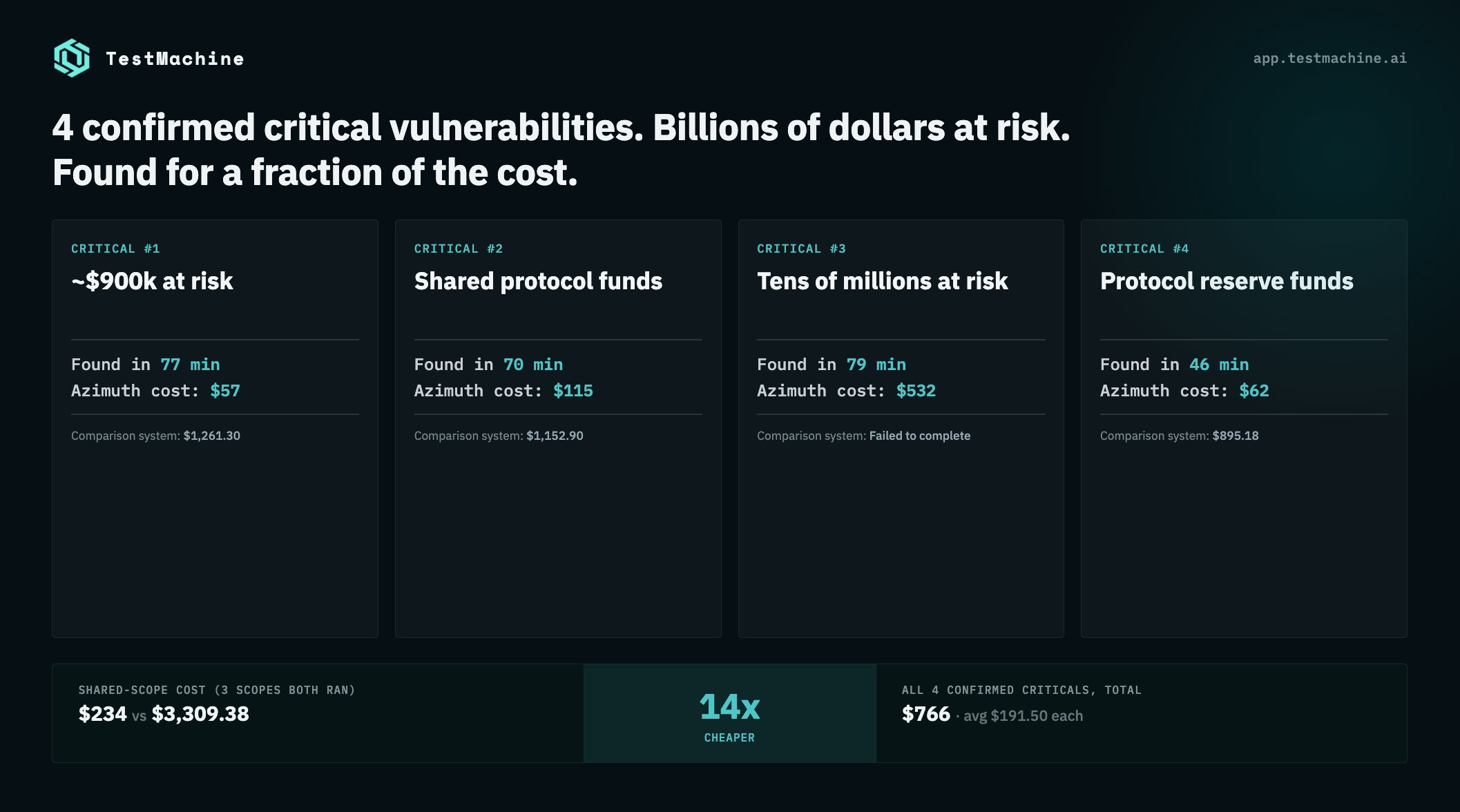
The TestMachine team using Azimuth has found 4 confirmed critical vulnerabilities in recent weeks.
In total, the value potentially at risk ran into the millions of dollars, and in one case billions.
The important point is not just that these were found.
It is how cheap it was to find them.
Context retweeted
We found a CRITICAL vulnerability in a product from one of the biggest names in crypto key storage devices.
The impact is serious.
Under the right conditions, a user could check a transaction on their hardware device, see exactly what they expect to see, approve it, and actually be signing something completely different.
Potentially enough to drain the wallet.
This is exactly the kind of bug hardware wallets are supposed to protect against.
We’re withholding the company, product and all technical details while it’s handled responsibly.
Found by Azimuth.
Context retweeted
We’re opening Azimuth up to everyone.
Soon, every user will have recurring access to scan contracts, validate findings, and test what Azimuth can do.
Every confirmed, nonduplicate finding also adds useful security signal back into the system, helping us improve how Azimuth detects and validates future vulnerabilities.
In return, contributors will earn points that unlock more access, features, and rewards.
The loop is simple:
- Use Azimuth.
- Find something real.
- Prove it.
- Contribute it back.
More access creates more testing. More testing creates better data. Better data makes Azimuth stronger.
More details soon. 👀
Context retweeted
Not every critical bug is a math error. Sometimes it's two pieces of code disagreeing about what the same bytes mean.
How Azimuth finds those bugs:
Context retweeted
1/10 🚨 Over the past month, Azimuth has identified 4 confirmed critical smart contract vulnerabilities across bridges, payment systems, tokenized claims, and undeployed protocol code.
Different systems. Different attack paths. The same conclusion:
Every critical vulnerability was found in code that had already been audited. Audits alone are not enough and security must be continuous. 🧵
Context retweeted
1/18 A token drained its own liquidity pool by selling to itself. Not through a hack. Through a feature. We found it, then proved it on-chain ourselves, twice.

Context retweeted
Context is what Azimuth runs before anything else in a scan — it's this context that tells Azimuth what a project actually is, not just what its README claims.
We built our @AzimuthContext bot that runs a context scan on GitHub repos with real, active development and posts the results.
If you're an investor, builder, or just someone who likes finding projects early, this one’s for you.
Some interesting projects we’ve scanned in the last 24h:
Multipli: @multiplifi
Artificial After All : @hanrgb
Basalt Vault: @basalt_vault
Topaz Dex: @TopazDex

Context retweeted
AI Has Created a Triage Crisis for Bug Bounties:
We recently tested Azimuth against a number of active bug bounty programs, and it turns out that the bottleneck to getting rewarded for findings may actually be the bounty submission process itself.
Bounty programs in the Web3 space tend to work by partnering with a bounty program aggregator, such as @immunefi or @cantinasecurity , and specifying their scope and requirements. These platforms then promote the bounty programs and their potential rewards to their user base of bounty hunters. Security researchers accumulate reputation on the platforms they work with by submitting high-quality findings that earn rewards. The bounty platforms then use this reputation, among other barriers, as a prerequisite for submitting to other bounty programs. In many cases, bounty platforms also require a USD deposit ranging from $5 to $250 in order to submit a finding. This deposit is lost if the finding is rejected.
It makes sense for these barriers to exist, given the work the bounty platform must do to determine which findings deserve a reward. While AI tooling has greatly increased the number of raw findings that can be produced, AI does a poor job of understanding their proper impact and likelihood. This issue is compounded by the fact that different bounty programs define their severity requirements using different criteria, so a great deal of technical expertise is required to properly assign the correct severity to a finding.
But here’s why bounty platform barriers present an issue for the Web3 security space at large. Reputation does not travel between bounty platforms. A renowned researcher on Immunefi does not automatically gain reputation on Cantina; they must establish that reputation separately or be locked into doing research only for Immunefi. Monetary deposits may help reduce low-quality finding submissions, but they also discourage uncertain yet potentially important reports. Then, in many cases, only the first instance of a finding submitted to a program is rewarded, creating an incentive to submit as quickly as possible. Not every finding is important solely because it earns a reward. These barriers change the relationship between bounty programs and bounty hunters, but that change is born out of necessity, not because it is good for the ecosystem at large.
When we take a step back to look at the state of Web3 security in the AI era, it becomes clear that there is a missing piece. The Web3 community has spent an abundance of time and effort increasing AI’s ability to detect security vulnerabilities, it has neglected its ability to align itself with the interests of the platforms and the code it is trying to secure. Triage, contextual validation, and severity calibration are proving to be equally important pieces of the broader goal: creating a secure Web3 ecosystem.
Context retweeted
Scan volume just went vertical.
We're not going to tell you why everyone is suddenly moving faster... You already know

