










ALT A wide field view showcases Jupiter in the upper right quadrant. The planet’s swirling horizontal stripes are rendered in blues, browns, and cream. Electric blue auroras glow above Jupiter’s north and south poles. A white glow emanates out from the auroras. Along the planet’s equator, rings glow in a faint white. These rings are one million times fainter than the planet itself! At the far left edge of the rings, a moon appears as a tiny white dot. This moon is only about 12 miles (20 km) across. Slightly further to the left, another moon, about 100 miles (150 km) across, glows with tiny white diffraction spikes. The rest of the image is the blackness of space, with faintly glowing white galaxies in the distance.

ALT The image is split down the middle, showing two views of the Southern Ring Nebula. Both feature black backgrounds speckled with tiny bright stars and distant galaxies. Both show the planetary nebula as a misshapen oval that is slightly angled from top left to bottom right and takes up the majority of each image. At left, the near-infrared image shows a bright white star at the center with long diffraction spikes. Large, transparent teal and orange ovals, which are shells ejected by the unseen central star, surround it. At right, the mid-infrared image shows two stars at the center very close to one another. The one at left is red, the smaller one at right is light blue. The blue star has tiny triangles around it. A large transparent red oval surrounds the central stars. From that extend shells in a mix of colors, which are red to the left and right and teal to the top and bottom. Overall, the oval shape of the planetary nebula appears slightly smaller than the one seen at left.


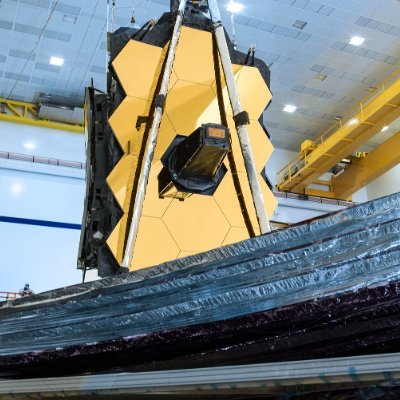
ALT Webb's golden mirror is reflecting the light in a dim room with a blue background. A person in a cleanroom suit stands on an orange lift in front of the mirror.

ALT Curious Universe Sounding Rockets
