

Official account of the British Indian Ocean Territory Administration (BIOTA)
UK and the Indian Ocean
Joined April 2026
- Tweets30
- Following45
- Followers2.3K
- Likes6


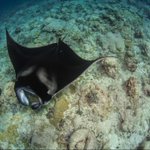


Happy #WorldMantaDay! BIOT provides crucial habitat for an estimated 900 vulnerable reef manta rays, as well as three Critically Endangered species of devil ray. Because of this, our Egmont Atoll was officially designated an internationally Important Shark and Ray Area (ISRA) by the @IUCN in 2024.
📸 by Simon Hilbourne.


We’ve also worked closely with @Bertarelli_fdn, which has supported the tagging of reef manta rays in BIOT. This research is helping us better understand their movements and diving behaviour, providing a clearer picture of how reef manta rays use habitats across the Territory.

Unfortunately, these fantastic rays remain targets for illegal fishing. The BIOT Patrol Vessel has interdicted several vessels in the last few years with mobulids on board. These findings highlight the importance of continued surveillance and enforcement to protect manta and devil rays.
These rays benefit from protection both in BIOT and internationally. In BIOT, commercial fishing is prohibited entirely and we continue to improve our patrolling and detection capability to prevent the scourge of Illegal, Unreported and Unregulated fishing in our Marine Protected Area.

We’re passionate advocates of well-researched marine science, which plays a critical role in the management of Marine Protected Areas. A strong evidence base is critical. We hold a lot of data, both from before and after 2022, that would have improved the accuracy of your paper, @SeaAroundUs, and which might lead to some different, and stronger, conclusions. For the record, there isn’t, and never was, a prawn fishery! Let us know if you’d like to chat.


The final post in our crabs of #BIOT series: the red-eyed rock crab. Found hiding in cracks of rocky shorelines, it feeds on molluscs while concealing itself from predators during low tide. The is species is nocturnal, ranges in colour from brown to dark purple, and is known for its fiery red eyes and feisty behaviour.

To celebrate #WorldSeabirdDay, we thought we’d talk about how BIOT provides a critical habitat for seabird populations. We’ve got over 280,000 pairs of breeding seabirds across the Territory. This includes the red-footed booby, which we have in internationally important numbers - in 2023, 11,700 pairs on Diego Garcia alone. 1/3


BIOT is also home to terns, shearwaters, frigate birds, noddies and more. #DarwinPlus and @Bertarelli_fdn have supported work to track, record and better understand them. 2/3


Seabirds nest in trees along the shore, diving into the ocean to feed on small fish. They are integral to the BIOT ecosystem; their 💩 providing natural fertiliser for our coral reefs. To help them thrive we have supported rat eradication programmes, including with @ChagosTrust, helping limit the number of seabird eggs eaten by this invasive predator 🐀. 3/3

London will be about 10 degrees hotter than #DiegoGarcia this week. To help keep calm and carry on, we thought some photos of BIOT beaches might be in order 🏝️.
We work hard to keep the beaches clean, but it’s a never-ending battle against ocean plastic. Since 2019 we’ve collected over 30,000 tonnes of it. Almost none originated in the Territory.


Customs and immigration are key issues for any government - the BIOT Administration is no exception. BIOT is a unique place, hosting a military facility, where almost everything we need has to be shipped in. Our laws reflect these special circumstances.
Based on the island of Diego Garcia, but operating territory-wide, the BIOT Customs and Immigration Officers search and process over 100 shipping containers a month. This keeps the territory safe, preventing prohibited items and protecting our pristine environment from potential biohazards.
The Customs and Immigration Officers are Royal Navy personnel, posted to BIOT for up to a year at a time.

Let us introduce you to the #BIOT Patrol Vessel. Originally designed to support oil rigs in the North Sea, she’s made a new home in BIOT, where she protects against illegal fishing in one of the world’s largest no-take Marine Protected Areas. Penalties can be severe for those she catches: the seizure of kit, substantial fines or even prison.

The Chagos Brain coral is a critically endangered coral species found exclusively in BIOT. Once thought extinct, it is often coined the world’s rarest coral. In 2023, as part of an emergency response to ocean heatwaves, BIOT collaborated with coral scientists to conserve this important species. Action was taken by researchers at @OxZooDept, @ZSLMarine, @OceanoMonaco and the @HornimanMuseum, supported by UK Government funding from Darwin Plus, together with the Percy Sladen Memorial Trust and @Bertarelli_fdn, to recover live colonies of Chagos Brain coral and establish a refuge population in aquaria. Successful breeding of these corals is providing a critical safety net for this rare and remarkable coral (3/4)


To learn more about action taken to locate and conserve the Chagos Brain coral, you can watch this video created by @OxfordSparks, featuring @MarineBryology (Dr Bryan Wilson, then Research Fellow in Biology at the University of Oxford). On the Edge of Existence: Rediscovering A Lost Coral youtu.be/PJlEXOx5DzA - some photos from him below (4/4)


On #WorldReefAwarenessDay we wanted to share with you information on #BIOT's coral reefs. BIOT is home to one of the last large-scale coral wildernesses on the planet, with over 20,000 sq kilometres of shallow banks and atolls. These include about 1% of all global reefs. BIOT’s reefs provide important habitat for over 250 species of coral and 800 species of fish (1/4)


Isolated from major pollution sources and protected by an extensive marine reserve, BIOT’s waters are considered a near-pristine global example of reef health and recovery. Following marine heatwaves, reefs in the BIOT archipelago have bounced back to optimum health at speeds rarely seen elsewhere in the world. High fish populations and natural nutrient subsidies from seabird communities are thought to play a crucial role in reef resilience (2/4)


