
yongqin wang retweeted

Martin Wolf: Martin Wolf’s best books on economics to read this year ft.trib.al/00TOZMU

yongqin wang retweeted

Can the dollar’s global dominance endure in a more multipolar world? Olivier Jeanne of Johns Hopkins University will deliver the 2026 Mundell-Fleming Lecture at the Annual Research Conference, introduced by @STenreyroIMF. Tune in on November 12 at 2:30 PM ET. #ARCPolak
youtube.com/watch/XrwKeO0s_f…

yongqin wang retweeted

If you are hiring in Macro-Finance/Monetary, I urge you to take a look at Lennart, an outstanding candidate on the market from Cambridge.
His JMP won the 2026 ECB Young Economist Prize and the Cambridge Finance Best Student Paper Award.
lennart-niermann.com/


Excited to present my JMP: Decomposing the Investment Channel of Monetary Policy
❓How does corporate investment respond to lower borrowing costs? And how do contemporaneous belief revisions around monetary policy surprises affect this response?
💡We find that investment is more responsive to small changes in borrowing costs than previously thought. Further, belief revisions that coincide with monetary policy surprises appear to play a sizable dampening role.
🔗lennart-niermann.github.io/J…
👇Summary

yongqin wang retweeted

Thinking Like a Theorist
by Sanjeev Arora
Lecture notes: cs.princeton.edu/courses/arc…

yongqin wang retweeted

Думаю якщо демократи не стануть страждати хуйнею типа відкачуванням трупа камали чи штовханням АОС і просто поставлять цього чувака з Georgia то 2028мі вибори можно виграти дуже просто

yongqin wang retweeted
Stablecoins. Digital money. Geopolitical shifts. Could they usher in new forms of currency competition & cooperation? Join @KGeorgieva opening the #ARCPolak2026, where @STenreyroIMF & leading researchers will explore the future of the int’l monetary system. imf.org/en/news/seminars/con…

yongqin wang retweeted

We develop a methodology for revealing the weights that import tariffs place on groups in society. Our estimates imply that redistributive motives across sectors -- rather than across states -- account for a significant fraction of US tariff variation.
econometricsociety.org/publi…


yongqin wang retweeted

What monetary policy maximizes efficiency—the joint surplus of all households—in heterogeneous-agent New Keynesian economies (HANK)? In a canonical HANK model, the answer is the same policy as in RANK. Read on for why (1/9) nber.org/papers/w35967

yongqin wang retweeted

James Madison: "I go on this great republican principle, that the people will have virtue and intelligence to select men of virtue and wisdom. Is there no virtue among us? If there be not, we are in a wretched situation. No theoretical checks--no form of government can render us secure. To suppose that any form of government will secure liberty or happiness without any virtue in the people, is a chimerical idea. If there be sufficient virtue and intelligence in the community, it will be exercised in the selection of these men. So that we do not depend on their virtue, or put confidence in our rulers, but in the people who are to choose them."
yongqin wang retweeted

With democrats taking control of Congress I expect (with varying levels of confidence) that:
1. Jay Powell will step out of the Fed as central bank independence will be more secure.
2. Tariff policy will be less insane.
3. Fiscal deficits will remain a problem
yongqin wang retweeted

The modern research effort in behavioral finance began in the 1980s. Forty years later, this paper reviews recent progress in the field, lists open questions, and comments on new directions, from Nicholas C. Barberis nber.org/papers/w35959

yongqin wang retweeted

Morreu William Nordhaus, aos 85 anos.
Ganhou o Nobel da Economia em 2018, partilhado com Paul Romer, por trazer as alterações climáticas para a macroeconomia. Gerações de estudantes aprenderam economia pelo manual de Samuelson e Nordhaus. Mas o meu artigo preferido dele é outro: "Schumpeterian Profits in the American Economy: Theory and Measurement", de 2004.
Nordhaus quis saber quanto do valor criado pela inovação fica com quem inova. Fez as contas para as empresas americanas, fora da agricultura, entre 1948 e 2001. A resposta: cerca de 2,2%. O resto foi para a sociedade, sobretudo para os consumidores, em preços mais baixos e produtos melhores.
Por cada 100 euros de valor que um inovador cria, fica com pouco mais de 2. Nós ficamos com os outros 98.
Julian Simon passou a vida a insistir nisto: quem inventa e empreende deixa o mundo muito mais rico do que o encontrou.
Convém lembrá-lo sempre que alguém propõe tributar pesadamente as fortunas dos empreendedores, como se fossem um peso para a sociedade. O inovador já fica com uma fatia mínima do valor que cria. Taxar essa fatia rende pouco e põe em risco tudo o resto.
Quem fez fortuna a inovar não é um fardo social. É o maior benfeitor da sociedade, e cobra por isso pouco mais de 2%.

yongqin wang retweeted
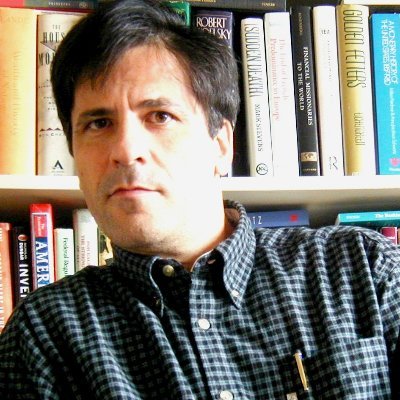
I recently cited Sven Beckert's very good book on the history of cotton production in which he argued that capitalism and globalization occurred together. In this interview he argues that the issue today is no longer the problem of production, which has historically always been the main constraint on human welfare, but rather the problem of distribution.
youtu.be/DDw2yHQ8Usc?si=e46j…

yongqin wang retweeted

This is great—impressively researched: “The story of a bold political experiment in nineteenth-century France to establish power through finance.”: press.uchicago.edu/ucp/books…

yongqin wang retweeted
I had the honor of delivering the John Kuszczak Memorial Lecture @bankofcanada where I spoke about the policy implication of pseudonymous stablecoins. Always wonderful to catch up with Governor Tiff Macklem. You can watch the lecture here: youtube.com/watch?v=GjvwPU0k…


yongqin wang retweeted

China's Deposit Insurance Fund has a remarkably small financial buffer relative to the deposits it protects. At the end of 2025, its reported balance was RMB130 billion, an estimated 0.1% of insured deposits—far below the fund's 1.5% target.
Read: piie.com/blogs/realtime-econ…

yongqin wang retweeted

Super interesting!
"Winners and Losers: Competition, Creative Destruction, and Labor Income Risk" by Brice Green, Leonid Kogan, Dimitris Papanikolaou, and Lawrence D. W. Schmidt.
"Using U.S. administrative data, we find that technology-driven creative destruction in the product market passes through to worker earnings. The passthrough to incumbent worker earnings is both asymmetric and concentrated: profit drops from rival innovations lead to proportionally greater earnings declines and changes in the likelihood of job destruction than profit gains from their own firm’s innovations, while top workers are significantly more exposed than the average worker. We develop an endogenous-growth model with monopsonistic labor markets and worker heterogeneity that replicates this asymmetry and the distribution of earnings risk. In the model, creative destruction exposes highincome workers to concentrated downside risk while increasing upward mobility for lower-income workers, shaping the welfare consequences of innovation policy."
conference.nber.org/conf_pap…

yongqin wang retweeted

New CEPR Discussion Paper - DP22070
The Battle over Knowledge: Multinationals, Diffusion, and Governance
Laura Alfaro @the_IDB @HarvardHBS, Maggie Chen @gwbusiness @GWtweets, @BJavorcik @EBRD @OxfordEconDept @UniofOxford
ow.ly/zf5O50ZZeCQ
#CEPR_ITRE #EconTwitter

yongqin wang retweeted
We study why 401(k) plans are often low quality. We quantify two forces—misaligned employer incentives and imperfect competition—and evaluate if subsidies, pooled employer plans, or direct quality regulation improve outcomes. @bhattacv @IllanesGaston
econometricsociety.org/publi…
