

Aviation writer who actually flew. PPL, drone-certified, published in Air Facts, AvBuyer & more. Commissions and content welcome👇
British Isles
Joined May 2012
- Tweets611
- Following465
- Followers1.4K
- Likes28.3K



Pinned Tweet
Aviation writing has a credibility problem. Most of it reads like it was assembled from Wikipedia by someone who has never touched a control column.
I write the other kind.
PPL since 1991, published in Air Facts, AvBuyer, Pilot Institute, Key Aero, and Redbird Flight. Owner of the 69,000-member Student Pilot Community on Facebook. Drone certified.
Commissions and social content for aviation brands, flight schools and drone businesses.
See the work: benlovegrove.com/writing

Small flat? One box or bag is enough. Printable checklist for a single person: compact food, small stove, wipes, bin bags, cash. Link in the first reply. #72hourkit

Print the checklist from the image above, then visit prep72hours.com to choose and assemble your needs.

Mother Shipton, the Yorkshire prophetess.
Legend says she was born Ursula Southeil in 1488, in a cave beside the River Nidd at Knaresborough, during a thunderstorm. Her mother was a fifteen year old orphan named Agatha, and no one would say who the father was. Whispers named the Devil.
She grew up odd to look at, with a hooked nose and a crooked frame, and uncannily wise. She married a carpenter named Toby Shipton and became known as Mother Shipton, the woman who saw what was coming.
The best loved tale is Cardinal Wolsey. She is said to have told him he would see York but never reach it. He was arrested on his way north and died at Leicester in 1530. Later tellings credit her with the Armada and the Great Fire of London.
Beside her cave is the Dropping Well, where water trickles over the rock and turns whatever hangs beneath it to stone. Visitors have come to see it for centuries, and it is often called England's oldest tourist attraction.
Her most famous verse, the one that ended the world in 1881, was actually written by a Victorian publisher who later owned up to it. The world carried on. The old legend of the cave, the storm and the woman who knew carries on too.

The Barghest, the black hound of the Yorkshire dales.
Across the north of England, from the lanes of Leeds to the moors of the Dales, people spoke of a great black dog that was not a dog at all. The Barghest is a shape-shifter. Most often it walks as a huge shaggy hound with eyes like burning coals and a coat as dark as the night around it. Sometimes it appears headless. Sometimes it takes the shape of a goat, a bull, or a pale shadow slipping along a wall.
It is an omen of death. To hear its howl at the door was to know a funeral was coming. If you saw it clearly, the old people said, you had little time left. Its favourite haunts were lonely places: stiles, bridges, crossroads, and narrow gorges where the walls close in, like Troller's Gill in the Yorkshire Dales. Travellers kept to the road after dark, and mothers called their children in when the light began to fail.
Some say the name means the burial ghost, the spirit that walks with the coffin. Others trace it to an older word for a goblin. The old tales never agreed, which suits a creature that was never one thing for long.
East Anglia has Black Shuck. The north has the Barghest. The same dark dog, wearing a different county's name.

What does a UK airline pilot earn at the start? BALPA's published range for short-haul first officers is £35,000 to £60,000 basic, before allowances. The page is undated, so check current figures. (AI-generated video) #aviationcareers
The core checklist every household can start with: water, no-cook food, torch, radio, power bank, first aid, medication, cash. Print it and tick off what you have. Link in the first reply. #72hourkit

Print the checklist from the image above, then visit prep72hours.com to choose and assemble your needs.
Hereward the Wake is remembered as the last Englishman to stand against the Conqueror.
The legend makes him a wild young lord of the Lincolnshire fens, so unruly that he was outlawed and sent abroad. He fought as a soldier of fortune in Flanders, and came home to find the Normans in his family's lands. He gathered every dispossessed Englishman he could and made his stand at Ely, then an island in a wilderness of reed, mere and mist.
William the Conqueror could not reach him. The fens swallowed his horsemen, so he built a great causeway across the marsh. The old story says he also hired a witch to sit in a wooden tower and curse the rebels. Hereward's men crept round to the reeds and set them alight, and the tower and the witch went up with them.
In the end Ely fell, and the tale says the monks showed the Normans a way through. Hereward slipped away into the fen and the rest is told differently by every teller. Some say he made peace with the king and died an old man. Others say Normans caught him sleeping and killed him.
The fen folk never quite let him go. They called him "the Wake", the watchful one, and some say he still watches over the marsh.

Every pilot started as someone who looked at the sky and thought, one day. Where are you on the journey? (AI-generated video) #aviationcareers #pilotlife
Before he was Archbishop of Canterbury, Dunstan was a blacksmith who kept his forge within reach of a chapel at Glastonbury, and it's there that English folklore places its most enduring legend about him.
The Devil, so the story goes, came to Dunstan's smithy disguised as a traveller and asked him to reshoe a horse, or in some tellings simply to shoe his own cloven foot. Dunstan recognised him at once. He heated his tongs in the forge fire until they glowed, then seized the Devil by the nose and refused to let go until he had sworn never to enter a house where a horseshoe hung over the door. It's one of the oldest explanations offered for why a horseshoe nailed above a threshold is still considered lucky in England today.
The man behind the legend was real enough: born around 909 near Glastonbury, Dunstan rose from monk to abbot to royal adviser, crowned King Edgar, and became Archbishop of Canterbury in 960, reshaping English monastic life along the way. He was remembered too as a gifted harpist and metalworker, which is likely how the blacksmith legend took root in the first place. He died in 988 and was buried at Canterbury.

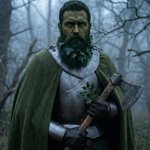
On New Year's morning, as Arthur's court sits down to feast at Camelot, the hall doors burst open and in rides a knight unlike any other. He is a giant, and he is green. Not a knight wearing green, but a man whose skin, hair, beard and even his great warhorse are all one deep woodland green, as if he had stepped straight out of the forest itself.
He carries no shield, only a massive axe, and he makes a strange request. Let any knight here strike me one blow with this axe, he says, on the condition that in a year and a day, I return the blow myself. Young Sir Gawain accepts, and swings the axe clean through the giant's neck.
The head rolls across the floor. And the body does not fall. It walks forward, picks its own head up by the hair, and the head speaks, reminding Gawain of his promise, before the whole green knight rides out of the hall as if nothing at all had happened.
A year later, deep in a winter wood, Gawain learns the truth. The green giant and the mysterious lord who sheltered him on the way were the same being all along, and the whole ordeal was a test set by Morgan le Fay to humble Camelot's pride. Some call him a nature spirit older than the Round Table itself, the wild world knocking on civilization's door.

I created Prep72hours.com a couple of years ago because it was apparent then that having three days' supply of food, water, and other essentials seemed like a good idea. Maybe it's because my father used to keep a food store in case we got cut off from the village (as we were in the winter of 1963).
The site is filled with ideas for your store cupboard / box under the stairs / in the garage. You might never need them, but if the power/gas goes off for more than a few hours what would you do?


She rises where the water goes still, before the mist even clears. No one sees her come. She is simply there, standing on the surface as if it were solid ground, with a sword held up in both hands, wrapped in its scabbard, blade catching light that has no source.
That sword is Excalibur, and the hand that takes it from her is young Arthur's, guided there by Merlin himself. The old chronicles never agree on her name. Some call her Nimue, some Viviane, some simply "the Lady." What they do agree on is that she is older than Camelot and answers to no king in it.
She raises Lancelot too, after his father falls, taking the infant into her underwater hall and teaching him there until he is a man fit to ride out as her foster son, Lancelot du Lac, "of the Lake."
And she is there again at the end. When the dying Arthur sends Bedivere to cast Excalibur back into the water, it is her hand that rises to catch it, draws it under, and is gone. Then the barge comes for Arthur himself, carrying him toward Avalon, and some say she is one of the three queens aboard it, taking back what was only ever lent.

Deep in the forests of Arthur's Britain roams a beast unlike any other, a creature stitched together from four different animals. It has the head and neck of a serpent, the body of a leopard, the haunches of a lion, and the feet of a hart. When it moves, a sound rises from its belly like the baying of thirty hunting hounds all questing at once, which is how it earned its name.
No knight ever lands the final blow. King Pellinore chases it for years, abandoning tournaments and even his own family mid-conversation the moment its cry reaches him, forever a step behind. When age finally slows him, the quest passes to his successor, and the beast runs on, never caught, never quite escaping either.
Some who tell the tale see something deeper in the chase: a hunt that can never end because the thing being hunted was never meant to be caught, a shame or a secret from the kingdom's own founding that simply cannot be laid to rest. Others take it simply as the strangest monster in the whole Round Table cycle, a rumour given four mismatched bodies and a voice like a pack of hounds.
Either way, somewhere out past Camelot's walls, it is almost certainly still running.

As the nights draw in and autumn storms begin to gather, keep your eyes to the ground and your door bolted, for this is when the Wild Hunt rides.
Across England the story takes different shapes but always the same shiver. At Windsor, it's Herne the Hunter who leads the spectral chase through the Great Park, antlers crowned in moonlight, hounds baying at his heels. On the moors of Devon, the Yeth Hounds run headless and silent, more terrible for making no sound at all. In Yorkshire and Lancashire, the Gabriel Hounds pass unseen overhead, their cries carrying down through the clouds, and to hear them is to know a death is coming to someone near you. In East Anglia, old memory ties the hunt to Woden himself, riding out with his pack as he once did long before the churches rose.
The warning was always the same. If the Hunt passes over you, do not look up, and do not answer if it calls your name. Throw yourself flat on the earth, face down, and let it ride on by. Those who join the chase, the old tellers say, are never quite seen to come home again.

Will Scarlet rode into the old ballads as one of Robin Hood's own band, named alongside Little John and Much the Miller's Son in the earliest surviving telling of the outlaw's story, a ballad printed around 1495. His name itself is part of his legend: some tellings say he earned it for the bold scarlet clothing he wore through the greenwood, a flash of red among all that Lincoln green. Other manuscripts call him Scarlok or Scathelocke instead, a reminder that these ballads were sung and copied long before anyone settled on a single spelling, let alone a single story.
A later ballad goes further and makes him kin to Robin himself, a cousin who meets the outlaw by chance in the forest, the two men fighting before they recognise each other and Will joins the band as family rather than a stranger won over.
It was a Victorian retelling, published in 1883, that gave Will Scarlet his most lasting modern shape: a sharp-dressed, quick-tempered young swordsman, more a dandy than a brute, who could out-duel most of Sherwood and still mind his manners doing it. The dashing cousin at Robin's side, equal parts charm and blade.

Morgan le Fay is one of the strangest figures to come down through the Arthurian cycle, because the old stories can never quite agree on whether she is the court's protector or its downfall.
In the earliest versions she is a healer, a shape-shifter who studied the arts of medicine and magic until she could cure wounds no physician could touch. She is Arthur's own half-sister, raised at the same hearth, and when Arthur falls at Camlann it is Morgan who receives his broken body into the barge bound for Avalon, the isle where he is said to sleep and heal rather than die.
But later tellings turn her colder. She becomes the enchantress who draws Merlin's secrets from him, who schemes against Guinevere, who sends the Green Knight to test Camelot's honor and finds it wanting. Some stories have her trained in a convent before the magic came to her, others place her among the fairy folk from birth.
Perhaps that is the truest thing about her: she was never written as one thing. Healer and threat, kin and rival, she stands at the edge of Arthur's world the way the otherworld always does in these tales, close enough to save him, strange enough to be feared.

As Camlann burned into silence, only one knight of the Round Table still stood: Sir Bedivere, battered and alone beside his dying king.
Arthur, mortally wounded, gave him one last command: carry Excalibur to the nearby lake and cast it into the water. Twice Bedivere walked to the shore and twice he turned back, the blade too precious, too beautiful, too much a piece of the kingdom itself to let go. Twice he lied to Arthur about what he'd done.
The third time, ashamed, he finally threw it. A hand rose from the water, caught the sword by the hilt, brandished it once, and drew it under. The lake had reclaimed what it once lent.
Bedivere carried Arthur to the water's edge himself. There a barge waited, carrying three mourning queens, come to take the king to Avalon to heal, or perhaps simply to rest.
Some later tellings have Bedivere living on as a hermit, keeping vigil at a chapel near the battlefield for the rest of his days: the last man who knew exactly how the story of Camelot really ended.

On this day in 1163, workers at Westminster Abbey moved the bones of Edward the Confessor into a new shrine behind the high altar, the church he had rebuilt and which has crowned English monarchs ever since. Edward ruled from 1042 to 1066, the last king of the old House of Wessex before the Norman Conquest swept away everything that had gone before within the year of his death.
He earned his epithet through a life of quiet piety rather than martyrdom. The best loved legend tells of a ring he gave away to a beggar on the road near his hunting lodge, a stranger later revealed to be St John the Evangelist travelling in disguise. Pilgrims returning from the Holy Land brought the ring back years afterward with word that Edward would die within six months and join John in paradise, a story that gave the Essex manor of Havering its very name (local tradition reads it as "have the ring"). Medieval chroniclers also credited him with visions of things to come, and some trace England's old custom of a monarch's touch curing the "king's evil" back to his reign.
He died in January 1066 with no heir, leaving the vacancy that led straight to Hastings and the Conquest. Canonized a century later, he remained England's patron saint until the rising cult of St George overtook him in the fourteenth century. His shrine still stands at Westminster Abbey, visited to this day.

