

Big ideas, built well. Tech, design, and growth with less agency, more partner.
New York, NY
Joined August 2011
- Tweets1.5K
- Following218
- Followers4.8K
- Likes359






There's one conversation about AI agents that isn't getting enough attention, and it's the one that matters most.
What happens after they're inside your systems?
Agents don't wait. They move across tools, trigger actions, and make decisions in sequence without a human in the loop at each step. That's the value proposition. It's also the risk surface.
Enterprise deployments tend to define access and stop there. What an agent is actually mandated to do, and where it stops gets treated as a detail to figure out later. An agent that can touch your systems without a clearly defined mandate is an open variable in your infrastructure, and open variables in large systems have a habit of becoming expensive problems.
A claims processing agent should be able to verify a policy, cross-reference a report, flag a discrepancy for human review. The moment it can initiate a payout above a threshold or change underlying policy terms without a second signature, the organisation has handed over a decision it probably didn't mean to. Defining that boundary is a governance decision, and it needs to be made before anything runs.
One agent is manageable. A fleet of agents is a department, and without consistency within that department, issues build quickly.
When agents don't behave predictably across a system, data drifts, decisions conflict, and the organisation inherits the mess.
Scope creep in a human team is visible. You can catch it, address it, course correct. In an agentic system, it compounds until it becomes structural.
Give agents the smallest footprint that gets the job done. The governance work feels slow upfront, but it's considerably slower to unpack later.
Remember the "AI Wrapper" gold rush of 2024?
Surviving the AI Infrastructure Reckoning had nothing to do with having a better prompt.
The startups still standing built a moat out of the one thing AI still can't touch: human obsession.
The playbook is looking a little something like:
• Automate the plumbing
• Obsess over the porcelain
• Build a partner, not a tool
• If it feels like slop, ship it again
• The "so what" should land in 10 seconds...or you've already lost them
While searching through a client’s design files an AI prompt was accidentally triggered.
While the visual output was bad (Ironic...sorry Figma!).
The descriptions of the intended designs were actually well written!
Again, a little ironic but we’ll take it.

Even though the designs were rough, the AI wrote surprisingly good descriptions of what it was trying to make.
For a Rockefeller Center email template it landed on:
"Art Deco elegance meets New York luxury — gold accents, sophisticated serif typography, architectural refinement"
That's... actually good copy?

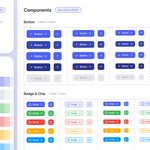
The more AI starts generating screens for you…
The more your design system becomes the guardrail.
It’s the thing keeping your colors, components, and layout logic consistent while the AI generates interface variations for you.
Reminder: the model doesn’t know your product, it only knows the internet.

Nobody ever looked back at a great product and said "wow they really nailed their feature list."
They say things like:
“It became part of my routine.”
“My team refused to switch.”
“I recommended it to everyone I know.”
It’s really not a bad idea to build towards these sentences.