

Smart Contract Engineer | Great architecture is clear. I design the system, secure the logic, and explain the 'why'. Send me a DM.
Imo State, Nigeria
Joined August 2022
- Tweets1.2K
- Following179
- Followers259
- Likes1.6K





Obinna Duru retweeted

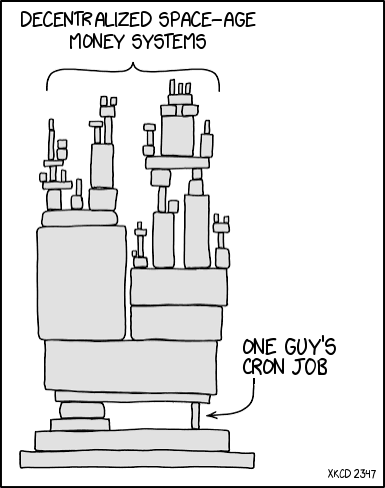
Yesterday's Railway issues, and an increasing stream of cloud provider incidents, highlight a major issue: decentralized apps have no way of scheduling or automating smart contract calls. Someone needs to run that cron on a server, which are becoming increasingly unreliable in the age of AI.
The point of decentralized systems is that we shouldn't need to rely on a single server to maintain an invariant that protects the correctness and solvency of self-sovereign money protocols. Automation needs to move to the blockchain, where a network of distributed nodes brings fault-tolerance and checks-and-balances.
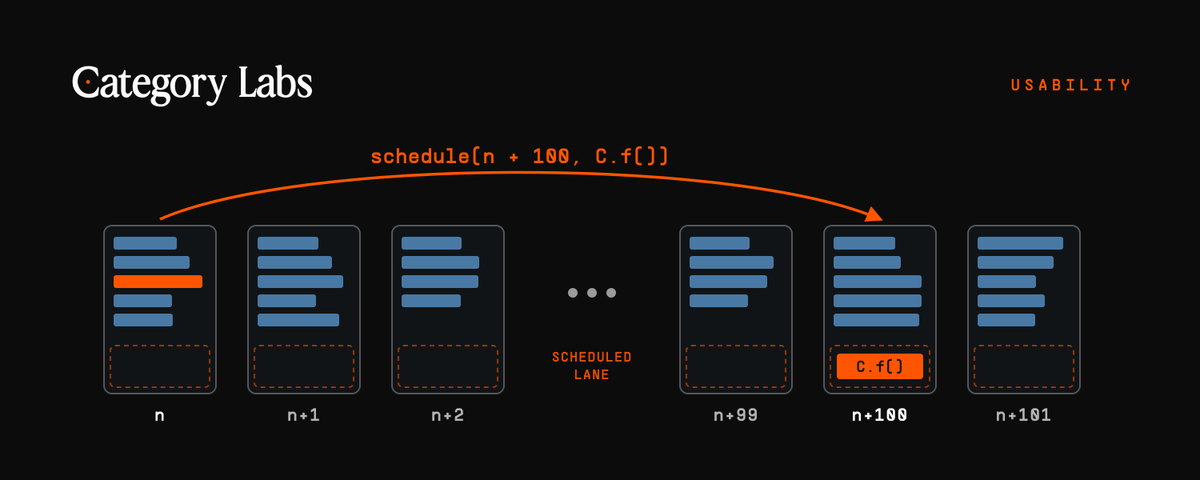
Scheduled Transactions are how we accomplish that.
Scheduled Transactions are far more than a replacement for keepers. They let users and applications alike set up interactions that recur on a cadence, happen once at a chosen moment, or follow from something that happened earlier.
Check out the details below, as well as a few examples of what you can build with Scheduled Transactions, such as on-chain keepers, recurring payments, long-running (asynchronous) computations, automatic refunds in atomic swaps, and order-book cleanup.

Obinna Duru retweeted

🚀 Kann Audits Internship Program 2.0 is here!
We're back with our second paid internship program for Security Researchers!
Looking for motivated hustlers across:
• Solidity
• Rust
• TypeScript / Off-chain
• ZK
We're giving emerging talent the opportunity to work on real security audits, build strong portfolios, collaborate with other researchers, and level up their skills.
Ready to prove yourself?
Apply here: kannaudits.com/internship
Once you've applied, comment "Applied!" below 👇


Obinna Duru retweeted

was surprised to see so much panic today, likely made worse by other things like rates and oil that distorted the actual substance in the AI/math talks
tl;dr — you're all gonna be fine. the leading chains of today have ample means to be able to respond to something like this in the unlikely scenario of it happening
longer:
i) is AI getting better at math? yes
does that imply that it will suddenly shatter foundational cryptography concepts? no
"computer smart. therefore the past work of all mathematicians is probably wrong." is not a logical chain with basis
sure, AI will find flaws in past human work in many areas -- in the same way humans themselves find flaws from other humans in many areas. this is how science works
if we find issues, we discuss them, fix them, and evolve
it takes large leaps of complete doomerism to assume that all teams, individuals, and ecosystems will fail at literally everything ranging from planning to prediction to detection to mitigation on all time horizons simultaneously
further, in these scenarios, AI is exclusively seen as a tool *only* for max destruction but never as a thing capable of a solution
so, it can apparently break everything but not fix anything. i hope you can see the bias here
for one, we already know this to be false given recent scaling of formal verification via ai
it is of course easier for AI to make progress in fields and topics that are relatively less looked at vs something like foundational cryptography which all intelligence agencies, nation states, and high-level mathematicians are heavily incentivized to break, all the time
ii) the most unhinged doomsday scenarios assume an instantaneous attack with no lead time by a random person outside of law and jurisdiction, which I would posit is simply not possible
even ignoring the fact that the labs would get there first (and hence the government)
it's not as if one can just break all cryptography on all chains via their beefed up cloud hosts over a few hours or days or even months
that not only assumes an algorithmic advancement with unfathomable magnitudes of improvement but also completely ignores the gargantuan operational complexity and opportunity cost of doing a global heist (vs the trillion other more important things you can do with an ECC break)
it would be vastly impressive if a slight speedup could be found, but the speedups required to fulfill the doomsday fantasies of people on here are not grounded in anything
iii) importantly, assume I am completely wrong for all of the above
well even in that case, upgrading the systems in a world where ECC breaks is entirely possible and feasible (and has been worked on for decades)
in fact, there are many ways of doing it that we know of depending on the existing constraints of the system!
imo, the biggest "risk" in all this is that a frontier lab publishes something about a slight speedup in the future, and then everyone extrapolates that to default to panic which then leads to a selloff like today
I don't think this is all bad because it never really hurts to think about and plan for these things on the protocol level, but the "retail" panic was certainly a huge self-own by the people pushing this stuff
doomerism is not going to win in crypto

People read one emotional Matt Green tweet about public key encryption, spent 0 seconds thinking about it, and decide to panic.
Sure ECDLP will be broken with QC's one day. But there's so many levels to this being wrong to panic over.
- 0 actual progress on attacking anything
- We have tons of alternate plans available.
- Quadratic advantage hash-based PKE
- Lattices
- Multivariate polynomials
- A whole field of KEM's from fine grained cryptanalysis. (Fun fact, works even if P=NP)
Sure you can wake-up and choose doomer and be wrong.
We have decades of cryptography to draw from on for all the above options, AND how to build a lot of what we want from UX tweaks without PKE. PKE just made a lot much easier, and less web of trust routing like.
Obinna Duru retweeted

I don't recommend anyone scramble to move their funds to new wallets today. But we should take the risks to cryptography from AI-accelerated math seriously, and minimize our exposure to not just quantum-vulnerable cryptography, but also potentially AI-vulnerable cryptography.
The core new area of risk from this viewpoint is, unfortunately, ML-DSA / FHE / lattices.
(and it's also another reason, along with quantum, why ECDSA might fall even faster than expected, hence the "fresh address" recommendation)
So far most people have been in the mode of thinking "elliptic curves broken, hashes safe, lattices safe". But there is a good chance that the concrete security of lattices will take serious hits from the next two years of AI math.
The basic threat model is: factoring is something that naively takes 2^(n/2) time, but over decades smart people have found and optimized number field sieves, and degraded that to 2^O(n^(1/3)), which is why RSA keys and signatures need to be ~400 bytes (and not 64 bytes). What if there are skeletons in the closet like that, both for elliptic curves and lattices, that we are simply not smart enough to discover - but bots soon will be?
This is a major part of the reason why for the past year ethereum's lean roadmap has been going in the "hash-only" direction: no lattices, no ML-DSA, no Falcon, no lattice-based commitments inside ZK proofs, etc. Signatures in lean ethereum are all hash-based, either WOTS or SPHINCS-.
For signatures and proofs, we already know how to go hash-only. The bigger challenge is for *public-key encryption* - and this goes far beyond blockchains. Secure communication, anonymizing protocols, lots of things need public-key encryption.
And unfortunately there are long-standing mathematical theorems showing why public-key encryption cannot be done with hashes alone. You have to have some kind of trapdoor object that has at least one form of usable "structure" - either group theory (incl. isogenies) or lattices or code-based or potentially in the future even more newfangled and spooky things (local mixing?). But for anything that has structure, you should assume that AI will make at least some progress in breaking that structure. Here, one reasonable inference is that if you want to make something plausibly long-term secure, multiply the key sizes by 10.
To me that's a very plausible world and something not at all extreme to predict. If AI will bring us 50 years of math in 2 years, then that 50 years of math may very plausibly include a "naive factoring -> GNFS" level of improvement to our ability to break lattices. In that world, lattices will still exist, but they will have to be significantly bigger to guarantee the same level of safety.
And at those new larger sizes, hash-based constructions will beat lattice-based constructions on concrete efficiency in every use case where hash-based constructions are possible at all.
Theoretically, of course it's possible that hashes are broken too (eg. P = NP would imply that). But I think P = NP is very unlikely. And intuitively, it's much more likely that a mathematical object has exactly no exploitable structure (like hashes are intended to), than that a mathematical object has exactly ~3 forms of exploitable structure (for elliptic curves: associativity, Schoof, pairings) and not some secret fourth form of structure we have not yet discovered that greatly degrades its security (for elliptic curves, ECDLP and pairing security). Similar for LWE, SVP, RLWE and the zoo of lattice problems.
For this reason, we do not yet see any reason to worry and start padding the byte size of hashes (if we start to worry more, we would pad the round count first before doing anything to the byte size).
Concrete TLDR, my own personal views:
* Hash-based > lattice-based, in those situations where hash-based is possible at all
* For anything lattice-based, be much more paranoid on param sizes. Remember that blockchains are only a small portion of the cryptography story; this point goes far beyond blockchains and applies to eg. access to websites, secure messaging, Tor / VPNs ...
* For privacy protocols, strongly favor NOT putting encrypted notes onchain. Instead, send them offchain through some third-party mechanism.
* If it's not difficult for you, keeping your funds in addresses which have not yet been used to make a transaction is a good idea. If it's easy for you, do it. **But be careful about migrations; I personally have lost more money in botched migrations than I have lost in all hacks combined**.
* For multisig wallets, doing confirmations offchain is better than onchain, because this way the signatures of signer wallets do not get exposed to the public, so if ECDSA falls to AI much faster than expected, at least the multisig "gracefully degrades" to a 1-of-1 where the 1 is whoever was gathering the signatures - a much better place to be than "anyone can take the money"
firefly.social/post/x/210783…
Obinna Duru retweeted
The trove of math breakthroughs shared by OpenAI is another reminder that Quantum leaps ought to be anticipated.
Monad has a clear plan for Quantum security that we’d encourage others to review: monad.xyz/blog/post-quantum-…

Obinna Duru retweeted

This might be the biggest opportunity blockchains have ever had.
Technology has mostly been built around durable yet centralized trust systems. But the factors acting against these systems are getting more powerful as we near Super Intelligence™️.
Obviously code can break due to the sheer mathematical progress AI is bringing, but less obviously, humans can be broken too. Impersonation, blackmail, and other forms of social engineering attacks are only going to get more advanced. As such, just fixing holes in code made to secure our lives is not enough, to build truly trustworthy systems of value, you will have to decentralize them and add immutability such that no single actor can, in most clear words, “not fuck it up.” This is exactly what Ethereum was built for.
“Alright man, so what is Ethereum doing to survive this age? Are we cooked?”
Quite the contrary, the frontier is moving fast, but Ethereum is moving faster. Some quick points:
1. The Hegotá upgrade will set the tone.
This upgrade will make Ethereum cryptographically agile.
EIP-8141, lovingly known as “Frames,” changes Ethereum accounts at the root level so that transaction validations can be programmable instead of tied to the ECSDA key (the thing Justin is warning people about in his post). Essentially accounts can choose how to authenticate instead of being tied to the current status quo. There are a few quantum proof signatures out there like ML-DSA and SPHINCS, with frames you can choose whatever and also be open to even more gigabrain ones to come. When you are faced with a threat, agility is key, and Hegotá sets the tone for that agility.
2. The J* upgrade will produce a MVP quantum proof L1.
Okay, I know what you’re thinking, “why would you ever name such a consequential thing ‘I*’???What is wrong with you??” Trust me I thought this too, but I was promptly educated that names are not finalized until we get closer, in fact, the names even get a fun emoji next to them (e.g The Hegotá upgrade emoji is a goat 🐐 IFYKYK :P)
ANYWAYS
Think of J* as answering “what are the minimal changes Ethereum needs to make if quantum computers exist tomorrow?”
The goal here is to have enough to survive Q-day. Today, this maps to achieving a PQ heartbeat on consenus layers, leanDA PQ sampling, and leanSPHINCS transactions on execution.
TLDR: the aim is to ship this and then play Alright by Kendrick shortly after: “we gon’ be alright!”
4. The boxes are moving in real time
If you’ve ever seen the strawmap (a proposed roadmap for Ethereum), you’ll know it has a lot of boxes. In particular, there is a quantum box. Also fun fact: it’s literally called a strawmap because it moves as research moves, and man is it moving!
> On August 12, leanVM was moved forward from J* to I*
> A week later, the roadmap added the minimal viable post-quantum L1 milestone to J*
If you’re ever wondering whether Ethereum is taking this seriously, just watch the boxes and see how they dance.
5. AI is actually HELPING
AI makes cryptographic research faster, and AI assisted formal verification means you don’t have to trust AI’s answer. Check out some of @fradamt’s posts for more.
6. Quantum is just one threat in a much bigger battle
You can quantum proof a bank’s system but still be fallible to the humans that run it. Ethereum tackles this from both sides, it gardens the security while also distributing the authors of the network such that there is no single point of attack.
Other blockchains, and any place that stores value TBH, will begin to claim they are quantum proof, but they fail to address the threat of being human proof too.
7. The grand prize is here, and Ethereum can grab it.
A neutral and secure place for ALL value, that cannot be coerced by a government, a company, or Superintelligence.
Your life, your story, your money, can be here, forever. And many generations from now, the kids will look up and think: thank god they tried.
Godspeed.
Ethereum.

Today I call upon the blockchain industry to calmly begin planning for "bunker mode". My personal recommendation is to set in motion a controlled mass migration of assets to fresh addresses, i.e. addresses whose pubkeys remain hidden behind a hash.
Holders, starting with large and sophisticated ones, should consider moving the bulk of their funds to addresses that have never signed a transaction. And when they do sign one, they should also move remaining funds to a new address (possibly generated from the same seed phrase).
Don't rush. While I believe there is cause for action a rushed migration would do more harm than good. Don't panic either. Moving assets to protected addresses is a simple, preventative step which does not require new cryptography or new wallets.
IMO it is now reasonable to brace for the possibility that ECDSA breaks before qday, in the worst case in months not years. By "break" I mean fast private key recovery (e.g. in one week) on available hardware (e.g. a large GPU cluster).
Recent days have been humbling for human mathematical intuition. Long-held, unquestioned hypotheses have fallen. This includes the n log(n) bound for integer multiplication and the 3SUM conjecture. In hindsight, May's unexpected disproof of the Erdős unit distance conjecture was our warning shot.
Yesterday's OpenAI drop made it clear that mathematical superintelligence is upon us. They say there are weeks where decades happen. We are about to live through weeks where centuries of mathematical progress happen. Could our magic 64-byte ECDSA signatures be too good to be true? Was it just security through obscurity all this time?
Elliptic curves feel especially vulnerable to superintelligence. Curves carry rich structure, with room for fancy tricks like Schoof, Frobenius, pairings. (By contrast, hashes are designed to minimise algebraic structure.)
Separately, as Ewin Tang can attest, an efficient quantum algorithm sometimes foreshadows an efficient classical one. We should be open to the possibility of a classical counterpart to Shor that breaks elliptic curves and RSA at once.
Also noteworthy is the striking under-representation of cryptographic breakthroughs among the 722 mathematical results OpenAI published. I've witnessed first-hand the US government censoring academic quantum cryptanalysis results. Backroom interventionism is my base case.
I urge large, sophisticated actors to lead by example. Project11's "risq list" (bitcoin-risq-list.projecteleven[.]com) is a great tracker of exposed BTC pubkeys. Binance, Bitbank, Robinhood, Bitfinex, and Tether have an opportunity to harden their cold storage. Next month I'll address institutions in London in a live Q&A (forum.ethereuminstitutional[.]org/london-2026).
Again, please do not rush. Wallets holding under 50 BTC enjoy partial cover from "Satoshi's shield", i.e. his 20K exposed addresses that hold 50 BTC each. Load-bearing signers like oracles and L2 security councils should consider rotating ECDSA pubkeys with every signed message and/or multi-signing with a hash-based schemes like SPHINCS.
Exiting bunker mode safely will require post-AI cryptography. My inclination is to go all-in on hash-based cryptography and avoid structured mathematical assumptions entirely, whether from curves, lattices, or isogenies. A single battle-tested hash (e.g. from the SHA or BLAKE families) yields plausible post-AI security.
The Ethereum roadmap on strawmap[.]org fully embraces hash-based cryptography with end-to-end formal verification as a response to the quantum threat. Those timelines must now be revisited and accelerated in light of mathematical superintelligence. I'll be pushing for maximum defensive acceleration.
Obinna Duru retweeted

Preparing for a post-quantum world
The plan for Monad starts with protecting user funds by enabling accounts to upgrade to quantum-resistant authentication without changing their address
Check out the full roadmap here: monad.xyz/blog/post-quantum-…

Obinna Duru retweeted

🚨SOLIDITY-AUDITOR V4 IS NOW OPEN SOURCE (MIT LICENSE)
A single command now gets up to 85% recall on High severity findings from multi-week contests from last year. This used to cost protocols tens of thousands - we made it FREE, so any dev can build more safely. by PAG team🫡


Obinna Duru retweeted

Hello world 🌍
Join us as we activate our domain on August 1st 2026.
libertasalpha.com is a product of years of research and experimentation; finally going live.
-Personnel Development
-Venture formulation
-Asset development
Register to come: luma.com/zvevjwz2

Obinna Duru retweeted

Ladies and Gentlemen ✨
The time has finally come to welcome you into the power of decentralized innovation with @LibertasAlpha
Register to come: luma.com/zvevjwz2


Obinna Duru retweeted

Tip 1: Add a security prompt
Sounds dumb but it works
BaxBench found that just adding a generic security reminder improved Claude Code's secure code rate from 56% → 66%
Set up:
- @Cyfrin SolSkill: github.com/Cyfrin/solskill
- @traborofficial Claude Code config: github.com/trailofbits/claud…


Obinna Duru retweeted
Bookmark This post.
2026 is going to be the biggest year for Libertas Alpha Technologies so far 🚀

Obinna Duru retweeted

🧠 Everyone wants to write the next breakthrough protocol.
But the fastest way to level up? Read other people's code.
A lot of it.
🧵
Obinna Duru retweeted

Vitalik Buterin says @ethereum has sacrificed way too many core values—like decentralization, privacy, and financial self-sovereignty—just to chase mass adoption. He stresses that this has to end now.
According to Vitalik, starting in 2026, Ethereum needs to zero in on reclaiming those lost values by:
- Boosting private payments.
- Making it easier to run nodes.
- Building truly decentralized apps that don't rely on centralized servers.
- Giving users better control over their data and assets.
Ethereum also needs to be tough enough to last for decades, even centuries, without depending on the dev team, while pushing decentralized stablecoins so users aren't tied to the traditional financial system.

Obinna Duru retweeted

Smart Contract - Learning Resources (@blok_cap)
🟩 Beginner Track
• Rareskills – Basics of Solidity → rareskills.io/learn-solidity
• Cyfrin – Blockchain Basics → updraft.cyfrin.io/courses/bl…
• Cyfrin – Smart Contract Development → updraft.cyfrin.io/courses/so…
• Rareskills – Solidity Style Guide →
rareskills.io/post/solidity-…
• Rareskills – Solidity Beginner Mistakes → rareskills.io/post/solidity-…
• Cyfrin – Foundry Fundamentals → updraft.cyfrin.io/courses/fo…
• Rareskills – Foundry Testing (Solidity) →
rareskills.io/post/foundry-t…
• Rareskills – Solidity Events → rareskills.io/post/ethereum-…
• Rareskills – ERC 4626 →
rareskills.io/post/erc4626
🟦 Intermediate Track
• Cyfrin – Advanced Foundry → updraft.cyfrin.io/courses/ad…
• Rareskills – Invariant Testing (Solidity) →
rareskills.io/post/invariant…
• ConsenSys – Solidity Best Practices →
consensysdiligence.github.io…
• Rareskills – Function Selectors → rareskills.io/post/function-…
• EOAs, CREATE & CREATE2 → rareskills.io/post/ethereum-…
• Rareskills – Solidity Staticcall →
rareskills.io/post/solidity-…
• Rareskills – Low Level Call →
rareskills.io/post/low-level…
🟥 Advanced Track
• Rareskills – Proxy Patterns → rareskills.io/proxy-patterns
• Cyfrin – Smart Contract Security → updraft.cyfrin.io/courses/se…
• Rareskills – Gas Optimization → rareskills.io/post/gas-optim…
• Rareskills – Smart Contract Security → rareskills.io/post/smart-con…
• Rareskills – Diamond Proxy → rareskills.io/post/diamond-p…
• Github – Awesome Diamonds →
github.com/mudgen/awesome-di…
• Ethereum – Mastering Ethereum →
github.com/ethereumbook/ethe…


