Michal Šulc retweeted
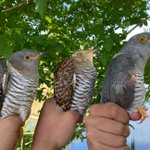
Požgayová et al. (2025) The number of brood parasite visits affects subsequent aggression towards the parasite dummy in host males, but not in females doi.org/10.1007/s00265-024-0… | @ivb_cas @BioSulc @GStetkova @rytikerttunen | #ornithology #broodparasitism | photos: M. Honza
Michal Šulc retweeted
Stoked this is published! Collect feathers > chop into tiny pieces > set them on fire > measure the gasses*. Differences in adults. Now just a small task of learning geographic assignment using multi-isotope isoscapes paired with geolocator data & larger sample size! Let’s gooo!
This quoted post is unavailable.
Michal Šulc retweeted
JOB ALERT
We seek an engaged and effective research leader to join us @CamZoology as Prince Philip Professor of Ecology and Evolutionary Biology.
Wonderful colleagues, exciting opportunities to shape @Cambridge_SBS future.
Deadline 6 Jan
More here: jobs.cam.ac.uk/job/48966/
Michal Šulc retweeted
Don't miss this breathtaking video showcasing the largest raptor roosting site on Earth 🌍 – Red-footed Falcons in Angola (subtitles available in several languages):
📽️ vimeo.com/1031899290
Simply stunning! 😲
@NatGeo #birdmigration #ornithology
Michal Šulc retweeted
Want to know how divorce in birds is associated with rainfall? 💔🌧️ I wrote a piece (in non-scientific jargon!) about our recent paper in @AnimalEcology 👇👇. If you want to read the science-y version, see: doi.org/10.1111/1365-2656.14… @AgusBentlage @hannahdugdale @SeychellesWarb
Divorce in songbirds: extreme weather pushes couples past breaking point, writes @Frigg_Speelman @Macquarie_Uni theconversation.com/divorce-…
Michal Šulc retweeted
I’m excited to share that our article with Dr. Cassie Stoddard @B_G_Hogan and @Geoffrey_E_Hill on ornamentation and speciation in the stunning Painted Buntings🌈🐦is now published! Check it out: rdcu.be/d0aeE
Photo credit: G.E. Hill
@NCN_PL #Etiuda #ornithology #color
Michal Šulc retweeted
Fears New York buildings’ deadly toll on migratory birds could be on the rise | New York | The Guardian theguardian.com/us-news/2024…
Michal Šulc retweeted
And that's a wrap! 29 #poisonfrogs papers for you to enjoy –> Part 1: tinyurl.com/3a3htezv & Part 2: tinyurl.com/5n8kfrth Thanks to all authors and reviewers, and to @evoecology, for making this happen. @LiaSchlippe designed the beautiful covers 😍👩🎨😍
Toxins, fights, astonishing navigation skills, elaborate parental care, crazy gen & phenot diversity, stunning colours, worrying diseases... Our @evoecology SI on #poisonfrogs (broad sense) is finally in the making! Follow this 🧶 to see the published studies as they come out 🔽
Michal Šulc retweeted
News from down under! Our latest study in @CurrentBiology uses weather radar to uncover Australia’s unique bird migration patterns—smaller in scale but high variable in timing, direction, and magnitude. Link: cell.com/current-biology/ful…. #ornithology #BirdMigration #Australia
Michal Šulc retweeted
Thanks for sharing :)!! If you haven't read it yet, check our review published in @AvianBiology about triazole fungicides effects on reproduction and physiology of birds! 👇🏻
NEW PAPER: Integrating adverse effects of triazole fungicides on reproduction and physiology of farmland birds.
➡️ vist.ly/3mj33b7
#ornithology #triazoles @IREC_CSIC_UCLM @JJimenezPenuela #farmland #fungizides #birds #reproduction
Michal Šulc retweeted
Discover the latest advancements in avian research! Volume 95, Issue 3 of our Journal of Field Ornithology is out. This edition features 12 papers from researchers all over the world.
Explore this issue: journal.afonet.org/vol95/iss…
#JournalofFieldOrnithology #sciencejournal
Michal Šulc retweeted
The Czech Turtle Doves tagged this year show two main migratory directions: one via Italy and one via the Balkans. Now they are in Africa where there is no LTE-M network. We hope to hear from them again when they are back in spring! 🕊️ | #HABITRACK #ornithology #birdmigration
Michal Šulc retweeted
Professor Edward H.Sargent a Canadian Scientist, who published many papers in top journals i.e., #science and #Nature. He wrote 10 tips on how to write papers. @PhDvibe @PhDVoice @Labiofy #PhDposition #phdlife #PhD #postdoc #chemtwitter #Science #AcademicChatter
Michal Šulc retweeted
Spatial cognitive ability is associated with longevity in food-caching chickadees | Science science.org/doi/10.1126/scie…
Michal Šulc retweeted
Open #PhD researcher position in my group @uniofjyvaskyla FINLAND:Contribution of #genetic and #environmental factors on #microbiome variation in birds, and its associations with #thermal #physiology. DL 13th Oct, starting in Jan25/flexible
ats.talentadore.com/apply/do…
Michal Šulc retweeted
Very happy to share our new paper in @PNASNews on how #GriffonVultures change their movement and social behaviour with age: pnas.org/doi/10.1073/pnas.24…
It seems that old griffons are much like old humans: they like to stay at home, are set in their routines and are a bit antisocial.
Michal Šulc retweeted
Dream postdoc team, plus Cornwall! 🏖️
I'm looking for a 3 yr postdoc to work on evo genetics and genomics of guppy behaviour with @erik_postma @BonnieFraser8 Based in Cornwall at Exeter's @cec. Think behavioural ecology meets quant gen in the genomics era. Info + links to app forms at sites.exeter.ac.uk/wilson-gr…
Michal Šulc retweeted
It's happening! 🤩
One of our tagged Turtle Doves has begun its journey and reached N Hungary. However, these beautiful birds face serious dangers as they are still hunted in some countries despite dramatic population declines. Let's protect them! 🕊️ | #HABITRACK #birdmigration
Michal Šulc retweeted
NEW PAPER: Active defence mechanisms in brood parasitism hosts and their consequences for parasite adaptation and speciation.
➡️ vist.ly/3f625
@dillenseger_g #ornithology #BroodParasitism #speciation

ALT Fig. 1 from the article: Theoretical genetic transmission in an obligate brood parasite, parasitising hosts that discriminate eggs. Here, a male mates with females of two different gentes; adults' genotype and phenotype are represented next to them. Egg-mimicry genes are located on the female-specific W-chromosome. Only the non-mimetic egg is rejected, exerting pressure on the females to produce mimetic eggs, but not on the male–female pairing as one egg is still successful. Thus, panmictic behaviour of males is not counter-selected.