

The simplest way to run quantum programs on CPU / GPU / QPUs. Sign up at https://teapawt.net/t.co/yTqB1J1ba0
USA
Joined May 2024
- Tweets753
- Following404
- Followers596
- Likes383









🔧 From zero to a quantum job in 3 lines of code.
@BlueQubitIO SDK works with the quantum libraries already in use, like Qiskit and Cirq. Build circuits as usual, then run them on large CPU and GPU machines or quantum hardware in the cloud. ☁️
How to start 👇
1️⃣ Install the SDK with pip install bluequbit
2️⃣ Open a free account at app.bluequbit.io and copy the unique token from the top right corner
3️⃣ Initialize with the token and submit the circuit
Switching backends takes one argument: device='cpu', ‘gpu’ or ‘quantum’. No rewrites, no environment setup. ⚡
👉 Get started: bit.ly/4sZkuv7
#QubitScript #QuantumComputing #Qiskit #Cirq #Python #QuantumComputingAlgorithms

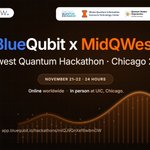
🚀 Midwest Quantum Hackathon is coming to BlueQubit!
Join @BlueQubitIO’s challenge, held as part of Midwest Quantum Hackathon (#MidQWest) 2026, and take on the task of estimating out-of-time-order correlators (OTOCs) - the observable behind Google’s Quantum Echoes quantum-advantage experiment.
🧠 Your challenge: estimate OTOCs for hidden quantum circuits, many of which are too large to simulate exactly.
🤖 AI is encouraged: build and steer AI agents to run simulations and optimize your approach.
💻 Participate online from anywhere or join the in-person #MidQWest event at @thisisUIC
⏱️ 24 hours
📅 November 21–22
🎟️ Free to participate
💳 $30 in BlueQubit credits for each participant/team at kickoff
🏆 Compete for the highest score across the challenge problems
No advanced quantum experience is required - quantum enthusiasts, students, researchers, and experienced practitioners are all welcome.
Ready to take on the challenge?
👉 Join the hackathon: app.bluequbit.io/hackathons/…
#QuantumComputing #QuantumHackathon #MidQWest2026 #OTOC #QuantumAI #BlueQubit

💰 Quantum platform pricing splits into four models, and the cheapest one depends entirely on usage shape.
1️⃣ Free and unlimited, locally: Qiskit Aer, Cirq, QuTiP. Cost is zero; the ceiling is local RAM.
2️⃣ Pay-per-use cloud simulation: @awscloud Braket SV1 at 34 qubits, TN1 at 50 for structured circuits, DM1 at 17 with noise, billed by the minute. Transparent, and easy to overspend during parameter sweeps.
3️⃣ Pay-as-you-go hardware access: @IBM bills by QPU runtime, per second, starting at $96 per minute, with prepaid Flex and Premium plans lowering the rate for larger commitments. On AWS Braket, IonQ, Rigetti and others bill per task plus per shot. Queue time remains a hidden cost that no price list shows.
4️⃣ Subscription plus credits: unlimited CPU simulation within a plan, with GPU and hardware jobs metered against an included credit balance. @BlueQubitIO runs this model: a free tier with a 34-qubit statevector simulator; $20/month with $25 in credits; $100/month with $120; team plans from $200 per seat (minimum three seats); and enterprise plans with access to IBM and Quantinuum hardware.
Worth knowing about credit models generally: credits usually reset monthly without rolling over, and running out pauses jobs rather than generating a surprise invoice. That is a feature for budget control and a constraint for bursty workloads.
The mistake that shows up repeatedly in budget planning: estimating cost from a single circuit run. Real spend comes from iteration count. A variational algorithm running 5,000 evaluations per training cycle turns a rounding error into a line item.
Useful habit regardless of platform: estimate before submitting. A runtime and cost estimate ahead of a paid job prevents most billing surprises.
#QubitScript #QuantumComputing #CloudCosts #TechStrategy
🔗 bluequbit.io

🧪 New in @BlueQubitIO Playground: one-click example circuits.
🔗 Bell State
🔍 Grover Search
🌊 Phase Estimation
⛰️ Peaked Circuit
Or drag and drop a QASM file. ⚡
👉 bit.ly/4BDa4oR
#QubitScript #QuantumComputing

📊 Optimization is the most common entry point into quantum computing, and the fastest place to waste compute budget.
Tooling by approach:
1️⃣ @qiskit Optimization: converters from common problem formulations into QUBO and Ising forms, with QAOA and VQE implementations attached.
2️⃣ @PennyLaneAI: the strongest fit for QAOA variants that need custom gradients or unusual ansatz structures.
3️⃣ @dwavequantum Ocean: annealing and hybrid solvers, now alongside gate-model hardware, which is now in beta testing. Often the more practical route for large, well-structured QUBOs today.
4️⃣ @awscloud Braket Hybrid Jobs: manages the classical optimizer loop alongside quantum execution, removing a common source of orchestration bugs.
5️⃣ @BlueQubitIO: optimization algorithms tuned to specific quantum hardware, plus GPU-backed differentiable simulation for parameter training. Used by #POLARISqb for QAOA work on combinatorial problems in drug discovery.
The cost driver in every variational optimization run is the same: thousands of circuit evaluations per training run. Algorithm design decides how many evaluations are needed in the first place, and simulation throughput decides how many hypotheses get tested in a week.
#QubitScript #QuantumAlgorithms #QuantumComputing #Optimization #QAOA
🔗 bluequbit.io

🤖 Frontier models helped find the key lemmas. A human rewrote every proof.
⚙️ Exact Clifford gate-count synthesis: NP-complete
🧮 Six types of CNOT actions block shortcuts
📖 Full paper: arxiv.org/pdf/2610.40886
#QubitScript #QuantumCircuits #AIforScience

🏆 #DuQuantum2026: the results are in.
On October 24, @BlueQubitIO ran a 24-hour quantum hackathon together with DuQuantum 2026 at @DukeU. Teams competed online from around the world and in person at Duke, estimating what quantum circuits too large to simulate exactly would measure. ⚛️
By the numbers
📝 200+ registrations
🚀 49,209 jobs submitted, 29,780 run to completion
⏱️ 970 hours of simulation, about 40 days of compute packed into one day
🔄 Around 40 simulations running at any given moment
📬 1,346 answer submissions
This single event beat the combined totals of all previous BlueQubit hackathons by about 1.9x on submitted and completed jobs, and about 1.4x on simulation hours. 📈
🤖 Built for AI agents
Job volumes like these point to one thing: agentic AI did much of the heavy lifting. The challenge was designed for that from day one. “You steer, and your agent runs the simulations.” Claude Code came preinstalled in Hybrid-mode sessions, and BlueQubit’s agent guide and skills were set up there for both Claude Code and Codex. About 20% of participants named Claude Code, Codex, or “an AI agent” in their submission notes, with workflows like “Claude Code + BlueQubit SDK.”
🥇 Winners at Duke
1️⃣ Cybercon + QuantTrader FX (also 2nd overall in the Introductory Track)
2️⃣ Primitive Labs
3️⃣ G Squared
🌍 Winners on the World leaderboard
1️⃣ Eugen Pyatygin
2️⃣ Shravan Cinthamani Shankar Hari
3️⃣ Muhammed Hayyan
Congratulations to every winner, and thanks to all participants and the DuQuantum team at Duke. 🙌
👉 Explore upcoming challenges: app.bluequbit.io/hackathons?…
#QubitScript #QuantumComputing #Hackathon #DuQuantum #AIforScience #QuantumSimulation #AgenticAI


⚙️ Production quantum code has requirements that research code does not: reproducibility, job tracking, and predictable failure behaviour.
What each option offers on that front:
1️⃣ Qiskit Runtime — session-based execution, primitives, and error mitigation built in. The most complete production story for IBM hardware.
2️⃣ AWS Braket SDK — Hybrid Jobs, S3 result storage, and IAM permissions. Fits cleanly into existing AWS deployment pipelines.
3️⃣ CUDA-Q — compiled kernels and multi-GPU orchestration for teams running their own infrastructure at scale.
4️⃣ Classiq — synthesis and versioning aimed at maintaining proprietary algorithms over time.
5️⃣ BlueQubit SDK — job naming, job history, and cost estimation before submission, with backend selection as a single argument rather than a code rewrite.
The requirement that separates production from research is not speed. It is being able to answer, six months later, exactly which backend produced a given result and with which configuration. Choose accordingly.
#QubitScript #QuantumComputing #SoftwareEngineering #MLOps #ProductionCode
🔗 bluequbit.io

✅ A classical verifier, a quantum prover, no crypto assumptions.
New result: relative to an oracle, a language beyond the polynomial hierarchy is decided exactly by a quantum computer and still checkable classically, with as few as log* n messages ⚡
📖 arxiv.org/pdf/2610.37635
#QubitScript #QuantumComputing #ComplexityTheory

🚀 Early adopters will benefit the most from the Quantum Advantage.
The teams that learn the tools now will be the ones ready when quantum hardware starts to outperform classical hardware. BlueQubit makes that first step free. ⚛️
What the platform brings together 👇
🖥️ The largest free universal quantum simulator: 34 qubits
⚡ GPU, MPS, and Pauli-path simulators, with Pauli-path tracking up to 1 billion paths
🧪 Hybrid notebook environments for variational and iterative workflows
🔗 Qiskit and Cirq support, with a job running in 3 lines of code
📊 One dashboard for every CPU, GPU, and quantum job
Start free, scale when ready.
👉 bit.ly/4B4ClnJ

👏 Congratulations to @PsiQuantum on the 8×8 Optical Circuit Switch demo! 1.2 dB insertion loss, 40 dB crosstalk, and sub-3 ms reconfiguration, all on the same silicon photonics platform built for utility-scale quantum. 💡⚛️

AI is pushing computing infrastructure to its limits. Our photonics can help.
Today, PsiQuantum is unveiling its industry-leading Optical Circuit Switch initiative with an 8×8 OCS demo built on the company’s low-loss silicon photonics platform—the same platform we’ve spent nearly a decade developing for quantum computing.
🧭 Which problems give quantum computers more than a quadratic edge?
A new compendium from OQI, Google, Microsoft, NVIDIA, JPMorgan Chase, and more maps them, from factoring to planted inference to OTOCs, with the exact conditions for advantage 📏
📖 arxiv.org/pdf/2610.32595
#QubitScript #QuantumComputing #QuantumAdvantage

🚀 Quantum hardware access is not the barrier most beginners assume it is. Almost all early learning happens on simulators.
Reasonable starting points, ordered by setup effort:
1️⃣ @IBM Quantum Platform — browser-based, free, connected to real devices. Zero installation. The most common first stop.
2️⃣ @PennyLaneAI demos — runnable tutorials that teach concepts alongside code. Strongest option for anyone arriving from machine learning.
3️⃣ @BlueQubitIO free tier — one pip install and a token, then existing Qiskit or Cirq circuits run on remote backends by setting a device argument. Removes the environment problems that stop many beginners in week one.
4️⃣ @qiskit locally — one pip install, full control. The right move once fundamentals are in place.
5️⃣ @awscloud Braket notebooks — managed Jupyter with hardware access attached. Overkill for learning, useful once experiments get serious.
Sequence that tends to work: simulator first, small circuits, verified results. Hardware afterwards, once expected outputs are already known. Debugging an unfamiliar algorithm on a noisy device teaches very little.
#QubitScript #QuantumComputing #LearnToCode #QuantumProgramming #DeveloperTools
🔗 bluequbit.io

🧾 In BlueQubit Hybrid: Past Sessions.
📈 Sessions, compute time, and spend at a glance
🖥️ Machine size per session
⏱️ Duration, start and end
✅ Status and cost
🔍 Filter and sort
👉 bit.ly/4jZjDrs

🎓 Academic quantum computing has settled into a fairly stable toolset.
1️⃣ Qiskit — the most cited framework in published work, which makes reproduction straightforward and reviewer questions rarer.
2️⃣ QuTiP — the standard for open quantum systems and Lindblad dynamics. A different problem class from gate-based simulation, and unmatched within it.
3️⃣ Cirq — common in NISQ-era experimental papers, particularly where device topology matters to the result.
4️⃣ PennyLane — dominant in the variational and QML literature.
5️⃣ BlueQubit — free CPU backends across statevector, MPS, and Pauli path methods, with additional credits available for academic projects on request, plus integration into the QED-C benchmark repository.
One practical note for anyone publishing: simulator version, backend type, and random seed belong in the methods section. A large share of reproduction failures in quantum papers trace back to unrecorded backend configuration rather than to the algorithm itself.
#QubitScript #QuantumComputing #AcademicResearch #QuantumResearch #HigherEd
🔗 bluequbit.io

⏳ Duke Quantum Hackathon opens Saturday, Oct 24, 11:30 am ET.
✅ Before kickoff:
🔹 Create a free BlueQubit account. Compute credits arrive as a coupon at kickoff, redeemed under Account → Billing → Redeem Coupon
🔹 Form a team (up to 5 recommended), with all submissions from a single account
🔹 Brush up on circuits and expectation values with the Qiskit or PennyLane intro tutorials
🔹 Read up on approximate simulation: matrix product states and Pauli propagation
🌍 Online for all; in person at Duke for DuQuantum 2026 participants. Free registration.
👉bit.ly/4zrSAJZ
#QubitScript #QuantumComputing

🤖 Quantum machine learning lives or dies on gradient computation. That narrows the field quickly.
1️⃣ @PennyLaneAI - designed for this. Automatic differentiation and native interfaces to PyTorch, JAX and TensorFlow. The default starting point.
2️⃣ @TensorFlow Quantum - tight Keras integration for teams already committed to TensorFlow. Built on Cirq, with a smaller contributor base than Qiskit or PennyLane.
3️⃣ @qiskit Machine Learning - sensible if the surrounding stack is already Qiskit. Fewer native autodiff options.
4️⃣ CUDA-Q by @nvidia - strongest option for multi-GPU training where the classical model is also large.
5️⃣ @BlueQubitIO - modifications to the cuQuantum–PennyLane integration, applied in published work training 27-qubit, 1000-parameter variational circuits using a modified adjoint differentiation method that computes all gradients in two circuit passes.
The real bottleneck in QML is rarely the quantum circuit. It is the number of circuit evaluations a training loop demands, which is why gradient method and simulation speed matter more than qubit count.
#QubitScript #QuantumMachineLearning #QML #PennyLane #AI
🔗 bluequbit.io

⚛️ Quantum Hackathon: @BlueQubitIO × @DukeU
📅 Oct 24, 11:30 am ET to Oct 25, 11:30 am ET
🌍 Online from anywhere or in person at Duke
🎟️ Free, all levels
👉 bit.ly/4zrSAJZ
#QubitScript #DuQuantum

✨ Magic states, 10–40x cheaper.
New qLDPC factory teleports CCZ magic from tricycle codes into single-shot 4D quadcycle codes, reaching logical error rates as low as 10⁻⁹ at p = 10⁻³ 📉
📖 arxiv.org/pdf/2610.10731
#QubitScript #QuantumComputing #QEC

🏢 Enterprise quantum evaluations tend to hinge on procurement questions, not physics questions.
What actually gets asked in the room:
1️⃣ #Azure Quantum — several hardware vendors under one Microsoft contract. Wins on paper for organisations already standardised on Azure.
2️⃣ #AWS Braket — the same logic on AWS, with IAM, CloudWatch and existing billing already in place. Frequently the shortest path to approval.
3️⃣ #IBM Quantum Platform — the deepest hardware roadmap and the most mature enterprise programme, tied to IBM's own devices.
4️⃣ #Classiq — circuit synthesis and IP management, aimed at teams building proprietary algorithms rather than running published ones.
5️⃣ #BlueQubit — managed simulation across statevector, MPS, and Pauli path backends, with Rigetti's 108-qubit Cepheus device self-serve, and IBM Fez and Quantinuum H2 available through partnership engagements. Per-seat team plans with pooled credits.
The recurring pattern: most enterprise quantum work is still simulation, and simulation capacity is the binding constraint far more often than #QPU access. Evaluations that begin with hardware qubit counts usually end up rewritten around simulation throughput.
#QubitScript #QuantumComputing #EnterpriseTech #DigitalTransformation
🔗 bluequbit.io
