

Artist and Storyteller, posting Folklore, Fantasy Art, Poetry, Literature, and Mythology.
Joined July 2025
- Tweets9.1K
- Following1.3K
- Followers13.7K
- Likes35.8K




“Dream-land” (1844) by Edgar Allan Poe.
By a route obscure and lonely,
Haunted by ill angels only,
Where an Eidolon, named NIGHT,
On a black throne reigns upright,
I have reached these lands but newly
From an ultimate dim Thule—
From a wild weird clime that lieth, sublime,
Out of SPACE—Out of TIME.
Bottomless vales and boundless floods,
And chasms, and caves, and Titan woods,
With forms that no man can discover
For the tears that drip all over;
Mountains toppling evermore
Into seas without a shore;
Seas that restlessly aspire,
Surging, unto skies of fire;
Lakes that endlessly outspread
Their lone waters—lone and dead,—
Their still waters—still and chilly
With the snows of the lolling lily.
By the lakes that thus outspread
Their lone waters, lone and dead,—
Their sad waters, sad and chilly
With the snows of the lolling lily,—
By the mountains—near the river
Murmuring lowly, murmuring ever,—
By the grey woods,—by the swamp
Where the toad and the newt encamp,—
By the dismal tarns and pools
Where dwell the Ghouls,—
By each spot the most unholy—
In each nook most melancholy,—
There the traveller meets, aghast,
Sheeted Memories of the Past—
Shrouded forms that start and sigh
As they pass the wanderer by—
White-robed forms of friends long given,
In agony, to the Earth—and Heaven.
For the heart whose woes are legion
’T is a peaceful, soothing region—
For the spirit that walks in shadow
’T is—oh, ’t is an Eldorado!
But the traveller, travelling through it,
May not—dare not openly view it;
Never its mysteries are exposed
To the weak human eye unclosed;
So wills its King, who hath forbid
The uplifting of the fring'd lid;
And thus the sad Soul that here passes
Beholds it but through darkened glasses.
By a route obscure and lonely,
Haunted by ill angels only,
Where an Eidolon, named NIGHT,
On a black throne reigns upright,
I have wandered home but newly
From this ultimate dim Thule.
From medical student to mystic, Arthur Conan Doyle’s obsession with the supernatural started long before Sherlock Holmes. Though trained in scientific logic, Doyle’s rationalism fractured in the 1880s.
Seeking proof that the soul survives death, he spent decades studying telepathy and séances.
When World War I brought devastating personal grief, claiming his son and brother, his quiet interest became an evangelical crusade. Desperate for comfort, Doyle sought a "smoking gun" to prove this unseen realm.
It arrived in 1920 with the Cottingley Fairies, photographic "proof" captured by two young girls. Blinded by bias, Doyle championed the blatant paper-cutout hoax in The Strand magazine. What ensued was a public disaster. The creator of the world's greatest detective faced intense ridicule, yet he fiercely defended the photos until his death in 1930.

The Cottingley Fairies are five famous photographs taken in 1917 by cousins Elsie Wright and Frances Griffiths in England. The pictures captured the girls alongside dancing fairies. They created the hoax using cardboard illustrations copied from a children's book and secured them to the ground with hatpins. Author Sir Arthur Conan Doyle famously championed the images as authentic proof of the supernatural. In 1983, the cousins finally admitted that the photographs were completely faked.

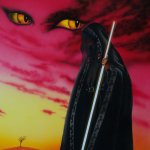
"The Traveller in Black" by Bruce Pennington, as a book cover for the 1971 paperback edition of John Brunner's classic fantasy collection.

Teapot of the Day!
✨🫖✨
Well, this one is a kettle, but I couldn't resist this level of cuteness. Also, I cannot find any information about this picture. So just enjoy a cute kitty in a kettle 🤍

The Cottingley Fairies are five famous photographs taken in 1917 by cousins Elsie Wright and Frances Griffiths in England. The pictures captured the girls alongside dancing fairies. They created the hoax using cardboard illustrations copied from a children's book and secured them to the ground with hatpins. Author Sir Arthur Conan Doyle famously championed the images as authentic proof of the supernatural. In 1983, the cousins finally admitted that the photographs were completely faked.


The winged stag is an ancient symbol of royal power and celestial speed, found on medieval heraldic crests and 16th-century Scottish palace fountains, not to be confused by the peryton, a modern invention created by author Jorge Luis Borges for his 1957 Book of Imaginary Beings.
Borges staged a literary hoax, claiming this creature (which casts a human shadow until it kills a man) was a real myth from Atlantis.
While they look identical, the winged stag belongs to genuine history, whereas the peryton belongs strictly to modern fantasy fiction.
🎨Annie Stegg

During the Victorian era, Halloween grew synonymous with spiritualism and the occult. Families gathered in dark parlors for séances. Holding hands around heavy tables, participants used mediumship, table-tipping, and early talking boards to summon the dead.


