

My work is unique — I use fish otoliths and nuclear bomb radioactivity from the 1950s and 1960s to understand how long fish can live (https://teapawt.net/t.co/TTCe7bI85Q).
- Tweets382
- Following255
- Followers177
- Likes998









ALT A complete bomb radiocarbon chronology — covering an 80-year period (1938–2018) and reflecting thermonuclear testing in the 1950s and 1960s — was established using known-date otolith material to trace the signal in the Baltic Sea and to establish a tool in validating the age of regional fishes. Of particular interest were Baltic herring and sprat estimated to live >20 years in the Baltic Sea, a longevity that is ~2 times greater than other locations. The new radiocarbon chronology was used to validate age estimates up to 22 years for herring and 18 years for sprat, although there was evidence of radiocarbon emissions from nuclear facilities, as well as environmental deficiencies. This work confirmed the accuracy of age reading protocols used for decades. An exploration of radiocarbon in otoliths of Baltic pike, pikeperch, and Baltic cod lend support for broader use of bomb radiocarbon dating on marine and freshwater organisms of the Baltic Sea basin.

ALT Alignment of radiocarbon measurements from sprat otolith cores for the calculated hatch years —determined from sprat otoliths estimated to be 2–18 years old — with the Baltic Sea chronological reference effectively validate the age reading protocols with a caveat. Some otoliths were clearly affected by processes that either elevated or reduced radiocarbon levels and these differences are attributed to environmental variation and not estimated age because the specimens could not be reasonably aligned to younger or older dates based on otolith mass being either too high or low for a given age adjustment of a few years.

ALT Remnants of the large pike (Pike-003) that was collected from Granfjärden, Sweden on 6 April 2005 with whole otolith images. The specimen was heavily damaged by a Baltic grey seal during the process of landing and as a result, the total length was not known. A length estimate from the coefficient of total length to head length (TL/HL) was calculated from 20 large pike individuals from the southern Baltic Sea around Rügen Island in northern Germany. Applying this ratio resulted in a TL estimate of 126.8 ± 4.2 cm (2SE) for the pike from Granfjärden. Considering the 20 large pike used to calculate this conversion factor ranged in length from 91.1 to 116.6 cm TL and had a wide TL/HL conversion factor (TL/HL = 3.15 to 4.04), the extremes for possible lengths of Pike-003 were 113.4 to 145.4 cm TL. Notwithstanding the unmeasured length, the otoliths of this pike were the largest known at 0.222 g with a very deep sulcus that can be seen in the proximal otolith view.

ALT Aged transverse otolith section viewed with transmitted light from the 77 cm pike perch (Gös-001) collected from Granfjärden, Sweden on 6 April 2005. The growth zone structure was very apparent and the age of 15 years (marked) is likely valid to within one year.


ALT Map of North Atlantic with surface current patterns relative to the migration path of European eel, with collection locations in Norway (orange stars), and the selected bomb-produced 14C chronology locations from across the North Atlantic and North America (nuclear symbols; see Figure 2). Eggs hatch in the Sargasso Sea and leptocephalus migrate to inshore and continental habitats of northern Africa, throughout Europe, and north to Scandinavia (blue shaded edges). Radiating contours of 10-, 15-, 25-, and 45-mm TL are European eel length limits, within which nothing greater than that length exists in surface water collections and are indicative of the northeasterly migration pattern (Schmidt 1923). The most applicable bomb 14C reference records are from coral and otoliths in the western North Atlantic (Gulf of Mexico, Caribbean, Bermuda, Antilles) because they represent levels expected for the North Atlantic (Sargasso Sea) and waters advected as the migration path along the Gulf Stream.


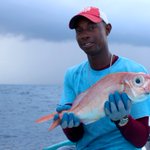
ALT Our paper on validation of a 60-year lifespan and use of otolith mass as a proxy for age is released. This paper sets the stage for other species where otolith age estimation — a laborious and expensive process that requires expertise — can be estimated by simply weighing the otolith. This is a promising direction for current and future monitoring of population age structure for fishes in countries that do not have the capacity to apply otolith processing and age reading. Pictured is a fisher Mario David of Cayos Cochinos, Honduras with one of the older specimens from offshore of Guanaja, in the Bay Islands of Honduras (photo credit, Ivy Baremore of MarAlliance).


ALT This historic photograph of an alligator gar caught in 1910 from Moon Lake, Mississippi, was reported to be ~10 feet (~3.05 m) in total length but there are no other reliable collections that have reached this length. Based on a series of proportional measurements made from what is likely to be actual 2 × 4-inch lumber in the same plane as the fish led to an estimated and likely more reliable length range of 2.3–2.6 m with a most probable calculated length of 2.5 m. Inset image covers the dimensional changes in ‘2 × 4’-inch lumber over time, providing an indication that the support wood in the photo- graph was actual 2 × 4-inch lumber because the cross-section dimensional ratio is 1:2.


ALT Redhorse sucker species were the largest catch category of a 2021 night-bowfishing tournament in Minnesota in which native fish composed >80% of the total number of fish harvest disposed. Other species included bowfin, bullheads, freshwater drum, bigmouth buffalo, white sucker and common carp. (a) The early stages of adding to the fish disposal bin after the first few teams had dumped their fish. (b) After 16 teams had dumped their fish into the disposal bin, including one disqualified team that shot more than 200 redhorse. (c) After all teams had dumped their fish into the disposal bin, including a second team that was disqualified for shooting more than 200 redhorse. Note the freshly discarded redhorse, in the right corner of the disposal bin.

