

Department of Botany and Zoology, Faculty of Science, Masaryk University
Brno, Czech Republic
Joined March 2017
- Tweets399
- Following97
- Followers155
- Likes782






BotZool MUNI retweeted

Our new analysis of Czech flora, part of Martina Sychrová's PhD thesis, shows that naturalized non-invasive species resemble resident native species in their traits. Conversely, invasive species tend to have different traits than native species. @JEcology
doi.org/10.1111/1365-2745.70…

BotZool MUNI retweeted
We sampled a grassland in Armenia with 90 and 104 vascular plant species in plots of 10 m² and 25 m², respectively. These counts are higher than those recorded in any European grassland so far, except for the Carpathian region and steppes near Kursk.
tuexenia.de/publications/tue…

BotZool MUNI retweeted
Can we trust? Yes, we can trust estimates of species turnover, but estimates of changes in species richness are less reliable. Our new article in the Journal of Ecology: doi.org/10.1111/1365-2745.70… @jecol

BotZool MUNI retweeted
Our new study, led by Xiao-Peng Tan, maps the distribution of plant strategies across European grasslands and projects how current patterns will be affected by ongoing climate change.
Open-access article: doi.org/10.1002/ecog.08334
@EcographyJourna

BotZool MUNI retweeted
The first comprehensive analysis of vegetation changes across Europe, based on the ReSurveyEurope dataset, is out! In an article led by Stephan Kambach, we analyzed 57,390 time series of vegetation plots. doi.org/10.1038/s41467-026-7…

BotZool MUNI retweeted
Our new study, led by Marc Riera, compares European niches and habitat relationships of alien plant species introduced intentionally or unintentionally. doi.org/10.1111/geb.70245

BotZool MUNI retweeted
Our new article in Science Advances, led by Gabriele Midolo, identifies the main factors driving changes in the species composition of plant communities across Europe: eutrophication, denser, more productive vegetation, and drying of wetlands. doi.org/10.1126/sciadv.aeb24…

BotZool MUNI retweeted
Záznam mé přednášky z Pražského hradu byl zveřejněn na YouTube:
youtube.com/watch?v=HLjXlLbU…

BotZool MUNI retweeted
After publishing species occurrence data in GBIF, we have now also made available online 117,739 vegetation plots from the Czech Vegetation Database in CSV and Turboveg formats, complemented with a data processing tutorial.
czechveg.github.io/

BotZool MUNI retweeted
We have just published 2,474,166 records of plant species occurrences from the Czech Vegetation Database in GBIF: doi.org/10.15468/94bfqd
These records represent 74% of the plant occurrence data and 30% of all organism occurrence data in the GBIF database for the Czech Republic.

BotZool MUNI retweeted
In two webinars on 13 and 27 March, we will present tools for open publishing of vegetation data, using the example of the Czech Vegetation Database (>117,000 vegetation plots), which goes fully open!
Registration for 17 March:
us06web.zoom.us/meeting/regi…

BotZool MUNI retweeted
Interested in a PhD in European wetland flora and vegetation? See details here: dropbox.com/scl/fi/r5ob6scr7…

BotZool MUNI retweeted
New interactive global maps of 31 plant traits were prepared by Daniel Lusk, based on plant distribution data from GBIF and sPlot, plant trait data from TRY, and various satellite-based products.
Map viewer: global-traits.projects.earth…
Article: doi.org/10.1038/s41467-026-6…

BotZool MUNI retweeted
In our new article in Nature Cities, led by Susanne Tautenhahn, we used our recently published European datasets of plant indicator values, linked them to citizen science data, and mapped environmental conditions for Europe and 326 European cities.
🔗 doi.org/10.1038/s44284-025-0…

BotZool MUNI retweeted
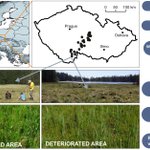
Further evidence of the declining quality of endangered natural habitats has just been published in a new Preslia article on vegetation resurvey by Klára Friesová and collaborators.
Open-access article: doi.org/10.23855/preslia.202…
Infographic by NotebookLM.

BotZool MUNI retweeted

🧵1/
New paper out in @EcographyJourna!
We looked at temperate deciduous forests across North America, West Eurasia, and East Eurasia, three regions that share ancient roots but have been separated for millions of years. What does that long breakup mean for today’s biodiversity?
BotZool MUNI retweeted
Our new paper in Ecology Letters, led by Jan Divíšek, shows that non-invasive alien plant species that establish in local plant communities tend to resemble the resident native species. In contrast, invasive alien species usually differ from native plants.
doi.org/10.1111/ele.70235

BotZool MUNI retweeted
The first European classification of vegetation in seasonally drained salt lakes, led by Svitlana Iemelianova from our Vegetation Science Group, supported by an MSCA4Ukraine grant. Our findings will change the standard European vegetation classification.
doi.org/10.1111/avsc.70044

BotZool MUNI retweeted
In our new article (Midolo et al., Ecology Letters), we show that plant species richness in European plant communities generally decreased between the 1960s and 1980s. However, since the 1990s, this trend seems to have stopped or even reversed. dx.doi.org/10.1111/ele.70248

BotZool MUNI retweeted

Vysokohorské ryby v Evropě? Kde? Proč? a Jak se tam dostaly? Více v odpovědi pro Zeptej se vědce
shorturl.at/0RrVO
