

Crypto YouTuber 腦哥 Chill塊鏈 沒有投資建議、沒有 Alpha、只是一個來自台灣的小韭菜 I make crypto contents on YouTube. (Taiwan, Mandarin)
Taiwan
Joined November 2022
- Tweets1.9K
- Following622
- Followers17.2K
- Likes8.3K








腦哥 BrainBroCrypto retweeted

如果黄金能被能量 + 汞大规模制造出来,
从叙事上,
利好BTC/ETH,尤其是BTC。

Last month, we demonstrated high-rate alchemy: turning mercury into real, stable gold, beating CERN’s record by a factor of 10.
Last week, we enriched isotopes in the world’s most powerful plasma centrifuge, beating the Soviet record that stood for 40 years.
Now, we’re building a fusion reactor in San Francisco to achieve record power density.
腦哥 BrainBroCrypto retweeted

JUST IN: Bitcoin's hashrate has jumped to its highest level in 7 months, despite some miners shifting to AI infrastructure! 🚀

腦哥 BrainBroCrypto retweeted
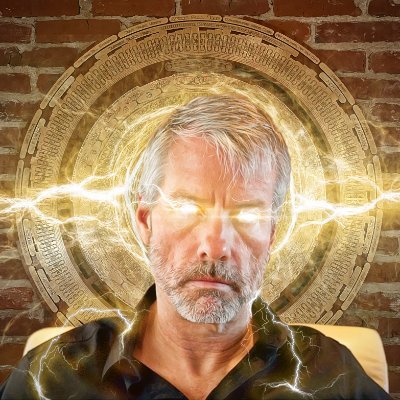
J.P. Morgan Asset Management’s base case projects Bitcoin to outperform U.S. stocks, bonds and gold over the next decade. Wall Street is doing the math.

腦哥 BrainBroCrypto retweeted

The GENIUS Act marks a watershed moment in American finance, further cementing the United States as the crypto capital of the world. Just as President Abraham Lincoln’s National Currency Act of 1863 established a national framework for bank-issued currency, the GENIUS Act establishes a federal framework for payment stablecoins in the digital age.
The @USOCC's final rule carries that landmark legislation forward, providing a clear, practical foundation for private-sector innovation, competition, and American leadership in digital assets.
腦哥 BrainBroCrypto retweeted

A new source of BTC demand is emerging.
BTC-focused perpetual preferred stocks have accumulated more than 135,000 BTC in just over a year, despite representing only a fraction of the global fixed income market.
What could happen if adoption expands?
🔗 Read our latest research: go.fidelity.com/ernlPz

腦哥 BrainBroCrypto retweeted

这可能是 Delphi Digital 最近最好的一篇长文:《庄家通吃:为什么投机是未来十年的主题》。
小编看完觉得,重点并不在于它投研了什么新赛道,更像是一种姿态和明示:
别再装价值投资了,大方承认“投机”就是这个时代的刚需。而在一个全民皆赌的时代,最聪明的策略不是去牌桌上挑筹码,你最好直接买下赌场本身。
文章里几个非常刺骨的洞察,以及大量值得细品的数据:
1. 为什么所有人都在赌?因为“正常路径”已经失效
历史上的投机大多由两种引擎驱动:
a.新技术带来的“基建狂热”,如当年的铁路、现在的 AI;
b.阶层固化和法币贬值逼出来的“彩票绝望”,赌一把算了。
而现在,这两个引擎在历史上首次同时全速运转。
对年轻人来说,靠打工存钱买房的传统社会契约已经破产;目前美国首次购房者的中位年龄创下了 40 岁的历史新高,占购房比例降至历史最低的 21%。
存 0 块钱和存 1 万块钱毫无区别,因为都付不起首付。所以,去期权市场、预测市场和土狗盘里博一个 100 倍,成了年轻人在数学上唯一合理的突围方式。
数据显示,80% 冲向高风险资产的 Z 世代坦言,这么做是因为“感觉自己在财务上掉队了”;
过去一年,36% 的 30 岁以下美国年轻男性参与过体育博彩,35 岁以下投资者中有 43% 交易过期权。
2. AI 是生产力,更是最大的“逼赌机器”
这是全文最反直觉的视角。我们总以为 AI 是用来投资的,但报告指出,AI 正在全方位把普通人逼向赌桌。
一方面,微软、谷歌、亚马逊和 Meta 四大巨头 2026 年的资本支出预计高达 7000 +亿元(约占美国 GDP 的 2.3%,是当年电信泡沫顶峰的两倍多);
另一方面,AI 正在消灭年轻人的上升阶梯。受 AI 冲击最严重的行业中,22-25 岁年轻人的就业率比正常水平低了 19%。
AI 一边在宏观上制造着百年一遇的财富神话,一边在微观上抽干年轻人的出路,直接给“彩票引擎”灌满了汽油。
3. 终极明示:抛弃筹码,去买赌场
既然投机是未来十年的绝对主题,散户的标的(今天炒 AI 算力、明天炒 Meme、后天赌球)会像走马灯一样轮动,绝大部分人最终都会归零。
数据大家也都知道,在 Pump.fun 发行的超 1900 万个代币中,只有 0.4% 的钱包实现了超 1 万美元的利润。
而“赌场们”正在吸金:
- 2026 年 Q2,Robinhood 光靠“事件合约(预测市场)”就赚了 1.56 亿美元,历史性地超越了它的股票业务和加密业务。
-Kalshi 和 Polymarket 的合并月交易量,从 2025 年中期的 20 亿美元,暴涨了 25 倍,在 2026 年 7 月达到惊人的 530 亿美元。
-Hyperliquid 在 2025 年处理了 3 万亿美元交易量,捕获了 9.72 亿美元的真实手续费,且几乎全部用来在二级市场回购 HYPE,如此财力其实也源自于链上的投资热情。
在文章最后,Delphi 实际上也给 Crypto 重新定了性:
别再纠结区块链到底有什么用,Crypto 最大的真实效用,就是为全球提供了一套零门槛、无休眠、成本低于 2 美元的终极投机基础设施。
叙事会死,代币会归零,但只要年轻人还需要一张改命的彩票,抽水的牌桌就永远印钞。
这就是未来十年最确定的 Alpha。


Our report “The House Always Wins: Why Speculation is a Theme of the Decade” is out now.
Speculation runs rampant when new tech rearranges what’s possible or the system stops working for most. AI and crypto are now fueling both.
Read it for free here.
delphi.link/Speculation


腦哥 BrainBroCrypto retweeted

嘲笑了十多年区块链的彭博财经主持人,终于改口了:华尔街的底层金融系统,可能真的要被区块链革命了!
彭博《Odd Lots》主持人 Joe Weisenthal 过去一直嘲笑那些说“比特币没什么价值,但区块链技术很有前途”的华尔街人士。
他觉得,如果不需要去中心化和抗审查,传统数据库又快又便宜,何必折腾区块链?
但现在,他公开重新审视自己的判断:当年那些被他嘲笑的人,可能真的看对了一部分。
改变他想法的,是 Hyperliquid、稳定币,以及越来越成熟的链上金融市场。
Hyperliquid 已经让交易者能够全天候交易原油、黄金、股票指数等资产的永续合约。
稳定币可以用于跨境支付,未来甚至可能让 AI Agent 自动完成几分钱的交易。
过去需要银行、券商、交易所、清算机构共同配合的金融活动,现在有机会在同一套可编程基础设施上完成。
这里有个非常有意思的问题:
全球银行、交易所和金融机构都有自己的封闭系统,谁愿意把核心业务搬到竞争对手的数据库里?
几乎没人愿意。
但如果底层是一套相对中立、公开可验证的协议,机构就有机会在保留各自业务和合规控制的同时,共享交易与结算基础设施。区块链最大的商业价值之一,恰恰是解决传统金融机构之间长期存在的信任和系统互通问题。
回头看这十几年的变化,真的挺感慨。
早期比特币被视为投机泡沫,区块链被嘲笑为寻找应用场景的技术,如今华尔街已经开始认真探索稳定币、资产代币化、链上衍生品和全天候交易。
连过去的怀疑者都开始重新评估它的价值,金融基础设施的变革显然已经不再只是币圈自己讲的故事。
未来十年,区块链将改写传统金融的交易、支付和结算方式。
当华尔街开始把生意搬到链上,区块链才真正进入了争夺传统金融市场的阶段。


腦哥 BrainBroCrypto retweeted

BREAKING🚨 @BlackRock just filed for another Bitcoin ETF. This one will be a "buffer" Bitcoin ETF which will means it will offer downside protection but investors will give up some upside to get that protection. Ticker will be $PBIT.

很多人都讚揚長期投資,如果你也是其中之一,能講講從幾年 (或幾個月) 以上開始是為長期嗎? 原因跟判斷方式道理為何? 比方說,假設你覺得 10 年開始才是長期,那 9 年為什麼不行? 以此類推到 1 年/ 1 秒為什麼不行?
這個問題其實總困擾我。畢竟 1000 年聽起來一定是長期,但 1000 年期的投資我大概也很難活著領取本金了
腦哥 BrainBroCrypto retweeted

孙宇晨的这个采访反响强烈,但是这个视频最大的Alpha其实是主持人。你难道不好奇,是谁让孙哥瞬间变了一个人,收起薄肌黄毛的嬉皮笑脸,这么严肃认真地输出?
他叫金明 William Joy,圈内叫他仙道。很低调,连 X 账号都没有。但他绝对是一个T0级的人类,我觉得能放到一起对标的大概只有谷爱凌了。他的履历第一眼看离谱到像编的:
- 现役自由潜水国家队,世界冠军,两项世界纪录,59 项国家纪录,打破了欧美33年开赛以来对自由潜水所有世界纪录的垄断
- 本科进哈佛学数学计算机,学生时代创业,入驻Harvard Innovation Lab,拿哈佛真理基金投资
- 极链科技创始人,27 岁拿到包括阿里在内的 10 亿元投资
- 湖畔大学四期,最年轻的创一代学员
- 从 2010 年持有特斯拉至今,加拿大持有 Tesla 最早的自然人
- 投资人,掌舵908HOLDING家办,前几天Token2049 Coinbase 全球交易赛获得第三,亚洲第一,为中国队拿到唯一的奖牌
仙道今年7月在本末社群的香港活动上做过一个精彩的压轴演讲,我推荐X上的大家如果没有看过,一定不要错过。覆盖面涉及到投资、卡牌、健康抗衰biohacking、美学、人生哲学、运气、社会责任,信息密度极高。在这个一天薄肌黄毛复读机的时代,已经很少能看到这么有深度+inspiring的内容了。
孙哥对话的视频,我只是2倍速看了一遍而已,仙道的这个视频,我1.5倍速看了两遍,甚至还在不断回去看细节。不要看AI总结,这个视频值得你的时间,看完你会来谢我。

孙宇晨最新深度采访完整版:看空BTC,看空纳指,观望ETH,看好AI应用,不玩A股... 严肃分享了很多市场观点和交易仓位,值得一看
看空BTC。认为比特币面对AI和量子计算的威胁很难全身而退,市场低估了这类风险对 BTC 的潜在冲击。抗量子升级只能救"愿意自救的人",硬分叉冻结老币在比特币的去中心化下几乎不可能达成共识。但是他的BTC是底仓,在过去一年的下跌中并没有减仓。
ETH目前仅2成仓位观望。 在去年 3600–4000 减了八九成的ETH(去年 11–12 月,减持逻辑是 4800 那个"只靠 Tom Lee 续命"的二顶),截至目前仍然没有买回。ETH减仓期间,他增配了美股。
纳指中线"微微看空",看空但还没做空。认为资金抱团太严重,硬件股被炒成软件股,AI 循环融资一出事全出事。美债是所有资金的"母级",现在被权益"子级"吸血,利率必须高才接得到钱,高到一定程度钱又会倒流。芯片短期不排除过剩,像 2000 年的光纤。
AI板块最看好应用。尤其 AI 健康管理(数据采集→挖掘→决策,不用等生病才去医院)。最不看好存储、光模块。一个锚:单一企业市值上限≈美债的一半,所以英伟达顶多再翻 4 倍,而应用层能翻 4 倍以上的机会太多了。明年后年主题会分化。
人民币会走强,美债危机被过度担忧。只要美国还握着 AI(芯片、存储、模型)的终极控制权,美债就不缺买家,"孙悟空跳不出如来佛的手掌心"。
基本没有A股仓位,但会做一些研究。对于A股光模块行情,他的解释是,这一方向能够连接美国AI投资需求,同时中国企业已有一定制造与产业布局,因此容易形成资金集中。所有老登类资产(白酒等)都不看好,新登类资产积极拥抱。
Hyperliquid是本轮周期里重要的新发展。认为美股永续合约为整个行业打开了新的产品空间,DEX 能否挤掉 CEX 取决于美国监管给不给 Uniswap 式豁免。
RWA 空间非常大。波场11月也要大力推美股上链,逻辑同 USDT:给第三世界一个配置美元资产的入口。
推荐书单:安·兰德《源泉》、王小波《黄金时代》、孙学 @justinsuntron @sunyuchentron

腦哥 BrainBroCrypto retweeted

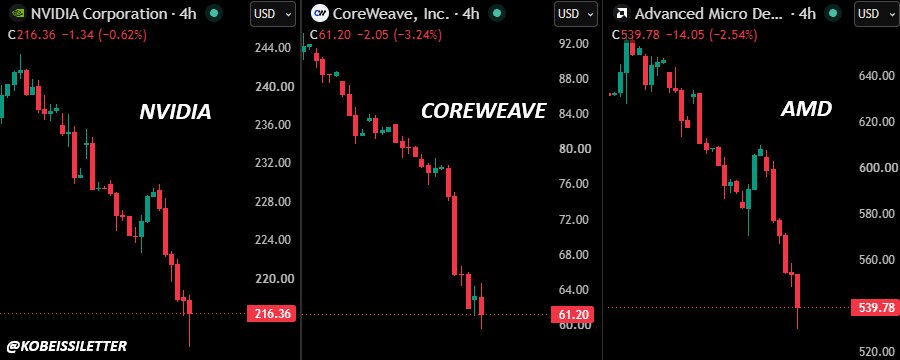
This major decline in Korean equities likely spilling over into crypto
- margin liquidations in brokerage
- Koreans major holders of crypto
Short term pain
$ETH


腦哥 BrainBroCrypto retweeted

这是什么震撼首发


Another angle to this is that dogs effectively stumbled onto what is for them the equivalent of artificial superintelligence 20,000 years ago. The Singularity already happened for dogs. They live in a world they cannot understand, surrounded by miraculous wonders they take entirely for granted, their every need seen to by entities whose thoughts they cannot begin to fathom.
The result is that there are about a billion dogs on the planet now. Most of them are pretty happy. Almost none of them need to work. It worked out pretty well for them.
腦哥 BrainBroCrypto retweeted

Today I call upon the blockchain industry to calmly begin planning for "bunker mode". My personal recommendation is to set in motion a controlled mass migration of assets to fresh addresses, i.e. addresses whose pubkeys remain hidden behind a hash.
Holders, starting with large and sophisticated ones, should consider moving the bulk of their funds to addresses that have never signed a transaction. And when they do sign one, they should also move remaining funds to a new address (possibly generated from the same seed phrase).
Don't rush. While I believe there is cause for action a rushed migration would do more harm than good. Don't panic either. Moving assets to protected addresses is a simple, preventative step which does not require new cryptography or new wallets.
IMO it is now reasonable to brace for the possibility that ECDSA breaks before qday, in the worst case in months not years. By "break" I mean fast private key recovery (e.g. in one week) on available hardware (e.g. a large GPU cluster).
Recent days have been humbling for human mathematical intuition. Long-held, unquestioned hypotheses have fallen. This includes the n log(n) bound for integer multiplication and the 3SUM conjecture. In hindsight, May's unexpected disproof of the Erdős unit distance conjecture was our warning shot.
Yesterday's OpenAI drop made it clear that mathematical superintelligence is upon us. They say there are weeks where decades happen. We are about to live through weeks where centuries of mathematical progress happen. Could our magic 64-byte ECDSA signatures be too good to be true? Was it just security through obscurity all this time?
Elliptic curves feel especially vulnerable to superintelligence. Curves carry rich structure, with room for fancy tricks like Schoof, Frobenius, pairings. (By contrast, hashes are designed to minimise algebraic structure.)
Separately, as Ewin Tang can attest, an efficient quantum algorithm sometimes foreshadows an efficient classical one. We should be open to the possibility of a classical counterpart to Shor that breaks elliptic curves and RSA at once.
Also noteworthy is the striking under-representation of cryptographic breakthroughs among the 722 mathematical results OpenAI published. I've witnessed first-hand the US government censoring academic quantum cryptanalysis results. Backroom interventionism is my base case.
I urge large, sophisticated actors to lead by example. Project11's "risq list" (bitcoin-risq-list.projecteleven[.]com) is a great tracker of exposed BTC pubkeys. Binance, Bitbank, Robinhood, Bitfinex, and Tether have an opportunity to harden their cold storage. Next month I'll address institutions in London in a live Q&A (forum.ethereuminstitutional[.]org/london-2026).
Again, please do not rush. Wallets holding under 50 BTC enjoy partial cover from "Satoshi's shield", i.e. his 20K exposed addresses that hold 50 BTC each. Load-bearing signers like oracles and L2 security councils should consider rotating ECDSA pubkeys with every signed message and/or multi-signing with a hash-based schemes like SPHINCS.
Exiting bunker mode safely will require post-AI cryptography. My inclination is to go all-in on hash-based cryptography and avoid structured mathematical assumptions entirely, whether from curves, lattices, or isogenies. A single battle-tested hash (e.g. from the SHA or BLAKE families) yields plausible post-AI security.
The Ethereum roadmap on strawmap[.]org fully embraces hash-based cryptography with end-to-end formal verification as a response to the quantum threat. Those timelines must now be revisited and accelerated in light of mathematical superintelligence. I'll be pushing for maximum defensive acceleration.
腦哥 BrainBroCrypto retweeted

Vitalik:不建议用户匆忙把资金转移到新钱包
Vitalik发文称,不建议用户因AI可能加速密码学破解而立即迁移资金,但应减少对量子计算和AI都可能构成风险的密码学方案的依赖,重点关注ML-DSA、全同态加密(FHE)及格密码。
他表示,未来两年AI在数学领域的进展可能削弱格密码的实际安全性,因此在可行情况下应优先采用基于哈希的方案;隐私协议尽量不要将加密信息上链,多签钱包也更适合进行链下确认。
Vitalik同时建议,条件允许时可将资金存放在尚未发起过交易的新地址,但提醒用户谨慎处理迁移操作,避免因操作失误造成损失。其观点并不意味着现有密码学方案已被攻破,而是强调应提前评估AI带来的长期安全风险。

I don't recommend anyone scramble to move their funds to new wallets today. But we should take the risks to cryptography from AI-accelerated math seriously, and minimize our exposure to not just quantum-vulnerable cryptography, but also potentially AI-vulnerable cryptography.
The core new area of risk from this viewpoint is, unfortunately, ML-DSA / FHE / lattices.
(and it's also another reason, along with quantum, why ECDSA might fall even faster than expected, hence the "fresh address" recommendation)
So far most people have been in the mode of thinking "elliptic curves broken, hashes safe, lattices safe". But there is a good chance that the concrete security of lattices will take serious hits from the next two years of AI math.
The basic threat model is: factoring is something that naively takes 2^(n/2) time, but over decades smart people have found and optimized number field sieves, and degraded that to 2^O(n^(1/3)), which is why RSA keys and signatures need to be ~400 bytes (and not 64 bytes). What if there are skeletons in the closet like that, both for elliptic curves and lattices, that we are simply not smart enough to discover - but bots soon will be?
This is a major part of the reason why for the past year ethereum's lean roadmap has been going in the "hash-only" direction: no lattices, no ML-DSA, no Falcon, no lattice-based commitments inside ZK proofs, etc. Signatures in lean ethereum are all hash-based, either WOTS or SPHINCS-.
For signatures and proofs, we already know how to go hash-only. The bigger challenge is for *public-key encryption* - and this goes far beyond blockchains. Secure communication, anonymizing protocols, lots of things need public-key encryption.
And unfortunately there are long-standing mathematical theorems showing why public-key encryption cannot be done with hashes alone. You have to have some kind of trapdoor object that has at least one form of usable "structure" - either group theory (incl. isogenies) or lattices or code-based or potentially in the future even more newfangled and spooky things (local mixing?). But for anything that has structure, you should assume that AI will make at least some progress in breaking that structure. Here, one reasonable inference is that if you want to make something plausibly long-term secure, multiply the key sizes by 10.
To me that's a very plausible world and something not at all extreme to predict. If AI will bring us 50 years of math in 2 years, then that 50 years of math may very plausibly include a "naive factoring -> GNFS" level of improvement to our ability to break lattices. In that world, lattices will still exist, but they will have to be significantly bigger to guarantee the same level of safety.
And at those new larger sizes, hash-based constructions will beat lattice-based constructions on concrete efficiency in every use case where hash-based constructions are possible at all.
Theoretically, of course it's possible that hashes are broken too (eg. P = NP would imply that). But I think P = NP is very unlikely. And intuitively, it's much more likely that a mathematical object has exactly no exploitable structure (like hashes are intended to), than that a mathematical object has exactly ~3 forms of exploitable structure (for elliptic curves: associativity, Schoof, pairings) and not some secret fourth form of structure we have not yet discovered that greatly degrades its security (for elliptic curves, ECDLP and pairing security). Similar for LWE, SVP, RLWE and the zoo of lattice problems.
For this reason, we do not yet see any reason to worry and start padding the byte size of hashes (if we start to worry more, we would pad the round count first before doing anything to the byte size).
Concrete TLDR, my own personal views:
* Hash-based > lattice-based, in those situations where hash-based is possible at all
* For anything lattice-based, be much more paranoid on param sizes. Remember that blockchains are only a small portion of the cryptography story; this point goes far beyond blockchains and applies to eg. access to websites, secure messaging, Tor / VPNs ...
* For privacy protocols, strongly favor NOT putting encrypted notes onchain. Instead, send them offchain through some third-party mechanism.
* If it's not difficult for you, keeping your funds in addresses which have not yet been used to make a transaction is a good idea. If it's easy for you, do it. **But be careful about migrations; I personally have lost more money in botched migrations than I have lost in all hacks combined**.
* For multisig wallets, doing confirmations offchain is better than onchain, because this way the signatures of signer wallets do not get exposed to the public, so if ECDSA falls to AI much faster than expected, at least the multisig "gracefully degrades" to a 1-of-1 where the 1 is whoever was gathering the signatures - a much better place to be than "anyone can take the money"
firefly.social/post/x/210783…



貝萊德:AI是機器原生的智慧,加密貨幣是機器原生的金錢

AI is machine-native intelligence and crypto is machine-native money. Both AI and digital assets translate real-world inputs into formats machines can use. Our latest research looks at why that connection could become increasingly important as AI evolves. blackrock.com/us/individual/…

腦哥 BrainBroCrypto retweeted

🚨NEW: The @SECGov just updated its crypto FAQ on token buybacks to add a stipulation that if there is no central party behind those token buybacks, then this arrangement likely does not constitute an investment contract.
It comes following comments from @a16zcrypto General Counsel and Head of Policy @milesjennings last week that the prior wording could “empower an issuer to announce the buyback program without that announcement then creating an investment contract.”


🚨NEW: SEC staff has issued new FAQs clarifying how the Commission’s March interpretive release on digital assets applies to token functionality, staking receipt tokens and investment contracts.
Among the guidance: once a network is functional, services to maintain, improve or grow it generally would not count as “essential managerial efforts” under the Howey test.
The FAQs reflect staff views and have no legal force or effect.
