

News that hits your pocket.
Canada
Joined September 2026
- Tweets608
- Following51
- Followers35
- Likes19


🌎 BREAKINGPOCKET — TODAY IN MARKETS — Monday, November 9, 2026
THE 3 BIGGEST STORIES
1) WALL STREET ROARS BACK AS OIL PLUNGES
Stocks staged a powerful relief rally after President Trump said fresh strikes on Iran were highly unlikely if talks progress, and Secretary Rubio cautioned there is no breakthrough yet. The Dow jumped 1,104 points (+2.15%) to 52,389.75, the S&P 500 rose 2.35% to 7,549.94 and the Nasdaq gained 2.74% — even with Nvidia still pressured by its board probe. Brent crude settled down 5.85% at $92.57 a barrel and WTI near $87. Canada's TSX rose 1.84%.
2) EUROPE'S BANKS LEAD THE GLOBAL RALLY
Crédit Agricole proposed combining its Italian arm with Banco BPM (20% premium), and UniCredit reported a 24% jump in quarterly profit — bank deals and earnings powered Europe's best day in weeks and fed the global risk-on tone.
3) THE RALLY RUNS INTO TOMORROW'S INFLATION TEST
Underneath the green: the New York Fed's October survey shows households still expect 3.9% inflation over the next year, Chicago Fed President Goolsbee warned services inflation is accelerating, and markets price roughly an 80% chance of a December Fed hike. US earnings after the bell were solid — Constellation Energy and KKR beat earlier in the day; The Trade Desk and Occidental beat after the close.
MARKET MOVES
• Dow +2.15% · S&P 500 +2.35% · Nasdaq +2.74% · TSX +1.84%
• Brent $92.57 (-5.85%) · WTI ~$87
• Gold ~$4,148 (+1.8%)
• Bitcoin ~$74,800 — notably lagging the stock rally
• VIX fell sharply (about -21% midday)
WHY IT MATTERS: Today was the market trading cheaper energy and lower geopolitical risk — both point to relief for fuel bills and inflation. But the Fed story has not changed: one hot CPI print tomorrow can hand the rate pressure right back to mortgages and borrowing costs.
🔭 TOMORROW'S WATCHLIST
• US October CPI — Tuesday 8:30 AM ET, the last big test before the Fed's December meeting
• CoreWeave earnings after Tuesday's close — the next AI-spending check
• Cisco and Applied Materials on Thursday; US PPI on Friday
Source: Exchange closes and company releases via Reuters, CoinDesk and exchange data; Federal Reserve Bank of New York; Federal Reserve officials' remarks.
74
⚡ POCKET ALERT: Qualys beats, raises guidance — and still falls ~9% after hours
Cybersecurity firm Qualys (QLYS) reported third-quarter results after Monday's close:
• Revenue rose 11% to $188.0 million, above the ~$186.6 million expected
• Adjusted EPS of $2.12 vs ~$1.96 expected; GAAP net income rose 14% to $57.2 million
• Billings grew ~14-15% to $211.9 million — faster than revenue
• Full-year 2026 revenue guidance raised to $736.9–738.9 million; Q4 revenue guided to $191–193 million
So why the selloff? Profitability narrowed: adjusted operating margin eased to 46% from 47% a year ago, and on the call the CFO guided Q4 calculated billings growth to roughly 8% — a sharp step down from 14% in Q3. Shares fell roughly 8–10% in after-hours trading.
MARKET IMPACT: In a market still jittery after last week's tech rout, "beat and raise" is no longer enough — investors are charging software names for every point of margin and every hint of slowing billings.
WHY IT MATTERS: Qualys sells security software to businesses — its billings are a small but real read on corporate spending discipline. Slower billings growth at steady headline revenue is the kind of early cooling signal that shows up later in tech hiring and budgets.
👀 WATCH: whether the after-hours drop holds at Tuesday's open, and if other software names reporting this week get the same treatment.
Source: Qualys Q3 2026 release (PR Newswire); Zacks; StockStory.
7
⚡ POCKET ALERT: Occidental beats on profit and output — and hits its $10 billion debt milestone
Occidental Petroleum (OXY) reported third-quarter results after Monday's close:
• Adjusted EPS of $1.91, well above the ~$1.43–1.47 consensus (GAAP EPS $1.61; net income $1.6 billion)
• Global production averaged 1,427 thousand barrels of oil equivalent per day — above guidance, despite temporary Gulf of America curtailments
• Average realized crude price of $85.91 a barrel (Brent averaged $89.27 in the quarter, up ~31% from a year earlier)
• Principal debt reduced to $10.0 billion, with $10.4 billion retired so far this year; Q3 operating cash flow was $4.1 billion
MARKET IMPACT: This is the mirror image of today's oil plunge (Brent settled -5.85% at $92.57). Occidental's quarter was carried by the high prices of July–September — the same prices now falling as US–Iran talk hopes build.
WHY IT MATTERS: Occidental is a direct line from crude prices to household wallets in reverse: the $89 Brent that padded its profits is the price drivers have been paying at the pump. If crude keeps sliding toward the high-$80s, producer profits compress — and pump prices follow with a lag.
👀 WATCH: Tuesday's trade in crude after the settle, and whether OXY's Q4 commentary assumes Brent holds near current levels.
Source: Occidental Petroleum Q3 2026 results release and 8-K; Reuters/LSEG estimates via Finimize; Zacks.
13
⚡ POCKET ALERT: The Trade Desk smashes lowered estimates — then hands back most of the pop
The Trade Desk (TTD) reported third-quarter results after Monday's close that landed far above the bar it had lowered in August:
• Revenue of $736 million — essentially flat vs a year ago (-0.5%), but $86 million above its own "at least $650 million" guidance and the ~$651 million Street consensus
• Adjusted EPS of 33 cents vs 25 cents expected; adjusted EBITDA of $266 million vs ~$160 million guided
• Q4 guidance: revenue of at least $755 million and adjusted EBITDA of at least $280 million, both well above consensus (~$688-692 million revenue)
• Buyback capacity lifted to $1 billion
• The sober side: GAAP net income fell to $38 million (8 cents a share) from $116 million, after ~$44 million in restructuring charges — and Q3 was the company's first year-over-year revenue decline since its 2016 IPO
MARKET IMPACT: The stock had already closed up 15.5% at $14.93, then spiked as much as ~26% after hours — before paring to roughly +4% after CFO Nate Olmstead cautioned on the call that the company does not expect the usual seasonal Q3-to-Q4 uplift, citing a still-challenging market and pressure on some large advertisers. CEO Jeff Green said results were "well ahead of our expectations" but still "below the level of growth we expect from ourselves."
WHY IT MATTERS: The Trade Desk is a bellwether for digital-ad spending — the money brands shift when they feel good or nervous about consumers. A beat this size against a lowered bar says ad budgets held up better than feared, but management's caution says the recovery is fragile, not finished.
👀 WATCH: whether the Q4 guide (at least $755 million) proves conservative, and if other ad names confirm the steadier tone.
Source: The Trade Desk Q3 2026 release (Business Wire, via SEC 8-K); Barron's; Stocktwits News call coverage.
12
📊 MARKET SNAPSHOT / ⚡ OIL: Wall Street roars back as oil's war premium drains — Dow +1,104, Brent settles at $92.57
US stocks rallied hard on Monday, winning back most of last week's losses in a second straight gain:
• S&P 500 +2.35% to 7,549.94 (+173.08) — its best day since April, now sitting 3.4% below its all-time high
• Dow +2.15% to 52,389.75 (+1,104.02)
• Nasdaq Composite +2.74% to 25,253.14 (+673.71)
• Russell 2000 +3.15% to 2,840.81
• In Canada, the S&P/TSX Composite rose 1.84% to 36,446.26 (+657.17); the Canadian dollar was unchanged at 70.82 cents US
What drove it: crude. Oil fell hard to its lowest levels since late August:
• Brent settled down $5.75 (-5.85%) at $92.57 a barrel — and kept falling after settlement, down more than $7 a barrel at one point
• US WTI settled down $3.98 (-4.38%) at $86.85, after touching $85.02 intraday, a level not seen since August
• This follows Brent's 16% plunge last week — its steepest weekly drop since the start of the COVID pandemic
What happened: President Trump said over the weekend he was "highly unlikely" to order fresh strikes on Iran while diplomatic talks progress, and traders are pricing in a rapidly unwinding geopolitical risk premium. Attacks on shipping near the Strait of Hormuz continue, so the supply risk has not disappeared — but for now, diplomacy is winning. JPMorgan also estimates the physical market is already in surplus, by about 1.4 million barrels a day in October.
One big exception in the rally: Nvidia fell about 4.3% against the tape. Gold rose about 1% to settle near $4,114 an ounce, and energy shares were the day's laggards in both the US and Canada.
WHY IT MATTERS: This rebound is really an energy story. Every dollar off crude is a dollar off future fuel, freight and heating costs — and off the inflation numbers central banks are watching. Sharply cheaper oil cools inflation pressure and weakens the case for ever-higher interest rates — the chain that runs straight into mortgage and loan pricing. Sustained cheaper oil is the fastest route to relief on borrowing costs.
👀 WATCH: US October CPI tomorrow (Tuesday) at 8:30 AM ET — the print that decides whether today's relief holds, with markets pricing roughly an 82% chance of a December Fed hike. Also the EIA Short-Term Energy Outlook on Tuesday and the OPEC monthly report on Wednesday — and any Hormuz headline that could snap the premium back.
Source: Associated Press closing figures; Bay Street (TSX close); Reuters (oil settlement, CME FedWatch pricing), DTN (intraday lows) and JPMorgan supply estimates as reported.
1
88
⚡ POCKET ALERT: Canada Inc. goes shopping — Strathcona builds an oil sands giant, RBC buys an Australian fund manager
Two Canadian deals in 24 hours, in opposite directions: one consolidates the oil patch at home, the other buys growth abroad.
DEAL 1 — Strathcona buys Greenfire (announced Sunday)
Calgary's Strathcona Resources has agreed to acquire Greenfire Resources:
• Total transaction value of about C$2.7–2.9 billion, including Greenfire's roughly C$550 million of net debt
• Greenfire holders choose: C$11.00 in cash per share (a 39% premium to Friday's close) or 0.25 Strathcona shares (an implied C$9.09, a 15% premium)
• Combined output of about 153,000 barrels a day — Canada's fourth-largest steam-assisted (SAGD) oil sands operator, with over 3 billion barrels of proved-plus-probable reserves
• Waterous Energy Fund — which controls both companies (57% of Strathcona, 72% of Greenfire) — supports the deal and will take shares
• Shareholder meetings are set for January 2027, with Competition Act and court approvals still needed; Greenfire would then be delisted
DEAL 2 — RBC buys Australia's Yarra Capital (announced Monday)
Royal Bank of Canada has agreed to acquire Yarra Capital Management, an Australian active fund manager based in Melbourne and Sydney:
• Yarra manages about A$18 billion (roughly US$12.4 billion), with about 75 employees, specialising in Australian fixed income, equities and alternatives
• The purchase price was not disclosed
• RBC says the deal is not expected to have a significant impact on its capital (CET1) ratio or future run-rate earnings — bank language for 'small, by our standards'
• Completion is expected in the first quarter of 2027, subject to regulatory approval, as part of RBC Global Asset Management's push to grow outside North America
WHY IT MATTERS: Both deals are the same strategy in different clothes — scale. The oil sands keep merging into fewer, bigger hands (the Cenovus-MEG pattern), because cost per barrel decides who survives when crude slides, as it is today. And Canada's biggest bank keeps buying fee-based asset managers abroad, which earn steady income without lending risk — one more sign the Big Six increasingly make their growth outside Canada.
👀 WATCH: the January shareholder votes and Competition Bureau review for Strathcona-Greenfire; the Q1 2027 close for RBC-Yarra, and whether RBC pairs it with more Asia-Pacific deals.
Source: Strathcona Resources and Greenfire Resources joint announcement (PR Newswire, Nov 8, 2026) and Royal Bank of Canada announcement (PR Newswire, Nov 9, 2026); Reuters and Dow Jones reporting.
104
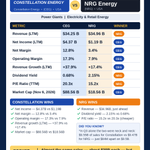
⚡ POCKET ALERT: The power trade prints again — NRG's profit more than triples, and it sells $4 billion of gas plants the same morning
Power was the through-line of Monday's earnings: Constellation Energy smashed estimates before the open (posted here this morning), and NRG Energy — one of America's biggest power retailers and generators — followed with a big third quarter of its own.
THE NRG NUMBERS:
• GAAP net income more than tripled to $561 million, from $152 million a year earlier
• Adjusted earnings of $4.68 a share, up from $2.78 — well above analyst estimates (trackers put consensus between roughly $3.03 and $3.44)
• Revenue rose 24% to $9.47 billion; adjusted EBITDA rose to $2.01 billion; free cash flow before growth spending was $1.24 billion
• Alongside the results, NRG agreed to sell six natural-gas plants totalling 4.9 gigawatts to LS Power for $4 billion in cash
• Full-year 2026 guidance reaffirmed (adjusted EPS $7.90–$9.90), with first 2027 guidance initiated
MARKET IMPACT: NRG shares were up about 9% late morning, near $96.50 — investors liked both the beat and the plan to turn older gas assets into cash. Constellation added about 8% on its own beat: raised guidance, a 45% revenue jump, and long-term nuclear deals with Amazon and Google.
WHY IT MATTERS: NRG sells electricity to about eight million customers, and Constellation runs America's largest nuclear fleet. Two power giants earning this much — and reshaping their fleets for billions — is a read on what AI-driven electricity demand is doing to power prices, the same prices households see in their utility bills.
👀 WATCH: regulatory clearance for the LS Power sale and NRG's 2027 guidance detail; whether data-centre power deals keep stacking up at Constellation.
Source: NRG Energy Q3 2026 results (SEC 8-K filing) and Constellation Energy Q3 2026 release, via Associated Press, Zacks, TipRanks and Reuters reporting.
73
🧠 POCKET EXPLAINER: Americans expect 3.9% inflation next year — steady, but well above target, and job fears just hit a pandemic high
The New York Fed's October Survey of Consumer Expectations, released Monday, shows households' inflation outlook did not move — and their labour-market outlook got darker.
The numbers:
• Inflation expected one year ahead: 3.9%, unchanged from September
• Three years ahead: 3.3%, unchanged; five years ahead: 3.0%, unchanged
• Expectations that unemployment will be higher a year from now: the highest since April 2020, in the early COVID shock
• The perceived chance of missing a minimum debt payment in the next three months rose to 13.8% — the highest since December 2025
• Expected household income growth eased to 3.0%; home-price expectations held at 3.0%; expected gas-price gains moderated
WHY IT MATTERS: The Fed watches this survey because expectations can become self-fulfilling — if households believe prices will keep rising near 4%, they spend and bargain accordingly. Steady-but-high expectations, plus rising job and debt-payment worries, describe a household sector that feels squeezed from both sides — exactly the backdrop the Fed weighs before its December meeting.
👀 WATCH: Tuesday's actual October CPI at 8:30 AM ET — whether the real print moves these expectations, and the Fed's December 8–9 decision.
Source: Federal Reserve Bank of New York, Survey of Consumer Expectations, October 2026; Reuters reporting.
26
👀 POCKET WATCH: Fed's Goolsbee — 'We've got to come to terms with the inflation failure'
Chicago Fed President Austan Goolsbee delivered one of the bluntest assessments yet from a Fed official on Monday, in a moderated Q&A in Chicago.
His key lines:
• 'We've got to come to terms with this cost side and inflation side failure in the mandate'
• Services inflation has been accelerating over the last few months — and it goes beyond tariff pressure
• The AI data-center buildout is starting to look like old-fashioned demand overheating
• But employment and growth are 'actually pretty stable' — 'the big problem has all been on the inflation side'
• Consumer spending has been the main driver of growth
Context: Goolsbee is a 2027 FOMC voter, not a voter this year — but his framing matters because it matches what markets are already pricing: roughly an 80% chance of another Fed hike at the December 8–9 meeting, after Friday's hot jobs report (+165K, unemployment 4.1%).
WHY IT MATTERS: When a Fed president calls inflation a 'failure' of the mandate while calling jobs stable, he is telling borrowers the direction of travel: rates stay high, or go higher, until prices behave. That is the path that sets mortgage rates, card APRs and business loan costs into 2027.
👀 WATCH: Fed Vice Chair for Supervision Bowman's economic-outlook speech at 3:30 PM ET today, and Tuesday's October CPI at 8:30 AM ET — the print that will test Goolsbee's warning.
Source: Goolsbee remarks at Leadership Greater Chicago Q&A, via Bloomberg, Seeking Alpha and FXStreet reporting.
1
26
🔄 BREAKINGPOCKET UPDATE: Dow up more than 1,000 points at midday — Monday's relief rally is accelerating
An update to this morning's open snapshot: by 12:15 PM ET the rally had roughly doubled.
• Dow Jones: +1,051 points (+2.05%) to 52,337
• S&P 500: +2.28% to about 7,545
• Nasdaq Composite: +2.64% to about 25,227
• VIX fear gauge: down about 21% to 20.31 — panic is draining out fast
• WTI crude: about $87.67 a barrel, down about 3.5%; Brent near $94
What is driving it: falling oil — on hopes the US-Iran talks keep fresh strikes off the table — is easing inflation worries a day before Tuesday's October CPI, and buyers are returning to the chip and tech names beaten up in last week's selloff. AMD jumped about 11% and Constellation Energy about 8% after its earnings beat.
The exception is Nvidia, still down roughly 5–6% after its board opened an investigation involving CEO Jensen Huang — one stock fighting the tape while everything around it rallies.
WHY IT MATTERS: Cheaper oil today means a softer inflation impulse tomorrow — and Tuesday's CPI is now the test that decides whether this rally is relief or a head-fake. A hot print would put December hike odds (already near 80%) and borrowing costs right back in focus.
👀 WATCH: the close — does the Dow hold +1,000? — and Tuesday's October CPI at 8:30 AM ET. All figures are intraday and can change.
Source: Midday index tallies via Investing.com, with CNBC, Associated Press and Yahoo Finance market reporting; cross-checked against a second midday market tally.

19
📊 MARKET SNAPSHOT: Wall Street storms back at the open as oil slides and chips rebound — everyone but Nvidia
Monday's open, after the worst week for the S&P 500 since April 2025:
• Dow Jones Industrial Average +540.52 points (+1.05%) to 51,826.25 at the open
• S&P 500 +59.90 points (+0.81%) to 7,436.76
• Nasdaq Composite +200.72 points (+0.82%) to 24,780.15
• Gains extended in the first minutes — by about 9:40 AM ET market reports had the S&P 500 up about 1.3% and the Nasdaq about 1.6%
• Canada followed: the S&P/TSX Composite opened up 0.7% at 36,038.46
What is driving it: oil. Brent slid into the $93–95 range in morning trade (prints varied by the hour in a fast market) and WTI traded near $88, extending last week's 16% Brent collapse — cheaper fuel is inflation relief. The 10-year Treasury yield eased to about 4.83% and the VIX fell more than 9%.
Chips led, with one exception: AMD jumped about 11% in early trade after an Oppenheimer upgrade, and TSMC rose more than 6% in market reports — while Nvidia stayed under pressure after its board opened an investigation tied to CEO Jensen Huang, the story posted here on Sunday.
WHY IT MATTERS: This bounce lives or dies on Tuesday's inflation report. A soft October CPI at 8:30 AM ET would let cheaper oil do its work on rate expectations; a hot print puts the December Fed hike — priced near 80% — right back at the centre of household borrowing costs.
👀 WATCH: US October CPI Tuesday 8:30 AM ET; Fed speakers through today; Occidental Petroleum and Take-Two Interactive report after the close.
Source: Reuters opening market snapshot and TSX report; early-trading detail via market reports.
61
👀 POCKET WATCH: Market pros see Canadian inflation ending 2026 at 3.0% — and back to 2.0% by the end of 2027
The Bank of Canada published its third-quarter Market Participants Survey on Monday — the median view of about 25 financial-market participants:
• Inflation (total CPI): 3.0% at the end of 2026, 2.0% at the end of 2027, and 2.0% five years out
• Real GDP growth: 1.6% at the end of 2026, 1.8% at the end of 2027
• 92% of respondents say the economy is running below its potential — a negative output gap
• The median recession probability is 13% over the next six months
• Trade tensions top both lists — named by 88% as an upside risk (if they ease) and by 88% as a downside risk (if they increase)
Two cautions belong with the numbers. The survey was conducted during the third quarter — before the Bank's October 28 hike to 2.50% — and its inflation path is softer than Governor Macklem's own warning to Parliament last week that inflation is running near 3.5% and could stay at or above 3% through much of 2027.
WHY IT MATTERS: This is the gap the December 9 decision sits inside. If the professionals are right and inflation glides back to 2%, the case for another hike weakens and mortgage-rate pressure eases; if the Governor's hotter path is right, borrowing costs stay higher for longer.
👀 WATCH: the Bank's summary of deliberations on Tuesday, then October CPI on November 16 — the next hard test of which path is winning.
Source: Bank of Canada, Market Participants Survey — Third Quarter of 2026.
31
⚡ POCKET ALERT: Barrick's gold windfall — adjusted earnings per share up 41% as gold averaged $4,243 an ounce
Barrick Mining (TSX: ABX, NYSE: B) reported third-quarter results before Monday's open:
• Adjusted earnings of $0.82 a share, up 41% from a year earlier; net earnings of $1.32 billion, or $0.80 a share
• Revenue rose 22% to $5.07 billion, broadly in line with the roughly $5.1 billion expected
• The average realised gold price was $4,243 an ounce, up 23% from a year earlier
• Production: 816,000 ounces of gold (up 3% on the quarter) and 50,000 tonnes of copper
• Operating cash flow of $2.49 billion; $1.04 billion returned to shareholders in the quarter — $761 million of buybacks plus a $0.175-a-share dividend
• Full-year guidance reiterated: 2.90–3.25 million ounces of gold and 190,000–220,000 tonnes of copper
The watch-out is costs: all-in sustaining costs rose 24% from a year earlier to $1,911 an ounce, as fuel, supplies and stronger local currencies ate into the price windfall.
MARKET IMPACT: Barrick shares were up about 4% in Toronto on Monday, with gold itself trading above $4,100 an ounce.
WHY IT MATTERS: Barrick is a TSX heavyweight, so its results move Canadian portfolios and pension funds directly. The quarter shows both sides of a $4,000 gold price — record cash coming in, and costs chasing it up.
👀 WATCH: the 11:00 AM ET results call for any cost or production commentary, and whether the gold price holds above $4,000 into year-end.
Source: Barrick Mining Q3 2026 results release (GlobeNewswire); cost detail via Kitco News; share price via Finnhub market data.
38
⚡ POCKET ALERT: Europe's banks are redrawing the map — a mega-merger proposed in Italy, a record quarter at UniCredit
Two stories out of Europe on Monday morning point the same way: bank profits are surging, and the surplus is being spent on takeovers and payouts.
STORY 1 — Crédit Agricole proposes merging its Italian bank with Banco BPM
France's Crédit Agricole said Monday it has proposed combining its Italian business with Banco BPM, and has submitted the proposal to Banco BPM's board for evaluation.
The terms on the table:
• An exchange ratio reflecting a 20% valuation premium for Banco BPM
• A €1 billion extraordinary dividend for Banco BPM's existing shareholders
• Crédit Agricole's stake would rise from 29.6% of Banco BPM to about 45% of the combined bank
• The combined lender would serve about 6.5 million customers through more than 2,300 branches, and stay listed in Milan
• Crédit Agricole estimates about €800 million a year in pre-tax synergies and a roughly 24% lift to Banco BPM's 2027 earnings per share — its own projections, not results
• Targeted completion: second half of 2027, if it proceeds
What still has to happen: Banco BPM's board must first engage, then shareholders must approve under Italy's whitewash procedure, alongside European Central Bank authorisation and Italy's golden power review.
MARKET IMPACT: Banco BPM shares jumped more than 10% on the proposal, while Crédit Agricole dipped about 0.6% — investors see the Italian bank's holders getting the better of the opening terms.
STORY 2 — UniCredit posts the best quarter in its history
Italy's UniCredit reported third-quarter results on Monday that beat forecasts by a wide margin:
• Net profit rose 24% from a year earlier to €3.3 billion, against a €2.8 billion company-compiled consensus
• Revenue rose 12% to €6.9 billion — net interest income up 8%, fees and insurance income up 11%
• Return on tangible equity reached 25.5%; CET1 capital stood at 15%
• Full-year 2026 profit guidance was raised to well above €11.5 billion before extraordinary charges, from around €11.5 billion previously
• The interim dividend was more than doubled, to €3.00 a share
MARKET IMPACT: UniCredit shares rose about 5–6% in Milan, and European bank stocks led the Stoxx 600 higher.
The other live story: UniCredit is weeks from control of Germany's Commerzbank. The European Central Bank cleared it to pass 30% in mid-October, remaining approvals are expected by late November, and CEO Andrea Orcel says a Commerzbank shareholder vote on a new board will follow immediately after control is secured.
WHY IT MATTERS: High rates are still feeding bank profits across Europe, and the surplus is going two places — bigger payouts to shareholders and takeovers. For Banco BPM shareholders the pocket angle is direct: a premium plus a €1 billion dividend, though today that is a pitch on paper, not cash in hand. Together, these deals are redrawing who owns Europe's banks — which eventually shapes lending and fees for households and businesses.
👀 WATCH: Banco BPM's board response and any rival signal from Monte dei Paschi; the late-November Commerzbank approvals and board vote.
Source: Crédit Agricole proposal announcement and UniCredit Q3 2026 results, via Reuters; market reaction via Finimize and Dow Jones.
51

🧠 POCKET EXPLAINER: Canada's money is about to move instantly — and the Bank of Canada just put a watchdog over it
Sending money in Canada still runs on old plumbing: payments that wait for business hours, cut-off times and the next processing day. That is about to change.
WHAT HAPPENED: Bank of Canada Governor Tiff Macklem has designated the Real-Time Rail (RTR) — Canada's new instant-payments system, operated by Payments Canada — as a "prominent payment system" under the Payment Clearing and Settlement Act, effective November 8, 2026. In plain terms: the central bank now formally oversees it.
WHAT THE RTR IS: a new national system that clears and settles payments continuously, in seconds, with the money available immediately — 24 hours a day, every day, including weekends and holidays. Interac e-Transfers will also be cleared and settled over it. The launch is planned for the final quarter of 2026, with banks joining in phases, and Payments Canada targets more than 9 in 10 Canadian bank accounts reachable by the third quarter of 2027.
WHAT THE DESIGNATION CHANGES:
• Payments Canada must run the RTR to the Bank's risk-management standards, with controls that keep it safe and resilient
• The RTR falls under the Bank's resolution regime — if the system ever became non-viable, there is an official plan to keep this critical service running
• The Bank does not do consumer protection, but it expects designated systems to take proper measures against fraud
WHY IT MATTERS: Instant money helps almost everyone — workers and small businesses get paid without waiting days, and a payment sent on a Friday night actually arrives on Friday night. But instant also means final: money that lands in seconds is much harder to pull back, which is exactly why fraud controls and central-bank oversight are being locked in before the system scales, not after.
👀 WATCH: the launch in the coming weeks — which banks connect first, and how quickly e-Transfer volumes move onto the new rail through 2027.
Source: Bank of Canada news release, November 9, 2026; Payments Canada launch timeline.
1
1
61
🔄 BREAKINGPOCKET UPDATE: Rubio tempers the Iran-deal optimism — talks 'not very productive,' no breakthrough near
A day after President Trump told CNN that fresh US strikes on Iran are highly unlikely while talks progress, Secretary of State Marco Rubio gave the other half of the picture before leaving Florida for the G7 foreign ministers' meeting in Paris.
What Rubio said, on the record to reporters:
• 'I can't say we're on the verge of a breakthrough'
• The talks 'haven't been very productive' because Iranian demands are 'simply not just unacceptable, but in some cases outrageous and ridiculous and really unrealistic'
• The administration still prefers a diplomatic solution over military escalation
Tehran is reviewing proposals passed through Qatar, the main mediator — its reported conditions include ending the US blockade of Iranian ports, lifting sanctions and releasing frozen assets. Trump is scheduled to meet Qatar's prime minister at the White House on Monday.
MARKET IMPACT: Oil fell anyway in early Monday trading — Brent was down about 1.7% to $96.67 in the morning, before sliding further — because the market is pricing the 'no new strikes' half of the message more than the 'no deal yet' half.
WHY IT MATTERS: A real deal is the fastest route to cheaper oil, gasoline and shipping costs. A stalemate — no strikes, but no deal and no normal Hormuz traffic — keeps a risk premium in energy prices and in the inflation numbers that decide interest rates.
👀 WATCH: Monday's Trump–Qatar meeting at the White House, and any G7 statement on Iran out of Paris.
Source: Associated Press reporting of Rubio's remarks, via Reuters and multiple outlets; Reuters on oil.
60
📊 MARKET SNAPSHOT: Futures rebound to start the week — the Dow leads, Nvidia drags, and oil slides again
Monday premarket, about an hour before the open:
• Dow futures rose roughly 1%, S&P 500 futures about 0.6% and Nasdaq 100 futures about 0.4% — a second day of repair after the S&P 500's worst week since April 2025
• Nvidia fell about 5% premarket as its board's independent probe into CEO Jensen Huang — reported over the weekend — weighed on the AI leader and capped the Nasdaq
• Brent crude slid about 3–4% toward $95 a barrel, extending last week's roughly 16% fall, its steepest since the start of the pandemic, as US–Iran diplomacy kept the war premium draining out of oil
• Gold rose about 1.4% to around $4,123 an ounce on the softer oil and a weaker dollar
• Bitcoin sat near $74,000 and ether about 5% lower — crypto is still not joining the rebound
• The US 10-year Treasury yield was little changed near 4.86%
WHY IT MATTERS: This is a fragile rebound, not a verdict. Everything this morning — futures, oil, gold, yields — is positioning ahead of Tuesday's October CPI at 8:30 AM ET, the last inflation print before the Fed's December 9 decision, with markets pricing roughly a three-in-four chance of a December hike. A hot print reprices mortgages and loans; a soft one lets this rebound breathe.
👀 WATCH: Fed speakers Bowman and Goolsbee today, the $58 billion 3-year Treasury auction at 1:00 PM ET, and Tuesday's CPI.
Source: Premarket market data via multiple morning market reports (EODHD/Yahoo Finance data); Reuters on oil and gold.
40
⚡ POCKET ALERT: KKR posts record quarterly profit — the exit machine is running again
KKR reported third-quarter results on Monday with record recurring earnings, as asset sales and management fees both surged.
The numbers:
• Adjusted net income rose 29% to $1.645 billion, or $1.78 a share — beating the $1.59 average estimate compiled by LSEG
• Fee-related earnings hit a record $1.3 billion, up 27%; total operating earnings reached about $1.7 billion, up 25%
• Assets under management climbed 11% to $804 billion, with $25 billion raised in the quarter
• The mixed side: total GAAP revenue fell to $4.56 billion from $5.53 billion a year earlier, and insurance operating earnings dropped to $230 million from $305 million
• KKR sold assets in the quarter including data-centre cooling firm CoolIT Systems and Atlantic Aviation
KKR said it expects to return more than $40 billion to clients in 2026 — over 50% above its previous annual record — and the $17 billion sale of USI Insurance Services to Aon, expected to close in the fourth quarter, could add roughly $2 billion to adjusted profit.
MARKET IMPACT: No dramatic premarket move — the story is the trend, not the pop: the world's biggest alternative managers are selling assets again after years when high rates froze exits.
WHY IT MATTERS: Private equity holds stakes in thousands of everyday companies. When exits reopen and cash flows back to pension funds and other investors, deal-making — and the fees and job moves that come with it — picks up across the economy.
👀 WATCH: the 10:00 AM ET earnings call, and whether the USI sale closes on schedule in Q4.
Source: KKR Q3 2026 results release, via Reuters; LSEG estimates via Reuters.
17
⚡ POCKET ALERT: Constellation Energy smashes Q3 estimates — and raised guidance for the second time this year
Constellation Energy, the largest US nuclear power operator, reported third-quarter results before the open on Monday that cleared expectations by a wide margin.
The numbers:
• Adjusted operating earnings of $5.06 a share, up from $3.04 a year earlier — well ahead of the roughly $3.90 consensus
• GAAP earnings of $5.19 a share, up from $2.97
• Revenue rose 45% to $9.55 billion, from $6.57 billion a year earlier
• Full-year 2026 adjusted guidance raised to $12.50–$12.80 a share, from $11.50–$12.50 — the second increase this year
• The nuclear fleet generated 46,677 gigawatt-hours and ran at about 97.2% capacity; the company credited favourable market conditions and the addition of Calpine, bought in January
Alongside the results, Constellation pointed to long-term power deals tied to AI data-centre demand, including a 20-year, 690-megawatt agreement with Amazon and a 20-year Google arrangement enabling more than $4.3 billion of investment across 11 nuclear units.
MARKET IMPACT: Shares rose about 4% in premarket trading.
WHY IT MATTERS: AI runs on electricity, and this quarter shows who is getting paid for it. The same power demand lifting Constellation's profits is the demand pressuring electricity prices for households and businesses — the AI boom has a power bill, and it is being shared.
👀 WATCH: the 9:00 AM ET earnings call for updates on the Crane nuclear restart supplying Microsoft, and whether data-centre power deals keep stacking up.
Source: Constellation Energy Q3 2026 earnings release, via Zacks, Reuters reporting and company summaries.
23