

Associate Professor @RutgersSCJ studying policing, city budgets, and housing. More active on BlueSky: https://teapawt.net/t.co/DIcBrJbIFE.
NY & NJ
Joined April 2009
- Tweets1K
- Following606
- Followers1.3K
- Likes1.6K




Pinned Tweet
When times are tight, do cities cut police or social service budgets more? In a 🚨new study🚨, I find revenue loss is associated with shallow, temporary cuts to policing and deep, enduring cuts to social services. The article, in Criminology, is free. doi.org/10.1111/1745-9125.12…

A few weeks ago, Malcolm Gladwell made the media rounds arguing the U.S. should double its number of police officers. In interviews with Oprah, the New Yorker, Fox News Radio, and elsewhere, he cited a study by two Harvard professors to support his claim.
Yes, “police per homicide” is correlated with fewer police killings, but the homicide denominator, not the police officer numerator, is doing most of the work there. Countries with more homicides have more police killings, but that tells us little about police staffing.
You can read my (slightly technical) write-up of the reanalysis here: brendenbeck.net/papers/lu_re…
The NYPD intensified its low-level enforcement under Eric Adams. Has Mamdani reversed course? Yes, but only gradually. Details in a new Substack post. brendenbeck.substack.com/p/t…

Brenden Beck retweeted

Automated speed cameras, which detect and fine speeding motorists, reduced total collisions by around 30% and injuries by around 16%, on average, within 900 feet of intersections in the first 7 months of deployment in New York City. In PNAS: ow.ly/hFaz50XHylc

ALT Traffic enforcement camera in New York City. Stock photo.
Brenden Beck retweeted

Wait...
Speed cameras work?
"Cumulatively, over the seven months following [speed camera's] introduction, collisions declined by 30% and injuries by 16%."


Brenden Beck retweeted

Do speed cameras work? Our new study in @PNASNews provides rare causal evidence about NYC’s automated enforcement program, finding large reductions in collisions (30%) & injuries (16%). From me, @BrendenBeck and @jbenmenachem. pnas.org/doi/abs/10.1073/pna…

It’s true, I have joined the faculty at the @RutgersSCJ. I will dearly miss my CU Denver colleagues and students, but I’m excited to return to the NYC area and work alongside the amazing criminal justice scholars at Rutgers. If you’re in the area, get in touch!

School of Criminal Justice @Rutgers_Newark welcomes Dr. @BrendenBeck to its esteemed faculty this fall as an Associate Professor. #highered

Brenden Beck retweeted

.@BUsociologydept is hiring two assistant professors! Sociology of sexualities and sociology of race & ethnicity. See position ads below. @ASAnews
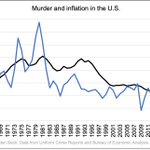
With inflation and crime both declining, it's worth remembering the two are related and we don't really know why!


Are you a member of the American Sociological Association's Community and Urban Sociology Section (@ComUrbASA)? If so, sign up now to be a mentor or mentee at this year's conference! umassamherst.co1.qualtrics.c…
Nicole Krauss' new short story in the @NewYorker is a great elucidation of suburban crime. No kidnappers, but price fixers, tax evaders, overbillers, and hit-and-runners. newyorker.com/magazine/2023/…

Here on Tax Day, let's remember the ubiquity of tax evasion. The IRS estimates that 13% of owed taxes are never paid, totaling $171 billion in the typical year. For comparison, Americans lost $9.4 billion to property theft in 2019 according to FBI data.
If we assume that underreporting to the police means the actual property theft number is three times higher than $9.4b, tax evasion is still responsible for *six times* more lost money than all shoplifting, car theft, robbery, and burglary incidents combined.
2
2
188
You can decide whether tax evasion receives 6x more attention from the press and elected officials than property crime.
Sources:
crsreports.congress.gov/prod…
ucr.fbi.gov/crime-in-the-u.s…
1
135